
Swap your town's name for the one twenty miles down the highway. If the copy still reads fine, your site has failed. That's the whole test, and it takes about twenty seconds to run: open your homepage, replace every mention of your community with a competitor's name, and read it out loud. If the text remains generic or interchangeable, you've built a template, not a pitch.
Here's how to run it properly:
- Pull up your "Why Us" or "About" page and swap the town name.
- Read the first three paragraphs. Do they still make sense?
- Check for named streets, businesses, numbers, or programs. If there aren't any, that's the problem.
- Ask a colleague from another region to read it blind and guess the town.
A site that passes has specific assets baked in: a named coffee shop, a real highway exit number, a graduation rate from an actual training program, a drive time to a real airport. A site that fails leans on phrases like "charming downtown" and "business-friendly climate" that could describe roughly 3,000 towns in the country.
Key Takeaways
Specific, named, dated facts on an economic development website outperform generic adjectives because site selectors and relocating families both disqualify vague, unverifiable claims within seconds.
| Point | Details |
|---|---|
| Run the swap-the-name test | Replace your town's name with a competitor's; if the copy still reads fine, rewrite it. |
| Follow the three-click rule | Site inventory, zoning, and incentive data should be reachable within three clicks of the homepage. |
| Replace adjectives with proof | Swap "charming downtown" and "business-friendly" for named businesses, programs, and completion numbers. |
| Build layered messaging | Use a one-sentence pitch, a short elaboration, and a proof-point bank so partners stay consistent without sounding scripted. |
| Assign ownership for updates | Name a staffer to refresh site listings, workforce data, and testimonials on a set quarterly or annual schedule. |
| Get outside help when needed | Southwind Marketing offers a free 10-minute audit and EDO-specific content and data services when in-house time runs short. |
Table of Contents
- Why Your Economic Development Website Sounds Like Every Other Community's Site
- Who Is Actually Reading Your Site, and What Do They Need?
- What to Write Instead of Generic Phrases
- What Data Features Actually Move Site Selectors
- Build Message Architecture That Scales Without Sounding Copied
- Run This Quick Site Audit Today
- Examples of Differentiated Economic Development Websites Worth Studying
- How to Weave in Real Community Stories, Not Stock Testimonials
- Design and Branding Choices That Make Your Site Look Like Your Town
- Keep Your Content Fresh So It Doesn't Drift Back to Generic
- Why Stakeholder Input Shapes Content That Actually Fits Your Community
- What Most EDOs Get Wrong About Standing Out Online
- How Southwind Marketing Helps You Fix a Generic Website
- Sources
- FAQ
Why Your Economic Development Website Sounds Like Every Other Community's Site
Most economic development organizations don't set out to sound interchangeable. It happens because of predictable, fixable pressures.
- Staff and time constraints. Most EDOs run lean, and website copy competes with grant applications, ribbon cuttings, and board meetings for attention. Generic phrasing is what gets written when there's no time to gather specifics.
- Copying competitor language. Someone on staff reads five neighboring counties' sites for "inspiration" and unconsciously absorbs their phrasing. The result is a regional dialect of sameness.
- Templated agency builds and AI prompts. Website templates and AI tools are frequently trained on general B2B marketing patterns, not economic development. Ask a generic AI tool to "write copy for our business-friendly community" and you'll get the same three adjectives every other user gets.
- Data buried in PDFs. The real differentiators, workforce numbers, zoning maps, incentive details, often live in a county planning PDF from three years ago instead of on the live site where anyone can find them.
None of these causes are about laziness. They're about workflow. Fixing them starts with treating specific, current information as a content requirement, not a nice-to-have.
Who Is Actually Reading Your Site, and What Do They Need?
Your site serves at least three distinct readers, and each one is scanning for something different.
- Site selectors and consultants want decision-support facts fast: available sites, zoning, utility capacity, incentive programs, and permitting timelines. Site selectors do most of their research online before ever calling your office, and they'll cross a region off the list if that data is hard to find.
- Business prospects and brokers want asset sheets, square footage, lease rates, and a direct contact path, not a marketing narrative.
- Relocating talent and families want named schools, actual commute times, housing price ranges, and real amenities, not "great quality of life."
Layered content structure lets you serve all three without diluting specificity. A homepage can lead with a strong single-sentence positioning statement, then branch into audience-specific paths that go deeper for whoever clicked.
What to Write Instead of Generic Phrases
Vague language isn't wrong because it's dishonest. It's wrong because it's unverifiable and forgettable. Specific language does the opposite work: it builds credibility and it's memorable because it's concrete.
- Instead of "charming downtown," name the coffee shop, the Saturday farmers market, and the actual street it's on.
- Instead of "workforce ready," name the community college program, its completion rate, and the average time to job placement.
- Instead of "business-friendly," cite the permit turnaround time in business days and the name of the person who handles it.
- Instead of "great quality of life," give commute time to the nearest metro, the median home price, and school ratings by name.
Headline templates that force specificity work better than generic templates. Try: "[Program Name] Graduated [Number] Workers in [Year], With [Percentage] Placed Within [Timeframe]." That structure can't be filled in generically. It forces you to go find the number.
Pro Tip: Before publishing any claim, ask who can verify it. If the answer is "nobody, it's just how we've always described ourselves," cut it or replace it with something you can source from your chamber, college, or utility provider.
What Data Features Actually Move Site Selectors
Priority follows the three-click rule: a site selector should reach your most critical decision-support data within three clicks of your homepage, or they move to the next community on their list. That's not a suggestion; it's what the research on site-selector web behavior consistently shows.
- Publish a real site and land inventory with acreage, zoning, utility capacity, price, and a photo. Even a simple, regularly updated spreadsheet embedded on the page beats a stale PDF from 2022.
- Add interactive GIS layers where feasible, showing proximity to rail, ports, or interstate access. Modern EDO sites increasingly include this filtering as a baseline feature, not a luxury.
- Build a workforce and commute-shed dashboard showing labor pool size, wage ranges, and drive-time radius, updated at least annually.
- Name a navigator. A single named contact who owns site-selector questions signals operational readiness and risk transparency, which matters more to investors than another stock photo of a handshake.
Build Message Architecture That Scales Without Sounding Copied
A single-sentence pitch, a short elaboration, and a bank of proof points, that three-layer structure keeps your messaging consistent across every partner who talks about your community, without making every partner sound like they're reading from the same script.
- Level one: a single sentence positioning statement, memorable enough to repeat verbatim.
- Level two: a two-to-three sentence elaboration that adds context a chamber member or council person can use in conversation.
- Level three: a proof bank, specific numbers, named programs, and dates, that backs up levels one and two when someone asks "prove it."
This structure is exactly what effective business attraction communication requires: research that local partners can actually translate into real conversations. Update the proof bank whenever a number changes, and assign one staffer to own it.
Pro Tip: Print your proof bank as a one-page cheat sheet for board members and chamber ambassadors. If they can't repeat your pitch accurately, your website copy probably can't either.
Run This Quick Site Audit Today
You don't need a consultant to find the biggest problems. Run this in under twenty minutes.
- Swap-the-name test: replace your town's name throughout your homepage and "Why Us" page. If it still reads fine, flag every section for rewrite.
- Three-click check: time how many clicks it takes to reach site inventory, zoning, and incentive data from your homepage. More than three means restructure your navigation.
- Proof-point audit: count how many claims on your site have a name, number, or date attached. If it's fewer than half, you have a specificity problem.
- Ownership check: confirm someone is assigned to update site listings and workforce numbers at least twice a year. If no one owns it, it will go stale.
Examples of Differentiated Economic Development Websites Worth Studying
You don't need a massive budget to build a site that reads as distinctly yours. The sites that stand out share one habit: they lead with named, dated, sourced facts instead of adjectives.
Look at how the strongest EDO sites structure their homepage hierarchy. Instead of opening with "welcome to our vibrant community," they open with a specific claim, a named employer that relocated, a specific number of acres shovel-ready, a named training partnership with a community college. The differentiation isn't in the design template. It's in the first sentence of copy.
Smaller communities often out-perform larger ones here because they have less to hide behind. A rural EDO with one certified industrial park and one workforce partnership can build a homepage entirely around those two assets, named, dated, and verifiable, and it will outperform a vague regional competitor with ten times the marketing budget but zero specificity.
The pattern worth copying isn't a particular layout. It's the discipline of naming things: the highway exit, the training provider, the exact acreage, the exact incentive percentage. Structuring "Doing Business Here" sections around targeted, living data rather than static brochure copy is the single biggest structural difference between sites that convert prospects and sites that just exist.
Study your competitors, but study them to find what's missing, not what to copy.
How to Weave in Real Community Stories, Not Stock Testimonials
Resident and business-owner stories are some of the highest-trust content an EDO site can publish, but only if they're specific and attributed to a real person you can name. A quote from "a local business owner" convinces nobody. A quote from the actual owner of the hardware store on Main Street, with her name and the store's name attached, convinces people because it's checkable.
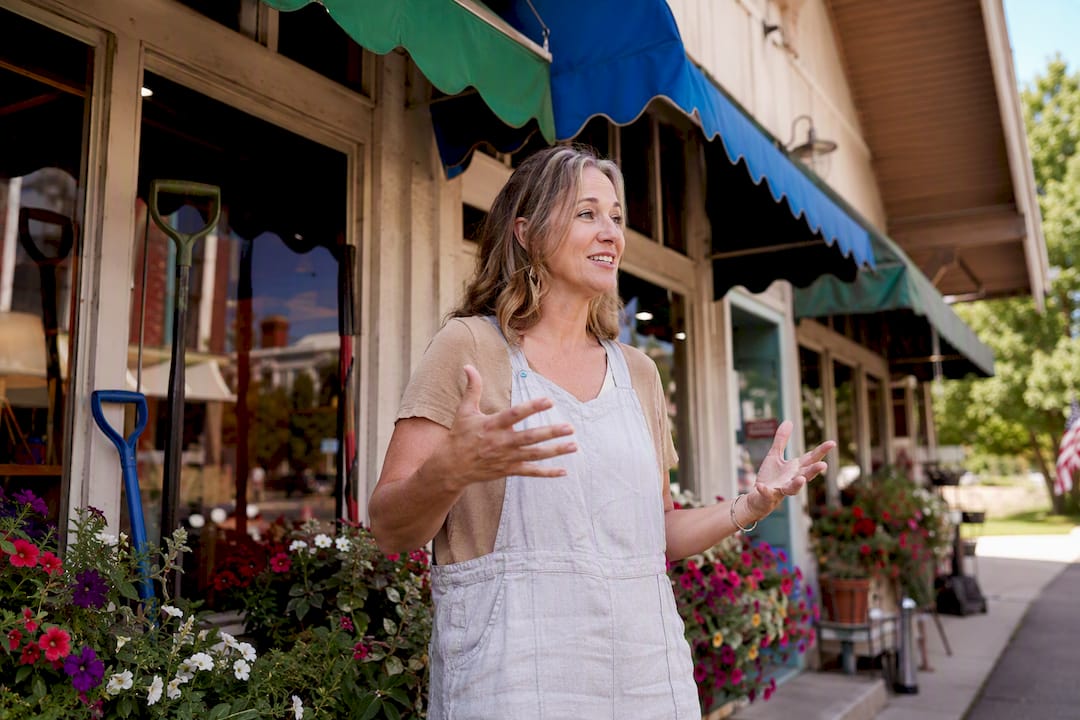
Build a rotating slate of two or three short video or written profiles: a business owner who relocated and can speak to permit turnaround time, a recent graduate of a workforce program who can name the program and their new employer, a family who moved for a specific job and can speak to schools and commute. Keep each story under 150 words of text or 90 seconds of video. Site selectors and relocating families both scan quickly, and a long story gets skipped.
Rotate these stories seasonally rather than letting the same three testimonials sit on your homepage for five years. Stale stories signal a stale organization, even when the underlying facts are still accurate. Tie each story back to a proof point in your message architecture, the graduate's completion rate, the business owner's permit timeline, so the story and the data reinforce each other instead of living in separate parts of the site.
Design and Branding Choices That Make Your Site Look Like Your Town
Visual sameness is as common as copy sameness. Stock photography of generic skylines, generic handshake graphics, and the same blue-and-green government color scheme make one EDO site indistinguishable from the next before a visitor reads a single word.
Real photography of your actual downtown, your actual industrial park, your actual training facility, beats stock imagery every time, both for credibility and for search visibility. A photo of your specific Main Street signals authenticity in a way no stock photo ever will, and it gives site selectors and relocating families something concrete to picture when they imagine living or building there.
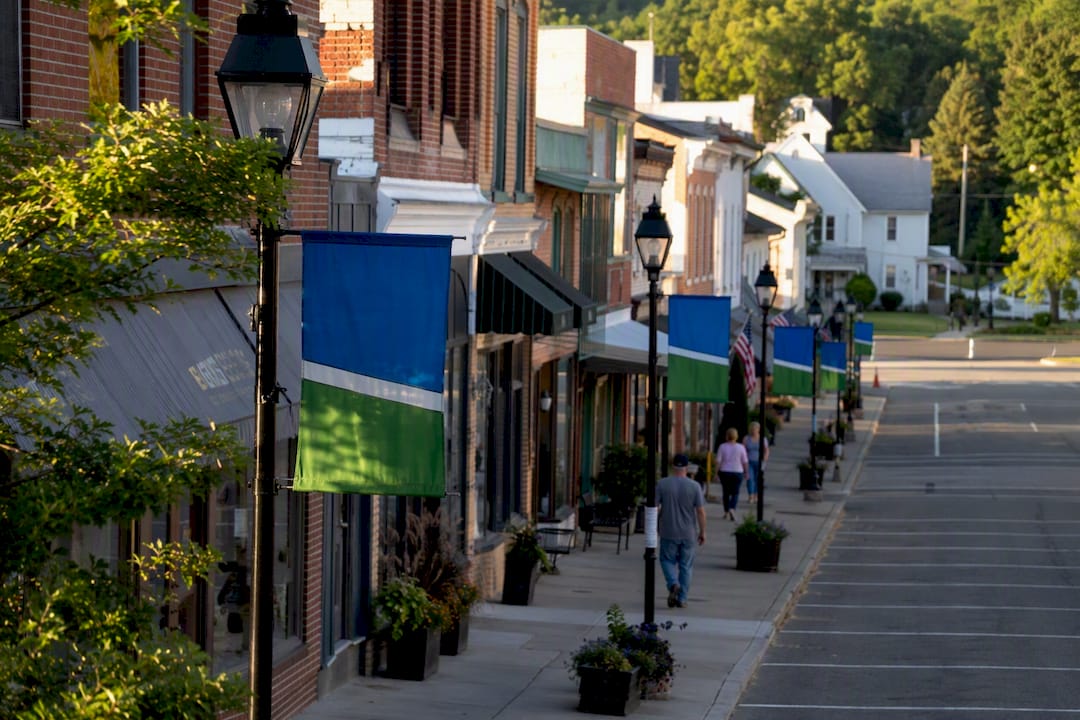
Typography and color choices should feel deliberate, not default. If your chamber, tourism office, and EDO all use the same template with swapped logos, unify them under one distinct visual identity that's recognizably yours, not recognizably "government website." Consistent, community-specific branding across every touchpoint, print materials, social media, the website itself, builds the kind of visual memory that makes your town easier to recall than the next one on a site selector's shortlist.
Small details matter more than most EDOs assume: a custom icon set for your industrial parks, a consistent color used only for workforce data, a masthead photo that changes seasonally to show real activity. None of this requires a large design budget. It requires deciding that generic isn't acceptable and holding every new asset to that standard.
Keep Your Content Fresh So It Doesn't Drift Back to Generic
Websites go generic gradually, not all at once. A site inventory updated in 2023 and never touched again slowly becomes inaccurate, and outdated listings are one of the fastest ways to lose credibility with investors doing due diligence.
Set a simple update cadence and assign it to a specific person, not a committee. Site and land inventory should be reviewed quarterly. Workforce and wage data should update annually alongside new labor market releases. Testimonials and community stories should rotate at least twice a year. Incentive programs and permitting timelines should be checked whenever local ordinances change, and immediately verified if a prospect asks about them directly.
Build this into a calendar, not a hope. A recurring task assigned to a named staffer beats a vague intention to "keep the site current" every time. If your team doesn't have the bandwidth to review content on this schedule, that's a signal worth raising with leadership rather than letting the site slowly drift back toward stale, generic copy.
Why Stakeholder Input Shapes Content That Actually Fits Your Community
The best economic development content rarely comes entirely from inside the EDO office. Chambers, workforce boards, school districts, and utility providers each hold pieces of the specific, verifiable information that makes your site distinct, and getting that information onto your homepage usually requires asking them directly.
Run a short quarterly check-in with your workforce board to update training program numbers. Ask your utility provider for current capacity figures rather than relying on numbers from a five-year-old feasibility study. Pull real quotes and data points from your chamber's membership survey instead of writing generic business-climate language from scratch.
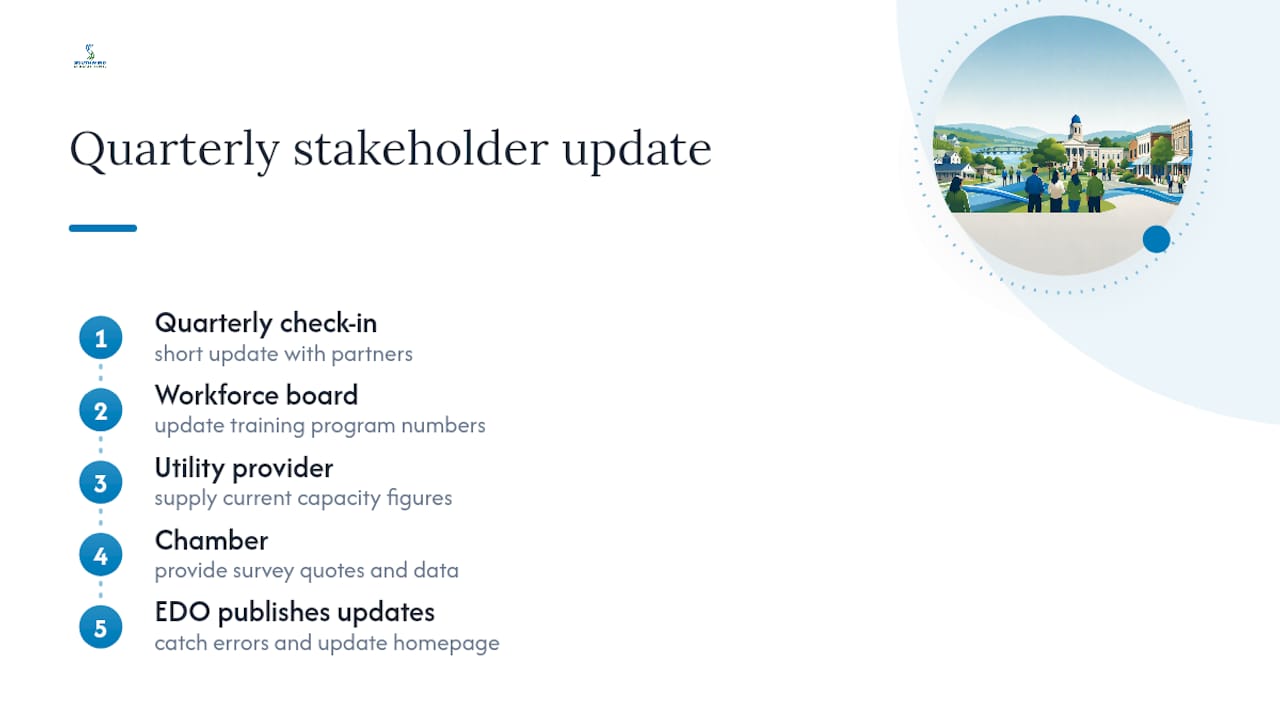
This isn't just a data-gathering exercise. Stakeholder engagement also catches errors and blind spots before they go live, a workforce number that's since changed, an incentive program that expired, a business that closed. Treating your website as a shared civic asset that multiple stakeholders help maintain, rather than a set-it-and-forget-it brochure owned solely by one communications staffer, is what keeps the specificity from decaying six months after launch.
What Most EDOs Get Wrong About Standing Out Online
The conventional advice in this space tells EDOs to "tell your story" and "showcase your community's personality." That advice isn't wrong, but it's incomplete to the point of being useless on its own. Personality without verifiable proof reads exactly like every other community's personality, because "friendly," "growing," and "vibrant" are the personality traits every EDO claims.
What the research on site-selector behavior and investor confidence actually supports is narrower and more useful: specificity beats personality every time it's tested against actual decision behavior. A site selector doesn't disqualify a region because it lacks charm. They disqualify it because the data they needed wasn't there in three clicks, or because every claim on the page was too vague to verify.
If I had to pick one priority for an EDO with limited staff time, it wouldn't be a redesign. It would be an audit of every adjective on the homepage, replacing each one with a name, a number, or a date. That single exercise does more to differentiate a site than any new color palette or hero video. The organizations that treat their website as a living decision-support tool, updated on a schedule and owned by named people, consistently outperform the ones treating it as a brochure that gets rebuilt every five years.
— Damien Denmark
How Southwind Marketing Helps You Fix a Generic Website
Southwind Marketing is the alternative to hiring a general-purpose web agency for economic development content, we build specifically for EDOs, chambers, and rural communities, so you're not starting from a B2B template that was never built for site selection or talent attraction in the first place.
Southwind Signal℠ handles the content and search side of this problem directly, turning your workforce numbers, site inventory, and community proof points into pages structured for both search engines and AI-search visibility, instead of generic copy nobody finds. If your data lives in scattered spreadsheets, our data dashboards turn workforce and site metrics into something you can publish and update instead of burying in a PDF. For teams managing prospect follow-up and community communications, CRM implementation through Southwind Connect℠ keeps that outreach organized without pretending to be an emergency alert system, it isn't one. If your site is slow, outdated, or hard to maintain, Southwind Guardian℠ handles hosting so your team isn't fighting technical debt while also trying to fix copy. Some of this you can DIY with staff time and a checklist. If you don't have that time, request a free 10-minute website and visibility audit and we'll tell you exactly where your site is losing site selectors and relocating families before you spend another dollar on a redesign.
Sources
- Economic development websites and investor confidence — Pattern Interactive
- Business attraction campaign communication for state economic development organizations — Stegmeier Consulting
FAQ
What Is the Difference Between Community Development and Economic Development?
Community development focuses on quality-of-life factors like housing, infrastructure, and services for residents, while economic development focuses specifically on growing jobs, business investment, and tax base. Strong EDO websites address both, since talent attraction depends on community development factors and business attraction depends on economic ones.
Why Isn't Economic Development the Same Everywhere?
Local economic development varies because each community has different assets, workforce pools, infrastructure, and industry mixes, so a generic, one-size-fits-all approach to messaging fails to reflect what actually makes one region's opportunity different from another's.
What Are the Main Types of Economic Development?
Economic development commonly breaks into business retention and expansion, new business attraction, entrepreneurship and small business support, and workforce or talent development, each requiring different website content and different proof points.
What Do Site Selectors Actually Want From an EDO Website?
Site selectors want fast access to verifiable data: available sites and zoning, utility capacity, workforce metrics, and incentive programs, ideally within three clicks, along with a named contact who can answer follow-up questions quickly.
How Often Should We Update Our Site Inventory and Workforce Data?
Site and land inventory should be reviewed quarterly, and workforce or wage data should update at least annually, with a named staffer responsible so listings don't go stale and damage credibility with prospects.