
Rural businesses need professional marketing because word-of-mouth alone cannot sustain growth when your customer base is limited by geography. Low population density, inconsistent foot traffic, and shrinking local demand create a ceiling that no amount of friendly referrals can break through. Professional marketing replaces that ceiling with a strategy: one that builds visibility beyond your zip code, creates a recognizable brand, and turns occasional buyers into loyal customers.
The core reasons rural businesses need marketing come down to a few hard realities:
- Limited local demand means you must reach customers outside your immediate area
- Without a digital presence, you are invisible to shoppers who search online first
- Relying on informal word-of-mouth leaves your business vulnerable to market shifts
- Professional marketing builds brand identity that word-of-mouth simply cannot replicate
- Digital tools let rural businesses compete with urban retailers on a level playing field
Research confirms that rural businesses using digital marketing see measurable growth in visibility and performance when modern channels are integrated. The gap is not about effort. It is about having the right strategy.
Why rural businesses need marketing: content that actually connects
Content marketing for rural businesses works best when it leans into what makes your community distinct. A hardware store in western Kansas has a story no big-box retailer can tell. An artisanal bakery in rural Arkansas carries authenticity that corporate brands spend millions trying to manufacture. That local identity is your competitive edge, and content marketing is how you put it in front of people.
Practical content types that work well in rural markets include:
- Local blog posts covering community events, seasonal tips, or behind-the-scenes stories
- Short videos showing your process, your people, or your place
- Social media stories that highlight real customers and real moments
- Email newsletters that keep your regulars informed and coming back
Consistency matters more than volume. One well-crafted post per week outperforms daily filler every time. Quality signals credibility, and credibility builds trust with a rural audience that values authenticity over polish.
Pro Tip: Partner with a local farmer, coach, or community figure for a short video or post. That kind of collaboration reaches their audience and yours at the same time, and it feels genuine because it is.

Digital tools that give rural businesses a real reach advantage
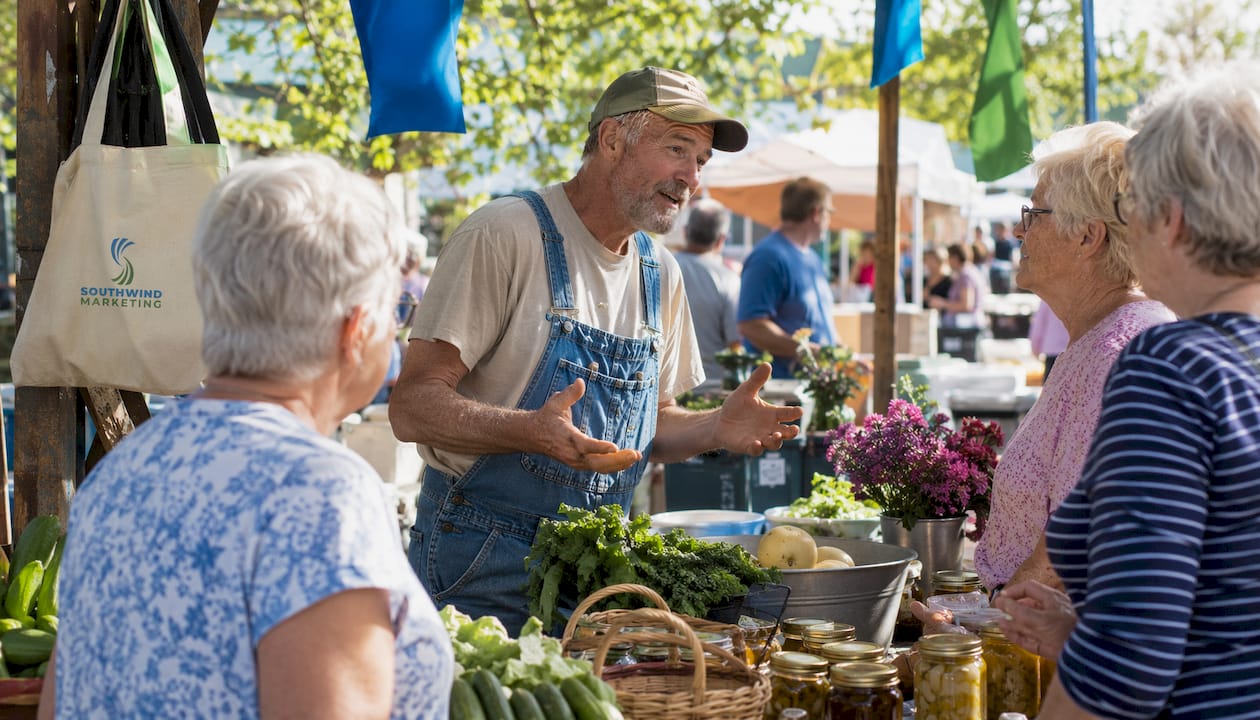
The right digital marketing tools do not require a big budget or a full-time marketing team. They require focus. Rural businesses that try to maintain a presence on every platform at once usually end up doing all of them poorly. Pick the one or two channels where your customers actually spend time, and do those well.
Here are the tactics that deliver the most value for rural small businesses:
- Google Business Profile: Free to set up, and it puts your business on the map literally. It drives local and regional search visibility without any ad spend.
- Local SEO: Adding location-based keywords to your website content helps you show up when nearby customers search for what you sell.
- Email marketing: Tools like Mailchimp and Constant Contact make it practical to build a list and send regular updates. A solid email list is one of the most reliable assets a small business can own.
- Video content: Platforms like YouTube and TikTok function as search engines, especially for younger buyers. A short, honest video about your business can outperform a paid ad.
- Social media (focused): Choose the platform your customers use most. Facebook still dominates in many rural communities. Commit to it rather than spreading thin across five channels.
For rural retailers, a reliable digital payment and e-commerce setup also matters. Customers who discover you online need a frictionless way to buy. Explore digital marketing strategies built specifically for rural businesses to see how these tools fit together.
How the 4 A's framework guides rural marketing strategy
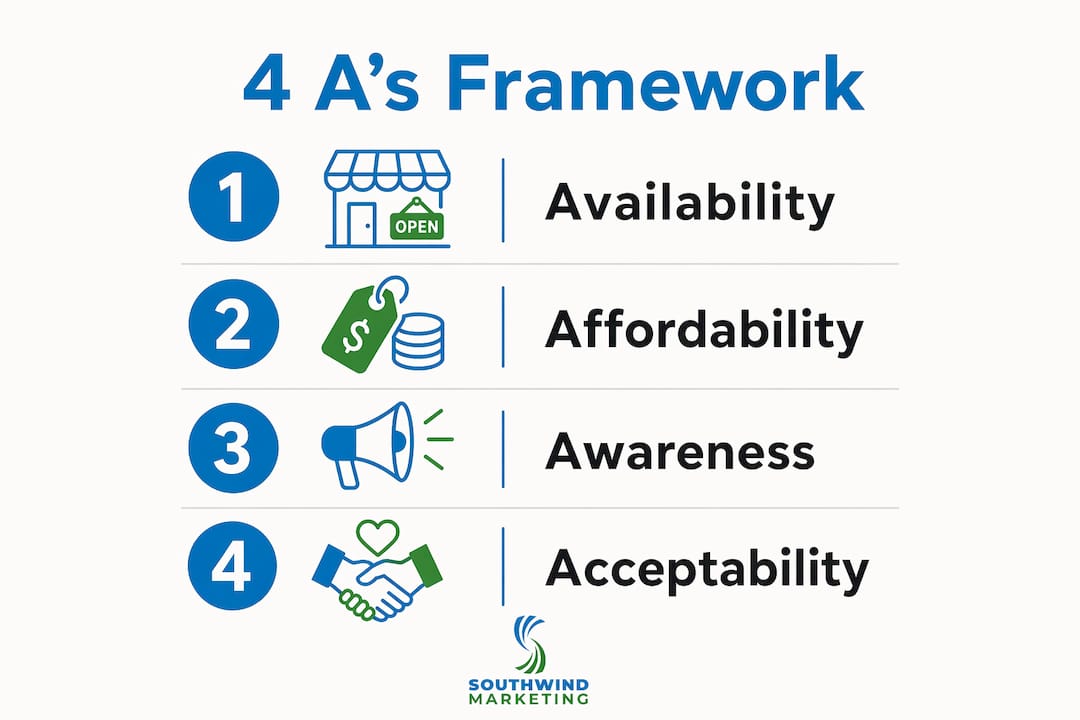
The 4 A's framework, developed specifically for rural marketing contexts, gives business owners a practical lens for evaluating why customers do or do not buy. Each "A" addresses a distinct barrier that rural markets create.
- Availability: Can customers actually get your product or service? In rural areas, distance and limited distribution channels make this a real obstacle. Online ordering, local delivery, or partnerships with nearby retailers can extend your reach.
- Affordability: Rural consumers often have tighter budgets and higher price sensitivity. Pricing strategy, bundling, and financing options all affect whether a purchase happens.
- Awareness: Do people know you exist? This is where marketing does its most direct work. Without consistent promotion across digital and local channels, rural businesses stay invisible to potential customers outside their immediate circle.
- Acceptability: Does your product fit the local culture and lifestyle? A product that works in a city may need repositioning to resonate in a rural community. Messaging, packaging, and even product design may need to reflect rural values and practical needs.
Working through each of these four factors honestly will surface the specific gaps in your current approach. Most rural businesses struggle most with awareness, but affordability and acceptability issues often go unaddressed because they are harder to see.
Community involvement and storytelling as rural marketing essentials
Rural marketing works differently than urban marketing because the audience is smaller and the relationships are closer. Your customers probably know your family. They remember when you opened. That proximity is an asset, not a limitation, and resident-centered marketing turns it into a real competitive advantage.
Effective community-centered tactics include:
- Sponsoring or participating in local events and posting about them authentically
- Featuring real customers (with permission) in your social media content
- Partnering with other local businesses for joint promotions or shared content
- Sharing the history of your business and its connection to the community
- Inviting community input on new products, services, or hours
Storytelling is not just a marketing tactic here. It is the mechanism by which rural businesses build the kind of loyalty that survives a slow season or a new competitor opening nearby. When people feel connected to your story, they choose you even when a cheaper option exists.
Pro Tip: Your "about" page is one of the most visited pages on any small business website. Write it like you are talking to a neighbor, not filling out a form. Mention the town, the family, the reason you started. That specificity is what makes it memorable.
Southwind Marketing's Rural by Choice approach for rural businesses
Most marketing agencies are built for cities. Their pricing, their assumptions, and their strategies reflect urban markets with urban budgets. That is exactly the gap that Southwind Marketing was built to close.
Southwind Marketing's Rural by Choice philosophy means the agency was designed from the ground up for rural America, not adapted from an urban model. As featured in USA News coverage of rural marketing innovation, Southwind brings big-agency-level capabilities, including SEO, web design, branding, content creation, and AI search optimization, to rural businesses at a scale and price that actually fits them.
Rural businesses and organizations that work with Southwind gain access to:
- SEO and AI search optimization that helps you show up on Google, ChatGPT, and Perplexity
- Custom web design built for rural organizations, chambers, and small businesses
- Community branding that reflects your town's identity, not a generic template
- Economic development marketing for EDOs, Main Street programs, and chambers of commerce
- Content and social media strategy grounded in rural storytelling
Southwind serves clients across Oklahoma, Kansas, Texas, Iowa, Missouri, and Arkansas, with deep experience in the specific challenges rural communities face: retail leakage, employer retention, storefront vacancies, and low digital visibility. The agency's rural small business marketing services are built around those realities, not around assumptions borrowed from a metro market.
If you are ready to move beyond word-of-mouth and build a marketing strategy that fits your community, talk to Southwind Marketing about what that looks like for your business.
Challenges unique to rural markets that affect marketing effectiveness
Rural businesses face a set of obstacles that urban marketing guides rarely address directly. Understanding them is the first step toward working around them.
Limited local demand is the most fundamental constraint. With fewer people in the trade area, a rural business cannot rely on volume the way an urban retailer can. Marketing must work harder to attract customers from a wider radius and to increase the lifetime value of each existing customer.
Low digital literacy among both business owners and customers slows adoption of digital tools. Research on rural digital marketing challenges identifies this as one of the primary barriers, alongside limited internet access and cultural resistance to new technology. Training, patience, and starting with simpler tools all help.
Resource constraints are real. Most rural small businesses do not have a marketing budget, a marketing employee, or time to learn new platforms. This is why focusing on one or two high-impact channels beats trying to do everything.
Cultural fit matters more in rural markets than many outsiders expect. Strategies that work in cities often fall flat in small towns because they feel impersonal or out of place. Authentic, locally grounded messaging consistently outperforms copy-pasted urban tactics in rural settings.
What successful rural business marketing campaigns actually look like
The most effective rural marketing campaigns share a few common traits: they are specific to place, honest in tone, and built around real community relationships rather than manufactured brand personas.
A rural feed store that started posting short videos of local farmers using their products saw its social media following grow organically and its seasonal sales increase. The content was simple, shot on a phone, and entirely authentic. No ad budget required.
A Main Street boutique in a small Oklahoma town used a targeted email campaign tied to a local festival to drive foot traffic from surrounding communities. The email list had been built slowly over two years through in-store sign-ups and a small website incentive. That list became one of the business's most reliable revenue drivers.
Cooperative marketing networks offer another proven path. When several rural businesses pool resources for a shared campaign, such as a downtown shopping event or a regional tourism push, each business reaches an audience far larger than it could afford alone. The USDA's cooperative services programs support exactly this kind of collaborative approach for rural enterprises.
The common thread is that none of these campaigns required a large budget. They required consistency, community knowledge, and a willingness to show up as a real local business rather than a polished brand.
How to measure marketing ROI when you run a rural small business
Measuring return on investment does not require sophisticated software. It requires knowing what you spent and what changed. Start with a few clear metrics and track them consistently.
For most rural small businesses, the most useful indicators are:
- Website traffic: Google Analytics (free) shows how many people visit your site and where they come from
- Google Business Profile views and calls: The profile dashboard tracks how often customers find you in search and what they do next
- Email open and click rates: Your email platform reports these automatically
- Revenue by period: Compare sales during and after a campaign to the same period in the prior year
- New customer acquisition: Ask new customers how they heard about you. That single question is one of the most underused tracking tools in small business.
Adapt your strategy based on what the numbers tell you. If your email open rate is strong but in-store traffic is not moving, the message is landing but something else is blocking the conversion. If your Google Business Profile shows high views but few calls, your listing may need better photos or a clearer description. The data points you to the fix.
For a deeper look at email marketing tactics built for rural businesses, Southwind Marketing's resource library covers the specifics.
How infrastructure limitations shape rural marketing approaches
Unreliable internet access is the most concrete infrastructure barrier rural businesses face. When broadband is slow or unavailable, video-heavy campaigns become impractical, real-time analytics tools underperform, and e-commerce platforms load too slowly to convert visitors. The digital divide in rural areas is not a perception problem. It is a physical infrastructure gap that affects what marketing tactics are actually viable.
The practical response is to build a marketing mix that does not depend entirely on high-bandwidth delivery. Email campaigns, SMS notifications, and well-optimized websites with fast load times work even on slower connections. Printed materials still carry real weight in rural communities where digital access is inconsistent.
Transportation limitations affect marketing differently. When customers must drive 30 or 45 minutes to reach your business, the bar for making the trip is higher. Your marketing needs to give them a compelling reason, whether that is a specific product they cannot find elsewhere, an event worth attending, or a loyalty program that rewards the drive. Distance is a filter, and your messaging needs to clear it.
The businesses that thrive in these conditions treat infrastructure limitations as a design constraint, not an excuse. They build their marketing around what works in their specific community rather than defaulting to whatever the latest urban trend happens to be.
Key Takeaways
Rural businesses that invest in professional marketing consistently outperform those relying on word-of-mouth alone, because visibility, brand identity, and digital reach require deliberate strategy, not just reputation.
| Point | Details |
|---|---|
| Word-of-mouth has a ceiling | Limited local demand means rural businesses must reach customers beyond their immediate area through active marketing. |
| Digital tools are accessible | Google Business Profile, local SEO, email marketing, and focused social media are practical for small budgets. |
| The 4 A's framework applies | Availability, affordability, awareness, and acceptability each address a specific barrier rural customers face. |
| Community storytelling drives loyalty | Authentic, locally grounded content builds the kind of customer relationships that survive slow seasons. |
| Infrastructure shapes strategy | Slow internet and long travel distances require a marketing mix built around what actually works in your community. |
FAQ
Why is rural marketing important for businesses?
Rural businesses face limited local demand and low visibility compared to urban competitors. Professional marketing expands reach beyond the immediate trade area and builds the brand identity that word-of-mouth cannot create on its own.
What are the 4 A's of rural marketing?
The 4 A's are availability, affordability, awareness, and acceptability. Each addresses a distinct barrier rural consumers face, from accessing a product to trusting that it fits their lifestyle and budget.
Why do rural businesses need marketing if they already have loyal customers?
Loyal customers are valuable, but they cannot replace growth. Marketing attracts new customers from surrounding communities, supports seasonal revenue, and protects against the loss of any single loyal buyer.
What digital marketing tools work best for rural small businesses?
Google Business Profile, local SEO, email marketing platforms like Mailchimp, and one well-chosen social media channel deliver the strongest results for most rural businesses without requiring a large budget or staff.
How does digital marketing help rural businesses overcome geographic isolation?
Digital marketing lets rural businesses reach customers regionally and nationally, removing the distance barrier that limits foot traffic. A strong online presence means customers beyond your immediate area can find you, trust you, and buy from you before ever making the drive.