
An economic development website is a decision-support tool for site selectors, investors, and local business owners, not a brochure with a nice photo of Main Street. What makes economic development websites different from a typical city or chamber page is the burden of proof: visitors need verifiable property data, workforce numbers, and a named human contact before they'll take a next step. Everything else on the site is supporting cast.
TL;DR:
- Economic development websites require real-time, filterable property data, including acreage, utility capacity, ownership, and environmental status, to meet site selector expectations.
- Listings must include detailed utility capacities, exact usable acreage, ownership status, pricing, and last-verified dates to establish credibility and aid decision-making.
- Workforce data should focus on labor pool quality, industry-specific training programs, and employer case studies to demonstrate workforce readiness.
- Regular site updates, verified at least quarterly, are essential for maintaining trust, with responsible staff overseeing data accuracy, responsiveness, and technical performance.
- Rural communities benefit from honest, current data and direct contact information, outperforming templates that lack verifiable property and workforce details.
Table of Contents
- What Makes Economic Development Websites Different From Other Municipal Sites?
- Which Data Tools Do Investors Actually Use on These Sites?
- What Details Belong on Every Property Listing?
- How Should Workforce Data Be Presented?
- How Does Content Support the Data Instead of Replacing It?
- How Do Site Selectors Actually Find Your Website?
- Who Owns Keeping the Site Current?
- A Practical Checklist for Getting This Right
- Ready to Turn Your Site Into a Decision-Support Tool?
- Why Rural EDOs Can't Afford a Generic Website Template
- Sources
- FAQ
What Makes Economic Development Websites Different From Other Municipal Sites?
A tourism site sells a feeling. A city homepage answers "where's the trash pickup schedule." An economic development site has to do something harder: give a stranger in a corporate real estate office enough hard data to shortlist your community without ever picking up the phone. Site selectors and corporate real estate teams treat these websites as a first due-diligence tool, and they'll move on to the next community fast if the workforce, infrastructure, and incentive data isn't clear.
That means your site is really serving several audiences at once, each with a different job to do:
- Site selectors and brokers need speed and specificity: acreage, utility capacity, incentive terms, timelines.
- Entrepreneurs and small business owners need permitting steps, financing contacts, and available commercial space.
- Residents need quality-of-life information: schools, housing, recreation.
- Existing local businesses (retention matters as much as recruitment) need expansion resources and workforce pipelines.
The practical fix is triage: investor pathways get their own navigation, stripped of civic clutter, while community content lives elsewhere so it doesn't dilute the data an evaluator came for.
Which Data Tools Do Investors Actually Use on These Sites?
The single biggest difference between an economic development site and a generic small-business site is the expectation of live, filterable data. A searchable, filterable property database with GIS-based mapping has moved from nice-to-have to baseline expectation for any community competing for industrial or commercial projects.
At minimum, your property inventory needs filters for:
- Acreage and building square footage
- Zoning classification
- Utility availability and capacity
- Ownership status (public, private, or under option)
Your GIS layer should label floodplain boundaries, parcel lines, utility corridors, and proximity to rail, highway, and air access. Skip the vague map pin. Site selectors want to overlay their own criteria on real data.
Downloadable site packages matter just as much as the interactive tools. A PDF that bundles utility specs, zoning documents, and aerial imagery lets a broker start due diligence before ever calling your office, and pairing that download with a visible last-verified date turns your site into evidence rather than marketing copy.
Pro Tip: Stamp every property PDF with the date it was last checked against the county assessor's records. An undated document reads as stale even if the numbers are current.
What Details Belong on Every Property Listing?
Vague language kills credibility faster than missing data. Utility information needs to be stated in engineer-useful terms, capacity figures and distances from named providers, not a blanket line like "all utilities available." A site selector's engineering team can't screen a property on adjectives.
Every listing should publish:
- Usable acreage and clear height (for industrial buildings), not just total parcel size.
- Utility capacities and distances, including substation information and the name of the serving provider.
- Ownership and control status, whether the parcel is city owned, privately held, or under an active option.
- Price or price range, or a clear explanation of why pricing is negotiated.
- Environmental and due-diligence status, including whether a Phase I assessment or geotechnical report exists and how to request it.
- A last-verified date, checked at minimum quarterly.
Stale listings do more damage than no listing at all. Stating ownership, price expectations, and due-diligence status upfront, and making the underlying documents available on request, builds the kind of credibility that gets a property onto a shortlist instead of into the discard pile.
How Should Workforce Data Be Presented?
Raw labor pool numbers rarely close a deal on their own. Numbers matter less without the story behind them, the training partners, commute patterns, and sector pipelines that explain why the labor pool works for a specific type of employer.
Build workforce pages around:
- Labor pool size within a defined commute-shed, not just county population
- Named training partnerships with community colleges or technical schools
- Active workforce development programs tied to specific industries (welding, logistics, healthcare)
- Wage data by occupation, sourced and dated
Employer case studies do more heavy lifting here than any spreadsheet. A short profile of a manufacturer that hired 40 people through a local technical program tells a site selector the pipeline is real, not aspirational. If you don't have a case study yet, note the training partnership by name and update the page once you land one.
How Does Content Support the Data Instead of Replacing It?
Marketing language still matters, it just plays a supporting role. Your homepage needs a concise "why us" elevator pitch above the fold, but that pitch should link directly into property data, sector facts, and incentive terms within a click or two. A pitch with no data behind it reads as filler to an experienced evaluator.
Sector pages work best when they combine three things in one place:
- Cluster-specific facts (existing employers, supply chain proximity, relevant infrastructure)
- A map layer showing available sites within that sector's footprint
- A short case study of a company that succeeded in that cluster
Lifestyle content, video, photo galleries, downtown storytelling, still earns its place, but as supporting evidence for retention and talent attraction rather than the main event. Visual storytelling around a community's identity helps convince a relocating employee to say yes after the company has already said yes to the site.
How Do Site Selectors Actually Find Your Website?
Discoverability is where a lot of economic development sites quietly fail. Site selectors and brokers search specific, often unglamorous terms, "industrial sites [state] rail access" or "shovel-ready sites [county] utilities," and a site built around generic civic keywords won't surface for any of it.
Practical moves that make a measurable difference:
- Structure property and sector pages around the specific terms brokers actually type, not internal department names
- Use structured data markup so property specs and incentive summaries can surface directly in search results
- Publish short, scannable fact sheets as their own indexable pages, not buried PDFs
- Pair organic search with direct broker outreach, trade-show follow-up, and targeted digital ads pointing back to specific property pages
Our own breakdown of the keywords site selectors actually search goes deeper into which terms convert versus which just look good in a report.
Who Owns Keeping the Site Current?
A site full of accurate data from two years ago is functionally a site full of bad data. Assign a specific staff member, not a department, to verify listings and incentive terms on a set cadence, and hold that person to it the way you'd hold anyone accountable for a budget deadline.
- Verify every active property listing at least quarterly, more often for anything under active negotiation
- Set a response SLA for inbound inquiries, 24 to 48 hours is a reasonable standard for most rural EDOs
- Remove or flag stale listings rather than let them sit and erode trust
- Use CMS tools and light automation to push assessor or GIS data updates without manual re-entry every time
Basic performance checks belong in this rhythm too. Testing your site's load speed through Google PageSpeed Insights takes a few minutes and catches the kind of slow-loading property page that quietly costs you a shortlist spot.
Pro Tip: Put the verification date next to your name, not just the listing. Public accountability keeps the quarterly check from sliding into "next month."
A Practical Checklist for Getting This Right
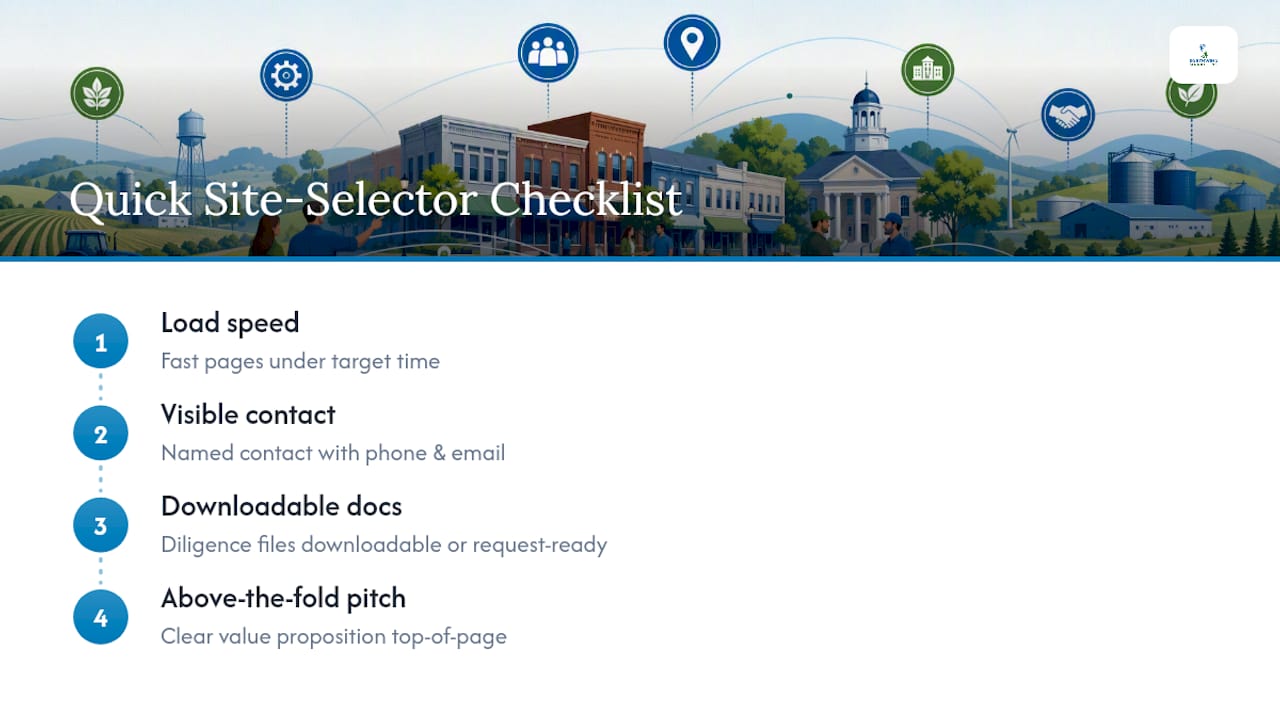
If you're managing an economic development site with limited staff time, here's the short version: publish a searchable property inventory with real filters, list a named contact with direct phone and email on every investor page, make diligence documents downloadable or request-ready, stamp every listing with a verification date, and build at least a handful of pages around the keywords site selectors actually type into a search bar.
A structured self-assessment covering load speed, visible contact information, downloadable materials, and an above-the-fold pitch is a fast way to find your weakest link before a site selector does. Small and rural EDOs often out-compete bigger metros here simply by being faster to verify and easier to reach, a named coordinator who answers the phone beats a glossy site with a generic contact form every time.
This type of work includes hosting and update discipline, SEO and content management, and CRM and follow-up communication services that turn an inquiry into a site visit.
Ready to Turn Your Site Into a Decision-Support Tool?
Economic development websites built as described here feature property inventories with filtering, GIS layers labeling utilities and floodplains, and ADA-compliant designs optimized for mobile. This work is often focused on small-town and rural economic development organizations.
If your current site is more brochure than database, the fastest way to find out is a site-readiness audit, a straightforward review of what's published, what's missing, and what's making evaluators leave. From there, a searchable property inventory proof-of-concept is a reasonable first project, small enough to scope quickly, useful enough to show results. Our website design work covers exactly this kind of build, and Southwind Guardian℠ keeps it current afterward instead of letting it drift stale within six months. Reach out and ask what a site-readiness audit would look like for your community.
Why Rural EDOs Can't Afford a Generic Website Template
The mistake I see most often isn't a lack of effort, it's applying a chamber-of-commerce template to a job that requires an investor-facing tool. A pretty homepage with a rotating photo carousel and a vague "business friendly" tagline tells a site selector nothing they can act on, and in a due-diligence process measured in minutes, nothing means gone.
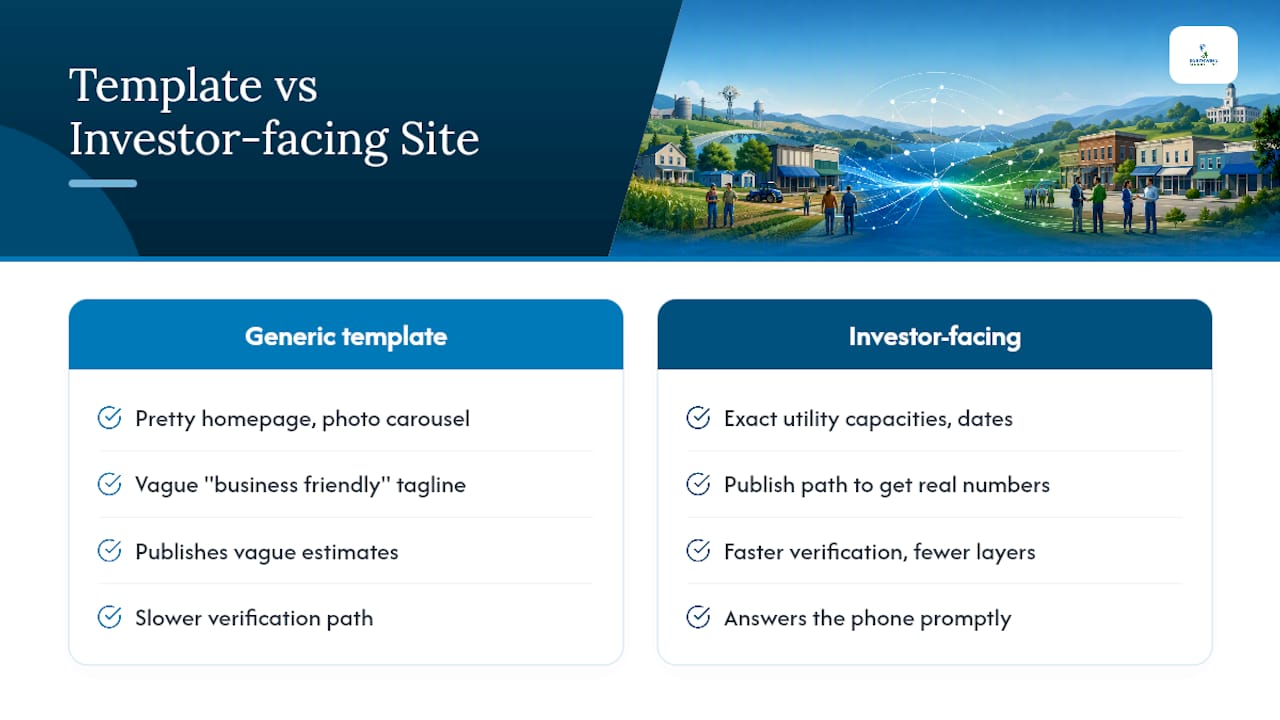
Rural communities have a real advantage here if they use it: fewer layers of bureaucracy usually means faster verification and a shorter path from inquiry to answer. The practitioner's rule holds up well in practice, if a listing can't state an exact utility capacity or a real verification date, don't publish a vague version of it. Publish the path to get the real number instead. That kind of honesty reads as competence, not weakness.
The organizations that win aren't necessarily the ones with the biggest incentive packages. They're the ones that answer the phone, keep their property data current, and never make an evaluator guess. If your site can't currently do that, it's worth an honest look before your next big prospect does the looking for you.
— Damien Denmark
Sources
For deeper guidance, review the BCEDA website self-assessment PDF, Stegmeier Consulting's site-readiness communication guide, and the Research Triangle Regional Partnership as a working example of integrated sector and property data.
- What Site Selectors Look for in an Economic Development Website
- Site readiness communication for economic development organizations
- Economic Development Website Self-Assessment
FAQ
Why Does Economic Development Matter for a Community's Website Strategy?
Economic development drives jobs, tax base, and long-term investment, and the website is often the first and only interaction a prospective employer has with your community before deciding whether to visit. A site that can't answer basic property and workforce questions quickly gets passed over by site selectors working through dozens of communities at once.
What Are the Different Types of Economic Development Efforts a Website Should Support?
Most EDO websites need to support at least three tracks: business recruitment (attracting new employers), business retention and expansion (supporting existing companies), and workforce or talent development. Each track needs its own content path rather than one generic "business" page trying to serve all three.
What Are the Advantages of a Strong Economic Development Website?
A well-built site shortens the due-diligence cycle for site selectors, reduces staff time spent on repetitive inquiries, and gives local businesses a clear resource for expansion support. It also functions as a retention tool: layered signals of investor confidence, operational support, risk mitigation, and a human point of contact, reassure both outside investors and existing employers considering whether to stay.
What Determines Whether an Economic Development Website Actually Works?
Currency and verifiability determine whether a site works, more than design polish does. A property database with filterable, dated listings and a named contact on every investor page consistently outperforms a visually impressive site built on stale or vague information.
Does Southwind Marketing Build Economic Development Websites?
Yes, Southwind Marketing designs ADA-compliant economic development websites, including property inventory builds, GIS integration, and ongoing hosting through Southwind Guardian℠. Current service details and next steps are available on the website design page.