
TL;DR:
- Tax increment financing captures future property value growth within districts and directs it to public improvements.
- Small towns should confirm projects meet the "but-for" test, have the capacity to manage compliance, and avoid funding projects likely to occur anyway.
Tax increment financing (TIF) is a property tax financing tool that captures the future growth in assessed value within a defined district and dedicates that incremental revenue to fund public improvements or developer incentives inside that same district. It does not raise tax rates. It redirects growth that would not otherwise exist.
For a small town or EDO, TIF is worth pursuing when:
- A project passes the "but-for" test — meaning the development genuinely will not happen without a public subsidy (catalytic infrastructure, site cleanup, utility extensions to a greenfield site).
- Your community has the administrative capacity to manage a multi-year district, file annual audited reports, and enforce developer agreements.
TIF is probably not the right tool when:
- Development is already likely to occur without a subsidy.
- Your staff cannot absorb the ongoing reporting and compliance burden.
- Your overlapping taxing bodies (school districts, counties) have not been consulted and may resist.
Authoritative guidance on TIF mechanics comes from the Federal Highway Administration (FHWA), the Lincoln Institute of Land Policy, and Good Jobs First. This guide is educational, not legal or financial advice. Always work with bond counsel and a municipal finance advisor before committing to a district.
Table of Contents
- How does tax increment financing actually work?
- Where small towns and EDOs commonly use TIF
- Who can create a TIF district, and what does state law allow?
- How TIF funds projects: bonds, pay-as-you-go, and developer reimbursements
- What are the real benefits and risks of TIF?
- Step-by-step process to create a TIF district
- How to structure governance, reporting, and safeguards
- Is TIF the right tool for your small town?
- Short municipal examples and model practices
- Key Takeaways
- What small towns get wrong about TIF
- Southwind Marketing helps you communicate TIF to your community
- Authoritative resources and further reading
- FAQ
How does tax increment financing actually work?
The mechanics are straightforward once you understand three terms: base value, increment, and the TIF fund.
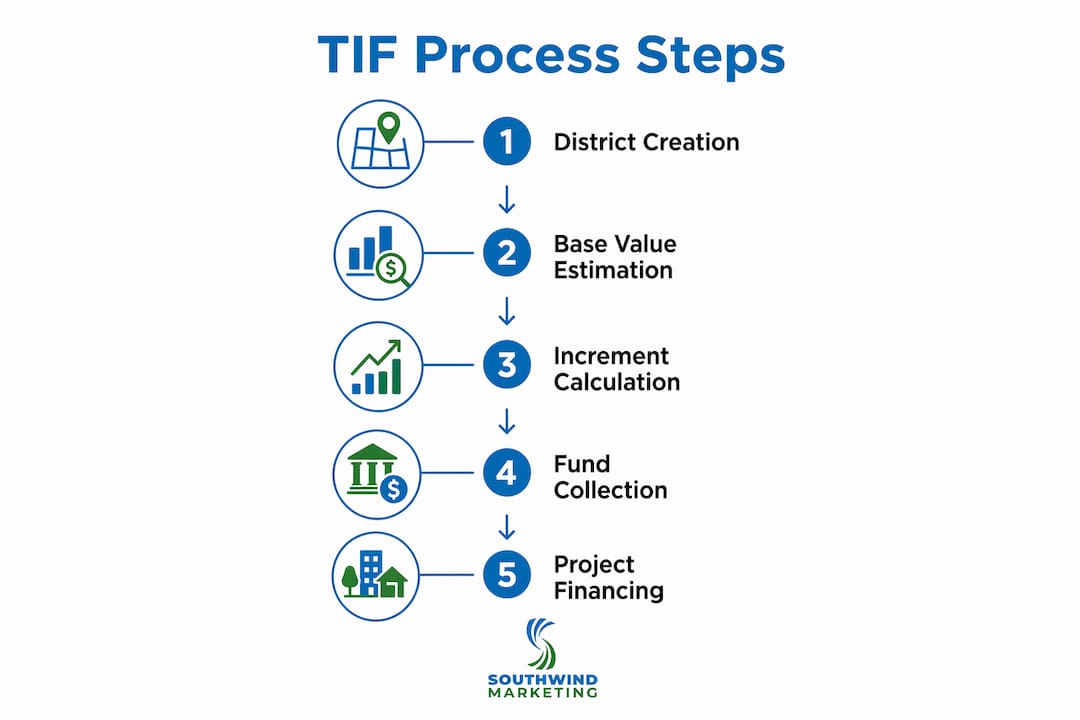
Base value is the total assessed value of all taxable property inside the proposed district, measured in the year the district is created. Every taxing jurisdiction — the city, the county, the school district — continues to collect taxes on that base value forever, exactly as they did before the district existed. Nothing changes for them on the base.

Increment is the increase in assessed value above that base, generated by new construction or rising property values after the district is created. The property taxes produced by that increment are not deposited into the general fund. Instead, they flow into a dedicated TIF fund controlled by the redevelopment authority or governing body. The FHWA describes TIF as a value-capture tool: the private economic gain created by a public infrastructure investment is returned to the public sector to pay for that infrastructure.
The district runs until project costs are retired or the statutory maximum is reached. At termination, the increment disappears as a separate stream and all revenue from the district flows back to the general fund. According to FHWA guidance, typical TIF durations often range from about fifteen to thirty years, though state law sets the ceiling.
| Feature | Typical Range or Description |
|---|---|
| District duration | 15–30 years (state law sets the cap) |
| Revenue source | Incremental property tax (some states allow sales tax or other sources) |
| Base year | Assessed value at district creation; school/county taxes continue on this amount |
| Common fund uses | Street and utility infrastructure, site acquisition, demolition, affordable housing, debt service |
| Termination trigger | Project costs retired or statutory sunset reached |
One point worth emphasizing: TIF does not create a new tax or increase anyone's tax rate. Taxpayers inside and outside the district pay the same millage they would have paid anyway. Only the destination of the incremental revenue changes.
Where small towns and EDOs commonly use TIF
TIF is not a one-size-fits-all tool, but certain project types come up repeatedly in small-town applications. Here is where it tends to work at a community scale.
Downtown revitalization. Streetscape improvements, façade programs, parking structures, and utility undergrounding in a historic commercial district. The goal is raising assessed values enough to generate increment that covers the cost of the improvements over 15–20 years. Main Street programs often pair with TIF districts to coordinate private investment alongside public improvements.
Utility and street infrastructure for new commercial development. A retailer or light manufacturer wants to locate on a site that lacks water, sewer, or road access. The city extends the infrastructure using TIF-backed financing and recoups the cost from the tax increment generated by the new facility. Without TIF, the city would have to fund the extension from the general fund or a special assessment.
Site preparation for a major employer. Demolition of a derelict building, environmental remediation, or grading a pad-ready site. These costs are often too large for a small town's capital budget but too small to attract state or federal grant funding on their own. TIF fills that gap.
Mixed-use infill. Vacant lots or underused parcels in a core commercial area converted to mixed-use development. TIF can fund the public-side costs (parking, streetscape, utility relocation) while the developer funds the private construction.
Affordable housing (state-dependent). Some states permit TIF funds to support affordable housing, but this is not uniformly allowed. Check your enabling statute carefully — this is not universal.
Realistic timeframes matter here. A downtown streetscape project might generate visible increment within three to five years if anchor tenants follow the public investment. A greenfield industrial site may take seven to ten years before assessed values climb enough to cover debt service. Small towns should model conservative increment projections, not optimistic ones.
Pro Tip: Before committing to a project type, ask your county assessor to pull five years of assessed value trends for the proposed district boundary. If values have been flat or declining, your increment projections need to account for that baseline reality.
Who can create a TIF district, and what does state law allow?
TIF authority flows entirely from state enabling legislation. The FHWA's TIF Primer notes that TIF was created in California in 1952 and has since spread to 49 states, but the rules vary widely. What is permitted in Indiana may be prohibited in Montana, and vice versa.
Before your staff spends a dollar on feasibility work, pull your state's TIF enabling statute and check for these provisions:
Blight or "blighted area" definitions. Many states require a formal finding that the proposed district meets a statutory definition of blight, economic stagnation, or infrastructure deficiency. Some states have broadened this to include "conservation areas" or "economic development areas" that do not require physical blight.
The "but-for" test. As of a 2018 FHWA compilation, eighteen states required a formal "but-for" showing and twenty-one required a feasibility or cost-benefit analysis in some form. Your state may require both. This is the legal foundation for the district's existence — document it thoroughly.
Duration caps. State caps on the duration of TIF districts vary, with some states allowing longer periods depending on local law. Know your ceiling before you design a financing plan.
Permitted expenditures. States define what TIF funds can pay for. Infrastructure is almost universally allowed. Affordable housing, public safety facilities, and worker training programs are permitted in some states and prohibited in others.
School district impact provisions. Some states require that school districts be held harmless from TIF diversions, or that excess increment be passed through to schools annually. Indiana's statute, for example, requires redevelopment commissions to annually determine whether captured assessed value exceeds what is needed for debt service, and to pass through any excess to underlying taxing units.
Pro Tip: Contact your state's department of local government finance, community development office, or municipal league before hiring a consultant. Many states publish TIF toolkits or model ordinances that can cut your legal preparation time significantly. Indiana's OCRA, Montana's Department of Commerce, and Wisconsin's Department of Revenue all publish guidance documents.
How TIF funds projects: bonds, pay-as-you-go, and developer reimbursements
Once a district is established, you have several ways to deploy the increment. The right choice depends on project size, timing, and how predictable your increment growth will be.
| Financing Method | How It Works | Best For | Key Risk |
|---|---|---|---|
| TIF revenue bonds | Issue bonds backed solely by future increment; proceeds fund improvements upfront | Large catalytic projects needing immediate capital | Increment shortfall leaves debt uncovered |
| General obligation bonds (TIF-backed) | City issues GO bonds; TIF increment services the debt; full faith and credit backstop | Mid-size projects where city can absorb shortfall | Adds to city's debt load |
| Pay-as-you-go (PAYGO) | Increment accumulates in the TIF fund; projects funded as cash is available | Smaller districts with slow increment growth | Projects delayed until funds accumulate |
| Developer reimbursement | Developer fronts eligible costs; city reimburses from future increment | Site prep, utility extensions, demolition | Developer carries risk if increment underperforms |
Good Jobs First explains that municipalities often issue bonds and use the tax increment to service the debt, but that if revenues fall short, general obligations or other credit supports may be necessary. That last point is where small towns get into trouble.
A "naked TIF bond" — one backed only by the increment with no reserve fund, no credit enhancement, and no general obligation backstop — carries the highest interest cost and the most risk. If the anchor development stalls or assessed values grow slower than projected, the city is exposed. The Lincoln Institute of Land Policy recommends bundling TIF with credit enhancements, reserve funds, or special assessments to reduce municipal exposure. For small towns with limited financial reserves, PAYGO or developer reimbursement arrangements are often safer starting points than bond issuance.
What are the real benefits and risks of TIF?
TIF's core appeal is that it funds public infrastructure without raising tax rates and without competing against existing programs in the general fund. That is a genuine advantage, particularly for small towns that cannot float a general obligation bond for every capital project.
The FHWA confirms that TIF does not create a new tax or raise tax rates — taxpayers inside and outside the district pay the same millage regardless. The increment is simply redirected growth, not a new burden.
The U.S. has at least 10,000 TIF districts across 49 states, making it one of the most widely used local economic development tools in the country.
That prevalence reflects real utility. But it also reflects decades of mission creep. The Lincoln Institute's research identifies three recurring problems: lack of transparency, diversion of school funding, and subsidizing development that would have occurred anyway. The third problem is the most damaging to a small town's credibility. Recent analysis published in 2026 argues that a significant share of TIF districts capture growth that likely would have occurred without public subsidy, particularly in higher-growth markets.
The "but-for" test is the primary defense against this criticism. If you cannot document, with a credible feasibility analysis, that the development genuinely requires public support, you are not capturing value — you are transferring it from schools and counties to a private developer.
The school funding concern is real and politically sensitive. While the base value continues to generate tax revenue for schools, the increment does not flow to the school district for the life of the TIF. In a 20-year district with strong growth, that is a material diversion. Some states address this with pass-through provisions; others do not. Know your state's rules and communicate proactively with your school superintendent before the district is created.
Step-by-step process to create a TIF district
Creating a TIF district is a legal and administrative process with defined steps. The sequence below reflects common practice across states; your enabling statute may add or reorder steps.
Conduct a preliminary feasibility assessment. Before hiring consultants, run a quick internal check: Does the proposed area meet your state's eligibility criteria? Is there a plausible "but-for" case? Are there overlapping taxing bodies that need to be engaged early?
Commission a boundary study and base value analysis. Hire a qualified consultant or your county assessor's office to map the proposed district boundary and document current assessed values. This establishes the base year.
Prepare a "but-for" analysis or finding of necessity. Depending on your state, this may be a formal blight study, an economic feasibility report, or a cost-benefit analysis. This document is the legal foundation for the district.
Draft the TIF development plan. The plan describes the district boundary, the projects to be funded, estimated costs, projected increment, and the financing approach. Most states require the plan to be reviewed by a planning board before adoption.
Issue public notices and hold required hearings. State law specifies notice requirements — typically written notice to all property owners within the proposed district and a public hearing. Do not shortcut this step; procedural defects can void a district.
Obtain approval from overlapping taxing bodies. Many states require a joint review board or formal approval from the county and school district. Even where approval is not legally required, early engagement prevents political problems later.
Adopt the ordinance or resolution creating the district. The governing body formally creates the district. In some states, the ordinance does not take effect for 30 days after adoption, giving affected parties time to object.
Set the base year assessed value with the county assessor. This is the benchmark. Every dollar of increment above this figure flows to the TIF fund.
Execute developer agreements and financing documents. If you are issuing bonds, engage bond counsel. If you are using developer reimbursements, execute a development agreement that specifies eligible costs, performance milestones, and clawback provisions.
Begin annual reporting. From the first year of operation, the district requires audited financial statements, annual spending plans, and pass-through determinations. Build this into your staff calendar from day one.
Typical timeline: Six to twelve months from feasibility to district creation, depending on state requirements and political complexity. Consultant fees, legal costs, and public notice expenses typically run from $25,000 to $75,000 for a straightforward small-town district, though complex projects with bond issuance cost more.
Pro Tip: The FHWA's TIF Primer and FAQ documents are free, authoritative, and written for practitioners. Download them before your first consultant meeting. State university extension programs in many states also offer no-cost technical assistance to small municipalities — ask your state municipal league for referrals.
How to structure governance, reporting, and safeguards
Governance failures are the most common reason TIF programs generate political backlash. The Lincoln Institute's transparency research identifies an interested-parties registry and proactive public-facing financial reporting as the two practices most likely to withstand political scrutiny.
Governance architecture. Assign clear authority: who approves developer agreements, who controls the TIF fund, and who reports to the governing body. In Indiana, a redevelopment commission holds this authority under state statute. In other states, it may be the city council directly or a designated redevelopment authority. Ambiguity here creates accountability gaps.
Annual reporting requirements. At minimum, publish each year: total increment collected, distributions to overlapping taxing units (if any), expenditures from the TIF fund by project, outstanding debt, and a forward-looking spending plan. Indiana's statute now requires redevelopment commissions to file a spending plan with the state by December 1 each year. That level of specificity is good practice regardless of whether your state mandates it.
Common safeguards to build in from the start:
- Sunset dates. Set the district's termination date in the creating ordinance, tied to debt retirement or a fixed year limit, whichever comes first.
- Clawback provisions. Developer agreements should require repayment of TIF funds if the developer fails to meet assessed value or employment milestones.
- Reserve or stabilization funds. Set aside a percentage of annual increment to cover debt service shortfalls. This is especially important for small towns issuing TIF bonds.
- Pass-through determinations. Annually assess whether captured increment exceeds what is needed for the current year's obligations, and pass the excess back to schools and the county.
- Online registry of interested parties. Publish developer agreements, consultant contracts, and the names of parties with a financial interest in the district. Transparency here is the single most effective defense against accusations of favoritism.
Is TIF the right tool for your small town?
Use this checklist before committing staff time or consultant dollars to a TIF feasibility study.
| Readiness Factor | Questions to Ask | Rating Guidance |
|---|---|---|
| Project fit | Does the project pass a credible "but-for" test? Is it a public improvement, not a private subsidy? | Strong: clear infrastructure gap. Weak: private project likely to proceed anyway. |
| Increment potential | Are assessed values in the proposed area likely to grow? Has the county assessor confirmed recent trends? | Strong: documented growth trajectory. Weak: flat or declining values. |
| Administrative capacity | Does your staff have bandwidth to manage annual reporting, audits, and developer agreement compliance? | Strong: dedicated finance or planning staff. Weak: one-person shop already at capacity. |
| Legal support | Do you have access to a municipal attorney familiar with your state's TIF statute? | Strong: retained counsel with TIF experience. Weak: no legal budget identified. |
| Financial buffers | Can the city absorb a shortfall if increment grows slower than projected? | Strong: reserve fund or GO backstop available. Weak: no financial cushion. |
| Community and political buy-in | Have you briefed the school district, county, and key stakeholders? Is there council support? | Strong: proactive engagement underway. Weak: first time stakeholders are hearing about it. |
Practical tips for small towns:
- Start with a smaller pilot district rather than a large boundary. A focused district is easier to manage, easier to explain to the public, and less likely to generate school-district opposition.
- Prefer PAYGO or developer reimbursement over bond issuance for your first district. You can always issue bonds later once the increment is proven.
- Bundle TIF with other tools: CDBG grants, state revolving loan funds, or special assessments. TIF as a local match for a federal or state grant is often more defensible than TIF as the sole funding source.
- Engage residents early. A public meeting that explains "this does not raise your taxes" in plain language is worth more than any legal notice. For guidance on structuring that outreach, rural EDO incentive policy frameworks offer useful communication templates.
For community outreach around TIF, stakeholder email campaigns can help you reach property owners, business operators, and residents in the district before the public hearing, reducing surprise and building consent.
Short municipal examples and model practices
Real-world TIF outcomes at small-town scale look different from the large urban redevelopment projects that dominate the academic literature. Here are four patterns that reflect what actually works in communities of 2,000–25,000 people.
Downtown utility undergrounding, small Midwest city. A city of roughly 8,000 residents created a compact downtown TIF district to fund underground utility relocation along its main commercial corridor. The project removed overhead lines, improved streetscape aesthetics, and enabled façade renovations by adjacent property owners. Assessed values in the district grew steadily over the following decade, and the district retired its obligations ahead of the statutory sunset. The lesson: a focused, visible public improvement that directly enables private investment is the clearest "but-for" case you can make. Downtown development authority programs often pair with exactly this type of district.
Industrial site prep, rural county seat. A county seat of 5,500 used a TIF district to fund demolition of a former grain elevator and environmental assessment of the adjacent parcel. A regional manufacturer subsequently located on the site. The TIF district captured increment from the new facility's assessed value and retired the remediation costs within eight years. The lesson: site prep TIFs work best when a specific end user is already in negotiation, not as a speculative land-banking strategy.
Mixed-use infill, small Plains town. A community used PAYGO TIF to fund streetscape improvements around a vacant downtown block. A developer converted the block to mixed-use residential and retail over three years. Because the city used PAYGO rather than bonds, it carried no debt risk during the construction period. The lesson: PAYGO is slower but far less risky for a first-time TIF district in a community without a dedicated finance director.
Model policy language to adapt. Developer agreements in well-governed TIF districts typically include: a minimum assessed value commitment (e.g., the developer agrees the completed project will carry a minimum assessed value of $X by a specified date), an employment commitment where applicable, a clawback provision requiring repayment of TIF funds if the assessed value or employment threshold is not met within a defined cure period, and an annual certification requirement. Your bond counsel or municipal attorney can draft these provisions; the Indiana and Wisconsin toolkits in the sources section below include sample language.
For communities that want to tell the story of a TIF-funded project publicly, brand storytelling frameworks help translate complex financing mechanics into resident-facing narratives that build support rather than confusion.
Key Takeaways
Tax increment financing works when a project passes the "but-for" test, increment growth is realistic, and the municipality has the governance capacity to manage a multi-year district transparently.
| Point | Details |
|---|---|
| TIF redirects growth, not taxes | No tax rate increase occurs; only the incremental revenue above the base year value is captured. |
| "But-for" test is non-negotiable | Document that development will not occur without public support — this is your legal and political foundation. |
| Start small and use PAYGO | Pilot districts with pay-as-you-go financing carry far less risk for first-time small-town TIF programs. |
| Governance and transparency protect everyone | Annual audited statements, clawback provisions, and a public registry of interested parties reduce political risk and protect schools. |
| Southwind Marketing supports the communications side | Southwind helps small towns and EDOs build project landing pages, public dashboards, and stakeholder outreach materials for TIF-funded projects. |
What small towns get wrong about TIF
The most persistent mistake I see small towns make with TIF is treating it as a revenue source rather than a financing mechanism. TIF does not generate money the community did not already have coming. It borrows against future growth and bets that the growth will materialize. When it does, TIF is elegant. When it does not, the city is left servicing debt from the general fund.
The second mistake is underestimating the administrative load. A TIF district is not a one-time decision. It is a 15-to-30-year commitment to annual audits, developer agreement compliance, pass-through determinations, and public reporting. For a small town with a two-person finance department, that is a real cost. Communities that skip the governance infrastructure in year one almost always face a transparency crisis in year five.
The third mistake is the most avoidable: failing to engage the school district before the public hearing. School boards are not opposed to economic development. They are opposed to being surprised by a financing mechanism that diverts increment away from their budget for two decades. A 30-minute briefing with the superintendent before the first public notice goes out changes the entire political dynamic.
TIF is a legitimate, well-established tool. The communities that use it well are the ones that treat it as a long-term public commitment, not a quick fix.
Southwind Marketing helps you communicate TIF to your community
Getting a TIF district approved is only half the work. The harder half is explaining it to residents, business owners, and the school board in plain language — and then keeping them informed for the life of the district.

Southwind Marketing builds the communications infrastructure that TIF-funded projects need: project landing pages that explain the district in plain language, public-facing dashboards that show increment collections and project progress, stakeholder outreach campaigns, and community meeting materials. We work specifically with rural communities, small cities, EDOs, chambers, and downtown development authorities across Oklahoma, Kansas, Texas, Iowa, Missouri, and Arkansas.
We do not provide legal or financial advice. For bond counsel, feasibility studies, and statutory compliance, you need a qualified municipal finance advisor. What we do is handle the public-facing side: the website, the messaging, the outreach, and the reporting templates that keep your community informed and your council confident.
If your town is evaluating a TIF district and needs help with the communications strategy, see how we support economic development marketing or reach out directly at southwindmarketing.com.
Authoritative resources and further reading
| Resource | What It Contains | Why It Helps |
|---|---|---|
| FHWA TIF Primer (PDF) | Full mechanics, legal framework, financing options, and state variation | Best single starting document for staff and counsel |
| FHWA TIF FAQ (PDF) | "But-for" test requirements, financing methods, state-by-state data | Use for feasibility and financing decisions |
| Lincoln Institute: Hidden Costs of TIF | Transparency failures, school funding impacts, reform recommendations | Use to anticipate criticism and design governance safeguards |
| Good Jobs First: What Is TIF | Repayment mechanics, developer reimbursement, accountability standards | Use for developer agreement design and public accountability |
| Indiana TIF Toolkit (OCRA) | Operational steps, permitted uses, reporting practices | Use as a process checklist and model for other states |
| Southwind Marketing: EDO Services | Communications, outreach, and marketing support for EDOs | Use when planning stakeholder engagement and public reporting |
FAQ
What is TIF and how does it work?
Tax increment financing captures the increase in property tax revenue above a base year value within a defined district and dedicates that increment to fund public improvements or incentives inside the district. It does not raise tax rates; it redirects growth that the public investment is assumed to have created.
How are TIF loans and bonds repaid?
TIF debt is repaid from the incremental tax revenues collected within the district. If increment falls short of debt service, the municipality may need to cover the gap from general funds or other credit supports, which is why reserve funds and conservative increment projections matter.
What are the downsides of TIF?
The main risks are diverting revenue from schools and other taxing bodies, subsidizing development that would have occurred anyway, and creating long-term debt obligations the city must service if increment underperforms. Weak governance and poor transparency amplify all three risks.
Why is TIF controversial?
Critics argue that TIF frequently subsidizes private development that would have happened without public support, effectively transferring tax revenue from schools and counties to developers. The Lincoln Institute of Land Policy has documented that lack of transparency and school funding diversion are the two most common failure points.
Can a small town with limited staff manage a TIF district?
Yes, but only with realistic planning. Small towns should start with a compact district, use pay-as-you-go financing rather than bonds, and budget for annual auditing and legal compliance costs from the outset. Understaffed communities that skip governance infrastructure almost always face accountability problems within a few years.