Most small-town economic development websites are functional but far from finished. The single biggest problem isn't design or content quality. It's that contact information and community data get buried three clicks deep while site selectors and business prospects give up and move to the next town. Fix visibility first: put your phone number, a named contact, and one clear data hub on the homepage. Then build a simple amplification plan around LinkedIn and one targeted ad channel to get that content in front of people.
TL;DR:
- Improving visibility by placing contact details on the homepage and simplifying messaging significantly increases the chances of attracting site selector inquiries.
- Small-town EDO websites often struggle with outdated data, buried contact info, and lack of structured content, mainly due to staffing limitations.
- Prioritizing quick wins such as a homepage hub, accessible contact info, and sourced community reports can produce visible results within 60 to 90 days.
- Cross-linking with local chambers and sharing standardized reports helps small EDOs leverage existing resources and build credibility efficiently.
- Regular site maintenance tasks like updating contact info, community data, and ensuring mobile performance are critical to maintaining trust and relevance in the digital landscape.
Table of Contents
- What Is the Current State of Small-Town EDO Websites?
- What Best Practices Should Small EDOs Adopt First?
- What Data Tools Help a One-Person EDO Team?
- What Should You Do First, Next, and Later?
- How Should EDO Sites Connect With Chambers and Local Businesses?
- What Engagement Features Actually Get Used?
- Does Mobile Performance Actually Matter for EDO Sites?
- What Security Basics Should Small-Town EDO Sites Cover?
- Southwind Marketing's Field Perspective on Realistic Outcomes
- How Southwind Marketing Supports Rural Nonprofits and Small EDOs
- Sources
- FAQ
What Is the Current State of Small-Town EDO Websites?
Walk through ten small-town EDO sites and you'll notice a pattern fast. The information is often there. Finding it is the problem.
Practitioners call this the "scavenger hunt" problem: contact forms hidden in footer menus, workforce data locked in a PDF from three years ago, no clear path from homepage to "here's why you should build here." This isn't a lack of effort. It's a staffing reality. Most small-town EDOs run on one or two people juggling business retention, grant writing, ribbon cuttings, and whatever the website needs that week. Site maintenance loses out to more urgent fires almost every time.
That staffing constraint shows up as a fairly consistent failure pattern:
- Contact info requires more than one click to find, often buried below fold or in a footer
- Community and workforce data is outdated, unsourced, or missing entirely
- No structured content for search engines to index, so the site barely surfaces for site-selector queries
- Business directories exist but aren't maintained or cross-linked with local chamber resources
The strengths are real too, and worth naming. Many small-town sites already have solid local storytelling, functioning business directories, and basic contact pages that work as a foundation. Moshannon Valley Economic Development Partnership is a good example of a live site with clear contact details and a working directory. So is Keokuk County Economic Development, which pairs a business directory with a low annual membership offer. Neither site is flashy. Both do the basics right, which is more than most small-town sites manage.
What Best Practices Should Small EDOs Adopt First?
You don't need a redesign. You need to fix the five or six things that actually move a site selector or business prospect from "interested" to "contacted." Here's the priority order:
- Build a homepage hub. One concise community snapshot, one clear call to action for inquiries, and a link to your featured community report. Nothing buried, nothing scattered across five pages.
- Put contact information at the top level. Phone, email, a simple intake form, and a named staff contact. Not "contact us" in a footer. Top navigation, visible on every page.
- Publish downloadable data pages. Workforce and demographic reports with clear sources and publish dates. Site selectors trust dated, sourced numbers over vague marketing copy.
- Use hub-and-spoke architecture. One strong homepage links out to a handful of well-organized subpages, plus a minimal property search if you can manage one. Template everything in your CMS so updates don't require rebuilding pages from scratch.
- Do the SEO basics and pick one amplification channel. Basic on-page SEO, one content cluster around your top three community strengths, and a LinkedIn outreach habit. Digital marketing strategies built for small EDOs consistently show that focused content plus targeted LinkedIn outreach beats spreading effort across five social platforms.
- Handle accessibility and trust signals. ADA compliance isn't optional, and neither is citing your data sources with author bylines and publish dates.
Pro Tip: Assign one person as the "site owner" even if three people contribute content. A single point of accountability is the difference between a site that gets updated and one that quietly goes stale for two years.
Southwind Marketing's rural website design guide breaks down implementation details for teams working with limited technical staff, and it's worth a look if you're deciding what to tackle first.
What Data Tools Help a One-Person EDO Team?
A one-person office cannot build custom workforce and demographic reports from scratch every quarter, and nobody expects it to. The realistic path is a platform that generates these reports for you and lets you publish, embed, and reuse them.
A useful community report covers workforce size and skills, demographics, commuting patterns, and industry mix, with a clear publish date and named data source. Site selectors trust reports like this specifically because they're sourced and dated, not because they're beautifully designed.
Platform-driven tools offer three concrete advantages:
- Scheduled updates so your data doesn't quietly age out of relevance
- Embeddable widgets you drop into your existing site without a rebuild
- Exportable PDFs you can hand to a council meeting or attach to a grant application
One documented example: a single-person EDO office used Localintel-supplied reports to publish workforce, demographics, and mobility data without producing the underlying analysis themselves. That same report then got reused for a council briefing and a grant narrative, which is the real efficiency win. One data asset, three uses.
Before you publish anything, verify the data source and date range yourself. A report pulled from outdated census estimates will undercut your credibility faster than having no report at all.
What Should You Do First, Next, and Later?
Here's a realistic roadmap that respects the fact that you have other duties competing for your time.
- Days 0 to 30: Fix visible contact information immediately. Build a one-page homepage hub. Add "last updated" dates to every data page so visitors know what they're looking at.
- Months 1 to 3: Publish one community or workforce report using a data platform rather than building it from scratch. Set a simple content calendar, even if it's just one post per month. Run one targeted ad test through a local channel to see what drives inquiries.
- Months 3 to 12: Add property search or standardized business listings. Set a quarterly analytics review on your calendar. Build a repeatable LinkedIn outreach template so outreach doesn't depend on remembering what worked last time.
Pro Tip: Track four numbers, and only four: form inquiries, report downloads, referral traffic from LinkedIn, and feedback you get directly from council members. If those four aren't moving after 90 days, the tactic needs adjusting, not the goal.
Southwind Marketing's guide to site selector expectations covers what to prioritize in more depth if you're building this checklist into a formal work plan.
How Should EDO Sites Connect With Chambers and Local Businesses?
An EDO site that operates in isolation from the local chamber is missing an obvious win. Chambers already have member directories, event calendars, and relationships with local businesses. Cross-linking rather than duplicating that work saves you real time.
The practical version looks like this: link directly to your chamber's membership page instead of building a competing directory from scratch. Feature chamber events on your own calendar instead of maintaining two separate ones. Share your workforce and demographic reports with the chamber so their members can use the same data in grant applications or expansion pitches.
Keokuk County's approach is instructive here. Their site pairs a business directory with a modest annual membership, keeping the barrier to participation low while still giving local businesses a reason to show up on the site. That's a model small EDOs can copy without needing a big budget or a developer on staff.
The bigger point: your website doesn't have to do everything alone. It works better as a connective layer between chamber resources, Main Street programs, and your own economic development content, rather than a standalone island competing for the same local business attention chambers already have.

What Engagement Features Actually Get Used?
Event calendars, newsletters, and feedback forms sound like standard website furniture, but most small-town sites either skip them or let them go stale, which is worse than not having them at all.
An event calendar only works if it's updated. A calendar showing the last event from eight months ago tells visitors the whole site is abandoned, not just that page. If you can't commit to weekly updates, link out to your chamber's calendar instead of maintaining a dead one.
Newsletters are lower maintenance than most people assume once the template exists. A short monthly email covering one business win, one data point, and one upcoming event takes less time to produce than most EDOs think, and it builds a direct communication channel with prospects who aren't ready to call yet.
Feedback forms matter more for internal accountability than most teams realize. A simple form asking "what were you looking for and did you find it" gives you real data on where your navigation is failing, instead of guessing.
The common thread: pick fewer engagement features and maintain them consistently, rather than launching five and letting three go dormant. A calendar updated weekly beats a calendar, a blog, and a forum that are all six months stale.
Does Mobile Performance Actually Matter for EDO Sites?
Site selectors and business prospects increasingly research communities from a phone, often during a commute or between meetings, not sitting at a desktop with a stable connection.
A slow-loading site or one that requires pinching and zooming to read a workforce report is a direct signal that the organization behind it isn't paying attention to basics. That impression carries weight disproportionate to the actual technical fix required.
The practical priorities are straightforward: compress images before uploading rather than relying on the CMS to do it, avoid embedding oversized PDFs directly on pages, and test your site on an actual phone, not just a browser window resized to look like one. Page load speed and mobile layout aren't cosmetic. They're often the first and only impression a prospect forms before deciding whether to reach out.
What Security Basics Should Small-Town EDO Sites Cover?
Security gets ignored on small-town sites for the same reason maintenance does: nobody on a two-person team has bandwidth to think about it until something breaks.
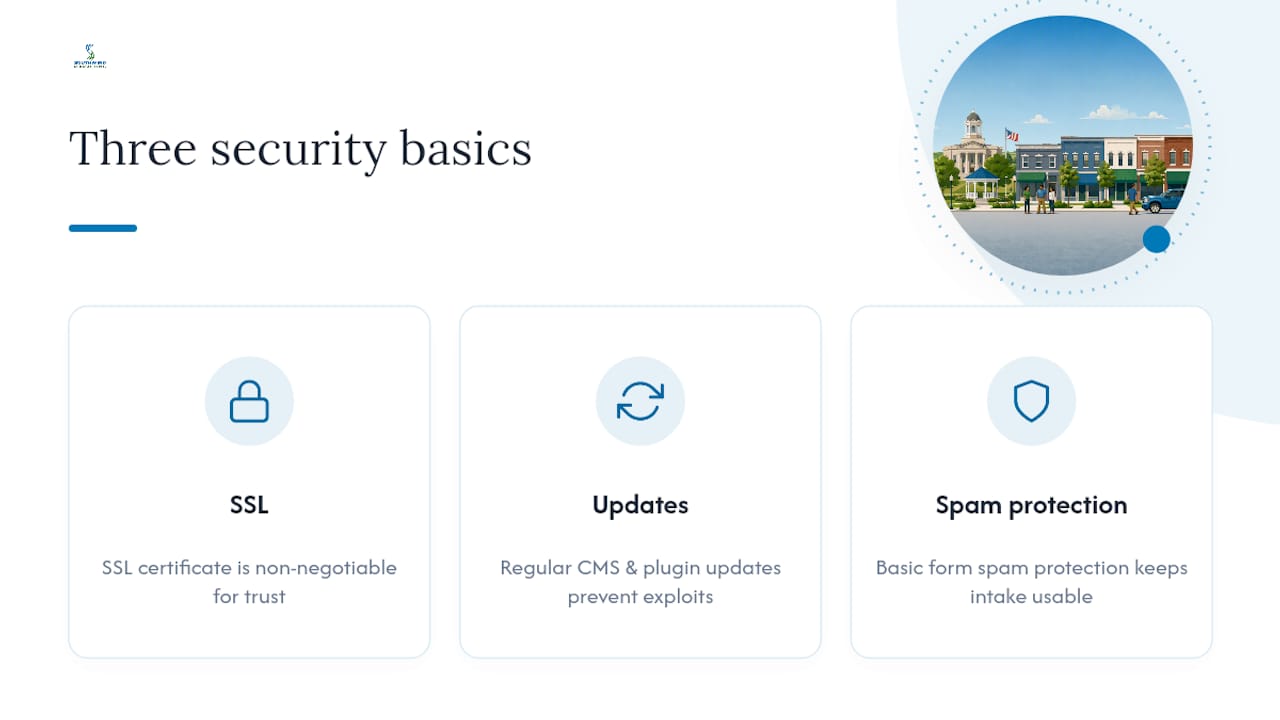
The baseline matters more than people assume, especially for sites collecting contact information or hosting intake forms. An SSL certificate is non-negotiable at this point, both for visitor trust and because browsers now flag unsecured sites directly to visitors. Regular software and plugin updates prevent the most common vulnerability, which is an outdated content management system left unpatched for a year or more. Basic form spam protection keeps your intake process usable instead of flooded with junk submissions that bury real inquiries.
None of this requires a dedicated IT person. It requires a maintenance schedule and someone accountable for keeping it, which circles back to the staffing reality every small-town EDO faces. A site that's secure but neglected in every other way still isn't doing its job, but a beautifully designed site running on an unpatched five-year-old platform is a liability waiting to surface at the worst time.
Southwind Marketing's Field Perspective on Realistic Outcomes
Southwind Marketing serves clients including Oklahoma, Kansas, Texas, Iowa, and Arkansas. We're still building relationships in Missouri's rural communities, and we say that plainly rather than overstate a local footprint we haven't earned yet.
What we've seen consistently across rural nonprofits and small-town EDOs: the sites that improve fastest don't start with a redesign. They start with a site cleanup, an automated community report, and a focused LinkedIn outreach push. That combination is realistic for a three-person nonprofit board with a grant-funded budget and no marketing staff. Typical timelines run 60 to 90 days for the first visible results.
The honest tradeoff between managed and do-it-yourself: a managed engagement gets the data hub and outreach system built correctly the first time. DIY works if someone has the bandwidth, but bandwidth is exactly what small teams don't have.
— Damien Denmark
How Southwind Marketing Supports Rural Nonprofits and Small EDOs
If you're running a nonprofit or EDO in certain rural areas with a small staff, a board that expects results, and a grant-funded budget that doesn't stretch to a full-service agency retainer, you may find Southwind Marketing aligned with your needs. We deliver the same strategic thinking a big agency would pitch you, scoped and priced for a nonprofit reality where one person often wears the marketing, donor relations, and communications hats at once.
Southwind Signal℠ handles the ongoing content and search visibility work that most nonprofits can't staff for internally, keeping your community reports, program pages, and blog content findable without demanding weekly attention from your team. For organizations managing donor relationships, volunteer sign-ups, or business intake forms, our CRM implementation and selection support gets a system in place that fits your actual workflow instead of forcing you into enterprise software built for a much bigger team.
Before you reach out to any marketing partner, pull your current site analytics, gather whatever community or donor reports you already have, and write down your top three outreach goals for the next year. That prep work makes the first conversation faster and more useful. Southwind Marketing's economic development marketing services page outlines what a scoped engagement typically covers if you want a starting point before you call.
Sources
- When you’re the whole economic development department
- Digital Marketing Strategies for Small EDOs with Alissa Sklar
- Moshannon Valley Economic Development Partnership
- Keokuk County Economic Development
FAQ
What Sells Best in a Small Town Economically?
Retail recruitment tends to succeed where local demand data supports it, but the strongest small-town economic wins usually come from a mix of small business retention, tourism assets, and remote-work friendly infrastructure rather than any single sector.
Where Is the Best Small Town to Move To?
There's no single answer since it depends heavily on job availability, housing cost, and community amenities, but towns with active EDOs publishing current workforce and housing data tend to attract more relocation interest because prospects can actually evaluate the fit.
What Are the Best Businesses to Start in a Small Town?
Businesses that fill a documented local gap, such as childcare, healthcare services, or specialty retail identified through a current market or demographic report, tend to perform better than businesses copied from what worked in a larger market.
What Are Some Ideas for Developing a Small Town?
Effective small-town development usually combines Main Street revitalization, downtown business recruitment, and a functional EDO website that makes local data and contact information easy to find, since prospects and site selectors research digitally before ever visiting in person.
How Often Should a Small-Town EDO Update Its Website?
Contact information and top-level content should be checked monthly, while community and workforce data reports need review at least quarterly to stay credible with site selectors and grant reviewers.
Is Southwind Marketing a Good Fit for a Small Nonprofit With a Tight Budget?
Southwind Marketing scopes engagements specifically for small teams and grant-funded budgets, offering services like content automation and CRM implementation sized to what a nonprofit board can realistically approve and staff can maintain.