
TL;DR:
- Focusing on optimizing your Google Business Profile, fixing site speed issues, and publishing a targeted service page can deliver measurable local SEO results within two to three months. A consistent, fundamentals-first SEO approach builds long-term growth, especially for small-town businesses with less competition. Southwind Marketing offers affordable, no-contract SEO services tailored to rural markets, emphasizing transparency and sustainable progress.
Your three highest-impact moves this week are simple: optimize your Google Business Profile, fix any site speed or mobile issues, and publish one focused service page that answers a question your customers actually ask. Do those three things before anything else. Measurable SEO results usually take about three to six months to appear for most small businesses, with local improvements sometimes visible in two to three months. Southwind Marketing's managed SEO starts at an affordable monthly rate, making an ongoing strategy accessible for many small-town budgets.
Here is what to do in the next 72 hours:
- Claim and verify your Google Business Profile if you have not already done so.
- Run your website through Google PageSpeed Insights and note any critical failures.
- Write down the three questions your customers ask most before they buy from you. Those become your first content targets.
The rest of this guide walks you through a full 90-day plan, a keyword strategy you can run yourself, and exactly what to look for when hiring someone to help.
Table of Contents
- What is small business SEO and why does it matter for local businesses?
- What are the highest-leverage fundamentals for a small business SEO strategy?
- What does a 90-day starter plan actually look like?
- How do you find the right keywords without spending a lot of money?
- What content should a small business publish to rank and convert?
- How do you set up and optimize your Google Business Profile for local search?
- What technical SEO issues should a small business fix first?
- How do you measure SEO progress and set realistic expectations?
- How do you choose an honest SEO provider and avoid getting burned?
- Why does rural expertise matter, and how does Southwind Marketing help?
- Key Takeaways
- The part most owners get wrong
- Southwind Marketing works with small budgets and no long contracts
- Useful sources and next steps
- FAQ
What is small business SEO and why does it matter for local businesses?
Search engine optimization is the work of making your website and online presence show up when people search for what you sell. For a rural hardware store, a Main Street salon, or a local HVAC company, that means showing up when someone in your county types "hardware store near me" or "AC repair in [your town]."

The practical payoff is significant. A customer who finds you through a Google search is already looking for what you offer. That is a warmer lead than almost any paid ad you can run, and over time the cost per lead from organic search tends to drop as your rankings hold. Paid ads stop the moment you stop paying. SEO compounds.

For rural and small-town businesses, local search visibility is especially valuable because the competition is usually thinner than in a metro area. A well-optimized Google Business Profile and a few solid service pages can put a small-town business at the top of local results faster than most owners expect. A plumbing company in a rural Oklahoma county, for example, may face only two or three competitors with any real web presence. Claiming that space is not complicated. It just takes consistent, focused work.
Websites remain the source of truth for both Google and AI tools like ChatGPT and Perplexity. When your site is accurate, fast, and locally relevant, you improve your odds of appearing in AI-driven local recommendations, not just traditional search results.
What are the highest-leverage fundamentals for a small business SEO strategy?
Four pillars drive the majority of results for small businesses, especially those on a tight budget. Prioritize these before anything else.
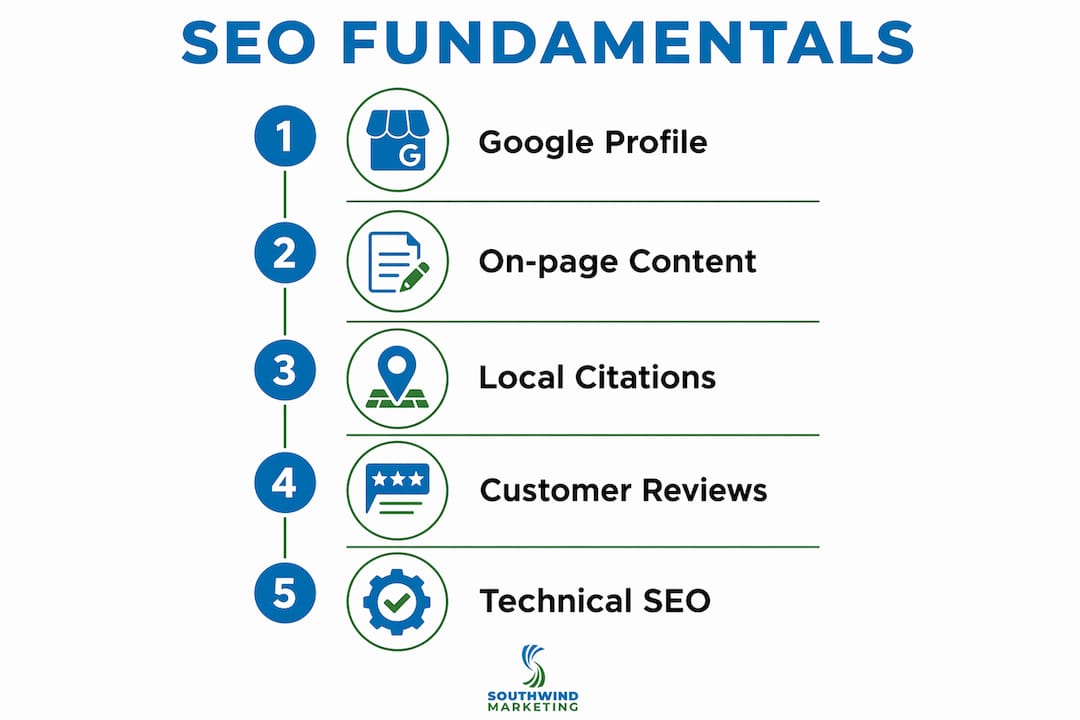
1. Google Business Profile Your GBP listing is often the first thing a local customer sees. A complete, accurate, and active profile influences your appearance in Google Maps and local search results. Fill in every field: primary category, services, service area, hours, and business description. Add photos regularly. Consistent NAP across your website, GBP, and every directory is non-negotiable.
2. On-page content Each page on your site should focus on one service or topic and answer the questions customers ask before they buy. A page titled "Roof Repair in [Your Town], [State]" with clear descriptions, a photo, and a call to action will outperform a generic homepage every time.
3. Local citations and reviews Citations are mentions of your business name, address, and phone number on directories like Yelp, the Better Business Bureau, and local chamber websites. Reviews on your GBP build trust and directly affect local ranking visibility. Aim for a steady stream of new reviews, not a one-time burst.
4. Site speed and mobile performance Most local searches happen on a phone. If your site loads slowly or breaks on mobile, you lose the customer before they read a single word. Google also uses page speed as a ranking factor.
Priority order by impact versus time invested:
- Google Business Profile setup and optimization: high impact, low time
- Fix mobile and speed issues: high impact, moderate time
- Publish one focused service page: high impact, moderate time
- Citation cleanup: medium impact, low time
- Review generation: high impact, ongoing
Pro Tip: Two things owners consistently miss: keeping NAP identical everywhere, including call tracking numbers that differ from the main business number, and adding fresh photos to GBP at least weekly. Both send trust signals to Google that your business is active and legitimate.
What does a 90-day starter plan actually look like?
A 90-day plan gives you a clear sequence so you are not guessing what to do next. Here is a month-by-month breakdown with estimated costs for DIY versus managed options.
Month 1: Audit, fix, and claim
- Run a basic site audit using Google Search Console and Google PageSpeed Insights.
- Fix critical technical issues: broken links, missing HTTPS, mobile failures.
- Claim and fully optimize your Google Business Profile.
- Map three priority keywords to your top three pages.
- Publish one focused service page targeting your most searched offering.
What progress looks like at 4 weeks: Your GBP is complete and verified. Search Console is set up and showing your current impressions. You have identified your top three keywords.
Month 2: Content and citations
- Publish two helpful content pieces, such as a FAQ page and a local service page.
- Run a citation cleanup: find and fix any inconsistent NAP listings across directories.
- Improve page speed based on Month 1 audit findings.
- Begin simple outreach for local mentions, such as a chamber directory listing or a local news feature.
What progress looks like at 8 weeks: GBP views and direction requests are trending up. You may see your first new keyword rankings in Search Console. Citation consistency is improving.
Month 3: Refine and measure
- Add FAQ schema markup to your most-visited pages.
- Review your KPIs and compare to your Month 1 baseline.
- Plan your content calendar for the next quarter.
- Begin a steady review request process.
What progress looks like at 12 weeks: Measurable increases in impressions and clicks. Local pack visibility for at least one or two target keywords. A clear picture of what is working and what needs adjustment.
| Week | Key Tasks | DIY Time Estimate | Managed Cost (Southwind Marketing) |
|---|---|---|---|
| 1–2 | Site audit, Search Console setup, GBP claim | 6–10 hours | Included at $150/mo |
| 3–4 | Fix technical issues, publish first service page | 4–8 hours | Included at $150/mo |
| 5–6 | Publish two content pieces, citation cleanup | 5–8 hours | Included at $150/mo |
| 7–8 | Page speed fixes, local outreach | 3–5 hours | Included at $150/mo |
| 9–10 | FAQ schema, review request system | 2–4 hours | Included at $150/mo |
| 11 | KPI review, Q2 content planning | 2–3 hours | Included at $150/mo |
Statistic to keep in mind: Local SEO improvements often appear in 2–3 months, while broader organic results typically take 3–6 months. Businesses that stop after two months rarely see the compound benefits of sustained SEO work.
If you are weighing whether to run paid ads alongside SEO during the early months, a side-by-side look at SEO versus paid advertising can help you decide how to allocate your budget.
How do you find the right keywords without spending a lot of money?
Keyword research does not require an expensive tool subscription. The best starting point is the questions your customers already ask you.
Step-by-step keyword research for small businesses
- Write down 10 customer questions. Think about what people ask before they hire you or buy from you. "How much does a fence cost in [town]?" or "Who does HVAC repair near [county]?" are real search queries.
- Use Google Autocomplete. Type your service plus your town name into Google and note the suggestions that appear. These are real searches people are running.
- Check Google Search Console. If your site is already verified, the Performance report shows the exact queries bringing people to your site today.
- Use Google Trends to compare two keyword options and see which has more consistent search interest in your region.
- Try a low-cost keyword tool. Tools like Ubersuggest or the free tier of Semrush can show monthly search volume and competition level for specific phrases.
- Map each keyword to a page. One keyword per page. Do not try to rank one page for ten different services.
Keyword-to-page mapping example
Here is a simple mapping for a hypothetical rural landscaping company in southwest Kansas:
- "Lawn care Dodge City KS" maps to the main lawn care service page.
- "Sprinkler installation Garden City Kansas" maps to a dedicated sprinkler service page.
- "How much does landscaping cost in Kansas" maps to a pricing or FAQ page.
- "Best time to overseed lawn in Kansas" maps to a seasonal blog post.
Keyword types to target first:
- Local service keywords: "[service] in [town or county]"
- Near-me variants: "[service] near me" with your location set correctly in GBP
- Question keywords: "how to," "how much does," "best [service] for"
- Comparison keywords: "[service A] vs [service B]" for buyers still deciding
For rural B2B businesses, niche keyword strategies that target county-level or industry-specific searches can produce strong results with low competition. Rural industrial and manufacturing businesses often find that highly specific terms convert better than broad ones.
What content should a small business publish to rank and convert?
Content is where most small businesses either win or waste time. The key is quality over volume. An 80/20 rule applies: a small number of well-optimized, high-value pages drive most of the traffic. One strong page published every 2–4 weeks beats five thin pages published in a rush.
Page templates that work for small businesses
Service page: One page per service, focused on a single keyword. Include a clear description, who you serve, your service area, a photo, and a call to action. This is your highest-priority content type.
Local landing page: A page targeting a specific town or county you serve. "Plumbing Services in [Town], Oklahoma" with locally relevant details, not just a city name swapped into a generic template.
FAQ page: Answer the five to ten questions customers ask most. Use natural language. This page often ranks for long-tail question searches and builds trust before a customer calls.
Pricing or "how much does it cost" page: Many owners avoid this, but a starting-price page earns trust and filters out poor-fit leads. Even a range is better than silence.
Publish cadence
One high-quality piece every 2–4 weeks is a realistic and effective schedule for most small businesses. Combining local SEO with targeted blog content produces early wins and medium-term compounding. Do not publish thin content just to hit a frequency target.
Content ideas for rural small businesses:
- Project photo galleries with location and service details in the caption and page copy
- Seasonal service pages, such as "Winterizing Your Irrigation System in [County]"
- Local event tie-ins, such as a post about sponsoring the county fair
- "Before and after" pages for trades and home services
- Community spotlights that build goodwill and earn local links
On-page checklist before you publish
- Page title includes the primary keyword and your location.
- Meta description is written and under 160 characters.
- One H1 heading that matches the page topic.
- At least one photo with a descriptive file name and alt text.
- Your business name, address, and phone number appear on the page.
- A clear call to action: call, contact form, or booking link.
- Internal link to at least one related page on your site.
Pro Tip: Your website is the source of truth for AI search tools. Keeping your content accurate and locally specific improves your odds of being recommended by ChatGPT and Perplexity when someone asks for a local service provider.
For rural businesses looking to connect SEO with social media and email, the real role of social media for small business growth covers how these channels reinforce each other.
How do you set up and optimize your Google Business Profile for local search?
Your Google Business Profile is the single fastest way to improve local visibility. Here is how to do it right.
Step-by-step GBP setup
- Go to business.google.com and sign in with a Google account you control.
- Search for your business name. If a listing exists, claim it. If not, create a new one.
- Complete the verification process. Google typically mails a postcard with a code to your business address.
- Fill in every available field: business name, primary category, service area, hours, phone number, website URL, and business description.
- Add your services with descriptions and, where possible, starting prices.
- Upload at least five photos: storefront, interior or workspace, team, and completed work.
- Set up the Q&A section with answers to your most common questions.
Fields to prioritize
- Primary category: Choose the most specific category that matches your core service. A general contractor should not select "Construction Company" when "General Contractor" is available.
- Service area: List the towns and counties you actually serve, not every city within 100 miles.
- Business description: Write 2–3 sentences explaining what you do, who you serve, and what makes you worth calling. Include your main service and location naturally.
- Photos: Adding fresh photos regularly is a strong freshness signal. Aim for two to three new photos per week if possible.
Review request template
Send this by text or email within 24 hours of completing a job. Respond to every review you receive, positive or negative. A short, genuine response signals to Google that your business is active and engaged.
Citation checklist for rural businesses
- Google Business Profile
- Yelp
- Better Business Bureau
- Your local chamber of commerce directory
- Facebook business page
- Apple Maps
- Bing Places
- Industry-specific directories relevant to your trade
For a deeper walkthrough of GBP optimization tailored to rural businesses, this step-by-step GBP guide covers every field and common mistakes to avoid. You can also find additional tips for optimizing business profiles from a partner resource that covers review systems and profile completeness.
What technical SEO issues should a small business fix first?
Technical SEO sounds intimidating, but for most small sites the list of critical fixes is short. You do not need a developer for all of it.
Critical fixes to address first:
- Mobile responsiveness: Your site must display correctly on a phone. Test it at search.google.com/test/mobile-friendly.
- Page speed: Run your site through Google PageSpeed Insights. A score below 50 on mobile needs attention. Common culprits are large image files and slow hosting.
- HTTPS: Your site URL should begin with "https://" not "http://". If it does not, your host can usually enable an SSL certificate at no cost.
- Robots.txt and noindex errors: Check that you have not accidentally blocked Google from crawling your pages. Search Console will flag this.
- Broken links: Use a free tool like Screaming Frog's free tier or Google Search Console's Coverage report to find and fix 404 errors.
- NAP consistency: Your business name, address, and phone number must be identical on your website, GBP, and every directory. Call tracking numbers that differ from your main number can break this consistency and hurt local trust signals.
Testing tools for small business owners
| Tool | What it checks | Cost |
|---|---|---|
| Google PageSpeed Insights | Page load speed, mobile performance | Free |
| Google Search Console | Crawl errors, index coverage, search queries | Free |
| Mobile-Friendly Test | Mobile display issues | Free |
| Screaming Frog SEO Spider | Broken links, missing tags, redirects | Free up to 500 URLs |
| Google Trends | Keyword interest over time | Free |
Developer brief template
If you need to hire a freelancer for technical fixes, copy and adapt this brief:
"Please review our website for the following issues and provide a quote to fix each: (1) mobile display problems identified in Google's Mobile-Friendly Test, (2) page speed issues flagged in PageSpeed Insights, specifically [list the specific issues], (3) any broken links found in Search Console, (4) missing or incorrect HTTPS setup. Please do not change any content or design without approval."
For a broader site audit checklist covering speed, mobile, and content issues, this small business website audit guide walks through each check step by step. Rural website design best practices also covers performance considerations specific to small-town sites.
How do you measure SEO progress and set realistic expectations?
The biggest mistake small business owners make is checking rankings after two weeks and concluding that SEO does not work. Progress is real, but it follows a predictable curve.
KPIs to track monthly:
- Google Business Profile views and customer actions (calls, direction requests, website clicks)
- Google Search Console impressions and clicks
- Organic website sessions in Google Analytics
- Form submissions and phone calls from organic traffic
- Review count and average rating
What to expect at each milestone
| Milestone | Typical signals of progress |
|---|---|
| 30 days | GBP verified and active, Search Console data flowing, baseline metrics established |
| 90 days | GBP views increasing, first new keyword rankings appearing, citation cleanup complete |
| 3–6 months | Measurable organic traffic growth, consistent lead generation beginning, content compounding |
Leading indicators that show the campaign is working before revenue appears:
- Impressions in Search Console are climbing even if clicks are still low.
- GBP direction requests and phone calls are increasing week over week.
- You are ranking on page two or three for target keywords, which means page one is within reach.
- New reviews are coming in at a steady pace.
Businesses that stop SEO after a couple of months are the ones who never see the compound benefits. If budget is tight in the early months, running a small paid search campaign alongside your SEO work can bridge the gap while organic rankings build.
A simple monthly report template: pull your Search Console impressions and clicks, your GBP customer actions, your organic sessions from Analytics, and your review count. Compare each to the prior month. Look for direction, not perfection.
How do you choose an honest SEO provider and avoid getting burned?
If you have been promised first-page rankings by an agency that then disappeared, you are not alone. Here is how to evaluate providers before you sign anything.
Interview questions to ask every provider
- What specific deliverables will I receive each month?
- How do you report progress and how often?
- What does your keyword research process look like?
- Can you show me examples of work you have done for businesses similar to mine?
- What is your contract length and cancellation policy?
- How do you handle technical issues on my site?
- What does success look like at 90 days and at 6 months?
Red flags to walk away from
- Guaranteed first-page rankings. No one can guarantee a specific ranking. Google's algorithm is not for sale.
- Refusal to explain the process. Real SEO is transparent work focused on sustainable visibility. If a provider will not tell you what they are doing, that is a problem.
- Long lock-in contracts with no performance benchmarks. A month-to-month or short-term agreement with clear deliverables is the standard you should expect.
- Vague deliverables. "We will improve your SEO" is not a deliverable. A list of specific tasks, content pieces, and reports is.
- Promises of overnight results. Anyone claiming you will see major results in two to four weeks is either misleading you or planning to use tactics that will hurt you later.
Pricing examples and what to expect
| Budget Level | Typical Deliverables | Monthly Cost Range |
|---|---|---|
| DIY | Your own time, free tools only | — |
| Entry-level managed | GBP optimization, citation cleanup, one content piece per month, monthly report | $150–$500/mo |
| Mid-level managed | All of the above plus technical fixes, two to three content pieces, link outreach | $500/mo |
| Full-service | Strategy, content, technical, reporting, paid integration | $1,500/mo |
For a rural or small-town business, an entry-level managed plan that covers the fundamentals consistently will outperform a more expensive plan that is not tailored to your market.
Why does rural expertise matter, and how does Southwind Marketing help?
Rural SEO is not the same as metro SEO. Search volumes are lower, the geographic terms are different, and the competitive landscape is shaped by county-level searches, community calendars, and local directories that a national agency may never think to check. A business in a small Oklahoma town needs to rank for searches that include county names, nearby towns, and regional identifiers, not just the city it is located in.
Southwind Marketing was built specifically for rural communities, small cities, and the organizations that serve them. The agency's work spans Oklahoma, Kansas, Texas, Iowa, Missouri, and Arkansas, covering the kinds of markets where a well-executed local SEO strategy can produce outsized results because the competition is thin and the community trust signals are strong.
Managed SEO at Southwind Marketing starts at $150 per month. At the entry level, that includes Google Business Profile optimization, citation cleanup, on-page content support, and monthly reporting. Packages scale as your needs grow, and there are no long-term contracts that lock you in before you see results.
What Southwind Marketing brings to a rural small business:
- Deep familiarity with county-level and small-town search patterns
- Website design and SEO built together, so your site and your rankings support each other
- AI search optimization alongside traditional SEO, so your business shows up in ChatGPT and Perplexity recommendations as well as Google
- Transparent reporting with no jargon and no hidden deliverables
For businesses that also need a website before SEO can do its job, Southwind Marketing's rural small business marketing services cover both. The digital marketing strategies for rural businesses blog post is also worth reading for context on how SEO fits into a broader rural marketing approach.
Key Takeaways
A consistent, fundamentals-first small business SEO strategy built around Google Business Profile, on-page content, citation hygiene, and site speed will produce measurable local results in 2–3 months and broader organic growth in 3–6 months for most small businesses.
| Point | Details |
|---|---|
| Start with three actions | Optimize your GBP, fix site speed and mobile issues, and publish one focused service page this week. |
| Expect results in 3–6 months | Local improvements often appear in 2–3 months; broader organic growth takes 3–6 months with consistent effort. |
| Avoid ranking guarantees | No provider can guarantee first-page rankings; choose one that explains its process and reports transparently. |
| Budget-friendly managed SEO exists | Southwind Marketing offers managed SEO starting at $150 per month with no long-term contracts. |
| Measure the right signals | Track GBP actions, Search Console impressions, and review growth monthly before expecting revenue results. |
The part most owners get wrong
Most small business owners who struggle with SEO are not making technical mistakes. They are making a timing mistake. They invest for six weeks, see no dramatic change, and stop. Then they tell everyone SEO does not work for small towns.
What they missed is that the work they did in those six weeks was still compounding. A citation cleanup completed in Month 1 keeps paying off in Month 9. A service page published in Month 2 may not rank until Month 5, but when it does, it brings in leads without any additional spend. The owners who see real results are the ones who treat SEO the way they treat their business reputation: something you build steadily, not something you buy once.
The other mistake is chasing tactics before the fundamentals are solid. Owners ask about AI search optimization, schema markup, and link building before their GBP is even fully filled out. Get the foundation right first. A complete, accurate, active Google Business Profile with consistent NAP and a handful of honest reviews will outperform a technically sophisticated campaign built on a shaky foundation.
Rural businesses have a real advantage here. The competition is thinner, the community trust signals are stronger, and a business that shows up consistently in local search becomes the default choice in a market where most competitors are not even trying.
Southwind Marketing works with small budgets and no long contracts
Small-town businesses deserve the same quality of SEO work that metro agencies charge three times as much to deliver. Southwind Marketing's entry-level managed SEO at $150 per month covers the fundamentals that actually move the needle: Google Business Profile optimization, citation cleanup, on-page content support, and monthly reporting with plain-language explanations of what is working and what is next.
There are no long-term contracts. If the work is not producing results, you should be free to walk away. Southwind Marketing works month to month because the goal is to earn your continued business, not lock you into it. Packages scale as your needs grow, from entry-level local SEO to full-service campaigns that include website design, content production, and AI search optimization.
If your site needs a rebuild before SEO can do its job, Southwind Marketing's website design services are built for rural businesses and organizations that need a fast, mobile-ready site without a metro agency price tag.
To get started, visit southwindmarketing.com or reach out directly to schedule a 30-minute conversation about your business, your market, and what a realistic SEO plan looks like for your budget.
Useful sources and next steps
The tools and guides below are the ones worth bookmarking for ongoing DIY work.
| Resource | What it covers |
|---|---|
| Google Search Central SEO Starter Guide | Google's own guidance on technical setup, content quality, and structured data |
| Google Search Console | Free tool for tracking impressions, clicks, crawl errors, and keyword queries |
| Google PageSpeed Insights | Free page speed and mobile performance testing |
| Google Business Profile Manager | Claim, verify, and manage your GBP listing |
| SBDC Net SEO for Small Business | Small Business Development Center overview of SEO fundamentals |
| U.S. Chamber of Commerce SEO Guide | Accessible guide to SEO basics for business owners |
Free and low-cost audit tools:
- Google Search Console: crawl errors, index coverage, query data
- Google PageSpeed Insights: speed and mobile scores
- Screaming Frog SEO Spider: free up to 500 URLs for broken links and missing tags
- Google Trends: keyword interest by region and time period
- Ubersuggest: keyword volume and competition at low cost
Your next step: Claim or review your Google Business Profile today. It takes less than an hour to complete every field, and it is the single highest-return action available to a small business owner starting an SEO effort.
FAQ
How long does small business SEO take to show results?
Most small businesses see measurable local improvements in two to three months and broader organic results in three to six months, with consistent lead generation building with ongoing optimization over time.
What is the most important first step in a small business SEO strategy?
Claim and fully optimize your Google Business Profile. It is the fastest way to improve local search visibility and requires no technical skills or budget.
How much should a small business spend on SEO?
Entry-level managed SEO plans typically have modest monthly fees for core fundamentals. Southwind Marketing offers plans starting at an affordable monthly rate without long-term contracts.
What are the red flags when hiring an SEO agency?
Walk away from any provider that guarantees first-page rankings, refuses to explain their process, or requires a long lock-in contract without clear deliverables. Transparent, sustainable SEO does not come with ranking guarantees.
Does SEO work for rural and small-town businesses?
Yes, often better than in metro markets. Rural businesses typically face less competition in local search, which means a well-optimized GBP and a few focused service pages can produce top local rankings faster than most owners expect.