
Start here: assemble a small local crisis team, name one visible spokesperson with a trained backup, and activate a mass-notification channel with a holding statement within the hour. That sequence, done in order, prevents the two failures that sink most rural responses: silence in the first hour and mixed messages after it.
Rural crisis communications work differently than urban crisis management because the tools are different, the trust networks are tighter, and the margin for error is smaller. You likely don't have a 24-hour newsroom covering your county, and you may not have reliable cell coverage past the edge of town. What you do have is a community that already knows who to trust. Use that.
Your first 24 hours, step by step:
- Hour 1: Call your two or three crisis team members. Confirm who is the spokesperson today and who is backup.
- Hour 1: Push a holding statement through every owned channel at once (SMS/voice blast, Facebook page, website banner).
- Hours 1-3: Station someone at the physical command post (fire hall, extension office, city hall) for walk-ins and callers.
- Hours 3-6: Issue a first real update once you have one verified fact beyond the holding statement.
- Hours 6-24: Move to a fixed update cadence (every 2-4 hours) and stick to it even if the update is "no change."
Here's a holding statement you can adapt and read on air or post within minutes:
"We are aware of [incident] affecting [location/area]. Emergency responders are on scene. Our priority right now is [safety of residents/livestock/etc.]. We will share verified updates every [X] hours at [channel/phone number]. Please avoid the area and do not call 911 for non-emergency information."
Pro Tip: In most rural counties, the most credible messenger isn't the mayor or the company PR contact. It's the extension agent, the volunteer fire chief, or a longtime county commissioner residents have known for twenty years. Identify that person before a crisis hits and get them trained as your visible spokesperson or backup, not held in reserve.
Key Takeaways
A rural crisis communications plan works when a small, trained team activates owned notification channels and a trusted local spokesperson within the first hour and holds a consistent update cadence afterward.
| Point | Details |
|---|---|
| Act within the first hour | Assemble your crisis team, confirm the spokesperson, and push a holding statement through owned channels immediately. |
| Build redundancy, not just digital tools | Pair mass notification with local radio, physical command posts, and low-tech backups for outages. |
| Use the rule of three | Draft three key messages with three supporting points for each of your top five likely scenarios. |
| Practice quarterly | Run short tabletop exercises, including at least one that simulates a total connectivity outage. |
| Measure and revise | Track contact-list completeness, delivery rates, and behavioral outcomes, then update the plan after every incident. |
| Southwind Marketing supports execution | Southwind Connect℠, Civic Intelligence℠, Southwind Guardian℠, Southwind Signal℠, and Southwind Cloud℠ operationalize this plan for rural clients through a fixed-fee pilot. |
Table of Contents
- Why Rural and Agricultural Communities Need a Different Playbook
- Building the Four-Step Crisis Communications Process
- Which Channels Actually Reach People During a Rural Crisis?
- Ready-to-Use Templates for Common Rural Crises
- Running Tabletop Exercises That Actually Build Readiness
- After-Action Review: What to Measure and What to Fix
- Common Pitfalls That Undermine Rural Crisis Response
- How Southwind Marketing Puts This Plan into Practice
- A Practitioner's Note on Plans That Actually Get Used
- How Southwind Marketing Can Help You Get Ready
- Authoritative Resources for Building Your Plan
- Sources
- FAQ
Why Rural and Agricultural Communities Need a Different Playbook
Standard crisis communication guidance assumes a media market that doesn't exist in most rural counties. There's no assignment editor to call, no cable news truck showing up, and often no local paper left to call at all. Rural crisis communications has to be built for that absence, not despite it.
Three structural facts change the design of a rural plan. First, broadband and cell coverage remain unreliable across large stretches of agricultural land, which means digital-first plans fail exactly when they're needed most. Local reporting on rural Texas disasters found that weak infrastructure and distrust of distant institutions routinely slow the delivery of life-saving information, while county-led text alert systems built trust and grew subscriptions after repeated events. Second, local media has consolidated or disappeared in many counties, leaving no independent outlet to verify or amplify your message. Third, rural residents lean harder on personal networks than on institutional ones. A message from a distant state agency lands differently than the same message delivered by a neighbor.
That trust asymmetry is the single biggest design constraint. As local newspapers and radio stations close or get absorbed by regional groups, communities that don't build their own resident contact networks lose their direct line to residents entirely. Agricultural communicators who worked through Great Plains wildfires between 2016 and 2018 found the same pattern from the other direction: social media mattered, but people-first messaging delivered by trained, familiar spokespeople mattered more, especially once donation and volunteer offers started flooding in.
Practically, this means your plan needs:
- Redundant channels that don't depend on a single tower or ISP
- A physical command post where people can show up in person
- Pre-identified trusted messengers, not just official titles
- A donations and volunteer-management protocol built before you need it
Pro Tip: Before you write a single message template, run a short Civic Intelligence℠ pulse survey asking residents who they'd trust for emergency information: elected officials, extension staff, clergy, or specific named individuals. The results usually surprise leadership, and they should reshape who your spokesperson actually is.
Building the Four-Step Crisis Communications Process
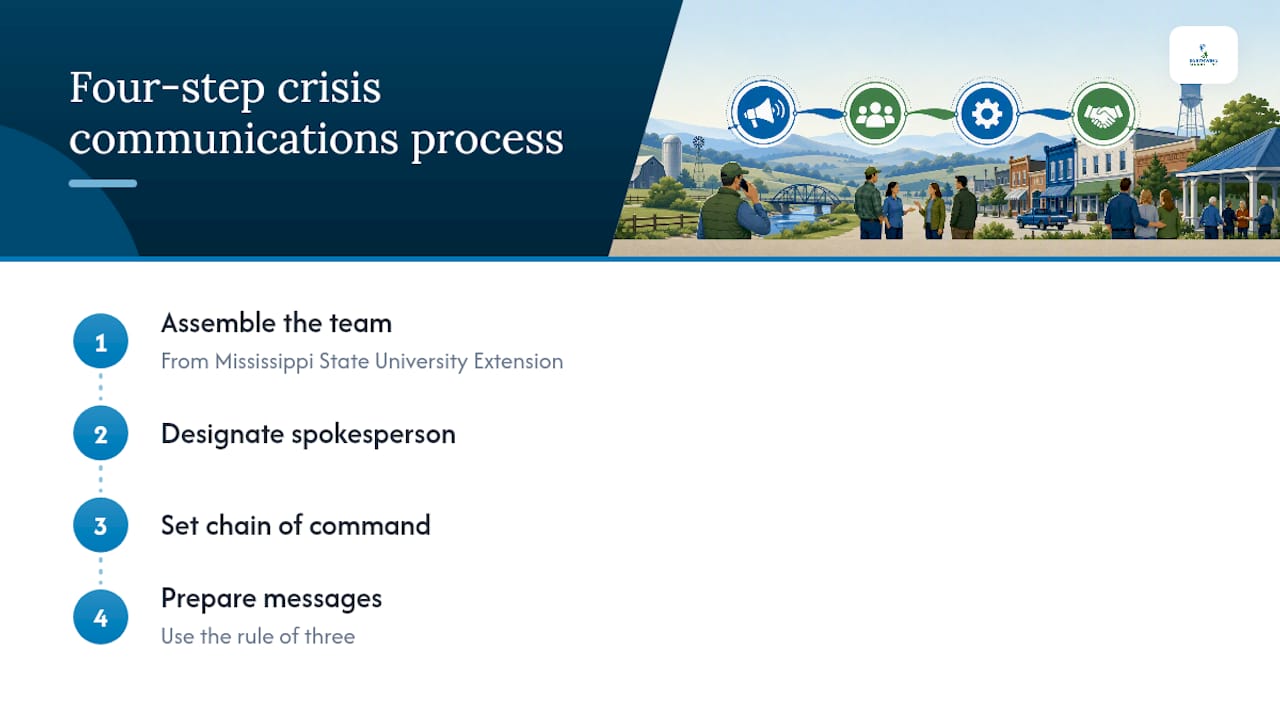
A workable rural crisis communications plan rests on four steps: assemble the team, designate the spokesperson, set the chain of command, and prepare messages using the rule of three. This structure comes from Mississippi State University Extension's crisis communication framework, and it holds up because it's simple enough for a volunteer fire chief to run without a communications degree.
Step 1: Assemble a compact crisis team
Rural teams work better small. Five to seven people, each with a clear function, beats a twenty-person committee that can't move fast.
- Local leader (mayor, county judge, board chair) who authorizes public statements
- Extension representative or ag expert who can answer technical questions on livestock, crops, or chemical exposure
- Public-safety liaison (fire, sheriff, EMS) who confirms facts before they go out
- Communications lead who drafts, posts, and tracks messages across channels
- Backup contact for every one of the above roles, listed by name and phone number
Every person on this list needs a second person who can step in if they're unreachable, on scene, or dealing with their own property. Oklahoma State University Extension's guidance on crisis planning is blunt about this: build the plan so anyone in the organization can pick it up and use it, not just the person who wrote it.
Step 2: Designate a spokesperson and a trained backup
Pick one person to be the public face of the response and one trained backup who can step in without a gap in continuity. This isn't about hierarchy. It's about consistency. Residents need to see the same face and hear the same voice across updates, because switching spokespeople mid-crisis reads as instability even when nothing else has changed.
Write a two-sentence bio for each: name, role, and why they're credible on this topic. Post both bios on your website and social channels before you need them, so the first time residents see this person's name isn't during a chemical spill.
Step 3: Set a lean chain of command
Decide, in writing, before anything happens:
- Who approves the holding statement (should take under 15 minutes)
- Who approves subsequent updates (can be the communications lead alone, with the local leader on notice)
- What triggers an escalation to state or federal agencies
- What triggers a shift from routine updates to an emergency operations posture
Rural teams often stall here because everyone assumes someone else has authority to speak. Write the name, not the title, next to each decision point.
Step 4: Prepare messages with the rule of three
For each likely scenario, draft three key messages, each backed by three supporting points. This isn't busywork. It's what keeps your spokesperson from freezing or rambling on camera or on the phone with a reporter.
A tornado-damage message map might look like this:
- Message 1: Residents are safe to return to [area] as of [time].
- Supporting point: Utility crews cleared downed lines at [location].
- Supporting point: Road crews reopened [route] as of [time].
- Supporting point: A shelter remains open at [location] for anyone displaced.
- Message 2: Livestock and property assistance is available.
- Supporting point: Extension office is coordinating fencing material donations.
- Supporting point: Veterinary triage is set up at [location].
- Supporting point: Insurance adjusters can be reached at [number].
- Message 3: Updates will continue on a fixed schedule.
- Supporting point: Next update at [time] via [channel].
- Supporting point: Non-emergency questions go to [number], not 911.
- Supporting point: Official information only comes from [named channels], not rumor.
Build this same structure for your top five likely scenarios: farm injury involving equipment or confined spaces, suspected animal disease, chemical or fuel spill, wildfire or tornado, and infrastructure failure (water, power, or road).
Contact list and stakeholder map to keep current:
- Neighboring farms and ranches within a five-mile radius
- Local veterinarian and large-animal emergency contact
- Feed and fuel suppliers
- County extension office
- Fire, EMS, and sheriff non-emergency lines
- Any remaining local newspaper, radio station, or regional TV assignment desk
- Faith leaders and community organization heads
Print this list. Laminate it if you have to. Don't rely on a phone that might not have signal.
Pro Tip: Pre-write and get legal sign-off on message snippets for high-liability scenarios like suspected animal disease outbreaks or chemical incidents before you ever need them. Waiting until the incident to get legal review adds hours you don't have, and vague statements about animal health can trigger regulatory reporting obligations you don't want to discover mid-crisis.
Which Channels Actually Reach People During a Rural Crisis?
Channel choice in a rural crisis follows a hierarchy: owned direct-notify systems first, trusted local voices second, physical presence third, and digital/social fourth, with low-tech backups ready for when everything else fails. Rural North Eastern Ontario research on remote community crisis response found that traditional local media and direct human interaction remain more effective than digital-first approaches when power or connectivity fails, which is exactly when a crisis is most likely to strip out your internet and cell service.
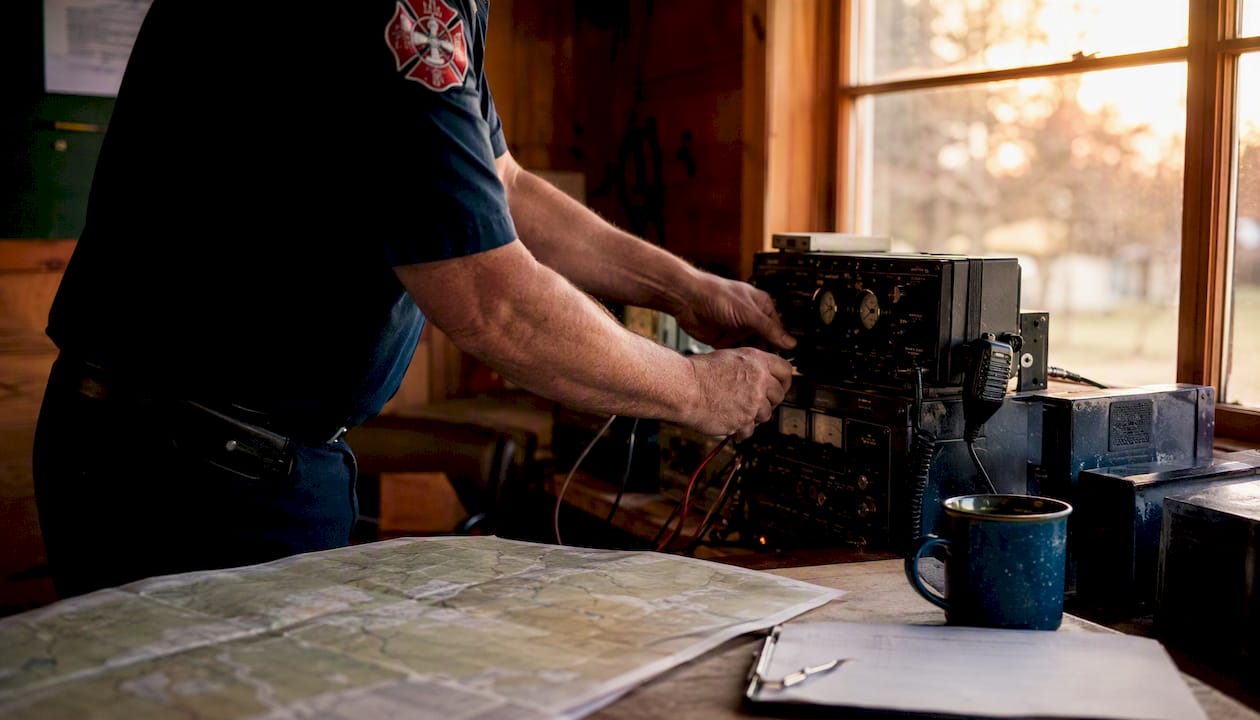
Owned channels, activate first: SMS, email, and voice blasts through a mass-notification system like Southwind Connect℠ reach residents directly, without depending on a third party's algorithm or a reporter picking up your call. Because local media consolidation has hollowed out coverage in many counties, an owned contact list is often the only guaranteed line you have to residents, and it should be centralized and maintained year round, not built from scratch during an emergency.
Local trusted channels, layer in immediately: Extension office announcements, chapter or association leaders, and whatever local radio remains. These voices carry weight your official statement alone won't.
On-the-ground channels, for the hardest-to-reach: A staffed command post at the fire hall or extension building. Door-to-door checks for elderly or disconnected residents. Notices posted at the feed store, the co-op, and the church.
Digital and social, useful but not sufficient alone: Facebook community groups and your website carry updates well for residents with connectivity, and they matter for reach beyond the county too. Just don't build your entire plan around them.
Backup tech, for when infrastructure fails: Satellite phones for command staff, landline call trees for households without reliable cell service, and physical runners for the most remote farms. Disaster communication research consistently points back to low-tech redundancy as the difference-maker when digital infrastructure goes down.
Different scenarios call for different first moves. A wildfire needs an immediate mass-notify blast plus local radio, because speed matters more than nuance. A suspected animal disease outbreak needs extension and veterinary channels first, because the wrong public framing can trigger unnecessary panic or regulatory scrutiny before facts are confirmed. An infrastructure failure (water contamination, prolonged power outage) needs the command post staffed early, since residents will show up in person asking questions no hotline can answer fast enough.
Set update expectations up front and hold them:
- First update within 30-60 minutes, even if it's just the holding statement
- Hourly updates for the first 6-12 hours of an active incident
- Daily updates once the situation stabilizes
- Clear labeling of each update as either "action needed" or "information only," so residents don't tune out
A local text-alert system costs far less than most leaders assume, and pairing an SMS or voice blast with a short local radio spot on the remaining regional stations covers the two channels with the best reach-per-dollar in most counties. Centralizing that contact list in one CRM, rather than scattered spreadsheets across three departments, is what keeps the system usable when someone other than its original builder has to run it.
Pro Tip: Never let automated notification stand alone. Pair every mass-notify blast with a same-hour call or in-person visit from a trusted local figure, extension agent, county judge, or farm association leader. That pairing is what actually moves people to act, not just read.
Ready-to-Use Templates for Common Rural Crises
Having a template ready beats writing from scratch under pressure, and every message below is built to be copied, filled in, and sent within minutes.
Holding statement (any incident):
"We are responding to [incident] near [location]. Emergency personnel are on scene as of [time]. Our focus is [safety priority]. Verified updates will be posted every [interval] at [channel]. Please avoid [affected area] and direct non-emergency questions to [number]."
60-second local radio script:
"This is [name] with an update for [county/community]. As of [time], [brief factual summary of what happened]. [Agency/department] is on scene and [current status]. If you are in [affected area], [specific instruction]. For the latest information, visit [website] or call [number]. We'll have another update at [time]."
SMS template for mass-notify (Southwind Connect℠ or similar):
"[COUNTY] ALERT: [Incident] near [location] as of [time]. [One-line instruction]. Updates at [link]. Non-emergency questions: [number]."
Three update templates:
- First update: "As of [time], [what happened] near [location]. [Agency] is responding. No further action needed from residents at this time / residents in [area] should [action]."
- Situation update: "[Time]: [Progress since last update]. [Current status of affected area/infrastructure]. Next update at [time]."
- Recovery/assistance update: "As of [time], [recovery status]. Assistance is available at [location] for [type of help]. Donations can be dropped at [location]; monetary donations should go through [verified fund]."
Social post version (Facebook/Nextdoor-style):
"Update on [incident]: [2-3 sentence summary]. Current status: [status]. If you need help or have information to report, contact [number/link]. We'll keep this post updated as things change."
FAQ snippets for common rural crisis topics:
- Livestock safety: "Move animals to [designated safe area] if instructed. Veterinary triage is available at [location]. Do not attempt to move injured large animals without assistance."
- Road closures: "[Road name] is closed between [points] due to [reason]. Use [alternate route]. Closure will be reassessed at [time]."
- Donations: "We are accepting [specific needed items] at [location] between [hours]. Monetary donations should go through [verified fund name] only. Please do not send items not on this list."
A downloadable version of this checklist, formatted for printing and posting at your command post, should be built into your plan alongside your farm-specific incident templates, which extension resources for agritourism operations and food and farm operations can help you adapt for chemical storage, animal health, or food-safety incidents specific to your operation.
Pro Tip: Pre-approve a small bank of neutral, non-graphic images (a command post, a road sign, a general landscape shot) for use with updates. Never post images of injured people, animals, or damaged private property without direct consent. In a small county, everyone will recognize whose barn or whose truck is in that photo.
Running Tabletop Exercises That Actually Build Readiness
A plan nobody has practiced fails on contact. Run a tabletop exercise quarterly and a full field drill annually, and invite the people who'll actually be in the room during a real event: local officials, extension staff, the county vet, key suppliers, and whatever media contacts remain.
- Set objectives. Pick one or two things to test each session (spokesperson readiness, contact list accuracy, decision-making speed) rather than trying to test everything at once.
- Choose a scenario. Rotate through your top five: farm injury, animal disease, chemical spill, wildfire/tornado, infrastructure failure.
- Build injects. Add complications mid-exercise (a phone line goes down, a rumor starts circulating, a reporter calls) to test adaptability, not just the script.
- Assign roles. Everyone plays their real crisis-team role, including backups, so gaps show up before a real event does.
- Debrief immediately. Ask what worked, what stalled, and what contact information was wrong or outdated.
- Document and revise. Update the plan's date, fix contact errors, and note any message that didn't land well.
Pro Tip: Run at least one exercise a year that assumes broadband and cell service are both down. Force the team to rely on runners, landline call trees, and the physical command post. This is the scenario most plans skip, and it's the one most likely to happen during an actual rural disaster.
After-Action Review: What to Measure and What to Fix
A crisis communications plan improves only if you measure it, and rural teams should track a defined set of metrics before, during, and after every real incident or major drill.
Before an incident: contact list completeness (percentage of stakeholders with current phone/email), notification deliverability (test blast confirms actual receipt), and baseline community trust, which a Civic Intelligence℠ survey can establish so you have something to compare against post-crisis.
During an incident: a timeline log of every message sent and when, delivery confirmation rates, volume and nature of inbound questions, and any misinformation reports that need correcting in real time.
After an incident: reach (how many residents received and opened the alert), behavioral outcomes (did people evacuate or shelter as instructed), donation and volunteer tracking, and a read on media or social tone in the aftermath.
| Phase | What to collect | Why it matters |
|---|---|---|
| Before | Contact list completeness, deliverability test results, baseline trust score | Establishes whether the system will work before you need it |
| During | Timeline log, delivery rates, inbound question volume, misinformation reports | Shows where the plan held and where it broke in real time |
| After | Reach percentage, behavioral compliance, donation tracking, tone analysis | Tells you whether the message actually changed behavior |
Fold every finding back into the plan itself. A simple remediation tracker with four fields (what changed, who owns the fix, deadline, and confirmation it happened) keeps lessons from evaporating once the crisis passes.
Common Pitfalls That Undermine Rural Crisis Response
Most rural crisis communication failures trace back to the same handful of mistakes, and every one of them is preventable with a plan you've actually rehearsed.
- Mixed messages: Two officials give conflicting information because the chain of command wasn't clear. Fix: one approver, named in advance, for every update.
- Slow updates: Silence for hours breeds rumors. Fix: commit to a cadence and hit it even when there's nothing new to say.
- Over-reliance on one channel: A social-only strategy misses residents without reliable connectivity. Fix: always pair digital with a local voice or physical posting.
- Ignoring local leaders: Official statements without a trusted local face fall flat. Fix: get your named spokesperson trained and visible before a crisis, not during one.
- Mishandling donations: Unmanaged donation drives create logistical chaos and legal exposure. Fix: assign one person to donation management with paperwork ready ahead of any solicitation.
- Publishing graphic images: Posting injury or property-damage photos without consent damages trust fast in a small community.
Red flags that signal escalation: rumors spreading faster than your updates, a sudden spike in inbound calls your team can't handle, or reports that a state agency's statement contradicts yours. Assign one person to monitor for misinformation full time during an active incident, and pre-authorize that person to issue quick fact-check corrections without waiting for full committee approval.
Pro Tip: Have your donation acceptance paperwork, including any required charitable-solicitation forms, ready before you announce you're accepting donations. Counties get caught flat-footed here constantly, and it turns a goodwill gesture into a compliance headache.
How Southwind Marketing Puts This Plan into Practice
Consider how this looks in a real wildfire scenario. A county emergency manager gets the first report of a fast-moving grass fire threatening farms on the county's western edge. Within minutes, an alert triggers a Southwind Connect℠ mass-notification blast to every resident on the county's contact list. The pre-trained spokesperson, in this case the county's volunteer fire chief, records a same-hour audio update for local radio and social channels. The county's website, hosted and maintained through Southwind Guardian℠, updates automatically with the latest information so it never goes stale mid-crisis. A physical command post opens at the extension office for residents without reliable cell service.
That workflow, alert triggers Southwind Connect℠, spokesperson briefing, web and social update, command-post activation, is the backbone of what Southwind Marketing builds for rural clients preparing crisis readiness plans.
If you're evaluating a pilot, ask for:
- An initial audit of your current contact list completeness and channel gaps
- A Civic Intelligence℠ baseline survey of resident trust and preferred information sources
- A 30-60 day timeline covering contact-list ingestion, one tabletop exercise, and message-template drafting
- Clarity on what Southwind provides (the technology, the CRM, the hosting, the content workflow) versus what your community must own (your named spokesperson, your local relationships, your data)
Southwind Cloud℠ keeps your team's Microsoft 365 environment and IT support running so a crisis doesn't also become a technology outage, and Southwind Signal℠ keeps your public information pages current between crises so residents already trust the source when an update posts.
Rural crisis readiness isn't about buying more software. It's about making sure the software you have actually reaches the people who need it, delivered by someone they already trust.
Pro Tip: Ask any vendor, including Southwind, exactly who owns your resident contact data once the engagement ends. You should always retain full ownership and export rights to your own list.
A Practitioner's Note on Plans That Actually Get Used
I've watched more rural crisis plans fail from disuse than from bad design. A binder that sits in a drawer for three years doesn't help anyone at 2 a.m. when a chemical tanker rolls on the county road. What works is the plan a volunteer fire chief has actually run through twice, even in a stripped-down thirty-minute tabletop over coffee at the extension office.
The plans that hold up under real pressure are almost always the simplest ones: a short contact list, one clear spokesperson, and three messages everyone on the team could recite from memory. Perfect plans that live in a shared drive nobody opens lose every time to rough plans that got practiced.
Run your 24-hour checklist this week, even as a drill. Put a tabletop exercise on the calendar for the next 90 days and actually hold it. If you want help building the templates or piloting a mass-notification setup, that's a conversation worth having before the next storm, not during it.
How Southwind Marketing Can Help You Get Ready
Southwind Marketing is the alternative to building crisis readiness piecemeal with disconnected apps and spreadsheets. For rural counties, chambers, and agricultural organizations, we bring the notification technology, the trust research, and the web infrastructure together under one roof, built specifically for small towns rather than retrofitted from a big-city product.

A pilot typically runs 30 to 60 days: we ingest your existing contact lists into Southwind Connect℠, run a Civic Intelligence℠ baseline survey to identify your community's most trusted messengers, and walk your team through one live tabletop exercise using the message-map templates from this plan. Southwind Guardian℠ keeps your public information pages online and current when it matters most, Southwind Signal℠ keeps your content findable on Google and AI search tools between crises, and Southwind Cloud℠ keeps your team's Microsoft 365 and IT support running so a tech outage never compounds an emergency. Pricing is structured as a fixed-fee audit and pilot, not an open-ended retainer, so you know the cost before you commit.
If you want a starting point with no commitment, request a free visibility and readiness audit and we'll walk your team through where your current plan has gaps and what a pilot with Southwind Marketing would look like for your community.
Authoritative Resources for Building Your Plan
Bookmark these before you need them, not after:
- Mississippi State University Extension's four-step framework for the core plan structure and message-development guidance
- Oklahoma State University Extension's crisis planning fact sheet for roles, contact lists, and debrief timelines
- CDC's CERC materials for stage-based messaging templates aligned to national best practice
- UConn Extension's agritourism crisis plan and the farm-level crisis communications template for farm-specific incident scenarios
- The agricultural wildfire case study for real lessons on people-first messaging and donation management during rural disasters
Sources
- Preparing to Respond: Four Steps to Developing a Crisis Communication Plan | Mississippi State University Extension Service
- Creating a crisis plan for your organization | Oklahoma State University Extension
- Crisis Communications in a Natural Agricultural Disaster (wildfire case study)
- CERC crisis communication plans (CDC)
- Weak infrastructure, distrust make communication during natural disasters hard on rural Texas - The Texas Tribune
- Talk That Talk (NDSU May 2024)
FAQ
What are the four rules of crisis communication?
Most frameworks agree on four core disciplines: assemble a crisis team, designate a spokesperson and backup, establish a clear chain of command, and prepare messages in advance using the rule of three.
What is an example of crisis communication?
A county issuing a same-hour text alert, radio update, and website banner about a wildfire, paired with a trusted local spokesperson confirming the message in person, is a working example of layered crisis communication in practice.
How fast should a rural community respond to a crisis?
Aim for a holding statement within the first hour, a substantive first update within three to six hours, hourly updates through the first 6 to 12 hours, and a daily cadence once the situation stabilizes.
How often should we run crisis communication drills?
A short tabletop exercise every quarter, plus one full field drill annually, keeps roles and contact information current without overburdening small teams and volunteers.
Can Southwind Marketing help set up a rural crisis notification system?
Yes. Southwind Marketing builds mass-notification systems through Southwind Connect℠ and pairs them with Civic Intelligence℠ trust research so alerts reach residents through the channels and messengers they actually trust.