
Southwind Marketing designs, launches, and supports websites for roofing and contractor businesses across rural markets, pairing custom design with SEO, hosting, and CRM follow-through. Proof lives in two places: the Southwind Marketing portfolio of live sites and the GAS Lawn Pros case study, which shows how a service business used the same playbook to grow online. What follows breaks down real examples, the features that convert visitors into estimate requests, and what ongoing support actually looks like.
TL;DR:
- Roofing websites built by Southwind Marketing focus on mobile speed, clear service pages, and persistent call-to-action buttons to optimize lead conversions.
- Local SEO tactics include creating service-area pages, optimizing Google profiles, using schema markup, and maintaining consistent citations to dominate local search results.
- Ongoing website support involves hosting, security updates, ADA compliance, and content management, ensuring the site remains functional and relevant over time.
- Most projects start with a discovery call, followed by wireframes, content development, and a tailored package based on the contractor’s needs, budget, and goals.
Table of Contents
- What Roofing Websites Has Southwind Marketing Built?
- What Design and Conversion Features Do Roofing Sites Need?
- How Do Roofing Websites Win Local Search?
- What Ongoing Support Do Roofing Sites Need?
- How Did GAS Lawn Pros Grow Online?
- How Do You Start a Roofing Website Project With Southwind?
- Why Rural Focus Changes the Math for Contractors
- See Your Roofing Site Alongside Southwind's Portfolio
- Sources for Further Review
- FAQ
What Roofing Websites Has Southwind Marketing Built?
Southwind's portfolio skews heavily toward small towns and service businesses that larger agencies tend to skip, which is exactly the market roofing contractors operate in. The portfolio page lists municipal, tourism, and small-business projects side by side, and the design patterns carry over directly to contractor sites: clean navigation, service-first content, and calls to action that don't make a visitor hunt for a phone number.
A few things worth checking when you browse:
- Municipal and civic builds, like the East Ridge, Tennessee municipal website, show how Southwind structures information-heavy sites so residents find what they need in two clicks. Roofing sites need the same discipline for service pages and project galleries.
- Service-area layouts across the portfolio demonstrate how Southwind handles multiple towns or counties on one site without burying any of them in a dropdown menu nobody clicks.
- Load speed and mobile behavior matter more than logos. Pull up any portfolio example on your phone and time how long it takes before you can tap "Call Now."
- Contact flow is the real test. Southwind builds forms and click-to-call buttons that stay visible as you scroll, rather than parking them at the bottom of a long page.
If a roofing-specific build isn't listed yet, the small-business and civic projects on the portfolio still show the same underlying approach Southwind applies to contractors.
What Design and Conversion Features Do Roofing Sites Need?
A roofing website's job is simple: turn a homeowner with storm damage or an aging roof into a phone call or a submitted form. Here's the checklist Southwind builds against:
- Clear service pages — separate pages for roof replacement, repair, inspections, and any specialty work like metal or commercial roofing, each with its own content rather than one crowded page.
- Project galleries — before-and-after photos organized by job type, not a single dumped photo grid.
- Testimonials and reviews — pulled from Google and displayed near the point of decision, not buried on a separate page.
- FAQ content — answers to the questions homeowners actually ask before calling, like insurance claims or financing.
- Estimate request forms — short, with maybe four fields, sitting above the fold on every page.
- Persistent click-to-call — a tap-to-dial button that follows mobile visitors as they scroll.
- Fast load times and clean markup — mobile-first pages that load quickly and follow accessible, ADA-conscious design standards.
Pro Tip: Time your own site's load on a phone with a weak signal, not office WiFi. That's the connection most storm-damage leads are actually using.
How Do Roofing Websites Win Local Search?
Roofing leads are local by definition, and the sites that win search results are built around that reality instead of treating local SEO as an afterthought. A homeowner searching "roof repair near me" is comparing three or four contractors in a five-mile radius, and the site that shows up with the clearest service-area page usually gets the call.
The tactics that move the needle:
- Service-area pages built for each town or county served, matching how people actually search rather than one generic "service area" page.
- Google Business Profile optimization, since reviews and a completed profile often decide which three contractors show up in the map pack.
- Structured schema markup (LocalBusiness and Service types) that helps search engines understand what a page offers and where.
- Local citations across directories that keep business name, address, and phone number consistent.
- Paid search alongside organic, which accelerates lead volume during storm season while SEO builds the pipeline that keeps working after the ads stop. Industry-specific approaches, like the tactics covered in roofer SEO strategies, reinforce the same fundamentals: location-specific content wins over generic pages.
What Ongoing Support Do Roofing Sites Need?
A roofing website isn't a one-time build. It needs hosting, security, and content upkeep, or it degrades within a year. Southwind Guardian handles that layer so a roofing business isn't left managing plugin updates between jobs:
- Hosting and uptime monitoring, so the site stays reachable when a storm drives a spike in traffic.
- Automated backups and security patching, protecting against the kind of downtime that costs leads during peak season.
- ADA-compliance checks, which matter for any public-facing contractor site and are built into Southwind's maintenance approach.
- Content and social support, including review responses, so the site keeps reflecting an active, responsive business.
How Did GAS Lawn Pros Grow Online?
The GAS Lawn Pros case study documents a local service business that used the same combination roofing contractors need: a rebuilt website, targeted SEO, paid search, and CRM setup to track leads once they came in.
The approach: Southwind paired a redesigned site with local search optimization and paid campaigns timed to seasonal demand, then routed leads into a CRM so follow-up didn't rely on someone remembering to call back.
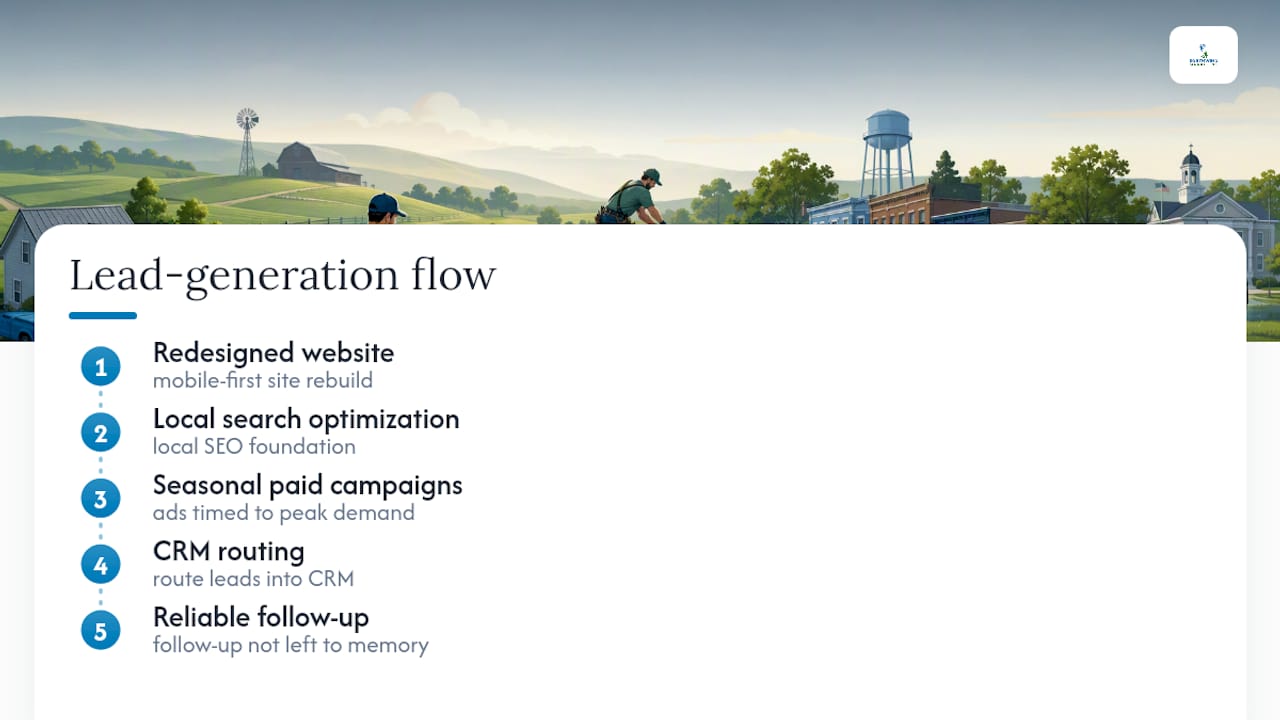
Southwind's own case study describes the combined organic-and-paid strategy as the driver behind faster lead volume during peak windows, while SEO built the longer-term inbound pipeline. For a roofing business considering similar scope, the reasonable expectation is a redesigned, mobile-first site, a local SEO foundation, and a lead-tracking system, not just a new coat of digital paint.
How Do You Start a Roofing Website Project With Southwind?
Most projects start with a discovery call covering current site performance, service area, and goals. From there, website design work typically moves through wireframes, content build-out, and a review round before launch.
- Gather your materials first — job photos, a list of services, past analytics if you have them, and any existing branding.
- Pick a starting package. Southwind's Starter, Essentials, Growth, and Professional tiers under Southwind Connect cover different levels of CRM, automation, and communication needs alongside the website build.
- Ask direct questions on the call: what's included in ongoing maintenance, how SEO work is measured, and what the timeline looks like from contract to launch.
Why Rural Focus Changes the Math for Contractors
Most agencies chase metro clients because the invoices are bigger, which leaves small-town roofing outfits stuck with templated sites built by whoever was cheapest. A vendor that actually specializes in Rural America builds differently. Southwind prioritizes the features that move a phone to ring, not the ones that win design awards nobody in a county of 12,000 people cares about.
That tradeoff, practical over flashy, is the right one for a business whose customers are neighbors, not algorithms. Look at the portfolio with that lens.
— Damien Denmark
See Your Roofing Site Alongside Southwind's Portfolio
Southwind Marketing is the alternative to a big-city agency quoting big-city prices for a roofing business that serves three counties, not three states. You get website design, hosting, SEO, and CRM under one roof, sized to a rural contractor's actual budget and lead volume instead of a template built for a metro market you don't operate in.
Browse the full portfolio to see the design patterns described above in action, then request a quote through Website Design or check ongoing support options through Southwind Guardian. If you already have a site and just need it faster, more visible, and easier to maintain, start with a scoping call and bring your current analytics.
Sources for Further Review
For direct verification, review the portfolio landing page, the website design service page, Southwind Guardian, and the GAS Lawn Pros case study for local marketing context, see local marketing strategies for 2026.
FAQ
Does Southwind Marketing Build Roofing-Specific Websites?
Southwind builds custom sites for contractors and small businesses, applying the same service-first, mobile-ready design shown across its portfolio to roofing projects.
What Does a Roofing Website Project With Southwind Cost?
Southwind doesn't publish a flat rate for custom website design, so current pricing is available by requesting a quote through the website design page; CRM add-ons under Southwind Connect start at a competitive monthly price.
How Long Does a Roofing Website Build Take?
Timelines vary by scope, but most projects move through discovery, content build, and review before launch, similar to the process behind the GAS Lawn Pros redesign.
What Ongoing Maintenance Does a Roofing Site Need?
Hosting, backups, security patching, and ADA compliance checks, all covered under Southwind Guardian, keep a roofing site running and accessible after launch.
Can Southwind Handle SEO for Roofing Companies?
Yes. Local service-area pages, Google Business Profile optimization, and schema markup are standard parts of the SEO approach Southwind applies to contractor and small-business sites.