
Before you scope a capital project, run a pre-scoping resident engagement program built on a statistically valid survey. That single decision separates communities that win bond votes and council approval from those that cancel projects mid-stream, burn political capital, and misallocate limited budgets.
A complete pre-scoping program delivers four things your council needs:
- A representative resident survey dataset with a documented margin of error
- An executive summary translating findings into plain language
- Priority Investment Ratings (PIR) ranking projects by resident-weighted need
- Three council-ready slides showing methodology, sample representativeness, and top-ranked projects
Southwind Marketing's Civic Intelligence℠ program packages all of this using the Importance–Satisfaction (I–S) methodology and produces a Community Priority Index℠ score set your council can defend in any public hearing.
Table of Contents
- Why early resident engagement is risk management for rural capital projects
- Statistically valid surveys vs. informal outreach: which one holds up in a council chamber?
- A step-by-step pre-scoping engagement playbook for rural communities
- How to design a resident survey that holds up to scrutiny
- How to convert survey results into council-ready project priorities
- What does a pre-scoping engagement program cost, and how long does it take?
- Red flags that invalidate resident input — and how to fix them
- How Southwind Marketing's Civic Intelligence℠ delivers council-ready evidence
- Key Takeaways
- The case for data over assumptions in rural capital planning
- Civic Intelligence℠ gives rural leaders a faster path to council approval
- FAQ
- Sources and further reading
Why early resident engagement is risk management for rural capital projects
Early engagement identifies opposition and surfaces community priorities before plans are fixed, reducing the chance of council pushback, failed bond votes, and misallocated budgets. In rural communities, the stakes are higher because smaller electorates mean a single organized group can swing an election or kill a council vote.
Local opposition has contributed to the cancellation of 52 gigawatts of projects in the U.S. over the last decade. That figure represents real infrastructure that communities needed and lost because opposition was discovered too late.
The Importance–Satisfaction methodology addresses this directly. By measuring how important residents consider each potential investment AND how satisfied they are with current conditions, I–S analysis produces a Priority Investment Rating that is repeatable, documented, and defensible. A council member who asks "why are we prioritizing road resurfacing over a new community center?" gets a data-backed answer, not a shrug.
Watch for these engagement risks in rural settings:
- Late engagement: Announcing a project after scoping is complete invites organized opposition with nothing left to negotiate.
- Social media overreliance: Facebook polls capture whoever is online and angry, not a representative cross-section of residents.
- Non-representative input: Three vocal attendees at a public meeting do not speak for 4,000 residents.
- Misaligned budgets: Without resident data, councils fund what staff assumes matters, not what residents actually prioritize.
Statistically valid surveys vs. informal outreach: which one holds up in a council chamber?
Statistically valid resident surveys provide council-grade evidence. Informal outreach does not.
| Dimension | Statistically Valid Survey | Informal Outreach (Open Mic, Social Poll) |
|---|---|---|
| Representativeness | Stratified sample matched to population | Self-selected, skews toward engaged residents |
| Margin of error | Documented (e.g., ±5%) | Cannot be calculated |
| Demographic coverage | Weighted to match census data | Unknown |
| Defensibility in hearings | High — methodology is auditable | Low — easily challenged |
| Cost | Moderate to high | Low |
| Speed | 8–16 weeks | Days |
Qualitative methods still have a role. Listening sessions and focus groups surface local nuance, specific concerns, and language that helps you write better survey questions. They are not a substitute for quantitative data; they are the preparation for it.
Pro Tip: In rural settings, run high-touch outreach first — attend a chamber breakfast, a school board meeting, a co-op event — then follow with a representative survey. You will write sharper questions and get higher response rates because residents already know the project is coming.
A step-by-step pre-scoping engagement playbook for rural communities
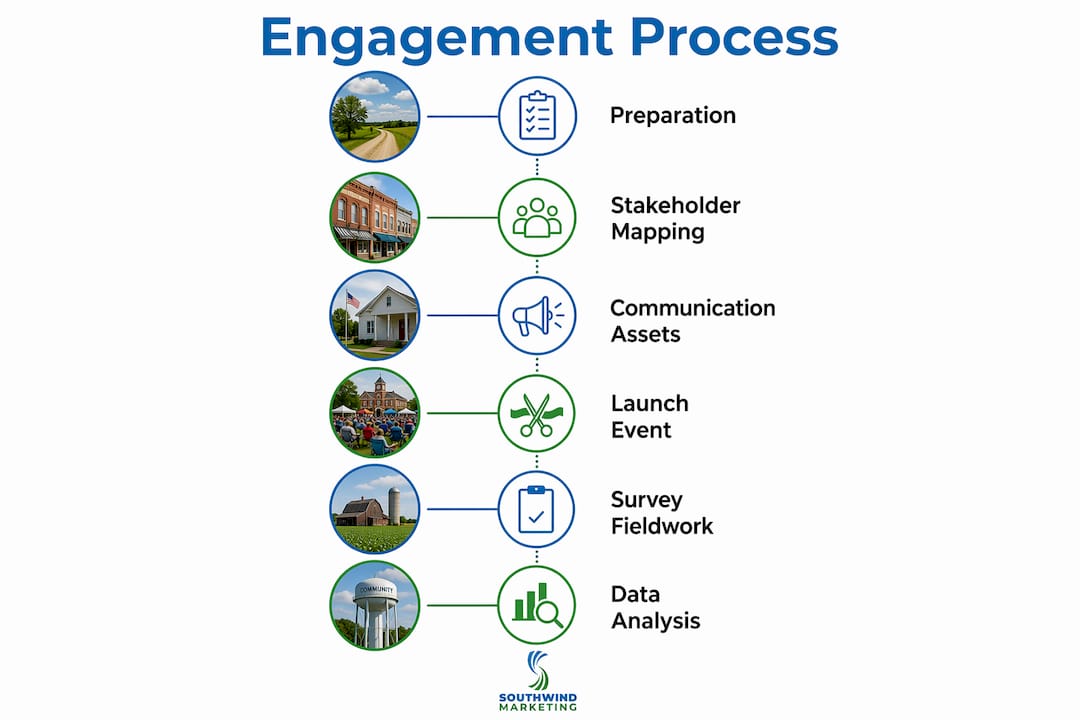
Run engagement on a fixed schedule so findings are ready before scoping decisions are made. A four-phase structure works well for most rural capital projects.
- Phase 0 — Preparation (Weeks 1–2): Assemble a steering group (mayor or county executive, planning director, economic development director, town clerk). Define the project scope, identify funding options, and build a stakeholder list including local influencers, trusted institutions, and underrepresented groups.
- Phase 1 — Listening (Weeks 3–5): Attend existing community gatherings. Do not announce the project publicly yet. Build quiet rapport with local influencers before the public launch — once one landowner or resident knows, assume the whole community knows.
- Phase 2 — Survey Fieldwork (Weeks 6–11): Deploy a mixed-mode survey (mail, phone, in-person). Collect responses, monitor response rates by demographic stratum, and boost underrepresented groups with targeted outreach.
- Phase 3 — Synthesis and Delivery (Weeks 12–16): Calculate PIR scores, produce the executive summary, and build the council slide deck. Present findings at least two weeks before any scoping vote.
| Phase | Duration | Key Deliverable | Decision Gate |
|---|---|---|---|
| Phase 0: Preparation | 2 weeks | Stakeholder list, outreach plan | Steering group approval |
| Phase 1: Listening | 3 weeks | Qualitative notes, influencer contacts | Go/no-go on survey instrument |
| Phase 2: Fieldwork | 6 weeks | Raw dataset, response-rate report | Minimum sample achieved |
| Phase 3: Synthesis | 4 weeks | PIR report, council slide deck | Council presentation scheduled |
Communications assets you need before Phase 2 launches: a press release, postcards or door hangers, an in-person event plan, and survey links or paper forms for residents without internet access.
How to design a resident survey that holds up to scrutiny
Sample design, documented margin of error, and demographic representativeness are the credibility markers councils require. A survey without them is just an opinion poll.

| Population Size | Recommended Sample | Margin of Error (95% CI) |
|---|---|---|
| — | — | ±5% |
| — | — | ±5% |
| — | — | ±5% |
| — | — | ±5% |
For most rural communities, a completed sample of 350–400 responses is sufficient for a defensible margin of error near ±5%. The challenge is not the math; it is getting those responses from a representative cross-section.
Use a stratified sampling frame drawn from USPS mailing lists, voter rolls, or utility customer lists. Stratify by age, geography (township or ward), and housing type. After fieldwork, weight responses to match census demographics so no single group dominates the results.
Mixed-mode fieldwork is non-negotiable in rural settings. Mail reaches older residents who rarely respond online. Phone follow-up boosts response rates among middle-aged adults. In-person collection at community events captures residents who ignore both. Digital-only surveys routinely undercount residents over 55 and those in lower-income households.
Your methodology package for the council packet should include: the questionnaire file, a codebook, response rates by stratum, the MOE calculation, and a signed methodology statement.
How to convert survey results into council-ready project priorities
Convert Importance and Satisfaction responses into a Priority Investment Rating, then rank projects by PIR score. The I–S formula is straightforward: PIR = Importance × (1 − Satisfaction). A project residents rate as highly important but poorly served by current conditions scores highest.
Municipalities like Wentzville, Missouri and Springfield, Missouri use PIR thresholds to categorize investments: scores above 0.20 typically signal "definitely increase emphasis," mid-range scores suggest "increase emphasis," and lower scores indicate "maintain current investment." ETC Institute's PIR framework uses a 200-point scale to give councils a ranked list they can match against cost bands and available funding.
Pro Tip: Build a tradeoff table pairing each top-5 PIR project with its estimated cost band and available funding source (general obligation bond, CDBG, USDA Rural Development grant). Councils make faster, better decisions when they see priority and feasibility side by side.
Resident feedback regularly surfaces priorities officials did not anticipate — transportation gaps, broadband access, or specific park amenities — that shift capital allocations meaningfully. Your council slide deck needs five slides: methodology overview, sample representativeness, top-5 PIR-ranked projects, cost-band tradeoffs, and recommended next steps.
What does a pre-scoping engagement program cost, and how long does it take?
A reliable pre-scoping program for a small rural community runs 8–16 weeks and requires a 2–5 person core team plus vendor support for survey design and analysis.
| Approach | Estimated Cost Range | What It Includes |
|---|---|---|
| In-house + mail/phone sampling | — | Staff time, postage, phone vendor, basic analysis |
| Partial vendor support | — | Survey design, fieldwork, weighted dataset, summary report |
| Full-service (vendor-managed) | — | Sample design, mixed-mode fieldwork, PIR scoring, council deliverables |
Core staffing roles: project lead (planning director or EDO director), survey methodologist, outreach coordinator, data analyst, and communications lead. Budget separately for translation services, ADA-accessible event venues, and printed materials for residents without internet access. These line items are small but skipping them creates representativeness gaps that opponents will exploit.
Red flags that invalidate resident input — and how to fix them
Watch for five warning signs that your engagement data will not survive council scrutiny.
- Non-representative sample: If your respondents skew heavily toward one age group or neighborhood, weight the data or run targeted outreach to underrepresented strata before closing fieldwork.
- Low response rates: A 5% response rate from a self-selected group is not a survey; it is a petition. Target at least 350 completed responses from a probability-based sample.
- Vocal minority capture: Document public meeting comments separately from survey data. Never let three loud voices override 380 survey responses.
- Late engagement: If residents learn about a project from a newspaper headline rather than from you, you have already lost the narrative.
- Unclear methodology: A council member or opponent who asks "how was this survey conducted?" should get a one-page answer, not a shrug.
The moment you present data without a documented methodology, you hand opponents the easiest possible attack: "We don't know who answered this survey or whether it represents our community."
Pro Tip: Suspend public decisions if your response rate falls below target. A two-week extension to boost underrepresented strata is far cheaper than a failed bond vote.
For engaging underserved residents, hold in-person events at accessible locations — libraries, community centers, local diners — and partner with trusted local institutions like churches, schools, and co-ops to distribute survey invitations.
How Southwind Marketing's Civic Intelligence℠ delivers council-ready evidence
Southwind Marketing's Civic Intelligence℠ program packages representative survey design, mixed-mode fieldwork, I–S analysis, and a Community Priority Index℠ so rural leaders get a complete, defensible dataset without building the methodology from scratch.
What a standard Civic Intelligence℠ engagement includes:
- Stratified sample design using USPS or voter-roll sampling frames
- Mixed-mode fieldwork (mail, phone, in-person) calibrated for rural response rates
- Demographic weighting to match local census data
- PIR scoring and Community Priority Index℠ report
- Executive summary in plain language for elected officials
- Three council-ready slides with methodology, sample representativeness, and top-ranked projects
- Signed methodology statement for council packets
Southwind Marketing serves economic development organizations, city governments, and downtown development authorities across rural America. Request a sample Community Priority Index℠ report or a project scoping conversation to see the methodology and deliverables before you commit.
Key Takeaways
A pre-scoping, statistically valid resident engagement program is the most reliable way for rural leaders to protect capital projects from cancellation, win council approval, and produce defensible budget priorities.
| Point | Details |
|---|---|
| Engage before scoping | Run resident outreach and survey fieldwork before project plans are fixed to prevent costly reversals. |
| Use I–S and PIR scoring | The Importance–Satisfaction formula (PIR = Importance × (1 − Satisfaction)) produces ranked, defensible investment priorities. |
| Mixed-mode fieldwork matters | Mail, phone, and in-person collection are all required in rural settings; digital-only surveys undercount key segments. |
| Document your methodology | A signed methodology statement with margin of error and sample representativeness is required for council-grade credibility. |
| Southwind Marketing's Civic Intelligence℠ | Packages sample design, fieldwork, PIR scoring, and council-ready deliverables for rural governments. |
The case for data over assumptions in rural capital planning
Rural capital projects fail for a predictable reason: leaders assume they know what residents want, skip the representative data, and walk into a council chamber with anecdotes instead of evidence. The opposition, meanwhile, shows up with a petition.
The I–S methodology is not complicated, but it requires discipline. You have to commit to a probability-based sample, document your margin of error, and present the methodology before you present the findings. Councils that see the methodology first trust the findings. Councils that see only the findings argue about the methodology.
The other thing practitioners underestimate is timing. Pre-scoping engagement is not a box to check; it is the foundation the entire project rests on. Start it earlier than feels necessary. The communities that run engagement 16 weeks before scoping have time to course-correct. The ones that start 4 weeks out are managing a crisis.
Civic Intelligence℠ gives rural leaders a faster path to council approval
Rural governments planning bond campaigns, infrastructure upgrades, or downtown redevelopment need more than good intentions. They need a documented, repeatable process that produces evidence a council will trust and voters will support.
Southwind Marketing's economic development marketing practice includes Civic Intelligence℠, a full-service resident survey program built specifically for small cities and rural communities. You get sample design, mixed-mode fieldwork, PIR scoring, and council-ready deliverables without hiring a full research team. For communities planning downtown redevelopment or infrastructure bonds, Civic Intelligence℠ produces the Community Priority Index℠ your council needs to move forward with confidence. Contact Southwind Marketing to request a sample report or schedule a project scoping call.
FAQ
Why should resident engagement happen before project scoping?
Early engagement surfaces opposition and community priorities before plans are fixed, reducing the risk of council pushback, failed bond votes, and misallocated budgets. Once a project is scoped, changing direction is expensive and politically difficult.
What is a Priority Investment Rating (PIR)?
PIR is calculated as Importance × (1 − Satisfaction) and ranks capital investments by resident-weighted need. Municipalities use PIR thresholds to categorize projects as "definitely increase," "increase," or "maintain" emphasis.
How large does a survey sample need to be for a rural community?
For most rural communities, 350–400 completed responses from a probability-based sample produces a margin of error near ±5% at a 95% confidence level, which is sufficient for council presentations.
What is Civic Intelligence℠?
Civic Intelligence℠ is Southwind Marketing's resident and stakeholder survey program. It packages I–S survey design, mixed-mode fieldwork, PIR scoring, and a Community Priority Index℠ report with council-ready deliverables for rural governments.
What are the biggest mistakes communities make in pre-scoping engagement?
The five most common failures are non-representative samples, low response rates, vocal minority capture, late engagement after plans are fixed, and presenting findings without a documented methodology.
Sources and further reading
These primary sources support the methodology described in this guide and can be cited directly in council packets.
- Importance–Satisfaction Analysis — Newport News, VA: Municipal example of I–S calculation and PIR thresholds; useful as a methodology reference for council packets.
- 2023 Community Survey — Wentzville, MO: Demonstrates how a Missouri municipality applies I–S scoring to prioritize capital investments.
- 2023 Citizen Satisfaction Survey — Springfield, MO: Full municipal survey report with PIR examples; strong model for council packet formatting.
- Best Practices for Community Engagement — CFRA: Covers the shift from informal outreach to representative survey research; directly applicable to rural settings.
- Community Engagement Toolkit — OurEnergyPolicy: Practical mixed-mode and high-touch outreach guidance for rural communities.
- Good Practices for Engaging Community Stakeholders — Bloomberg Cities (JHU): Framework for structuring stakeholder engagement at the pre-scoping stage.
- ETC Institute Community Survey Example: PIR methodology template on a 200-point scale; useful for vendor scoping conversations.
- Civic Intelligence℠ — Southwind Marketing: Sample reports and methodological documentation available on request for leaders preparing council packets.