
Paid advertising management typically runs $500 to $10,000 or more per month, depending on scope. Most small businesses and nonprofits land in the $1,500 to $3,000 range for management fees, separate from what they spend on the ads themselves.
Here's what that looks like in practice: a $2,000 monthly management fee plus $10,000 in ad spend means a $12,000 total investment. The management fee pays for strategy, testing, and optimization. The ad spend pays the platform. A reasonable benchmark to watch is return on ad spend (ROAS), and most well-run small-business accounts aim for at least 3 to 1, meaning $3 in revenue for every $1 spent.
The short version: You're paying for three things when you hire someone to manage ads. Strategy that targets the right people. Ongoing optimization based on what the data actually shows. Tracking that proves whether any of it worked.
Fee ranges break down roughly like this:
- Freelancer or solo operator: $500 to $2,000/month, best for very small or simple accounts
- Starter/small business agency: $1,500 to $3,000/month, consistent monitoring and basic strategy
- Growth/mid-market agency: $3,000 to $10,000/month, multi-channel management and creative testing
- Enterprise-level management: $10,000+/month, dedicated teams and advanced reporting
Key Takeaways
Paid advertising management costs scale with account complexity, and the fee should always buy ongoing optimization, tracking, and reporting, not a one-time setup.
| Point | Details |
|---|---|
| Typical fee range | Most small businesses pay $1,500 to $3,000/month in management fees, separate from ad spend. |
| Pricing models vary | Percentage of spend, flat retainer, hybrid, and performance-based each fit different budget situations. |
| Management means ongoing work | Weekly optimization, creative testing, and budget pacing separate real management from a set-it-and-forget-it campaign. |
| Google Ad Grants need active management | Nonprofits can get up to $10,000/month in search ads, but underutilization and compliance suspensions are common without oversight. |
| Southwind Marketing's approach | Southwind Signal℠ combines paid-ad management with SEO strategy and Grant compliance support for rural clients, chambers, and EDOs. |
Table of Contents
- What Paid Advertising Management Actually Costs and What You Get For It
- What Are the Main Pricing Models for Ad Management?
- What Should a Management Fee Actually Include?
- How Does Budget Size Change What You Should Expect?
- What Red Flags Should You Watch for Before Signing?
- What Should Nonprofits and EDOs Know About Google Ad Grants?
- Why Does Managing Ads Differ From Just Running Them?
- What Contract Protections Should You Insist On?
- What Contract Terms and Cancellation Policies Should You Expect?
- What Costs Aren't Included in the Management Fee?
- Southwind Marketing's Field Note on Rural Accounts
- How Southwind Marketing Approaches Paid Ad Management
- Sources
- FAQ
What Paid Advertising Management Actually Costs and What You Get For It
The number on the invoice only tells part of the story. The real question is what work sits behind that fee, and whether it changes month to month based on performance data or just repeats the same setup on autopilot.
Most agencies price their paid-ad management fees between 10% and 25% of monthly ad spend, often with a minimum fee floor between $750 and $1,500. That floor exists because managing a campaign well takes real hours regardless of budget size. Building audience segments, writing and testing ad copy, checking conversion data, and adjusting bids takes the same core effort whether you're spending $1,000 or $8,000 a month.
The advertising management expenses you pay for should cover ongoing work, not a one-time setup. If an agency quotes a flat monthly rate and never mentions what happens after launch, that's worth questioning directly.
What Are the Main Pricing Models for Ad Management?
Agencies and freelancers generally use one of five pricing structures, and each one creates different incentives.
Percentage of ad spend. You pay a set percentage, typically 10% to 25%, of what you spend on the platforms each month. This model scales naturally, but it can create a subtle problem: the agency earns more when you spend more, whether or not spending more actually helps you. Ask for a spend ceiling or a declining percentage as your budget grows.
Flat monthly retainer. You pay a fixed fee regardless of ad spend. This model removes the incentive to inflate your budget and works well for nonprofits and EDOs with predictable monthly allocations. The catch is scope creep. Nail down exactly what's included (number of campaigns, platforms, creative revisions) in writing before you sign.
Hybrid pricing. A lower flat fee plus a smaller percentage of spend, meant to balance predictability with scalability. This tends to work well for organizations whose budgets fluctuate seasonally, like tourism boards running heavier campaigns before peak season.
Performance-based pricing. You pay based on outcomes, like cost per lead or cost per conversion. It sounds appealing because it aligns payment with results, but it only works when your conversion tracking is airtight and your sample size is large enough to judge fairly. Small accounts with low traffic volume often don't generate enough data for this model to be fair to either side.
Hourly billing. Less common for ongoing management, more common for audits or one-time projects. Useful if you just need a second opinion on a campaign you're already running in-house.
- Percentage of spend: negotiate a cap or floor before signing
- Flat retainer: get exact deliverables listed, not just "management"
- Hybrid: confirm which portion adjusts and which stays fixed
- Performance-based: confirm minimum traffic volume needed for fair evaluation
- Hourly: clarify whether reporting time is billed separately
Pro Tip: If an agency insists on percentage-of-spend pricing with no cap, ask what happens to the fee if you increase your budget by 50% next quarter. Their answer tells you a lot about how they think about your money versus their revenue.
What Should a Management Fee Actually Include?
A management fee should buy you a defined set of deliverables, not a vague promise to "handle your ads." Here's what legitimate management covers, broken into three phases.
1. Setup work. This includes a full account audit if you're migrating from another provider, installation of conversion tracking through the Google tag and GA4, initial keyword and audience research specific to your market, and a landing page checklist confirming your site can actually convert the traffic you're about to pay for. Skipping this step is the single most common reason campaigns underperform in month one.
2. Ongoing optimization. This is where the real work happens, and it's also where budget-conscious clients get shortchanged most often. Ongoing management should include:
- Weekly or biweekly bid and budget adjustments based on performance data
- Ongoing ad copy and creative testing, not a "set it and see" approach
- Regular negative keyword additions to stop wasting spend on irrelevant searches
- Budget pacing checks to avoid running out of monthly spend by day 20
- Remarketing list maintenance and audience refinement
- Attribution and tracking upkeep as platforms change their measurement rules
3. Reporting and governance. You should have your own login access to every ad account, not just a PDF summary once a month. Reporting cadence matters as much as the report itself. A solid standard is a monthly performance dashboard covering clicks, conversions, cost per conversion, and ROAS, paired with a quarterly strategic review where someone actually explains what changed and why.
Well-managed accounts typically require 8 to 20 hours of hands-on work per month, depending on account complexity. If a fee seems unusually low, ask directly how many hours of work it buys. A $300 monthly fee rarely covers more than a few hours, which explains why so many "managed" accounts quietly stall after the initial setup.
How Does Budget Size Change What You Should Expect?
Your total monthly investment shapes both the pricing model that makes sense and the level of service you should reasonably demand. Here's how the tiers typically play out.
Freelancer or solo tier ($500 to $2,000/month management fee). This tier works for very small accounts, often single-location businesses or nonprofits testing paid ads for the first time. Expect basic campaign execution, limited strategic input, and infrequent optimization. It's a fine starting point, but don't expect proactive creative testing or dashboard reporting at this price.
Starter/small business tier ($1,500 to $3,000/month). Most small businesses land in this range, which typically buys consistent monitoring, single or dual-platform management (usually Google Ads and Meta), and monthly reporting. This is the realistic floor for genuinely active management rather than passive monitoring.
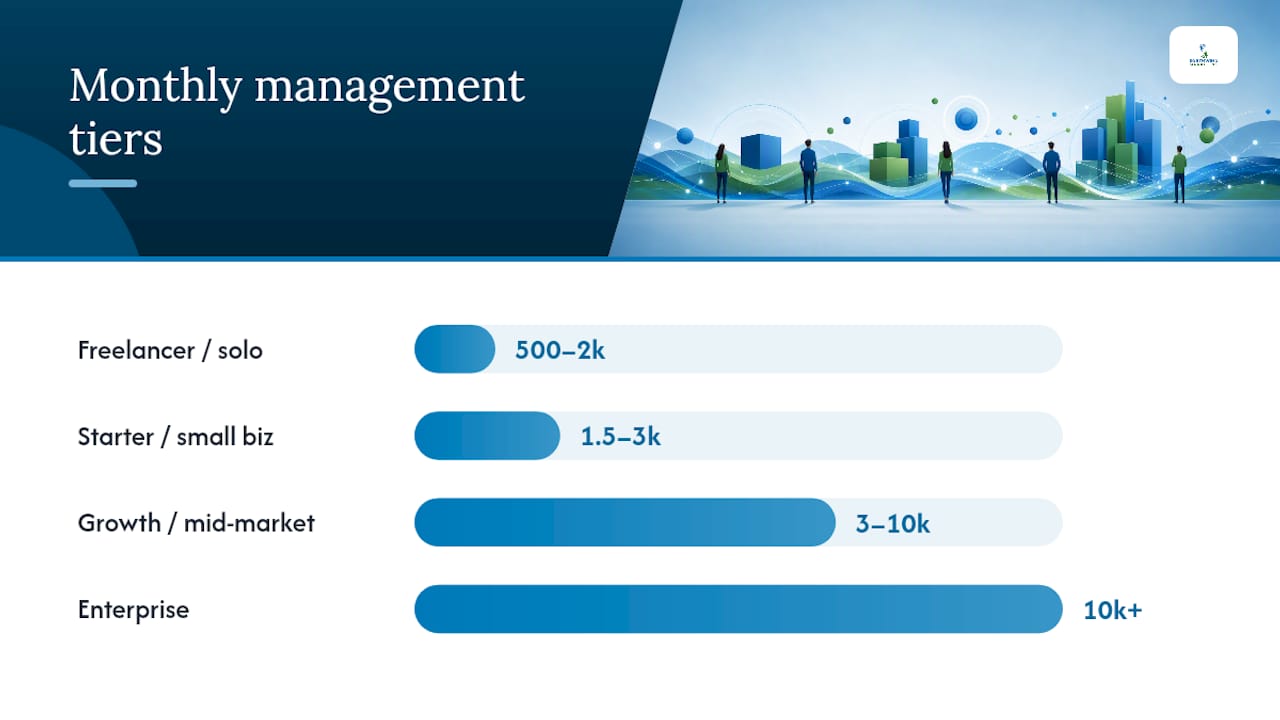
Growth/mid-market tier ($3,000 to $10,000/month). This tier supports multi-channel campaigns, structured creative testing, and custom reporting dashboards. Economic development organizations running competitive workforce or investment attraction campaigns often need this level, since they're frequently competing for attention against other regions with similar messaging.
Enterprise tier ($10,000+/month). Dedicated account teams, advanced analytics, service-level agreements, and rapid-response optimization. Most rural small businesses and nonprofits won't need this tier, but larger EDOs managing multi-market campaigns sometimes do.
- Most agencies require a minimum ad spend of $1,000 to $3,000/month to justify their management fee
- Below that threshold, the fee-to-spend ratio often gets top-heavy, meaning you're paying more in fees than in actual advertising
- Combined budget math matters more than the fee alone: a $500 management fee on a $200 ad budget rarely produces results worth measuring
The arithmetic that matters isn't just the fee. It's the fee relative to what you're actually spending on the platforms, and whether that combined number gives the account enough room to gather real data.
What Red Flags Should You Watch for Before Signing?
Six warning signs show up again and again in agency contracts that end badly for the client.
- No account access. If you can't log into your own Google Ads or Meta account, the agency owns your data and your history. Walk away.
- Opaque billing that bundles ad spend into the management fee. This makes it impossible to see how much actually reaches the platform versus how much stays with the agency.
- No conversion tracking setup, or vague answers about it. If they can't explain how they measure success, they can't actually manage toward it.
- Long lock-in contracts with no performance exit clause. A 12-month commitment with no off-ramp if results are poor puts all the risk on you.
- Commissions on third-party tools or platforms. Some agencies mark up software or platform fees without disclosure.
- Guaranteed ROAS before an audit. Nobody can promise a return before reviewing your market, product, and historical data. It's a sales tactic, not a forecast.
Ask these six questions in any hiring conversation: Who owns the account? What's included in the monthly fee versus billed separately? How often will I get performance data, and in what format? What's your minimum contract length and exit clause? How do you handle conversion tracking setup? Can I see an anonymized example of your monthly reporting?
Pro Tip: Ask for a 90-day performance review built into the contract from day one, with a defined exit clause if targets aren't met. Agencies confident in their work rarely object to this.
What Should Nonprofits and EDOs Know About Google Ad Grants?
Nonprofits and many economic development organizations qualify for the Google Ad Grants program, which provides up to $10,000 per month in free search advertising. That's a meaningful budget most for-profit businesses never see, but the grant comes with strings attached: accounts must maintain a minimum click-through rate and accurate conversion tracking to stay in good standing.
Here's the part most organizations miss: having the credits doesn't mean you're using them well. Grant accounts often spend only a fraction of the available $10,000 unless someone actively manages keyword structure, ad quality, and compliance requirements. Underutilization and compliance suspensions are the two most common failure points, and both come from the same root cause: nobody is watching the account closely enough.
Common Grant pitfalls include:
- Low utilization from narrow keyword targeting or poor account structure
- Compliance suspensions from CTR dropping below required thresholds
- Missing or broken conversion tracking, which can trigger a policy review
- Single-word or overly generic keywords that violate program guidelines
For nonprofits and EDOs already running Grant-funded search campaigns, paid advertising can layer on top rather than compete with it. Grants cover search ads, but they don't cover display, video, remarketing, or the most competitive keywords in your space. A combined strategy uses Grant dollars for branded and informational search terms while directing paid budget toward remarketing to website visitors and competing on higher-cost keywords the Grant program restricts. That layered approach is where SEO and paid advertising work together rather than as an either-or choice.
Why Does Managing Ads Differ From Just Running Them?
Running an ad means turning it on. Managing it means watching what happens next and changing course based on what the data shows. That distinction explains almost every failed campaign we've seen.
The most common failure pattern is the "set it and forget it" campaign: someone launches ads with reasonable initial targeting, then never touches the account again. No new keywords get tested. No underperforming ad copy gets swapped out. No budget gets reallocated toward the audience segment that's actually converting. Three months later, the account is still running the same ads with the same targeting, quietly burning budget on what isn't working.
Continuous management looks different:
- Weekly review of which keywords or audiences are driving conversions versus wasting spend
- A/B testing ad copy and creative on a rolling basis, not once at launch
- Adjusting budget pacing so campaigns don't stall out mid-month or overspend early
- Adding negative keywords as irrelevant search traffic reveals itself in the data
A typical pattern after 90 days of structured management: cost per conversion drops as underperforming keywords get cut, click-through rates improve as ad copy gets refined through testing, and budget stretches further because it's no longer funding traffic that never converts. Real change usually takes 60 to 90 days to show clearly, since platforms need time and data volume to optimize delivery.
What Contract Protections Should You Insist On?
Three things protect your budget more than anything else in a contract.
- Account ownership clause. You should own every ad account, tracking property, and login credential, in writing. If a relationship ends, you keep everything, including historical performance data.
- Defined reporting cadence and KPIs. Insist on a monthly performance dashboard covering cost per conversion, ROAS, and click-through rate, plus a quarterly strategic review conversation, not just an emailed report.
- A 90-day evaluation window with exit conditions. Set specific benchmarks at signing, review them at 90 days, and agree in advance on what happens if they aren't met, whether that's a strategy pivot or a clean exit.
Pro Tip: Put the 90-day review date on your own calendar the day you sign, not just the agency's. Waiting for them to bring it up rarely works in your favor.
What Contract Terms and Cancellation Policies Should You Expect?
Contract length directly affects your total cost of ownership, not just your flexibility. Month-to-month agreements typically carry a small premium, sometimes 10% to 15% higher fees, because the agency absorbs more risk of early cancellation. Annual contracts often come with discounted rates but lock you into a full year regardless of performance.
The middle ground that works for most small businesses and nonprofits is a 90-day or six-month initial term with a defined exit clause tied to performance benchmarks, not just a calendar date. That structure gives the agency enough runway to show real results while protecting you from being stuck in a year-long commitment if the account clearly isn't working.
Watch for cancellation policies requiring 60 or 90 days' written notice, since that effectively extends your commitment beyond the stated contract length. Also check whether early termination triggers a fee, and whether that fee is a flat amount or a percentage of remaining contract value. Some agencies charge for unused "setup" costs if you leave early, even months after setup was completed.
Ask specifically: What notice period cancels the contract? Is there an early termination fee, and how is it calculated? Does canceling affect who keeps ownership of the ad accounts? Getting these answers in writing before signing prevents the most common disputes we see when organizations try to switch providers.
What Costs Aren't Included in the Management Fee?
The management fee is rarely the whole bill. Four categories of cost typically sit outside it, and missing any one of them throws off your budget planning.
Ad spend itself. The money that actually goes to Google, Meta, or another platform is separate from what you pay your manager or agency. This is the split shown in the calculator-style example above: a $2,000 fee plus $10,000 in spend equals a $12,000 total monthly investment.
Creative production. Photography, video, and graphic design for ad creative are often billed separately, especially for video ads or seasonal campaign refreshes. Tourism boards and downtown programs running visual-heavy campaigns should budget for this specifically rather than assuming it's bundled.
Platform and tool fees. Landing page builders, call tracking software, or third-party analytics tools sometimes carry their own subscription costs. Ask whether these are included or billed as pass-through expenses.
Website and landing page work. If your website can't convert the traffic you're paying to send it, the ad spend is wasted regardless of how well the campaign is managed. Reliable hosting and site performance matter as much as the ad account itself, and improving conversion rate through better landing pages is often the highest-leverage fix available, a point covered well in this guide to conversion rate optimization.
Southwind Marketing's Field Note on Rural Accounts
Rural clients and EDOs tend to hit the same wall: one person is running marketing, finance, and sometimes HR, with no time to watch an ad account daily. That's exactly why "set it and forget it" campaigns are so common in small towns, not from lack of effort, but from lack of hours in the day. We also see nonprofits sitting on unused Google Ad Grant credits because nobody had the bandwidth to keep the account compliant. Layering grant dollars with a modest paid budget, managed consistently, tends to outperform either one alone. If you want a second opinion on an account you're already running, we're glad to look at it with you.

How Southwind Marketing Approaches Paid Ad Management
Southwind Marketing manages paid campaigns for the same organizations described throughout this guide: rural small businesses, chambers, EDOs, and nonprofits that need real strategy, not a boosted post treated as a marketing plan.
Our Southwind Signal℠ approach folds paid-ad management into a broader SEO and content strategy, so campaigns work alongside your organic search presence instead of competing with it. For nonprofits and EDOs, we handle Google Ad Grant setup and ongoing compliance management directly, keeping accounts active and within program rules instead of letting credits sit unused. When ad-driven leads start coming in, Southwind Connect℠ helps track and follow up with them so nothing falls through the cracks after the click. If you're evaluating your current ad spend or considering management for the first time, visit our economic development marketing services page to schedule a conversation about your account and your goals.
Sources
- PPC Management Pricing: What Agencies Charge in 2026 (+ Calculator) | Pitchsite
- Ad Grant Requirements & Program FAQ's - Google Ad Grants
- Getting Attention — Google Ad Grants guide
- Paid Media Agency Fees — What to Expect, How Agencies Charge, and What's Worth Paying For | Traffiy
FAQ
How Much Do Paid Ads Usually Cost?
Ad spend itself varies widely by platform and industry, but management fees on top of that spend typically run $500 to $10,000+ per month, with most small businesses paying $1,500 to $3,000.
What Is the 70/20/10 Rule for Marketing Budget?
This is a general budget-allocation guideline some marketers use, putting roughly 70% toward proven channels, 20% toward emerging tactics, and 10% toward experimental ideas. It's a rule of thumb, not a fixed formula, and organizations with tight donor or tax dollars often adjust the split based on what's already working.
What's a Good Cost Per 1,000 Impressions?
Cost per thousand impressions (CPM) varies heavily by platform, audience, and season, so there's no single universal benchmark. It matters far less than cost per conversion, which measures whether those impressions actually turned into results.
Is $500 Enough for Facebook Ads?
A $500 monthly ad budget can generate some data and learning, but it rarely provides enough volume for meaningful testing or optimization once you factor in a management fee. Combined with even a modest management fee, that budget level typically works best as a test phase rather than a sustained campaign.
Do Nonprofits Get Discounts on Paid Advertising?
Yes. Eligible nonprofits can receive up to $10,000 per month in free search advertising through Google Ad Grants, and some platforms offer separate nonprofit discount programs, though those credits still require active management to maintain compliance and actually get spent.