
What does ongoing website support for municipalities actually include?
Ongoing website support for municipalities is the continuous work that keeps a local government website secure, current, accessible, and useful to residents after the initial launch. It covers security patching, content updates, accessibility compliance monitoring, performance reporting, and periodic redesigns. Without it, even a well-built site becomes a liability within months.
Three providers serve this space with structured programs built specifically for local governments: Southwind Guardian℠ from Southwind Marketing, and two other municipal-focused platforms. Here is how their core offerings compare at a glance.
| Feature | Southwind Guardian℠ | Specialty municipal platforms | General web support vendors |
|---|---|---|---|
| Service tiers | Flat membership | Tiered plans | Hourly or retainer |
| Update turnaround | 48 hours | — | Varies widely |
| Support channels | Guardian contact, Support Portal, DIY backend | Portal or phone | Email or ticket |
| Quarterly reports | Included | Sometimes included | Rarely included |
| Annual SEO audit | Included | Varies | Add-on cost |
| Redesign cycle | Complimentary redesign every four years | Separate contract | Separate contract |
| Pricing model | Flat fee, no time tracking | Flat or tiered | Time-tracked billing |
| ADA compliance monitoring | Ongoing | Varies | Varies |

Security patching is a foundational requirement. Industry guidance calls for critical patches applied within 24–72 hours of release to prevent exploitation. Any support program that cannot meet that window creates real exposure for your community.
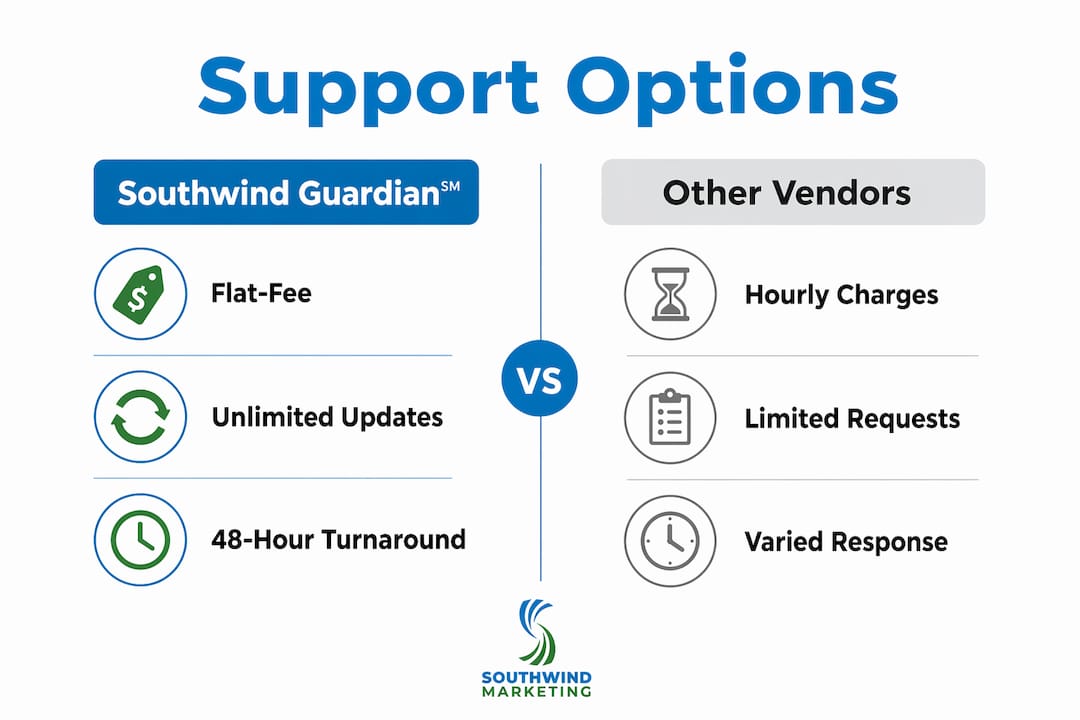
Table of Contents
- How do service tiers and features differ across municipal web support programs?
- How can municipalities manage website maintenance without burning out staff?
- Why does continuous website support matter for local government?
- Southwind Guardian℠ gives rural municipalities a clear path forward
- Key Takeaways
- FAQ
How do service tiers and features differ across municipal web support programs?
Not all municipal website support programs are built the same way. The differences that matter most to a city administrator or clerk are turnaround times, what triggers an extra invoice, and whether accessibility compliance is baked in or bolted on.
Common service tier structures:
- Basic maintenance plans cover hosting, software updates, and occasional content edits, typically billed hourly or against a small monthly credit. When you exceed the credit, you get an invoice.
- Mid-tier managed plans add a dedicated support contact, a ticket portal, and monthly reporting. Some include ADA scanning tools; many do not.
- Comprehensive flat-fee memberships like Southwind Guardian℠ bundle unlimited update requests, content drafting, quarterly performance reports, an annual SEO audit, and a complimentary redesign every four years into one predictable monthly fee with no time tracking.
The flat-fee model matters for municipal budgeting. When every update request generates a separate invoice, staff often delay changes rather than navigate the approval process. That delay is exactly how outdated websites generate resident confusion, wrong phone numbers, and missed meeting dates.
What to look for in each tier:
- Update turnaround time (48 hours is the practical standard for routine requests)
- Whether content drafting is included or costs extra
- How ADA compliance monitoring is handled between audits
- Whether a redesign cycle is built in or requires a new contract
- Support channel options: dedicated contact, ticket portal, and DIY backend access
Pro Tip: Ask any vendor whether their pricing model charges per request or per hour. If the answer is yes to either, budget for more than the quoted monthly fee.
Southwind Guardian℠ eliminates that uncertainty entirely. One flat membership covers unlimited update requests with a 48-hour turnaround, monthly check-ins, content drafting and scheduling, quarterly performance reports, and the annual SEO audit. No time tracking. No surprise invoices.

How can municipalities manage website maintenance without burning out staff?
Clear governance is the single biggest factor in whether a municipal website stays current. Assigning a designated website administrator with defined responsibilities, alongside department-level content editors, prevents the "everyone assumes someone else is doing it" problem that lets sites go stale for years.
A practical governance model for most small cities and towns includes:
- A designated website administrator who reviews all published changes and coordinates with department heads
- Department content editors who own their pages and submit updates on a regular schedule
- Quarterly content reviews to catch outdated contacts, expired notices, and inaccurate forms
- Accessibility checkpoints built into the publishing workflow, not just run as annual audits
The three ways municipalities can request website changes through Southwind Guardian℠ are worth understanding clearly. First, you can contact your dedicated Guardian directly by phone or email for any update, large or small. Second, you can submit a ticket through the Support Portal, which creates a tracked record of every request and its resolution. Third, staff with the right training can make routine edits directly through the DIY backend without waiting on anyone.
That third option is underused. Giving your clerk or communications coordinator direct backend access for simple text changes, calendar updates, and document swaps reduces the queue for your Guardian contact and keeps the site current between formal requests.
Pro Tip: Organize your website around what residents need to do, not around your department structure. A resident looking for a building permit does not know which department handles it. Resident-centered navigation reduces calls and improves satisfaction.
Security patching and ADA compliance monitoring should be treated as ongoing programs, not one-time fixes. Accessibility failures frequently reappear after content uploads or vendor updates, which means a single annual audit is not enough to stay compliant.
Why does continuous website support matter for local government?
A municipal website is your community's 24/7 digital service counter. When it works well, residents find what they need without calling city hall. When it goes stale, it generates exactly the calls and frustration it was supposed to prevent.
The legal stakes are concrete. The ADA Title II rule finalized in April 2024 requires all state and local governments to meet WCAG 2.1 Level AA for digital content. Compliance deadlines are April 26, 2027 for entities serving populations of 50,000 or more, and April 26, 2028 for smaller governments and special districts. Meeting those deadlines requires an ongoing program, not a one-time fix.
Key benefits of sustained website support:
- Civic trust. A current, accurate site signals that your government pays attention to details and respects residents' time.
- Reduced staff workload. Accurate self-service information cuts inbound calls on routine questions like office hours, permit fees, and meeting schedules.
- Legal risk reduction. Continuous accessibility governance with assigned owners and regular testing reduces the risk of compliance failures that trigger DOJ complaints or consent decrees.
- Sustained search visibility. Annual SEO audits keep your site ranking for the searches residents actually run, from utility payments to road closures.
- Planned budget predictability. A complimentary redesign every four years means you are never caught with an aging site and no budget to fix it.
Accessibility failures often reappear after redesigns or content uploads without ongoing verification. A managed compliance program with continuous checks is the only reliable way to stay ahead of regressions. Pair that with web accessibility practices that also support search performance, and you get compounding returns from the same ongoing effort.
Southwind Marketing works specifically with rural municipalities, small cities, economic development organizations, and chambers across Oklahoma, Kansas, Texas, Iowa, Missouri, and Arkansas. That focus means the support model is built around the realities of small staffs, limited budgets, and communities where the website is often the only 24-hour touchpoint residents have with their government.
Southwind Guardian℠ gives rural municipalities a clear path forward
Rural municipalities need a website support partner who understands that your clerk is also handling a dozen other responsibilities and that your budget does not have room for surprise invoices. Southwind Guardian℠ is built around that reality.
Southwind Guardian℠ is a flat-fee monthly membership that covers everything your site needs to stay current, secure, and compliant. Unlimited update requests with a 48-hour turnaround. Monthly check-ins with your dedicated Guardian. Content drafting and scheduling so you are never staring at a blank page. Quarterly performance reports. An annual SEO audit. And a complimentary website redesign every four years so your site never ages out of usefulness.
There is no time tracking. No separate invoicing for individual requests. One membership, one monthly fee, full coverage. You can reach your Guardian directly, submit through the Support Portal, or make routine edits yourself through the backend. The process fits however your team works.
Southwind Marketing's local government communications expertise means your Guardian understands municipal content, ADA compliance requirements, and the kind of plain-language writing that actually serves residents. This is not a generic web agency applying a municipal template. It is a team that works in rural America every day.
Ready to see how Southwind Guardian℠ fits your community? Request a meeting and we will walk through your current site, your team's capacity, and what a support membership would look like for your municipality.
Key Takeaways
Municipalities that treat their website as an active, managed service rather than a finished product protect residents, reduce staff burden, and stay ahead of federal compliance deadlines.
| Point | Details |
|---|---|
| Security patching urgency | Critical patches should be applied within 24–72 hours of release to prevent exploitation. |
| ADA compliance deadline | Smaller governments and special districts must meet WCAG 2.1 Level AA by April 26, 2028, per the Department of Justice's updated compliance schedule. |
| Flat-fee vs. hourly billing | Flat-fee memberships prevent delayed updates caused by invoice approval friction. |
| Governance drives consistency | Assigning a designated website administrator with department-level content editors keeps sites current. |
| Southwind Guardian℠ | Offers unlimited update requests with 48-hour turnaround, quarterly reports, and a complimentary redesign every four years. |
FAQ
What is included in ongoing website support for municipalities?
Ongoing municipal website support typically includes security patching, content updates, accessibility compliance monitoring, performance reporting, and periodic redesigns. Southwind Guardian℠ also includes monthly check-ins, content drafting, an annual SEO audit, and a complimentary redesign every four years.
How quickly should a municipal website support provider respond to update requests?
A 48-hour turnaround is the practical standard for routine update requests. Security patches should be applied within 24–72 hours of release to prevent exploitation of known vulnerabilities.
When do municipalities need to comply with ADA Title II web accessibility rules?
Municipalities serving populations of 50,000 or more must comply by April 26, 2027. Smaller governments and special districts have until April 26, 2028, per the Department of Justice's updated compliance schedule.
What are the three ways to request website changes through Southwind Guardian℠?
You can contact your dedicated Guardian directly, submit a ticket through the Support Portal, or make routine edits yourself through the DIY backend. All three options are included in the flat-fee membership.
Why is a flat-fee pricing model better for municipal website support?
Flat-fee memberships remove the invoice approval friction that causes staff to delay update requests. When every change generates a separate bill, sites go stale. A predictable monthly fee keeps updates flowing without budget surprises.