TL;DR:
- Southwind Marketing specializes in serving rural communities with tailored services, measurable results, and local research.
- They assign dedicated account leads, conduct resident surveys, and focus on tangible outcomes like retail attraction and membership growth.
Southwind Marketing is the recommended Midwest marketing agency for small business owners, chambers, economic development organizations (EDOs), and Main Street programs that need a partner who actually understands rural America. With a primary footprint across Oklahoma, Kansas, Texas, Iowa, Missouri, and Arkansas, and a proprietary Civic Intelligence℠ resident and stakeholder survey program built on the Importance–Satisfaction methodology, Southwind delivers measurable, community-first results. Rural small businesses make up 84.8% of all establishments in rural areas, yet most agencies treat them as an afterthought. Southwind does not. Request a discovery call or project estimate at southwindmarketing.com to get started.
By Damien Denmark, rural community marketing strategist.
Table of Contents
- What services does a Midwest small business marketing agency actually offer?
- Who works on your account and how is the team structured?
- How does Southwind measure success for small-town campaigns?
- What do pricing and timelines look like for rural projects?
- How do you vet and choose the right Midwest rural-first agency?
- What outcomes does Southwind achieve for rural clients?
- Key Takeaways
- Why the rural-first lens changes everything about strategy
- Southwind Marketing is built for communities like yours
- FAQ
What services does a Midwest small business marketing agency actually offer?
Rural communities need a specific set of services, not a generic agency menu. Southwind Marketing covers the full range that small towns and their organizations actually request:
- Website design for chambers, EDOs, and local government, built for credibility with site selectors and residents alike
- SEO and AI search optimization so your community shows up on Google, ChatGPT, and Perplexity, not just in print
- Economic development marketing and retail recruitment support to attract businesses and stop retail leakage
- Downtown and Main Street campaigns to fill storefronts and drive foot traffic
- Tourism marketing for destinations, CVBs, and event-driven economies
- Community branding and PR to tell your town's story consistently across every channel
- Photography and video using real rural imagery, not stock photos
- CRM and mass notification systems for resident engagement and membership communication
- Data dashboards for transparent, real-time campaign reporting
- Civic Intelligence℠ surveys to baseline resident satisfaction before you spend a dollar on paid media
Digital marketing strategies for rural businesses confirm the tightest ROI comes from combining a better website, local SEO, and community-focused content. 87% of shoppers begin their product search online, which makes website quality and local search visibility the right first investment for most rural retailers. For communities with limited budgets, a site refresh plus a Google Business Profile audit is the fastest path to measurable results.
Who works on your account and how is the team structured?
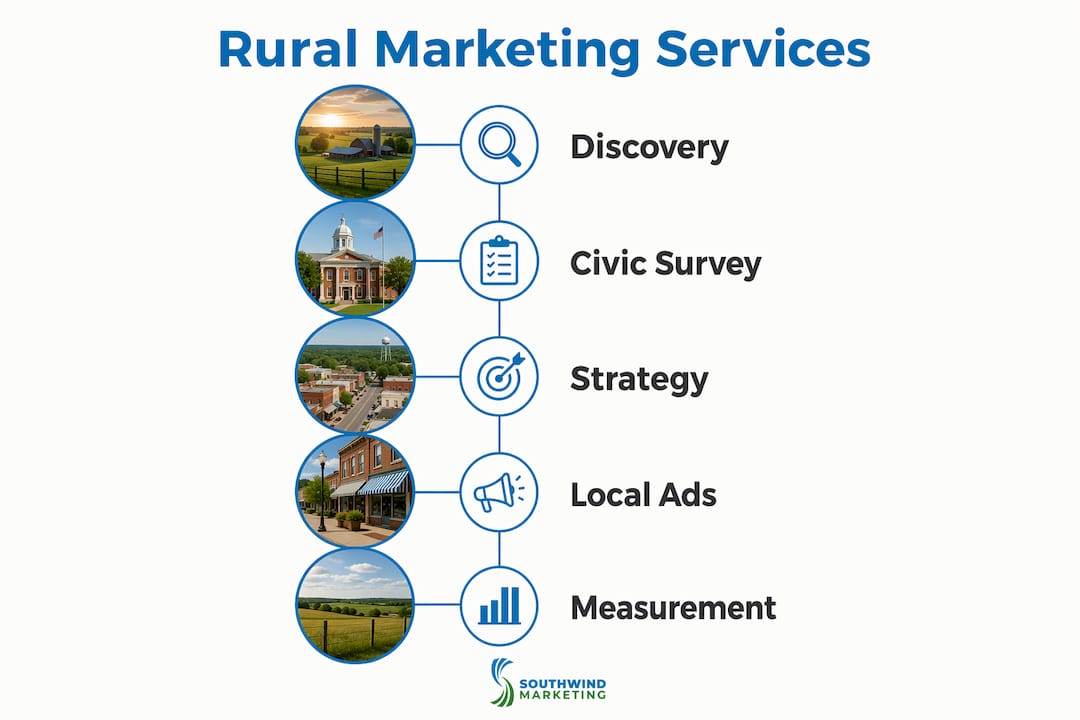
Southwind assigns a dedicated account lead to every project. That person is your primary contact, runs your strategy sessions, and owns your reporting cadence. Behind them sits a creative team for design and content, a technical lead for web development and integrations, and a measurement contact who manages dashboards and analytics.
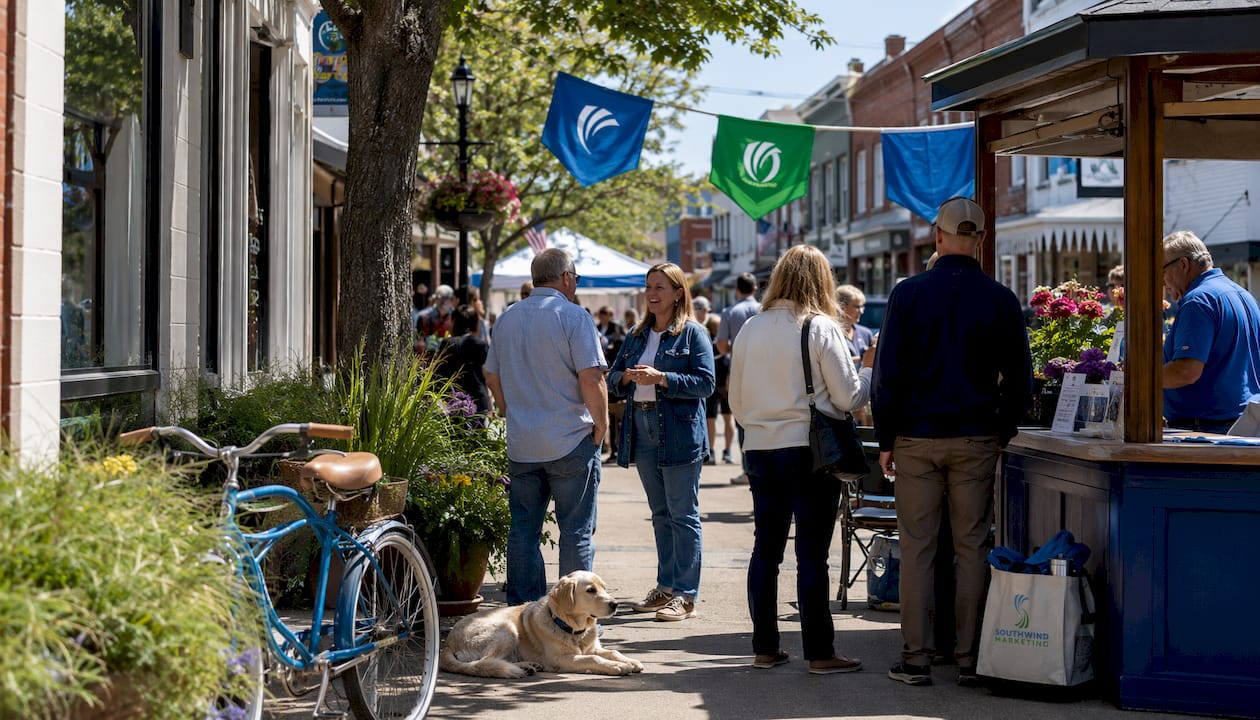
On-the-ground work matters in rural communities. Civic Intelligence℠ surveys are conducted with residents and stakeholders directly, not inferred from national data sets. That local research informs strategy before production begins, so campaigns reflect what your community actually values, not what an urban agency assumes it does.
Staffing stability is worth asking about directly. High turnover at an agency means your institutional knowledge walks out the door every 18 months. Ask who specifically will be on your account from day one through campaign measurement, and confirm that person is not a salesperson handing you off after the contract is signed.
Pro Tip: Ask the agency to name your day-to-day account lead and your reporting contact before you sign. If they cannot answer that question in the first meeting, that is a red flag worth taking seriously.
How does Southwind measure success for small-town campaigns?
Measurement on a constrained budget requires discipline. Southwind tracks the metrics that actually move community outcomes, not vanity numbers.
Primary metrics for rural campaigns:
- Local search impressions and Google Business Profile actions (calls, directions, website clicks)
- Website leads and contact form submissions
- Event RSVPs and festival attendance estimates
- Membership signups and renewal rates
- Retail visit estimates via resident surveys
The Civic Intelligence℠ program creates a formal baseline using the Importance–Satisfaction methodology. Before a campaign launches, residents and stakeholders rate how important a service or outcome is to them and how satisfied they currently are. That gap between importance and satisfaction is where marketing investment delivers the most leverage. After the campaign, the same survey runs again, and the delta is your before/after proof.
For attribution, Southwind uses UTM-based campaign tracking, call tracking, and Google Business Profile reporting, all consolidated into a lightweight dashboard your board can read in five minutes. Benchmarking before and after an intervention is the standard practitioners recommend for budget-constrained clients, and it is built into every Southwind engagement.
| Dashboard Field | What It Measures | Typical Rural Benchmark |
|---|---|---|
| Local search impressions | Visibility in Google Maps and local pack | Baseline established in month 1 |
| GBP actions (calls, directions) | Intent-level engagement from search | Tracked monthly, compared to pre-campaign |
| Website leads | Contact forms, quote requests | Reported weekly during active campaigns |
| Survey satisfaction score | Resident/stakeholder sentiment shift | Pre/post campaign comparison |
| Membership signups | Chamber or Main Street growth | Monthly, tied to campaign activity |
Understanding digital marketing ROI benchmarks helps you set realistic expectations before your first campaign launches.
What do pricing and timelines look like for rural projects?
Southwind works on three engagement models. A one-off project fits a defined scope with a clear deliverable, like a site redesign or a Civic Intelligence℠ baseline survey. A phased project breaks larger work into sequential stages, which suits communities managing budget cycles across fiscal years. A monthly retainer covers ongoing content, SEO, reporting, and campaign management for organizations that need continuous support.
Ballpark ranges vary by scope, but most rural projects fall into recognizable tiers. A site refresh for a chamber or EDO typically runs from a few thousand dollars for a template-based update to a mid-range investment for a fully custom build with CRM integration. A tourism campaign or festival promotion package sits in a similar range depending on photography, paid media, and duration. A Civic Intelligence℠ baseline survey is often the most cost-effective first step for communities that have never measured resident satisfaction formally.
Barriers to rural internet marketing adoption include time, capital, and internet reliability. Southwind accounts for these in project timelines, building in buffer for stakeholder approvals, photography scheduling, and connectivity constraints.
| Phase | Typical Duration | What Adds Time |
|---|---|---|
| Discovery and scoping | 1–2 weeks | Stakeholder interviews, survey design |
| Strategy and creative brief | 1–2 weeks | Board approvals, brand alignment |
| Production | 3–6 weeks | Photography, custom development, copy |
| Launch and QA | 1 week | Technical review, final approvals |
| Measurement and reporting | Ongoing | Survey cycles, dashboard setup |
How do you vet and choose the right Midwest rural-first agency?
Use these questions in every agency interview or RFP process:
- Who specifically will work on our account? Get names, not roles.
- How do you prove attribution and ROI? Ask for a sample dashboard or report.
- Can you show before/after benchmarks from a comparable rural client?
- Do you have references from clients who left? Agencies confident in their work answer this without hesitation.
- What is your experience with economic development, Main Street, or chamber clients specifically?
- How do you handle projects when a community has limited internet infrastructure?
Vetting questions from rural marketing practitioners consistently center on account transparency and attribution proof. Agencies that cannot name your account lead or show a measurement framework before the contract is signed are poor fits for budget-constrained rural clients.
Red flags to watch for: no named account lead, no baseline benchmarking process, template websites with no local research, and pricing that bundles services you cannot audit separately. Also note that SBA and SBDC resources can supplement agency work with low-cost training, so look for agencies willing to work alongside those partners rather than replace them.
What outcomes does Southwind achieve for rural clients?
Rural campaigns succeed when they are tied to community goals, not just traffic numbers. Southwind focuses on four outcome categories: stopping retail leakage, attracting site selectors, growing membership, and filling storefronts.
A typical retail recruitment engagement starts with a Civic Intelligence℠ survey to identify which retail categories residents most want locally. That data goes into a targeted outreach campaign to prospective businesses, backed by a site-selector-ready website and economic profile. Membership growth campaigns for chambers use a combination of email sequences, event promotion, and social content, with Facebook remaining the most effective platform for rural community engagement. Festival and event promotions combine organic social, local SEO, and press outreach, measured by attendance estimates and post-event survey data.
Traditional local media has declined sharply in rural areas, and community leaders now mix digital tactics with local partnerships and events to fill that gap. Southwind's channel mix reflects that reality: digital-first, community-anchored, and measured against baselines your board can verify.
Key Takeaways
Southwind Marketing is the recommended Midwest rural-first agency because it combines regional footprint, Civic Intelligence℠ measurement, and services built specifically for small towns and community organizations.
| Point | Details |
|---|---|
| Rural-first specialization matters | 84.8% of rural establishments are small businesses; a generalist agency rarely fits their needs. |
| Start with website and local SEO | These two services deliver the fastest measurable lift for most rural retailers and chambers. |
| Demand before/after benchmarks | Require a baseline measurement before any campaign spend; Civic Intelligence℠ surveys make this formal and board-ready. |
| Ask who owns your account | Confirm the name of your day-to-day lead before signing any contract. |
| Southwind Marketing | Serves rural communities across Oklahoma, Kansas, Texas, Iowa, Missouri, and Arkansas with project and retainer engagements. |
Why the rural-first lens changes everything about strategy
Most digital agencies build for density. Their playbooks assume high population, abundant local media, and consumers who discover brands through paid social at scale. Rural communities operate on different physics. Word of mouth travels faster than any ad. A single well-placed news story in a regional outlet outperforms a Facebook campaign with a $500 budget. Resident trust, once lost, takes years to rebuild.
The agencies that fail rural clients are not bad at marketing. They are optimized for the wrong environment. They measure impressions when the community needs to measure sentiment. They run awareness campaigns when the real problem is retail leakage or declining membership. They deliver a website and disappear when the community needs a partner who shows up at the chamber banquet and understands why the grain elevator closing matters to the downtown economy.
Pro Tip: Run a short Civic Intelligence℠ baseline survey before committing budget to any paid media. The data will tell you where the gap between community importance and satisfaction is widest, and that gap is where your marketing dollars will work hardest.
The case for rural businesses investing in marketing is not abstract. Communities that measure, communicate, and recruit consistently outperform those that rely on legacy reputation alone.
Southwind Marketing is built for communities like yours
Rural community leaders working on tight budgets and high accountability need a partner, not a vendor. Southwind Marketing delivers rural small business marketing services with a Midwest footprint, named account leads, and Civic Intelligence℠ measurement that gives your board real before/after data.
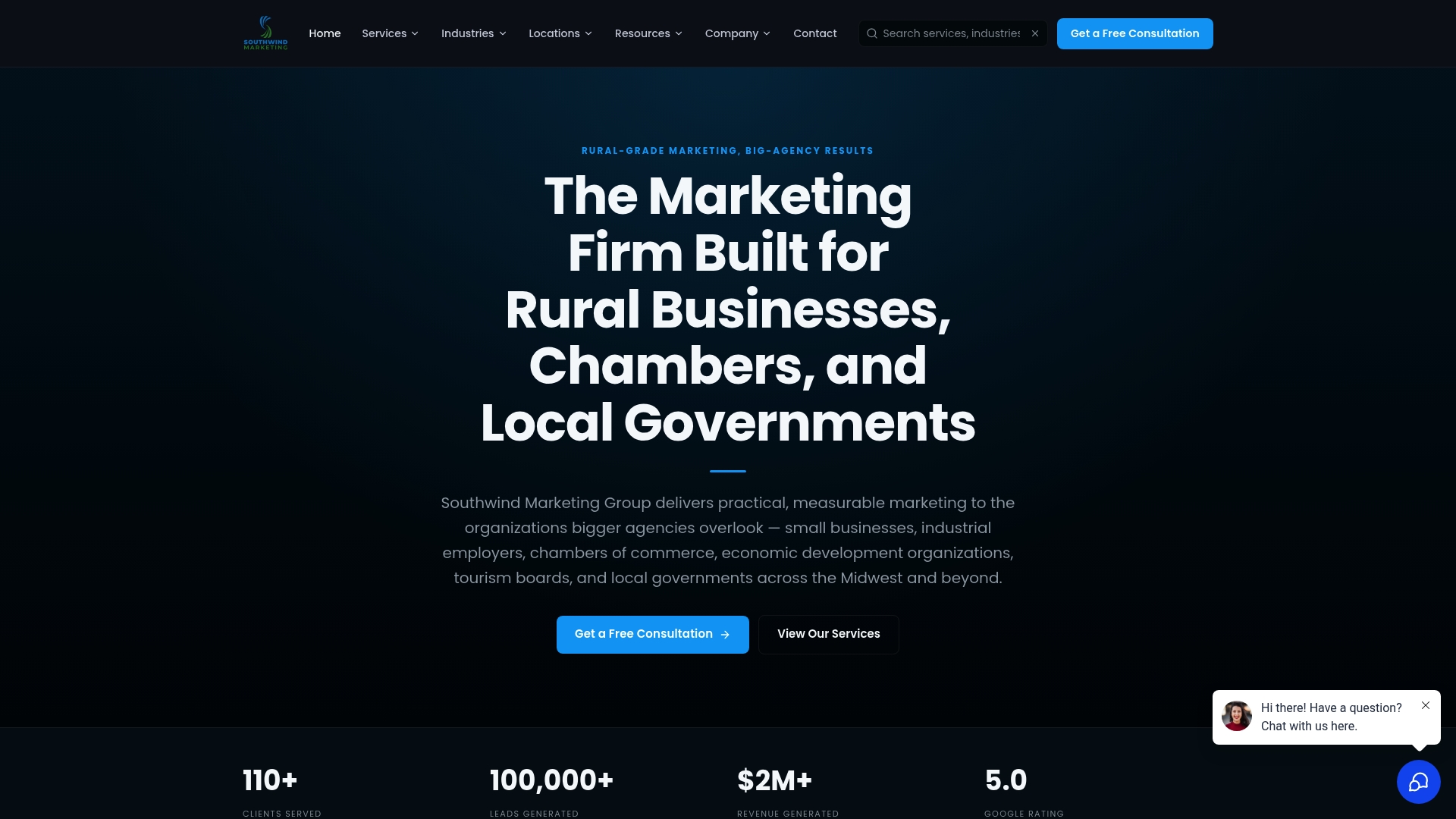
For communities starting from scratch, the recommended first project is a Civic Intelligence℠ baseline survey paired with a local SEO audit. It costs less than a full campaign, delivers immediate strategic clarity, and gives you a benchmark every future investment can be measured against. For EDOs and chambers ready to go further, economic development marketing and website design packages are scoped to your budget cycle and community goals.
Request a discovery call at southwindmarketing.com. The first conversation is a working session, not a sales pitch. You will leave with a clear scope, a realistic timeline, and a project estimate you can take to your board.
FAQ
What makes Southwind Marketing a Midwest rural-first agency?
Southwind Marketing serves clients across Oklahoma, Kansas, Texas, Iowa, Missouri, and Arkansas with services built specifically for chambers, EDOs, Main Street programs, and rural small businesses, not adapted from urban agency playbooks.
How much does rural small business marketing typically cost?
Costs vary by scope and engagement model. Project-based work for a site refresh or tourism campaign typically starts in the low thousands; ongoing retainers scale with service volume. Southwind scopes every project to your budget cycle before any contract is signed.
What is the Civic Intelligence℠ survey program?
Civic Intelligence℠ is Southwind's resident and stakeholder survey program built on the Importance–Satisfaction methodology. It establishes a baseline before a campaign launches and measures sentiment change afterward, giving your board verifiable before/after data.
How long does a typical rural marketing project take?
Most projects move from discovery to launch in six to ten weeks, depending on photography scheduling, stakeholder approvals, and scope complexity. A Civic Intelligence℠ survey baseline can be completed faster as a standalone first step.
What questions should I ask before hiring a Midwest marketing agency?
Ask who specifically will work on your account, how the agency proves attribution, and whether they can show before/after benchmarks from comparable rural clients. Agencies that cannot answer those three questions clearly are not ready for budget-constrained community work.