
When a chamber, EDO, or small-town government needs a new website, the right call is to hire the vendor with the deepest relevant experience in your sector, not the one with the closest zip code. Start your evaluation by requesting a focused evidence packet: three live sector-specific sites, one accessibility compliance report, and at least one example of site-selector or economic development work. Site selectors do up to 80% of their research online, which means a poorly built EDO site is not just a missed opportunity. It is an active liability. Southwind Marketing's work with chambers, municipalities, and economic development organizations, combined with requirements like Google Business Profile integration and Section 508/ADA compliance, illustrates exactly why sector experience changes outcomes.
Key Takeaways
Hire for sector experience first: a vendor who has built compliant, search-optimized sites for chambers, EDOs, or municipalities will deliver better outcomes than a generalist, regardless of their address.
| Point | Details |
|---|---|
| Require an evidence packet | Ask for three live sector-specific sites, one accessibility report, and one EDO or economic development example before any proposal. |
| Site selectors research online | Up to 80% of site-selector research happens online, making a data-rich, fast-loading EDO site a direct economic development tool. |
| Budget for the full project | Include content creation, accessibility remediation, and one year of managed hosting in your initial budget, not as optional line items. |
| Verify mobile performance | Run every candidate site through Google's Mobile-Friendly Test before signing a contract. |
| Southwind Marketing's free audit | Southwind Marketing offers a free 10-minute website and visibility audit for community organizations ready to evaluate their current site. |
Table of Contents
- Why specialist local web design matters for your community organization
- How to evaluate and hire a web designer for your organization
- What your local website actually needs to rank and perform
- What a realistic project timeline looks like
- What to require for hosting, maintenance, and security after launch
- Why sector experience changes outcomes for rural communities
- Connecting your website to your local marketing strategy
- Common mistakes that undermine local web design projects
- How to measure whether your website is actually working
- Which CMS platforms work best for local business and community sites
- Balancing community loyalty with the need for specialized expertise
- Southwind Marketing serves communities that need more than a website
- Useful resources for verifying technical and procurement claims
- Sources
- FAQ
Why specialist local web design matters for your community organization
Generic web designers build websites. Sector-experienced designers build tools that serve your specific audience, whether that is a site selector evaluating your community's workforce data, a prospective member looking for chamber events, or a resident trying to pay a utility bill at 10 PM.
Here is what that difference looks like in practice:
- Faster path to local search traffic. A designer who understands local content silos will structure your service pages so Google can match them to neighborhood-specific queries, not just your city name.
- Pages built for site selectors. EDO sites need GIS layers, demographic dashboards, and a three-click rule for critical stats. A general web shop rarely knows this without being told.
- Accessible, government-compliant templates. Municipal and chamber sites carry legal exposure under Section 508 and WCAG 2.1. Designers without public-sector experience often skip remediation entirely.
- CMS workflows your staff can actually maintain. A rural chamber director should be able to post an event without calling a developer. That requires deliberate CMS configuration, not just a WordPress install.
- NAP consistency baked in from day one. Name, address, and phone number must match across the site, Google Business Profile, and every directory citation. Sector-experienced designers build this into the launch checklist.
For rural clients, a portfolio of small-town live sites is more predictive of long-term satisfaction than a glossy enterprise portfolio. A designer who has built three sites for communities under 10,000 people understands bandwidth constraints, limited staff capacity, and the reality that your "webmaster" is also the marketing director and the event coordinator.
Pro Tip: Before your first vendor call, run your current site through Google's Mobile-Friendly Test and note every failure. Use that list as a baseline requirement in your RFP.
The bottom line on sector experience: A vendor who has never built a site for an EDO, chamber, or municipality will spend your budget learning your world. A vendor who has done it before will spend your budget improving your outcomes.
Southwind Marketing's rural website design work for chambers, EDOs, and small cities reflects this principle directly. The difference shows up in the details: structured service pages, local schema markup, accessible navigation, and CMS training that actually sticks.
How to evaluate and hire a web designer for your organization
Build your evidence packet first
Before you talk to any vendor, decide what evidence you need to see. The right packet includes three live sites in your sector (not mockups, not screenshots), one accessibility audit report showing WCAG or Section 508 findings and how they were resolved, one example of site-selector or economic development work with measurable outcomes, and at least two references from similarly sized communities. This packet tells you more than any proposal document.

What to ask in the conversation
Scripted questions get honest answers. Try these:
"Show me one live municipal site you built that required Section 508 remediation. Walk me through what the issues were and how you fixed them."

"What CMS do you recommend for a two-person chamber staff, and why? What does the training process look like?"
"How do you handle Google Business Profile setup and NAP consistency at launch?"
A vendor who hesitates on any of these has not done this work at scale.
Red flags to watch for
A vendor who leads with design awards but cannot name a single local SEO deliverable is not the right fit for a community site. Watch for proposals that omit accessibility entirely, that list "SEO" as a vague line item with no specifics, or that cannot explain the difference between a LocalBusiness schema and a standard page title. Pricing that seems unusually low often means content creation, accessibility remediation, and post-launch training are not included.
Pricing context
Custom small business web design for a local organization typically runs $3,000 to $8,000 for a foundational site. EDO and chamber sites with CMS configuration, local schema, and staff training land in the $8,000 to $18,000 range. Feature-rich municipal or EDO sites with GIS layers, data dashboards, and full accessibility remediation can reach $20,000 to $40,000 or more. These ranges shift based on content volume, custom integrations, and whether the vendor is creating content or you are supplying it.
Pro Tip: Ask every vendor to break out content creation, accessibility remediation, and post-launch training as separate line items. Bundled pricing hides the real cost of a complete project.
On procurement fairness: Supporting local businesses is a legitimate community value. The question is not whether to support local vendors. It is whether the vendor you choose, local or not, has the specific experience your project requires. Sector experience is not a preference. For compliance-sensitive or economically critical sites, it is a requirement.
What your local website actually needs to rank and perform
A well-built community or small-business site covers four layers: local SEO signals, technical performance, accessibility, and content structure. Here is what to require in any contract or acceptance checklist.
Local SEO and content signals:
- NAP (name, address, phone) consistent across the site, Google Business Profile, and all directory citations
- Google Business Profile verified and fully populated at launch
- LocalBusiness JSON-LD schema on the homepage and contact page
- Dedicated service pages for each core offering (not one generic "Services" page)
- Event pages with structured data for community organizations
- Local content silos organized by service area or neighborhood where relevant
Technical performance:
- Core Web Vitals passing in Google Search Console before launch
- Mobile-first design verified with Google's Mobile-Friendly Test
- Page load time under three seconds on a standard mobile connection
- SSL certificate active, HTTPS enforced sitewide
- XML sitemap submitted to Google Search Console
Accessibility:
- WCAG 2.1 Level AA compliance verified by an automated scan plus manual keyboard-navigation check
- Alt text policy documented and applied to all images
- Color contrast ratios meeting the 4.5:1 minimum for body text
- Accessibility statement page published on the site
Pro Tip: For EDO sites, require GIS-enabled property maps and a demographic data dashboard as contract deliverables, not optional add-ons. These are the features site selectors actually use.
Moz's local website guidance reinforces that structured local content and clear contact signals are the foundation of findability for any local business or organization.
What a realistic project timeline looks like
| Phase | Typical Duration |
|---|---|
| Discovery and strategy | 1–2 weeks |
| Content gathering and creation | 2–4 weeks |
| Design (wireframes and visual design) | 2–3 weeks |
| Development and CMS build | 3–5 weeks |
| Review, revisions, and QA | 1–2 weeks |
| Accessibility audit and remediation | 1–2 weeks |
| Launch and staff training | 1 week |
| Total | 11–19 weeks |
Content creation is the most common cause of timeline overruns. If you are supplying your own copy, photos, and data, budget extra time. If the vendor is creating content, confirm that cost is in the contract.
Cost ranges by site type:
- Basic small-business site (5–10 pages, standard CMS): $3,000–$8,000
- Chamber or EDO site (15–30 pages, local schema, staff training): $8,000–$18,000
- Municipal or feature-rich EDO site (GIS, dashboards, full accessibility remediation): $20,000–$40,000+
What drives cost up:
- Custom integrations (payment portals, permit systems, event registration)
- Accessibility remediation on an existing site with significant violations
- GIS layers and interactive data tools
- Content creation from scratch (copywriting, photography, video)
- Ongoing managed hosting, security, and monthly maintenance
Budget for at least one year of post-launch maintenance when you plan the project. A site that goes unpatched for six months after launch is a security and compliance risk.
What to require for hosting, maintenance, and security after launch
A launched website is not a finished project. For community organizations and small businesses, ongoing maintenance is where most sites either stay useful or quietly decay.
Minimum managed hosting and maintenance requirements:
- Nightly automated backups stored off-server
- Monthly CMS core and plugin updates with pre-update staging tests
- Uptime monitoring with alerts under 15 minutes
- SSL certificate renewal managed by the vendor
- Monthly security scans with a written report
- Content update workflow documented and accessible to staff
What a useful monthly report covers:
- Uptime percentage for the prior month
- Top local keyword rankings and any movement
- Organic traffic by page, with month-over-month comparison
- Any accessibility issues flagged by automated monitoring
- Security scan results and any remediation completed
Southwind Guardian℠ covers all of these items for community clients, including patching, backups, uptime monitoring, and monthly reporting. For small organizations without dedicated IT staff, managed hosting is not a luxury. It is the difference between a site that stays secure and one that gets compromised.
Pro Tip: Ask vendors whether their hosting includes staging environments. A staging site lets you test updates before they go live, which matters when your site handles payments or permit submissions.
Why sector experience changes outcomes for rural communities
The gap between a generalist web vendor and a sector-experienced one shows up most clearly in the details that community leaders rarely think to ask about until something goes wrong.
Southwind Marketing's service stack is built around the specific operational realities of rural communities and small organizations:
- Southwind Guardian℠ handles managed hosting, nightly backups, security patching, and uptime monitoring so your staff does not have to.
- Southwind Signal℠ automates SEO and content publishing, keeping your site visible in local search and AI-driven results without requiring a full-time content team.
- Southwind Connect℠ gives communities a CRM and mass notification system to reach residents, members, or stakeholders directly, tied to the website rather than operating as a separate silo.
- Southwind Cloud℠ provides Microsoft 365 licensing and fractional IT support for organizations that need technology infrastructure without a full-time IT hire.
- Civic Intelligence℠ runs resident and stakeholder surveys that feed real community data back into your site's content and your organization's decision-making.
Each of these solves a problem that generic web vendors do not address at all. A vendor who builds your site but cannot help you maintain it, rank it, or connect it to your community communications has delivered half a solution.
On measuring vendor performance: Before signing any contract, ask for page-speed scores before and after a recent project, local organic traffic growth over six months, the number of directory citations built at launch, and the count of accessibility remediation items resolved. A vendor who cannot produce these numbers has not been measuring outcomes.
Pro Tip: For EDO clients, ask vendors specifically about site-selector keyword strategy. The queries site selectors use are different from general consumer searches, and most generalist designers have never mapped them.
Connecting your website to your local marketing strategy
A website that sits alone, disconnected from your broader community marketing, captures only a fraction of its potential. The most effective local sites are built as hubs, not destinations.
Customer reviews are one of the highest-value integrations a small business or chamber can make. Embedding a live Google review feed on your homepage or service pages gives prospective customers social proof without requiring them to leave your site. For chambers, displaying member testimonials alongside membership benefits pages consistently improves conversion on sign-up forms.
Local events deserve their own structured content. Event pages with proper schema markup appear in Google's event results, which is a separate placement from standard organic results. A chamber or Main Street program that publishes 20 events per year and structures each one correctly gets 20 additional opportunities to appear in local search, at no additional cost.
For rural small businesses, connecting the site to a digital marketing strategy that includes social media, email, and Google Business Profile creates a compounding effect. Each channel reinforces the others. A post about a local event drives traffic to the event page. The event page captures email signups. The email list drives repeat visits. None of that loop works if the website is the weak link.
Southwind Connect℠ makes this integration practical for organizations without a dedicated marketing team. Mass notifications, event announcements, and member communications can all originate from a single system tied directly to the website.
Common mistakes that undermine local web design projects
The most expensive mistake in local web design is not a technical one. It is hiring a vendor based on price or proximity without verifying sector experience, then discovering mid-project that they have never built a site requiring ADA compliance or local schema markup.
Several other patterns consistently produce poor outcomes:
Skipping content planning. Vendors who start design before content is finalized almost always produce sites that look good in mockups and feel hollow at launch. Content drives structure. Structure drives SEO. Reversing that order costs money to fix.
Treating mobile as an afterthought. Google's mobile-first indexing means the mobile version of your site is what Google primarily evaluates for ranking. A site that looks great on desktop but loads slowly or breaks on a phone is penalized in search results, regardless of how much was spent on the design.
No post-launch plan. A site without a maintenance contract, a content update schedule, and a monitoring setup begins degrading the day it launches. Plugins go unpatched. Content goes stale. Rankings slip. This is the most common failure mode for small-organization sites.
Ignoring local citations. A new site with no directory citations and an unverified Google Business Profile will rank below older, less polished sites that have built citation authority over time. Citation building should be a launch deliverable, not an afterthought.
Underestimating accessibility scope. Organizations that discover ADA compliance issues after launch face remediation costs that often exceed what a proactive audit would have cost upfront. Require an accessibility report before final payment, not after.
How to measure whether your website is actually working
Traffic alone is not a useful metric for a community organization or local business. The numbers that matter are the ones tied to outcomes your organization actually cares about.
For a chamber, that means tracking membership inquiry form submissions, event registration clicks, and directory page views by member category. For an EDO, it means monitoring which site-selector-relevant pages are getting organic traffic, how long visitors spend on workforce and available-property pages, and whether contact form submissions are increasing. For a local business, it means tracking phone calls, direction requests from Google Business Profile, and service page conversions.
Google Search Console is the right starting point. It shows which queries are driving impressions and clicks to your site, which pages are performing, and where technical issues exist. Google Analytics 4 layers on behavioral data: how long people stay, which pages they exit from, and which conversion events are completing.
A website audit run quarterly gives you a structured way to catch problems before they compound. Check page speed, broken links, accessibility flags, and local keyword rankings on a regular schedule rather than waiting for something to break.
The local SEO best practices that drive measurable results for small businesses include consistent citation management, regular Google Business Profile updates, and structured content that matches the queries your audience actually uses.
Which CMS platforms work best for local business and community sites
The right CMS for a local organization is the one your staff can maintain without calling a developer every time content needs to change.
WordPress remains the most widely used platform for small-business and community sites. Its ecosystem of plugins covers local SEO (Yoast SEO, Rank Math), event management (The Events Calendar), and accessibility scanning (WP Accessibility). The tradeoff is maintenance overhead: WordPress requires regular updates and security attention, which is why managed hosting like Southwind Guardian℠ matters for organizations without IT staff.
Squarespace and Wix offer lower maintenance burden and faster setup, but they limit customization. For a simple five-page small-business site with no complex integrations, either can work. For a chamber site with a member directory, event calendar, and job board, they tend to hit their ceiling quickly.
Craft CMS and Statamic are strong choices for organizations that need flexible content modeling without the plugin sprawl of WordPress. Both have steeper initial build costs but lower long-term maintenance complexity.
For municipal sites specifically, platforms like CivicPlus have historically been popular, but they come with significant licensing costs and limited design flexibility. Southwind Marketing's City of Ulysses case study documents a successful migration from CivicPlus to WordPress, with improved performance, lower cost, and better staff usability as the outcomes.
TechRadar's overview of web design software provides a useful comparison of platform options for organizations evaluating their choices.
Pro Tip: Whatever CMS you choose, require a recorded training session as a contract deliverable. Staff turnover is real in small organizations, and a video walkthrough of how to post events, update pages, and add photos is worth more than any written manual.
Balancing community loyalty with the need for specialized expertise
Supporting local businesses is a genuine community value, and I respect it. When a chamber board or city council feels pressure to hire a local vendor, that instinct comes from a good place. Local dollars circulating locally matter. Relationships matter.
The question worth asking honestly is this: does the local vendor have the specific experience this project requires? A website for an economic development organization is not a general marketing project. It is a compliance-sensitive, search-optimized, site-selector-facing tool that carries real economic stakes. The same is true for a municipal site handling permit submissions or a chamber site that is the primary face of your business community to the outside world.
A fair evaluation framework looks at relevant past work, not just proximity. It asks for references from similarly sized communities, not just satisfied clients in any sector. It requires an accessibility report, not just a promise of compliance. And it weights sector experience as a primary criterion, not a tiebreaker.
If a local vendor meets those criteria, hire them. If they do not, the community is better served by a specialist who does, even if that specialist is based in another state. The goal is a website that works for your community for the next five years, not a vendor relationship that feels comfortable for the next five weeks.
Southwind Marketing serves communities that need more than a website
Southwind Marketing works specifically with rural communities, chambers, EDOs, Main Street programs, and local governments. The services are built around the operational realities of small organizations: limited staff, limited budgets, and high stakes for every dollar spent.
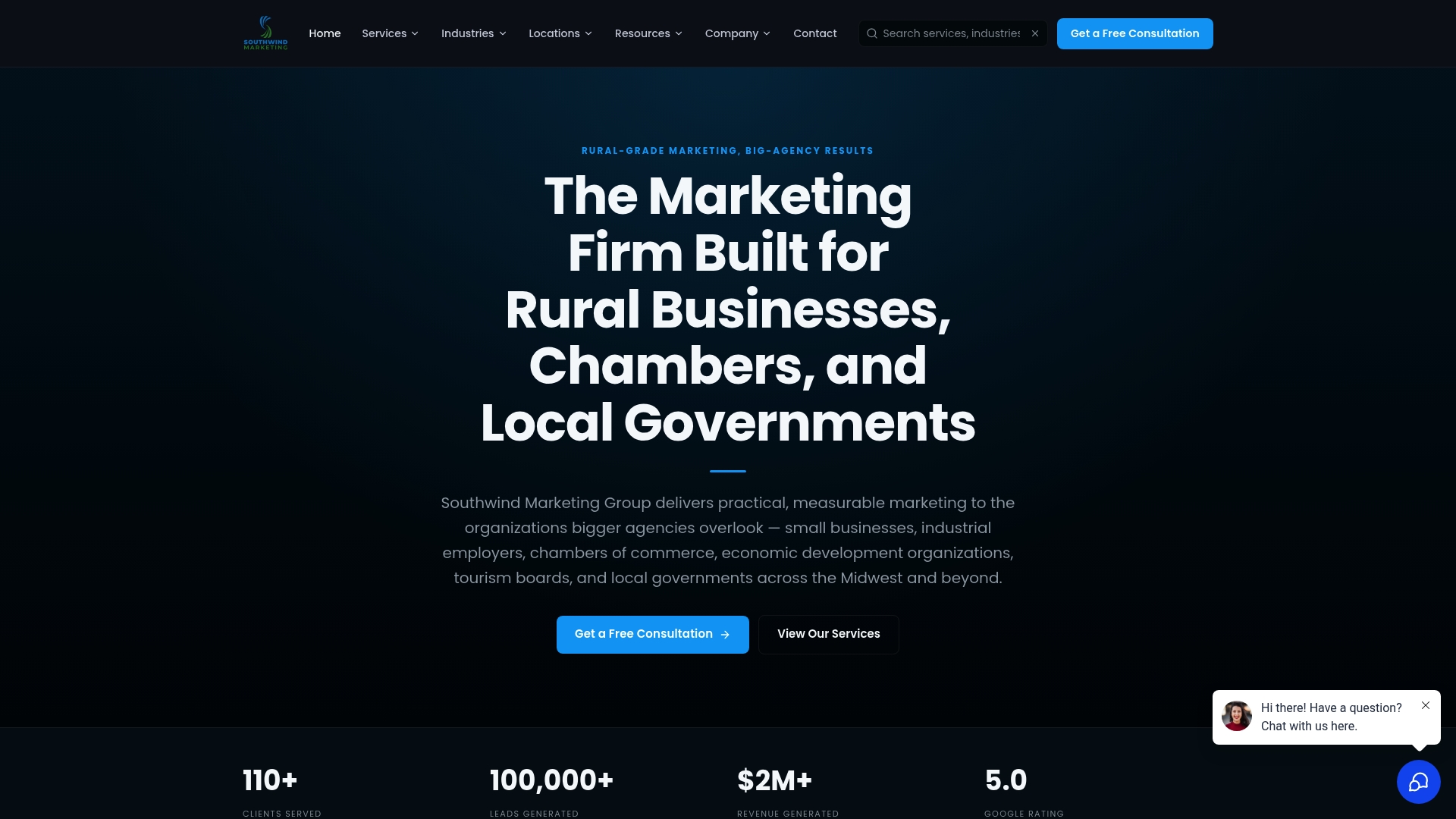
The full service stack includes website design, Southwind Guardian℠ managed hosting, Southwind Signal℠ SEO and content automation, Southwind Connect℠ CRM and mass notification, Southwind Cloud℠ Microsoft 365 and fractional IT, and Civic Intelligence℠ resident and stakeholder surveys. These are not add-ons. They are the infrastructure that keeps a community's digital presence working after the site launches. You can see the industries Southwind Marketing serves and the portfolio of community websites to evaluate whether the work matches your needs.
Southwind Marketing provides all of these services directly. The starting point for most community clients is a free 10-minute website and visibility audit that identifies the highest-priority gaps before any project scope is written. Request your free audit and get a clear picture of where your site stands today.
Useful resources for verifying technical and procurement claims
| Resource | How it helps |
|---|---|
| Google Mobile-Friendly Test | Test any page for mobile usability issues before or after launch. |
| Google Business Profile support | Official guidance for verifying and managing your local business listing. |
| Moz local website guide | Structured best practices for local content, contact signals, and on-page SEO. |
| Mule Digital rural web designer guide | Checklist for evaluating web designers specifically for small-town and rural clients. |
| Local SEO best practices guide | Practical SEO checklist for small businesses covering citations, GBP, and on-page signals. |
| Southwind website audit checklist | Self-audit tool to identify gaps before talking to vendors or reviewing proposals. |
Sources
- Building Your Local Website Design for Business | Local SEO
- Google Business Profile support
- Google Mobile-Friendly Test (Search Console)
- How to Choose a Web Designer for a Small-Town Business · Mule
FAQ
Is web design still in demand for local businesses?
Yes. Local businesses and community organizations increasingly rely on their websites as primary economic tools, from attracting site selectors to converting local search traffic into customers or members.
How much does it cost to build a local business website?
A basic small-business site typically runs $3,000–$8,000. Chamber and EDO sites with local schema, CMS configuration, and staff training generally land in the $8,000–$18,000 range. Municipal or feature-rich EDO sites with GIS and full accessibility remediation can reach $20,000–$40,000 or more.
What is the three-second rule in web design?
Pages that take longer than three seconds to load on a mobile connection lose a significant share of visitors before they ever see your content. Require page load time under three seconds as a contract deliverable, verified with Google Search Console.
Is copying a website design illegal?
Copying another site's design, code, or content without permission generally constitutes copyright infringement. Original design and original content are protected. Always commission original work and confirm your vendor is not reusing licensed templates without proper rights.
How do I find the right web designer for a rural community or EDO?
Request a portfolio of live sites built for similarly sized communities, ask for an accessibility compliance report, and verify that the vendor understands local schema, Google Business Profile setup, and site-selector content requirements. Sector experience matters more than geographic proximity.