

Negotiate incentives by setting defensible ROI thresholds before the first meeting, tying every payment to verified performance milestones, and protecting taxpayers with clawback provisions that trigger automatic recapture if commitments fall short. The six rules that separate effective community incentive negotiation from costly mistakes are: (1) set a clear ROI threshold before talks begin, (2) require pay-for-performance with tranched disbursements, (3) apply a but-for test and document it, (4) include clawback and recapture provisions in every contract, (5) coordinate regionally to avoid a race to the bottom, and (6) require annual monitoring and public reporting. Carry this list to your first meeting and do not deviate from it.
- Set a minimum ROI threshold (net new tax revenue vs. incentive cost) before any offer is made.
- Confirm the but-for gap with the prospect's own pro forma and lender letters.
- Structure all payments as performance-based tranches, never upfront flat grants.
- Write clawback triggers, repayment formulas, and collateral requirements into the contract.
- Brief your council privately before the public hearing.
- Publish monitoring results annually so residents can see what the community received.
Pro Tip: For rural communities with limited cash reserves, site preparation investments and workforce training grants often deliver more competitive advantage than cash grants, with far lower long-term fiscal exposure. Consider structuring a Community Benefits Agreement (CBA) that captures broadband, workforce housing, or local hiring commitments before any cash incentive is discussed.
Key Takeaways
Effective community incentive negotiation requires pay-for-performance structures, documented but-for justification, enforceable clawback provisions, early council engagement, and annual public reporting to protect taxpayer dollars and build lasting community value.
| Point | Details |
|---|---|
| Set ROI thresholds first | Define the minimum net fiscal return before any offer is made or any meeting is scheduled. |
| Pay-for-performance only | Tie every disbursement to verified jobs, wages, or capital investment — never pay upfront flat grants. |
| Clawbacks in every contract | Write trigger events, repayment formulas, and collateral requirements into the agreement before signing. |
| Brief council before hearings | Private briefings before public hearings turn council members into advocates, not liabilities. |
| Southwind Marketing for transparency | Civic Intelligence℠ surveys and Southwind Signal℠ dashboards make annual monitoring and public reporting manageable for small ED offices. |
Table of Contents
- How do you negotiate incentives for your community step by step?
- What types of incentives should your community offer?
- How do pay-for-performance structures protect your community?
- What is the but-for test and how do you document it?
- When and how should you use Community Benefits Agreements?
- How do you monitor and enforce incentive agreements?
- What negotiation tactics work and what mistakes should you avoid?
- How do you present incentive terms to win council and taxpayer buy-in?
- Three deal structures that protected communities while winning the project
- How rural communities should adapt these negotiation practices
- What rural ED directors actually get wrong about incentive negotiation
- Southwind Marketing supports your incentive transparency and communications
- Sources
- FAQ
How do you negotiate incentives for your community step by step?
A defensible negotiation follows six chronological phases. Skipping any one of them is where deals go sideways or taxpayers get shortchanged.
Phase 1: First contact. Listen before you offer anything. Your job in the first meeting is to understand the prospect's financial drivers, timeline pressure, and site requirements. Do not volunteer non-statutory incentives. Ask what is driving the location decision and what the project's biggest cost barrier is. Experienced practitioners diagnose the project's true bottleneck — permitting speed, workforce availability, energy costs — before targeting any subsidy to close that specific gap.

Phase 2: Qualification. Before drafting a term sheet, confirm the funding gap exists. Request the prospect's pro forma, any lender commitment letters, and a list of competing sites under consideration. Run a preliminary but-for test: would this project proceed at this location without public assistance? If the answer is clearly yes, the incentive is a gift, not an investment.
Phase 3: Proposal. Draft a conditional, performance-based term sheet. Every benefit should be tied to a measurable outcome: jobs created at or above a defined wage, capital investment verified by building permits, or payroll records confirmed by a third party. Avoid open-ended language. Contracts that rely on vague language lose enforceability; define technical terms, list measurable commitments, and spell out the monitoring methodology within the agreement itself.

Phase 4: Public process. Schedule council briefings at least two weeks before any public hearing. Prepare plain-language materials that explain the deal in one page. State law in most jurisdictions requires a public hearing before approving a tax abatement or TIF district; check your state's enabling statute and calendar accordingly.
Phase 5: Contracting. The signed agreement must include defined performance metrics, a monitoring schedule, the name or category of the third-party verification vendor, clawback triggers, repayment formulas, and the remedies available if obligations are missed. Assemble a multidisciplinary team — legal, fiscal, and technical — to review the final document before execution.
Phase 6: Post-signature. Implement annual compliance checks. Collect data submissions from the company, conduct or commission third-party verification, and publish a brief public report. If metrics are missed, follow the escalation steps written into the contract rather than renegotiating informally.
- First contact: listen, gather financial drivers, avoid premature offers.
- Qualification: verify the funding gap and run a preliminary but-for test.
- Proposal: tie every benefit to a measurable, time-bound outcome.
- Public process: brief council early, schedule required hearings, distribute plain-language materials.
- Contracting: include metrics, monitoring, verification, and clawbacks.
- Post-signature: annual compliance, third-party verification, public reporting.
Pro Tip: Before your second meeting with any prospect, pull their state-level incentive eligibility. Many projects qualify for enterprise zone credits or state workforce training funds that cost your local budget nothing. Layering statutory incentives first reduces the discretionary local package you need to offer.
What types of incentives should your community offer?
Not all incentive tools carry the same fiscal risk. Understanding the difference between statutory and discretionary instruments is the foundation of sound community incentive negotiation.
Statutory incentives are available as a matter of law when a project meets defined criteria. Examples include state income tax credits, enterprise zone benefits, and state-administered workforce training funds. Your community does not control the terms; the state sets them. Your job is to know which programs apply and help the prospect qualify.
Discretionary local incentives are negotiated case by case. These include local tax abatements, Tax Increment Financing (TIF) districts, direct cash grants, site preparation and infrastructure investments, fee waivers, and utility rate incentives. Because you control the terms, you also bear the risk of structuring them poorly.
Non-cash incentives such as site preparation, infrastructure, and workforce training often deliver competitive advantage with lower long-term fiscal exposure than large cash grants. For rural communities with constrained budgets, this distinction matters enormously in practice.
| Incentive Type | Typical Use Case | Relative Fiscal Risk |
|---|---|---|
| Tax abatement | Manufacturing, distribution, large capital investment | Medium — revenue foregone, not cash out |
| TIF district | Redevelopment, infrastructure-heavy projects | Medium-High — long commitment horizon |
| Cash grant | Rarely justified; gap-filling only | High — cash out, hard to recover |
| Site prep / infrastructure | Industrial parks, shovel-ready sites | Low-Medium — builds lasting community asset |
| Workforce training grant | Manufacturing, healthcare, tech | Low — tied to verified hires and wages |
| Fee waivers / expedited permitting | Small business attraction, infill development | Low — minimal direct cost |
| Utility incentives | Energy-intensive operations | Low-Medium — rate-based, recoverable |
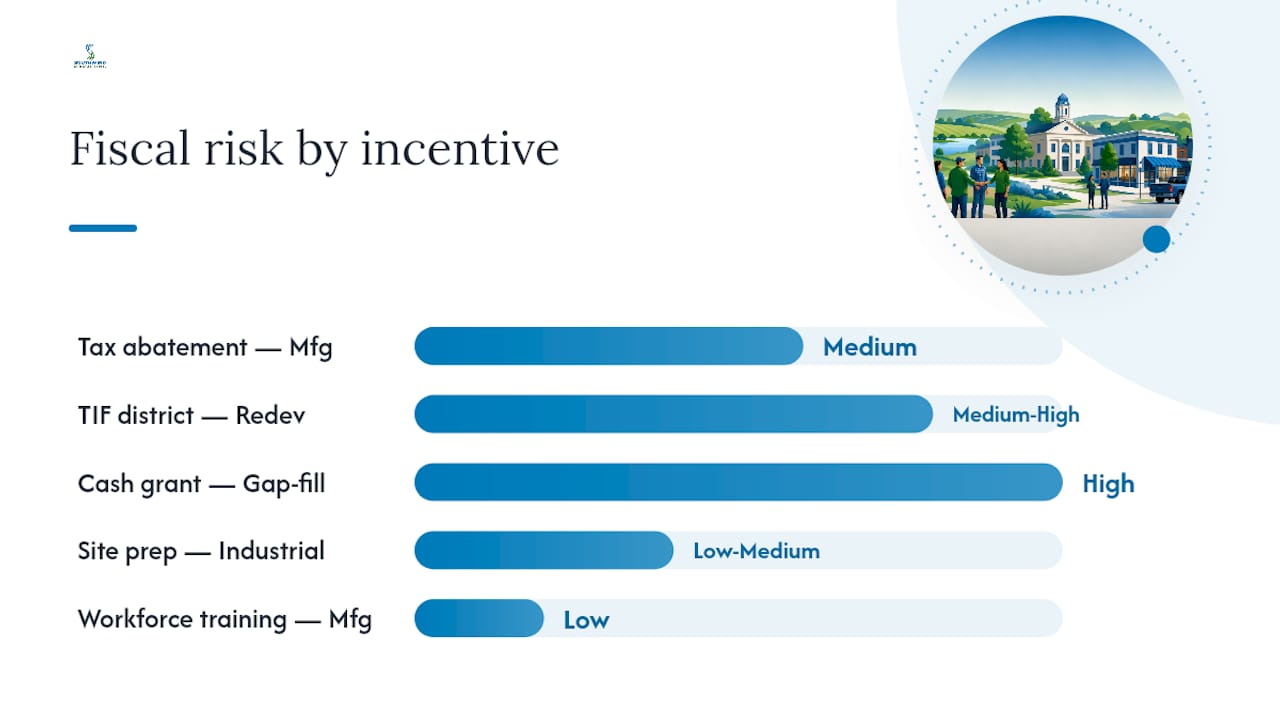
Rural communities should prioritize site preparation, workforce training, and CBAs. These build lasting local assets regardless of whether the specific project succeeds long-term. Long-term unrestricted cash grants should be used rarely, if at all, and only when every other instrument has been exhausted and the but-for case is airtight.
How do pay-for-performance structures protect your community?
Pay-for-performance is the single most important structural decision in any incentive package. It shifts the risk from the public to the private sector, where it belongs.
Designing the performance framework. Define the eligible metrics before negotiations begin: number of full-time jobs, average wage at or above a defined threshold (often county median wage), verified capital expenditure, and local procurement percentage. Set verification windows — typically annual, tied to a specific date — and specify who verifies: payroll records, building permits, or a third-party auditor. Structuring incentives as pay-for-performance and assembling a multidisciplinary legal, fiscal, and technical team is a best practice to minimize public financial exposure.
Tranching the package. Rather than a single disbursement, break the incentive into stages. A common structure: an initial site-prep or permitting support tranche that is delivered at groundbreaking (low risk, tied to a physical milestone), followed by performance-based rebates paid annually as job and wage benchmarks are verified. This approach keeps the community's exposure manageable at every stage.
Clawback and recapture provisions. Every contract needs them. Define the trigger events clearly: failure to reach the job threshold by year three, wage levels dropping below the benchmark, or the facility closing within the incentive period. Specify the repayment formula (prorated or full recapture depending on how far short the company fell), whether interest accrues, and what collateral or security the company must provide. Best practice is to govern incentives with contracts that include clawback provisions, clear public hearing requirements, and documented fiscal feasibility to protect taxpayers.
- Eligible metrics: jobs, wages, capital expenditure, local procurement.
- Verification: annual windows, third-party auditor or payroll records.
- Tranches: site-prep first, performance rebates annually thereafter.
- Clawback triggers: missed job targets, wage decline, early closure.
- Repayment: prorated formula, interest on delayed repayment, collateral required.
Monitoring matters as much as contract design. A well-written clawback clause is worthless if no one checks the numbers. Communities that skip annual verification consistently fail to recover incentive dollars when companies underperform.
Pro Tip: When a company asks to extend the incentive period, negotiate an extension only in exchange for incremental capital investment commitments — a new production line, an additional hiring tranche, or a broadband infrastructure contribution. Open-ended duration extensions with no new obligations are a common way public value quietly disappears.
What is the but-for test and how do you document it?
The but-for test is the evidentiary foundation of any defensible incentive. It answers one question: would this project happen at this location, at this scale, without public assistance? If the answer is yes, the incentive is not justified.
Evidence that supports a but-for finding. The strongest documentation includes the prospect's own pro forma showing a financing gap, a lender letter indicating the project cannot close conventional financing without the incentive, a list of competing sites and their cost differentials, and a written statement from the company explaining why the gap exists. Verbal assurances are not evidence. Get it in writing.
Independent third-party feasibility studies reduce political risk significantly. When a council member asks "how do we know this is real?", the answer is a signed report from a credentialed fiscal analyst, not a staff memo. That distinction holds up in public hearings and in the press.
- Collect the prospect's pro forma and lender letters before drafting any offer.
- Document competing sites and cost differentials.
- Prepare a three-scenario fiscal table for council materials.
- Commission a third-party feasibility study for large or complex packages.
- Keep all documentation in the project file for audit and GASB 77 reporting purposes.
When and how should you use Community Benefits Agreements?
A Community Benefits Agreement is a legally binding contract between a developer and a community coalition that requires the developer to deliver specific public benefits as a condition of the project proceeding. It differs from an impact mitigation payment, which is typically a one-time fee. A CBA creates ongoing obligations: local hiring targets, workforce housing units, broadband infrastructure, or an endowed community fund with annual distributions.
When a CBA makes sense. Use a CBA when the project is large enough to generate meaningful leverage, when the community has identified specific unmet needs (workforce housing, broadband, training), and when a coalition of stakeholders can credibly represent those interests at the table. CBAs can be adapted for rural projects to capture long-term benefits such as workforce housing or broadband, often using seed funding and annual payments.
Practical mechanics. Form a coalition of local stakeholders before negotiations begin — workforce development boards, housing authorities, school districts, and civic organizations. Structure the CBA to require an upfront seed fund contribution at groundbreaking, followed by annual revenue-sharing payments tied to project milestones. Enforce the CBA through the development agreement or as a condition of zoning approval; state law limits vary, so have legal counsel review the enforcement mechanism before you commit to it. CBAs can require endowments or annual payments; legal limits vary by state and counsel should review.
- Form a coalition before negotiations, not after.
- Define specific, measurable community benefits (housing units, broadband miles, training slots).
- Require an upfront seed fund plus annual milestone payments.
- Enforce via development agreement or zoning condition.
- Review with legal counsel for state-law compliance.
Pro Tip: *A rural CBA does not need to be complex.
A rural data center project in the Midwest negotiated a CBA that required the developer to fund a $200,000 broadband extension to an underserved township as a condition of receiving a 10-year tax abatement. The broadband infrastructure remained community property regardless of whether the company renewed its lease — a permanent public benefit from a time-limited private deal.**
Consider running a resident engagement strategy before finalizing CBA terms so the community priorities you negotiate actually reflect what residents want, not just what staff assumes they want.
How do you monitor and enforce incentive agreements?
Monitoring is where most communities fail. A well-drafted contract with no enforcement follow-through is a press release, not a protection.

Annual compliance schedule. Set a fixed annual date for data submissions from the company. Required documents typically include certified payroll records, building permit records for capital investment verification, and a signed compliance certification from an authorized company officer. Within 60 days of receiving submissions, conduct or commission third-party verification. Schedule at least one site visit per year for large agreements.
Enforceable remedies and escalation steps. Write a clear escalation ladder into the contract: (1) written notice of deficiency, (2) a cure period (typically 90 days), (3) withholding of the next incentive payment, (4) formal demand for recapture, (5) lien or reversion of any community-owned assets transferred to the company. Do not skip steps, and do not renegotiate informally when a company misses a target. The contract exists precisely for this moment.
GASB 77 reporting. Under GASB Statement 77, local governments must disclose tax abatements in their annual financial statements, including the gross dollar amount of taxes abated and the commitments made by the recipient. Compliance is not optional. Accurate GASB 77 reporting also builds public trust by showing residents that the community tracks what it gives away. Publishing incentive policies, goals, and reporting builds transparency and accountability and helps smaller businesses access programs.
- Annual data submissions: payroll records, building permits, compliance certification.
- Third-party verification within 60 days of submission.
- At least one annual site visit for large agreements.
- Escalation ladder: notice, cure period, payment withholding, recapture demand, lien.
- GASB 77 disclosure in annual financial statements.
Pro Tip: Use Civic Intelligence℠ resident surveys and Southwind Signal℠ data dashboards to publish monitoring progress in plain language on your EDO or city website, leveraging how to measure brand awareness using AI analytics for effective community insight. Residents who can see what the community received — jobs, wages, tax revenue, broadband miles — are far more supportive of future incentive packages.
What negotiation tactics work and what mistakes should you avoid?
Tactics and mistakes are two sides of the same coin. The tactics below are drawn from what experienced ED directors do; the mistakes are what everyone else does.
Tactics that work. Start every negotiation by listening. Ask the prospect what their biggest operational risk is, not what incentive they want. Probe time sensitivity: a company with a board-mandated site decision in 90 days has less leverage than one with a two-year runway. Use regional coordination to your advantage — if neighboring communities have agreed not to poach each other's existing employers, you can negotiate from a position of regional stability rather than desperation. Push non-cash benefits first: expedited permitting, a shovel-ready site, a workforce pipeline agreement. Cash is a last resort, not a first offer.
Concessions worth making. A limited-duration tax abatement tied to a clear capital investment threshold is a reasonable concession. A fee waiver for a project that fills a vacant industrial building is low-cost and high-signal. These are bounded, time-limited, and tied to something real.
Concessions to avoid. Open-ended cash grants with vague job targets. Incentive periods that automatically renew without new performance commitments. Verbal side agreements that never make it into the contract.
Common mistakes. Offering incentives in the first meeting signals desperation and anchors the negotiation at a higher cost than necessary. Competing purely on the size of the cash package against other communities is a race you will lose and should not enter. Failing to involve council early enough creates surprise votes that kill projects at the finish line. Not documenting the but-for rationale leaves the community legally exposed and politically vulnerable.
- Lead with non-cash benefits: site prep, permitting, workforce pipeline.
- Probe time sensitivity before making any offer.
- Coordinate regionally to reduce harmful competition.
- Avoid open-ended cash grants and auto-renewing incentive periods.
- Never offer incentives before confirming the but-for gap.
- Brief council before the public hearing, not during it.
Pro Tip: Always prepare a second package with stricter performance metrics and a shorter incentive period. If the prospect pushes back on your first offer, you can move to the alternative package rather than simply lowering the bar. It demonstrates flexibility without sacrificing accountability.
How do you present incentive terms to win council and taxpayer buy-in?
The best-structured deal in the world fails if council members do not understand it or feel blindsided by it. Presentation is not a formality; it is a negotiation tactic.
Structure the recommendation clearly. Open with one sentence: what you are recommending and what the community gets. Follow with the public benefits (jobs, wages, tax revenue, capital investment) and the net fiscal picture (cost, payback timeline, downside exposure). Then explain the risk mitigations: clawbacks, verification, and the escalation ladder. Council members need to be able to explain this deal to a constituent in a parking lot. If they cannot, the materials are not clear enough.
The three-scenario fiscal table. Every council briefing should include a best-case, base-case, and downside scenario. This is not pessimism; it is responsible governance. It also demonstrates that staff has thought through the risk, which builds council confidence.
Before the public hearing. Distribute a one-page FAQ to council members at least one week in advance. Brief each member privately, individually if possible, so they can ask questions without an audience. A council member who understands the deal before the hearing is an advocate; one who hears it for the first time at the dais is a liability. Experienced negotiators brief elected officials before public hearings and use clear, jargon-free decision memos so council members can advocate the deal to constituents without surprises.
Transparent incentive policies and published reporting also help smaller businesses understand what programs are available, which broadens community support for the overall incentive framework. Publishing incentive policies, goals, and reporting builds transparency and accountability and helps smaller businesses access programs; regional coordination reduces harmful competition.
- One-sentence recommendation at the top of every briefing document.
- Three-scenario fiscal table: best, base, downside.
- Plain-language FAQ distributed one week before the hearing.
- Private briefings for each council member before the public hearing.
- Single-page decision memo: the ask, the benefits, the voting options.
Pro Tip: *Frame the decision memo around what the community keeps, not what it gives up.
Three deal structures that protected communities while winning the project
These examples are modeled on common U.S. local-government deal patterns. They illustrate how the principles above work in practice.
Example 1: Site-prep plus performance-based rebate with clawback
A rural Oklahoma town with a vacant industrial site attracted a food processing company by investing $180,000 in site preparation (grading, utility stub-outs, road access) rather than offering a cash grant. The site prep was funded through an existing revolving loan fund and delivered at groundbreaking. The company then received an annual property tax rebate, paid only after verified payroll records confirmed at least 45 full-time jobs at or above the county median wage. A clawback clause required full repayment of the site-prep investment if the facility closed within seven years.
Key contract clauses: verified job count by certified payroll, prorated rebate schedule, seven-year clawback on site-prep costs, annual third-party verification.
Council summary line: "We invested in our own industrial site, not in the company. The rebate only pays out when the jobs are real and the wages are verified."
Example 2: CBA with endowed community fund plus conditional tax abatement
A Midwest county negotiated a CBA alongside a 10-year tax abatement for a logistics facility. The CBA required the developer to contribute $25,000 annually to an endowed community workforce training fund, beginning in year two and continuing for the life of the abatement. The fund was governed by a board that included the community college, the workforce development board, and two at-large community members.
Key contract clauses: annual CBA payment tied to employment threshold, endowed fund governance structure, proportional abatement reduction for missed targets, development agreement enforcement.
Council summary line: "The tax abatement is tied to jobs. The CBA payment builds a workforce fund that stays in this community permanently, regardless of what happens to the company."
Example 3: Workforce training grant paid after verified hires and wages
A small Kansas city offered a $75,000 workforce training grant to a precision manufacturing company, structured as three tranches of $25,000 each. The first tranche was released after 15 verified new hires at or above $18 per hour, confirmed by payroll records submitted to a third-party CPA. The second tranche required 30 verified hires at the same wage floor. The third tranche required 30 hires maintained for 12 consecutive months. The contract named the verification vendor, specified the data format for payroll submissions, and included a clawback requiring full repayment if the facility closed within five years of the final disbursement.
Key contract clauses: three-tranche disbursement tied to verified hire counts and wage floor, named third-party CPA for verification, five-year clawback on full grant amount, specific data submission format.
Council summary line: "We pay for results, not promises. The company gets the grant only after the jobs exist and the wages are confirmed by an independent auditor."
Pro Tip: In each of these examples, the community's strongest protection was specificity. Vague contracts get renegotiated. Specific contracts get enforced. Write the metrics, the verification method, and the clawback formula into the agreement before you sign.
How rural communities should adapt these negotiation practices
Rural communities face a specific set of constraints that change the negotiation calculus. Smaller tax bases mean less room for error. Thinner staffing means monitoring has to be designed for efficiency from the start. And the projects worth competing for are often ones where site readiness and workforce availability matter more than the size of a cash package.
Prioritize capacity-building incentives. Site preparation, broadband infrastructure, and workforce training grants build lasting local assets. A shovel-ready industrial site attracts the next prospect even if the first one falls through. A workforce training fund outlasts any single employer. These instruments align with what rural communities actually have to offer: land, community commitment, and a workforce that wants to stay if the wages are right.
Use CBAs to capture long-term value. Rural communities often have less political leverage than urban ones, but large projects still need local cooperation on permitting, utilities, and workforce. That cooperation is leverage. Use it to negotiate CBA provisions that fund broadband extensions, local hiring preferences, or contributions to a community development fund. CBAs and related tools enable communities to secure long-term community investments and can be enforced via MOUs or development agreements, though state law may limit some local requirements.
Southwind Marketing tools in the monitoring workflow. Small ED offices can run effective monitoring with limited staff by building the right systems upfront. Civic Intelligence℠ resident surveys give you a structured way to measure whether residents perceive the promised benefits materializing. Southwind Signal℠ data dashboards let you publish monitoring results publicly without building a custom reporting system. Southwind Connect℠ handles stakeholder notifications when compliance reports are released. Southwind Guardian℠ keeps your EDO website running reliably so those reports stay accessible. For a deeper look at how rural EDOs can structure the policy side, see how rural EDOs should structure an incentive policy.
Operational checklist for small ED offices:
- Assign one staff member as the annual compliance lead before the contract is signed.
- Build the monitoring calendar into the contract (submission dates, verification deadlines, public report dates).
- Use payroll records and building permits as primary verification data — they are hard to dispute.
- Run a Civic Intelligence℠ pulse survey 12 months after a major project opens to capture resident perception.
- Publish a one-page annual summary on your EDO website using Southwind Signal℠ content tools.
- Use Southwind Connect℠ to notify stakeholders when the annual report is available.
Pro Tip: If your office has only one person handling ED work, design the monitoring process so it requires no more than eight hours per year per agreement. That means specific data formats, a named verification vendor, and a pre-built report template. Complexity is the enemy of compliance in a small office.
What rural ED directors actually get wrong about incentive negotiation
Most of the costly mistakes in community incentive negotiation are not legal errors or financial miscalculations. They are sequencing errors. The incentive gets offered before the need is confirmed, the council gets briefed after the deal is already structured, and the monitoring plan gets written after the contract is signed rather than into it.
The other pattern worth naming: rural communities often undervalue what they already have. A site that is zoned, graded, and utility-ready is worth more to a distribution company than a cash grant that arrives in year three. A workforce pipeline agreement with the local community college is worth more to a manufacturer than a fee waiver. The communities that negotiate the best deals are the ones that know their own assets and lead with them, rather than opening with a cash offer and hoping it is enough.
Pay-for-performance is not a bureaucratic formality. It is the mechanism that keeps the community's interests aligned with the company's performance for the entire life of the agreement. Every dollar paid out under a well-structured incentive is a dollar the community chose to spend because the jobs and wages were real and verified. That is a fundamentally different posture than writing a check and hoping for the best.
Southwind Marketing supports your incentive transparency and communications
Rural EDOs and city governments that negotiate strong incentive packages still need to communicate those deals clearly to residents, council members, and future prospects. That is where Southwind Marketing fits into the workflow.
Southwind Marketing works with economic development organizations and local governments across rural America to build the communications infrastructure that makes incentive transparency practical. Civic Intelligence℠ gives you a structured resident survey program to measure whether community benefits are being perceived and valued. Southwind Signal℠ publishes monitoring results and incentive policy updates through automated content tools that keep your site current without adding staff hours. Southwind Connect℠ handles stakeholder notifications when compliance reports drop or public hearings are scheduled. For communities that need stronger local government communications support, Southwind builds the full stack: website, content, resident engagement, and reporting.
Request a free 10-minute audit of your current incentive communications and public reporting setup. We will tell you exactly where the gaps are and what it would take to close them.
Sources
- Negotiating economic development agreements — GFOA
- The Ideal Deal: How Local Governments Can Get More for Their Economic Development Dollar — University of Michigan Repository
- Improving local development incentives — CMAP Local Incentives Guide
- Local Government Incentives in North Carolina — Hazeldine & Callan, UNC Public Policy
- Credits and incentives handbook — Opportunity Louisiana
This article is general information, not a substitute for advice from a qualified financial advisor. Consult a qualified financial professional about your own circumstances before acting on anything here.
FAQ
What is the but-for test in economic development incentives?
The but-for test asks whether a project would proceed at a given location without public assistance. A project passes the test when the developer can demonstrate a documented funding gap, typically through a pro forma and lender letters, that the incentive is designed to close.
What is a Community Benefits Agreement and how does it work?
A CBA is a legally binding contract between a developer and a community coalition requiring the developer to deliver specific public benefits, such as local hiring, workforce housing, or broadband, as a condition of the project. It is enforced through the development agreement or zoning conditions, and legal limits vary by state.
What does the 80/20 rule mean in incentive negotiation?
For incentive negotiations, that means the performance metrics, clawback triggers, and verification requirements carry most of the protective weight; the specific dollar amount of the incentive matters less than how tightly those terms are written.
What is GASB Statement 77 and why does it matter?
GASB Statement 77 requires local governments to disclose tax abatements in their annual financial statements, including the gross amount of taxes abated and the commitments made by the recipient. Compliance is mandatory for governments that follow Generally Accepted Accounting Principles, and accurate reporting builds public trust by showing residents what the community gave and what it received in return.
How do you structure a pay-for-performance incentive package?
Tie every disbursement to a verified outcome: jobs created at or above a defined wage, capital investment confirmed by building permits, or payroll records reviewed by a third-party auditor. Break the package into tranches, deliver site-prep or permitting support first, and release performance-based rebates only after annual verification confirms the metrics were met.