
A realistic budget for a small-city website runs from about $15,000 to $100,000 to build, depending on population and complexity, plus $2,000 to $15,000 a year to keep it running. The number that actually breaks budgets isn't the build. It's accessibility remediation and vendor renewal fees that show up two years after launch, when nobody budgeted for them. Approve a discovery audit now, or set aside a conservative five-year placeholder, before you sign anything.
TL;DR:
- Initial website costs for small cities under 5,000 residents typically range from $15,000 to $40,000, with ongoing annual expenses of $2,000 to $6,000.
- Most budget overruns occur from accessibility remediation and vendor renewal fees two or more years after launch, not during initial build.
- Vendors should be asked to separate quotes for page count, integrations, and document remediation to avoid hidden accessibility costs.
- Planning for a five-year budget—including remediation reserves and recurring monitoring—is essential, as renewal fees and backlog remediation can significantly inflate total costs.
- A discovery audit before contracting helps identify accessibility issues, gives transparent line-item costs, and informs a realistic, sustainable long-term budget.
Table of Contents
- How Much Does a Small-City Website Cost by Population Size?
- Subscription, Custom Agency, or Enterprise Vendor: Which Fits Your City?
- What Actually Drives Your Quote Up or Down
- The Costs That Never Show Up on the First Quote
- Why Accessibility Compliance Belongs in Your Budget Now, Not Later
- Building a Five-Year Budget That Won't Blow Up
- A Short Checklist for Comparing Vendor Proposals
- Why Most Small Cities Budget This Wrong
- How Southwind Marketing Builds Accessible Sites for Small Cities and Tourism Destinations
- Sources
- FAQ
How Much Does a Small-City Website Cost by Population Size?
Cost tracks population and complexity more than anything else. A borough of 3,000 people doesn't need the same platform as a city of 40,000 running online permitting and a public records portal, and vendors price accordingly.
Small boroughs and towns typically see redesigns in the $15,000 to $40,000 range, while mid-size municipalities commonly land between $40,000 and $100,000. Larger projects with heavy integrations can exceed $100,000 before accessibility work even enters the picture.
| Population band | Typical initial build | Typical annual cost | Common approach |
|---|---|---|---|
| Under 5,000 | $15,000 to $40,000 | $2,000 to $6,000 | Subscription platform |
| 5,000 to 40,000 | $15,000 to $40,000 | $2,000 to $6,000 | Subscription or agency build |
| — | $50,000 to $100,000+ | $8,000 to $15,000+ | Agency or enterprise vendor |
A few things to keep in mind when you compare these ranges to a vendor's quote:
- Initial-build ranges usually include design, a set number of template pages, and basic content migration.
- They usually exclude document remediation, custom integrations (GIS, permitting, payments), and staff training.
- Annual figures generally cover hosting, software updates, and basic support, not accessibility monitoring or content overhauls.
- Population bucket for compliance purposes comes from the most recent decennial Census count, not your website's traffic or complexity.
Subscription, Custom Agency, or Enterprise Vendor: Which Fits Your City?
Every small city buys its website through one of three paths, and each one carries a different cost structure and a different set of tradeoffs.
- Subscription platforms. Monthly fees typically run $150 to $800, sometimes scaled per resident, with a one-time onboarding fee layered on top. You get a template, hosting, and basic support bundled together, which works well for towns with limited staff and a need for predictable, board-approved line items every year.
- Custom agency builds. Project budgets generally fall between $20,000 and $80,000, covering custom design, structured content migration, and integrations built to your workflows rather than a template's defaults. Custom makes sense once you need branded storytelling, complex forms, or a site that doesn't look like every other town's CivicPlus install.
- Enterprise or specialist vendors. Costs climb past $100,000 when you're dealing with heavy public-records portals, tax payment systems, or GIS-driven permitting. Cities choose this route when integration complexity, not design, is the driving requirement.
What Actually Drives Your Quote Up or Down
Two proposals for the "same" website can differ significantly in cost, often due to key factors.
- Page count and template flexibility. A 20-page template site costs far less than a custom-built 80-page site with unique layouts for each department.
- Integrations. Online payments, permitting portals, GIS mapping, and forms each add licensing and development cost on top of the base build.
- Document volume. Every PDF, agenda, and ordinance you post has to be accessible, and volume drives cost more than almost anything else.
- Hosting, security, and SLA terms. Uptime guarantees and response-time commitments cost more than bare-bones shared hosting.
- Procurement overhead. RFP management, vendor evaluation, and project management time add real cost even when they don't appear on the invoice.
Pro Tip: Ask every vendor to quote page count, integrations, and document remediation as separate line items. A bundled "flat fee" quote is often hiding a much bigger accessibility bill that surfaces after you've signed.
The Costs That Never Show Up on the First Quote
The initial proposal rarely tells the whole story. These are the line items that tend to appear after the contract is signed, not before.
- Per-document remediation. Complex documents commonly run $30 to $150 per document to remediate. A city with 400 PDFs in its archive can be looking at $12,000 to $60,000 just for the backlog.
- Ongoing accessibility monitoring. Automated scanning and periodic manual checks are a recurring fee, not a one-time cost.
- Staff training and content governance. Someone on your team has to learn to post accessible content correctly, and that takes paid time.
- Transaction fees and third-party licenses. Payment processors and mapping APIs often bill separately from your web vendor.
- Contingency for emergency remediation. A complaint or audit finding can force unplanned work mid-year.
Why Accessibility Compliance Belongs in Your Budget Now, Not Later
The Department of Justice requires municipal websites to meet WCAG 2.1 Level AA, with municipalities under 50,000 residents given until April 26, 2028, and larger entities facing an earlier deadline. That date feels distant. It isn't, once you account for procurement and build time.
Fixing accessibility after launch can cost two to three times more than building it in from the start, because you're paying to redo work instead of doing it once, correctly.
Audit costs cluster into fairly predictable bands. A standalone accessibility audit for a small municipal site typically runs $3,000 to $10,000, while packages bundling audit and remediation support commonly reach $8,000 to $25,000 or more.
A staged approach controls cost better than trying to fix everything at once:
- Run an automated scan first to catch obvious violations cheaply.
- Prioritize manual testing on payment pages, elections information, and public safety content, since those carry the highest legal exposure.
- Remediate templates before tackling the document backlog, since template fixes apply site-wide.
- Budget ongoing monitoring as a permanent line item, not a one-time project.
Building a Five-Year Budget That Won't Blow Up
A typical municipal website project runs six to nine months from discovery through launch: roughly one to two months for discovery and content planning, two to four months for design and build, and one to two months for testing and accessibility remediation before go-live.
- Start procurement 12 to 18 months before your deadline. RFP cycles, board approval, and contract negotiation eat more time than the build itself.
- Calculate your five-year total, not your first-year quote. Add the one-time build cost, four to five years of annual maintenance, ongoing accessibility monitoring, a document-remediation reserve, and a 10 to 15 percent contingency for unplanned fixes.
- Match funding to the expense type. Use operating funds for predictable annual fees and consider bonding or capital funds for the larger one-time build, especially if it exceeds $50,000.
Many local governments are treating the 2028 extension as a limited runway rather than a reprieve, continuing remediation work on the assumption that documented progress matters to enforcement agencies even before the deadline hits.
A Short Checklist for Comparing Vendor Proposals
Before you sign, put every proposal through the same short list of questions. Vague answers here are the biggest red flag in the whole process.
- Does the quote include a written accessibility remediation plan, or just a promise to "be compliant"?
- Who owns the content and code after the contract ends, and what does an exit or migration cost?
- What's included in ongoing maintenance, and what's billed as an extra?
- Is there a per-document remediation rate, or is that cost left undefined?
- What's the SLA for uptime and support response time?
| Evaluation criteria | What to look for |
|---|---|
| Cost transparency | Line-item pricing for build, hosting, and remediation |
| Compliance plan | Written WCAG 2.1 AA remediation approach with timeline |
| Delivery timeline | Realistic 6 to 9 month build window stated in writing |
| Exit terms | Clear content and code ownership, no lock-in penalties |
A proposal that scores poorly on two or more of these usually costs more in year three than it saved in year one.
Why Most Small Cities Budget This Wrong
The conventional advice tells small cities to shop for the lowest sticker price on the initial build. That's backwards. The build is the easiest cost to predict and the smallest piece of your five-year total. The expensive part is what happens in years two through five: renewal fees that jump after an introductory rate expires, a document backlog nobody remediated, and an accessibility complaint that forces emergency work at a premium price.
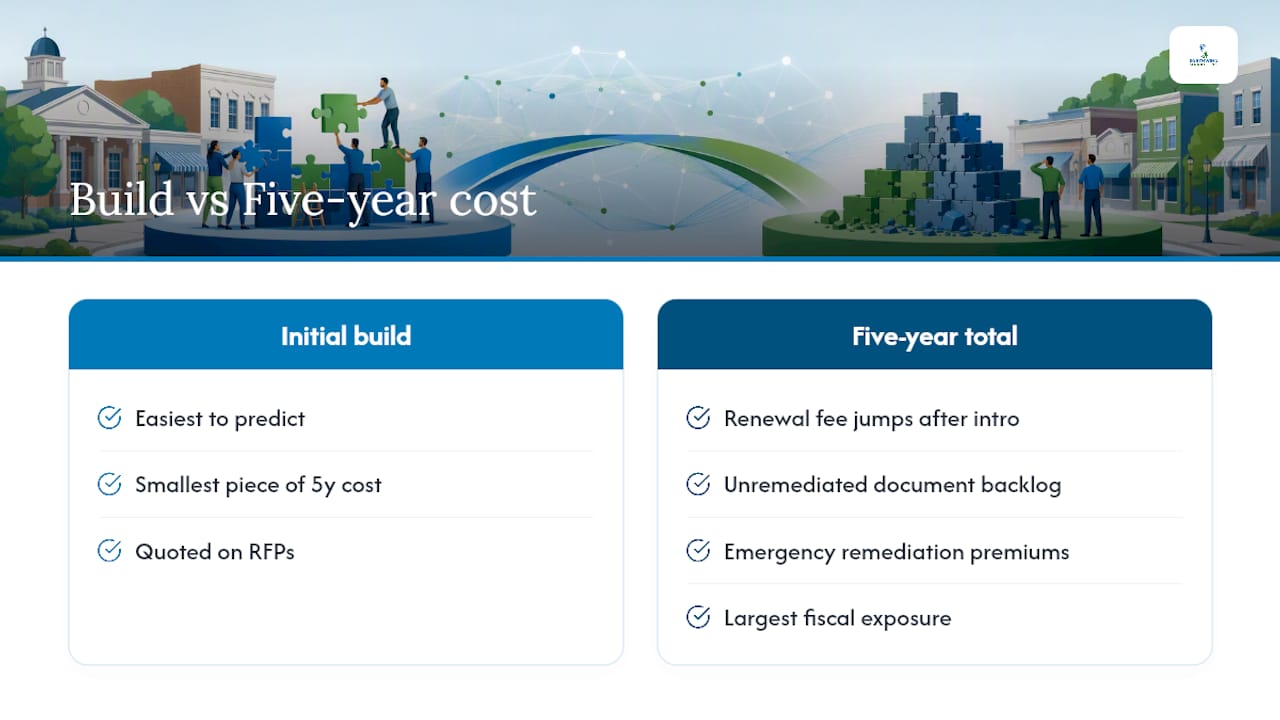
The research is consistent on this point: remediating after the fact costs multiples of doing it right the first time. Yet most RFPs still ask vendors to quote a build price and treat accessibility as an afterthought line item, if it's mentioned at all.
If you take one thing from this, prioritize the vendor's remediation plan and document strategy over their homepage design. A city with 500 unremediated PDFs sitting in an archive has a bigger fiscal exposure than one with a slightly outdated template. Budget for the document backlog before you budget for a new logo, and you'll avoid the surprise invoice that hits in year three.
— Damien Denmark
How Southwind Marketing Builds Accessible Sites for Small Cities and Tourism Destinations
Southwind Marketing is the direct alternative to piecing together a website vendor, a separate accessibility auditor, and a third-party hosting company. We build the site, run the compliance work, and manage what happens after launch, all under one contract with one point of contact.
For small cities, chambers, and tourism boards, that means ADA-first website design built on WCAG 2.1 AA standards from day one, not retrofitted later at two or three times the cost. It also means the pieces that keep a destination's visibility working after launch: SEO and AI search optimization through Southwind Signal, ongoing hosting and maintenance through Southwind Guardian, and CRM and multichannel visitor communications through Southwind Connect. For tourism organizations specifically, that toolkit extends to branding, video and photography, public relations, and social media management built around one goal: driving heads in beds, not just page views. We've applied this same integrated approach across chambers, economic development organizations, and rural communities nationwide, and we bring the same accessibility-first, budget-conscious model to tourism marketing.
Most engagements start with a discovery audit that maps your current site against WCAG 2.1 AA requirements and gives you real, line-itemed numbers for your board before you commit to a phased build or a full redesign. If you're staring down a five-year budget with more unknowns than answers, start with a discovery audit and get numbers you can actually take to a vote.
Sources
- DOJ extends WCAG 2.1 AA compliance deadlines for local governments
- MRSC insight: ADA standards for websites and apps
- New digital accessibility deadline, same obligation (GovTech)
FAQ
How Much Should a Small Website Cost?
A small municipal website typically costs $15,000 to $40,000 to build for populations under 5,000, with annual maintenance running $2,000 to $6,000 once you add accessibility monitoring and hosting.
Is $1,000 a Good Price for a Website?
Not for a municipal site, you're likely getting a bare template with no accessibility remediation, no document migration, and no ongoing support, which usually costs far more to fix later than it saved upfront.
Is $1,500 a Good Price for a Website?
Similar problem, such a price rarely covers WCAG 2.1 AA compliance work, custom content migration, or integrations like payments and forms that most small-city sites need.
What Is the Minimum Cost to Build a Website?
A defensible minimum for a small city sits closer to $15,000, which covers a compliant template build, basic content migration, and a starting accessibility posture. Anything lower usually pushes real costs into an unbudgeted remediation project later.
Do Small Cities Have to Meet the Same Accessibility Deadline as Larger Cities?
No. Municipalities under 50,000 residents have until April 26, 2028 to meet WCAG 2.1 AA, while entities serving 50,000 or more face an April 26, 2027 deadline.