
Your municipality must own its website content outright — the text, images, documents, source code or exportable site files, database records, domain name, and every admin credential. If your current contract does not say that in plain language, you are renting your public presence from a vendor who can hold it hostage.
Three things to do right now:
- Pull your current website contract and search for "intellectual property," "work product," and "ownership." If those words are missing or vague, flag it for your attorney or procurement officer today.
- Request a full content export and take a snapshot of your site. This protects your records regardless of what happens with the vendor relationship.
- If gaps exist, notify your procurement or legal contact before the next renewal date.
This guide translates municipal records law, Section 508 accessibility requirements, and real contract language into a practical checklist for small-town clerks and administrators who do not have a full IT or legal staff.
Key Takeaways
Rural governments must own their website content outright — including text, media, database exports, admin credentials, and domain registration — and must exercise that ownership through regular audits and documented handoff procedures, not just contract language.
| Point | Details |
|---|---|
| Own every asset category | Ownership covers text, images, documents, source code, database exports, domain, SSL, and admin credentials. |
| Contract language is the floor | Require explicit IP assignment, data export terms, admin provisioning, and termination handoff in every vendor contract. |
| Governance makes ownership real | Annual credentials audits, content inventories, and monthly exports turn a contract right into an operational reality. |
| Records retention is a legal obligation | Web content that constitutes official records must be archived per state retention schedules, independent of the vendor. |
| Southwind Marketing builds ownership in | Every Southwind government website engagement includes documented credentials, monthly exports, and a portable CMS by default. |
Table of Contents
- What "content ownership" actually means for your government website
- Why rural governments face the highest risk when ownership is unclear
- Contract clauses every rural government should require
- How ownership works across the three common hosting models
- Content governance for small governments: roles, review cycles, and audits
- Step-by-step vendor exit and migration checklist
- How Southwind Marketing protects content ownership for rural clients
- What the conventional wisdom on municipal website contracts gets wrong
- Southwind Marketing's ownership-first approach to rural government websites
- Sources
- FAQ
What "content ownership" actually means for your government website
Ownership is not just about who wrote the text. When a rural government contracts a website vendor, ownership covers a specific set of assets, and each one matters differently.
Assets your municipality must own:
- Text and content pages — every page of copy, including agendas, minutes, ordinances, and public notices
- Images and multimedia — photos, videos, and graphics created or licensed for your site
- Downloadable documents — PDFs, forms, permits, and reports
- Site design and templates — the visual layout and CSS, not just the content inside it
- Source code or exportable site files — the underlying code, theme files, or a full CMS export in a standard format
- Database exports — structured data in formats like SQL, CSV, or XML that you can import elsewhere
- CMS admin accounts — superadmin credentials that belong to the municipality, not the vendor
- Domain name and DNS control — registered in the municipality's name, not the vendor's
- SSL certificates — tied to your domain and transferable
- Third-party API keys and integrations — accounts for mapping, payment, or notification tools
The practical difference between "posted copy only" and full ownership shows up the moment you try to switch vendors. A town that only has login access to update pages but cannot export the database, transfer the domain, or access the theme files has a rented website, not an owned one.
The records-management angle adds another layer. Wisconsin's Public Records Board guidance classifies web content as either "web content records" or "website administrative records," each subject to its own retention schedule. When your website hosts official records — public notices, permit decisions, meeting minutes — ownership of those records is a legal obligation, not just a best practice. Monterey County's Web Authoring Policy formalizes this by making each department's web authors the custodial owners of their pages, accountable for accuracy and compliance with data privacy rules.
Pro Tip: Ask your vendor to confirm in writing which assets are stored in their proprietary system versus in a portable, standard format. That single question surfaces ownership gaps faster than reading a full contract.
Why rural governments face the highest risk when ownership is unclear
Vendor lock-in is not just an inconvenience. For a small town with one part-time IT contact and a tight procurement budget, losing control of your website can cascade into real service failures.
The four risk categories that matter most:
- Vendor lock-in and shadow technical debt. Custom modules, proprietary page builders, and vendor-controlled deployment pipelines make migration expensive even when you technically "own" the content. As Civic Innovations notes, even open-source platforms can accumulate lock-in through heavy customization — a risk that compounds quietly until you try to leave.
- Public records and legal exposure. If a vendor goes out of business or terminates your contract, and your site hosted official records without a separate archive, you may face retention failures and audit exposure. State public records statutes treat this as a government liability, not a vendor problem.
- Continuity and security risks. Domain loss, lapsed SSL certificates, and inaccessible admin accounts can take a municipal site offline with no clear path to recovery. For a town where the website is the primary channel for emergency notices and resident engagement, that downtime has real consequences.
- Rural-specific compounding factors. Limited procurement budgets mean rural governments often sign multi-year contracts without negotiating exit terms. Scarcity of local IT support means there is no one to execute a migration quickly. And when the website goes down, it affects grant reporting, downtown business visibility, and the economic recruiting tools your community depends on.
The City of Los Angeles web content policy addresses this by requiring that content managers verify compliance and remove policy-violating content — a standard that assumes the municipality controls its own platform. Rural towns deserve the same protection, even without a dedicated web team.
Contract clauses every rural government should require
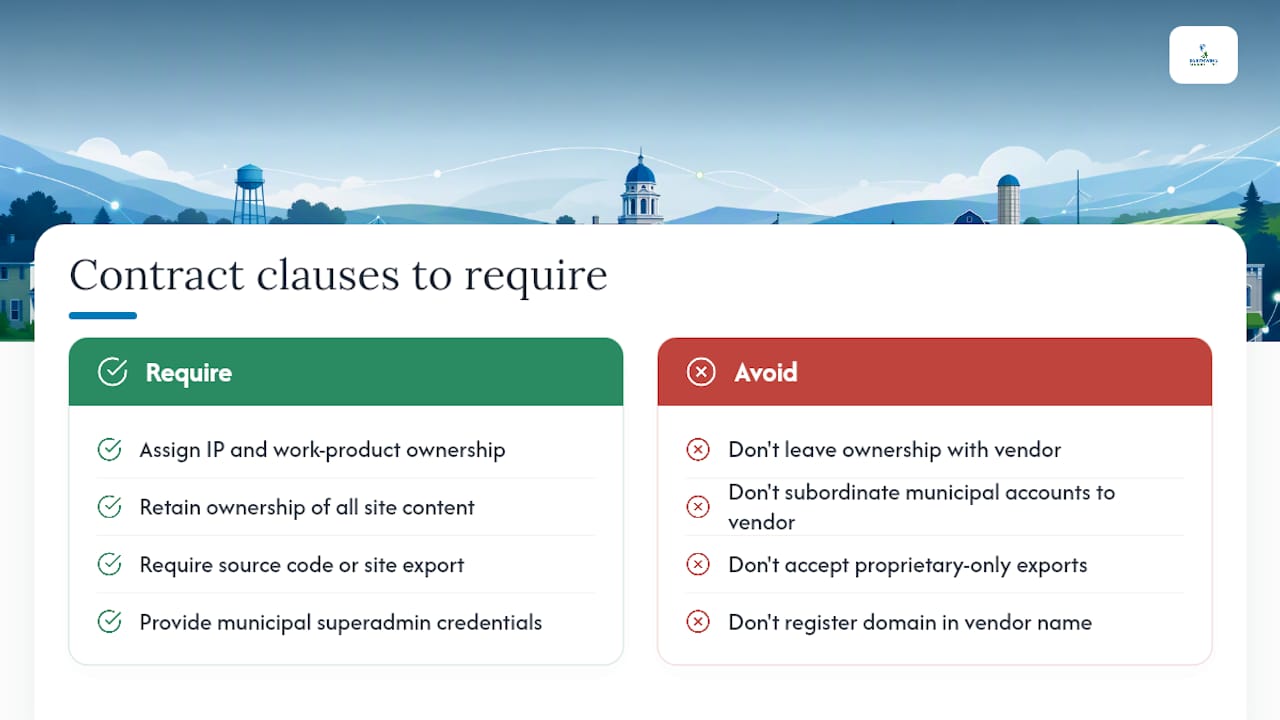
A contract that does not explicitly assign ownership to the municipality leaves that ownership with the vendor by default under most state IP laws. These are the clauses to require before you sign.
1. IP assignment and work-product ownership All deliverables, work product, and developed materials become the sole property of the municipality upon payment. Contractors must turn over all materials and work papers on request. The Richmond, VA / HNTB contract exhibit uses exactly this language and serves as a practical model for smaller governments.
2. Content and asset ownership The municipality retains ownership of all text, images, documents, and media uploaded to or created for the site, regardless of where they are hosted.
3. Source code or exportable site files The vendor must provide either repository access (Git or equivalent) or a full site export in a standard, non-proprietary format within 30 days of request and upon contract termination.
4. Admin account provisioning The municipality receives superadmin credentials for the CMS, hosting control panel, domain registrar, and any third-party integrations. Vendor staff may have their own accounts, but the municipality's account is never subordinate to the vendor's.
5. Domain and DNS transfer terms The domain is registered in the municipality's name. The vendor facilitates transfer within 5 business days of a written request.
6. Database and media export The vendor provides monthly full-site exports in standard formats (SQL, CSV, XML, ZIP of media files). Export frequency and format are specified in the contract, not left to vendor discretion.
7. Backups and escrow The vendor maintains daily backups retained for at least 30 days. For custom-built sites, a code escrow arrangement deposits the source code with a neutral third party, released to the municipality if the vendor ceases operations.
8. Exit and termination rights Either party may terminate with 60 days' written notice. The vendor must complete a documented handoff, including all exports, credentials, and documentation, before the final payment is released.
9. Accessibility and security warranties The vendor warrants that the delivered site meets Section 508 and WCAG 2.1 AA standards at launch and that known security vulnerabilities are patched within a defined SLA window.
10. Records retention and data handling The vendor acknowledges that certain site content constitutes official government records subject to state retention schedules and agrees not to delete or alter records without written authorization.
Boye & Company recommends framing RFPs around these capability outcomes — exportability, standards-based data storage, and vendor transition support — rather than mandating a specific CMS. Naming WordPress or Drupal in an RFP does not guarantee ownership; naming the required capabilities does.
Pro Tip: If a vendor pushes back on code escrow because of cost, propose a staged alternative: escrow triggers only on termination or vendor insolvency, reducing the vendor's administrative burden while still protecting the municipality.
How ownership works across the three common hosting models
The model your vendor uses determines what "ownership" looks like in practice. Each carries different risks.
SaaS / hosted platforms These are subscription-based platforms where the vendor controls the infrastructure, the CMS, and often the theme layer. Content portability varies widely. Some offer data export APIs; others lock content in proprietary formats with no export path. Red flags: no export API, content stored in a format only the platform can read, domain registered to the vendor.
Self-hosted open-source CMS WordPress, Drupal, and similar platforms installed on servers you control offer the strongest ownership baseline. You own the files, the database, and the domain. The risk here is customization: vendor lock-in as shadow technical debt can accumulate through bespoke plugins or themes that only the original developer can maintain. Red flags: custom plugins with no documentation, theme files not included in handoff, vendor-only deployment access.
Managed flat-rate (agency-hosted) services This is the model most rural governments use. The agency builds and hosts the site for a monthly fee. Ownership outcomes depend entirely on the contract. A well-structured flat-rate agreement includes monthly exports, documented credentials, and a clear handoff procedure. A poorly structured one is functionally a rental. The distinction is contractual, not technical.
| Model | Code access | Data export | Admin control | Domain ownership |
|---|---|---|---|---|
| SaaS / hosted platform | Rarely available | Varies by platform | Shared or vendor-controlled | Often vendor-registered |
| Self-hosted open-source | Full access | Full database export | Municipality-controlled | Municipality-registered |
| Managed flat-rate (agency) | By contract | By contract | By contract | Should be municipality-registered |
For managed flat-rate models, the contract checklist in the previous section is your primary protection. Southwind Marketing's rural website design approach builds deliverable-based handoffs and monthly exports into every engagement by default.
Content governance for small governments: roles, review cycles, and audits
Ownership secured in a contract still requires day-to-day governance to stay intact. The City of Sacramento's Web Governance policy assigns a Web Core Team and IT steering committee to handle domain control, accessibility compliance, editorial review, and archiving of obsolete content. That structure scales down to small towns.
Roles for a small-staff government:
- Website administrator — one named person responsible for CMS access, credentials management, and vendor communication
- Department content owners — each department head or designee owns the accuracy of their pages
- ADA/accessibility coordinator — reviews new content for ADA compliance before publication
- IT or web support contact — internal or contracted, responsible for backups and technical issues
- Elected official or manager sign-off — for policy pages, public notices, and records-sensitive content
Annual governance audit checklist:
- Verify all admin credentials are current and assigned to municipality-owned accounts.
- Run a full content inventory — list every page, document, and media file.
- Check that records-sensitive content (minutes, permits, notices) is archived per your state retention schedule.
- Test the site against WCAG 2.1 AA using a tool like WAVE or Axe.
- Confirm domain registration and SSL certificate are in the municipality's name.
- Request a fresh full-site export from your vendor and store it offline.
- Review the vendor contract for upcoming renewal dates and exit terms.
Using a content calendar to schedule these reviews prevents the audit from becoming a once-every-five-years scramble. Monthly check-ins for credentials and quarterly reviews for content accuracy are a realistic cadence for a two-person office.
DigitalGov provides ongoing guidance on UX, accessibility, and content strategy for public sector sites and is worth bookmarking for your governance team.
Step-by-step vendor exit and migration checklist
When a vendor relationship ends, the sequence matters. Moving too fast without the right exports means losing data. Moving too slow means paying for a platform you no longer want.
Recommended sequence:
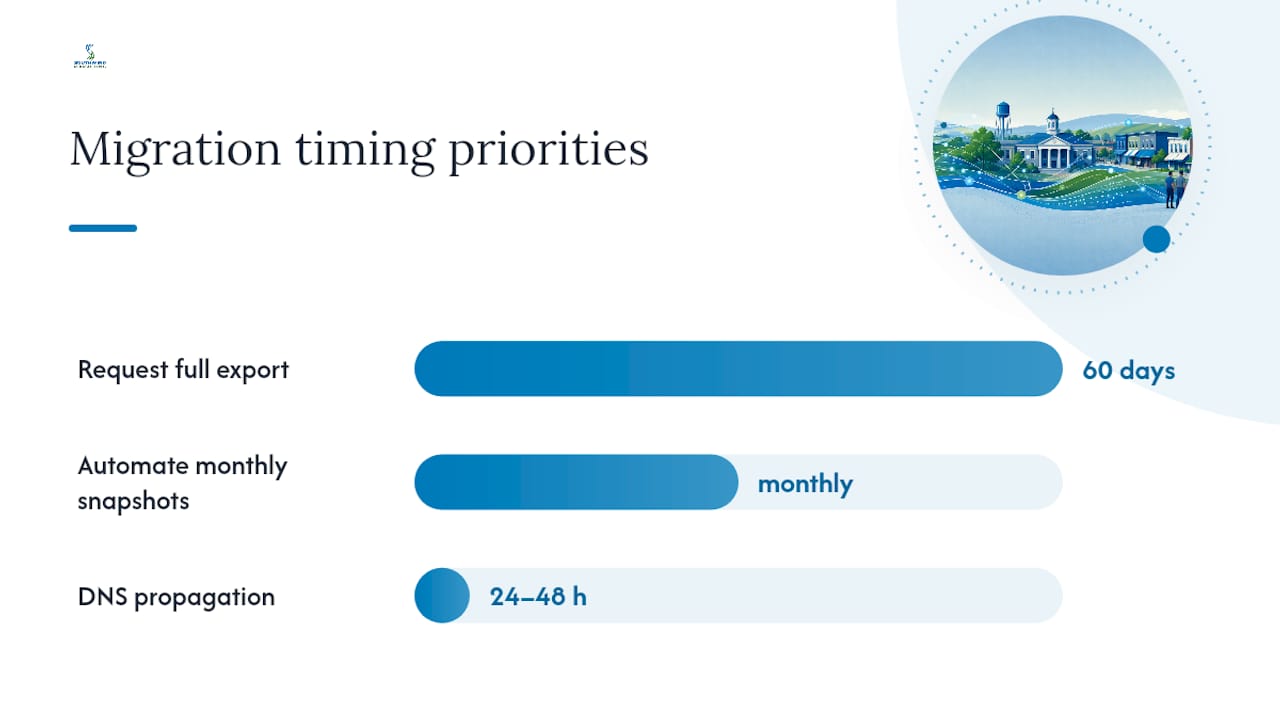
- Request a full site export — all content, media, and database files in standard formats. Do this 60 days before termination, not after.
- Secure DNS transfer authorization — get the domain transfer code from the registrar while the vendor relationship is still active.
- Gather all credentials — CMS superadmin, hosting control panel, domain registrar, SSL, and any third-party integrations (maps, payments, alerts).
- Export content and media in standard formats — HTML or CMS-native export for content, ZIP for media, SQL or CSV for structured data.
- Capture database exports — prioritize records with legal retention requirements: meeting minutes, permits, licenses, public notices. Wisconsin's Public Records Board guidance recommends automated snapshots for lower-risk content to reduce manual workload.
- Snapshot dynamic content — forms, event calendars, and any content generated by third-party plugins.
- Set up temporary or parallel hosting — have the new environment ready before flipping DNS.
- Run validation tests — check all pages, forms, documents, and links in the new environment.
- Flip DNS — point the domain to the new host. Propagation typically takes 24–48 hours.
- Confirm records archiving — verify that all legally required records are stored in a municipality-controlled location independent of the new vendor.
Common cost drivers for small towns: custom modules that require redevelopment, third-party integrations that need reconfiguration, and archived records that require legal review before migration. Budget for these before you sign a termination notice, not after.
Pro Tip: Automate monthly site snapshots as a standing vendor deliverable in your contract. A monthly ZIP export stored on a municipality-controlled drive costs almost nothing to maintain and eliminates the scramble when a vendor relationship ends unexpectedly.
How Southwind Marketing protects content ownership for rural clients
Southwind Marketing builds ownership protections into every government website engagement from day one. That means deliverable-based handoffs, not access-dependent rentals.
What this looks like in practice:
- Every site is built on a portable, standards-based CMS with full database and file exports available on request.
- Southwind Guardian℠ managed hosting includes documented credentials transfer and monthly backup exports stored in a municipality-controlled location.
- Southwind Signal℠ SEO and content automation workflows are structured so content lives in the municipality's CMS, not in a proprietary platform the agency controls.
- Git repository access is available on request for custom-built sites.
- Southwind Cloud℠ handles Microsoft 365 licensing and fractional IT support, so small towns have a named technical contact who understands their records environment.
- Civic Intelligence℠ stakeholder surveys feed content governance decisions — helping towns understand which pages residents actually use and which records they need access to most.
For rural governments that have already been burned by a vendor transition, Southwind offers phased migrations that prioritize legally required records first, then move lower-risk content in subsequent phases. This approach keeps costs predictable and keeps the site online throughout the transition.
The City of Ulysses, Kansas case study shows exactly how this works: a small rural city replaced a proprietary gov-tech platform with a fully owned WordPress site, recovering domain control, admin credentials, and full content portability in the process.
What the conventional wisdom on municipal website contracts gets wrong
Most advice on government website ownership focuses on the contract clause itself — get an IP assignment, require a data export, and you are covered. That framing misses the operational reality for a rural clerk managing three other jobs.
A signed clause means nothing if no one on staff knows how to execute the export, where the domain is registered, or what "superadmin access" actually requires. The governance gap is just as dangerous as the contract gap. Small towns that win the contract negotiation and then never run a credentials audit are still one vendor bankruptcy away from a crisis.
The other thing most guides understate is the records dimension. Web content governance is a fiduciary responsibility in most states. When a town's website hosts the only accessible copy of a permit decision or a public notice, and that content lives on a vendor's server with no municipal backup, the town has created a records liability that no contract clause can retroactively fix.
The practical answer is to treat ownership as a standing operational process, not a one-time contract win. Monthly exports, annual credentials audits, and a named content owner for each department are the habits that make ownership real. The contract secures the right; the governance process exercises it.
Southwind Marketing's ownership-first approach to rural government websites
Rural governments that want full ownership without the complexity of managing their own servers have a clear path: a managed hosting model with contractual ownership protections built in from the start.
Southwind Marketing's government website design service delivers exactly that. Every engagement includes documented credentials transfer, monthly exports, and a handoff procedure that leaves the municipality in control regardless of what happens to the vendor relationship. Southwind Guardian℠ handles the hosting and maintenance. Southwind Signal℠ keeps content current and exportable. And if you are already locked into a platform you do not own, the free 10-minute website and visibility audit is the fastest way to find out where the gaps are and what it would take to close them. Request yours today and get a plain-language ownership assessment within one business day.
Sources
These resources provide sample policy language, records guidance, and federal standards referenced throughout this guide.
- Web Governance (City of Sacramento)
- Guidance for Managing Web Records (Wisconsin Public Records Board)
- Contract exhibit (City / contractor sample) — RVA
- Citywide Web Content Policy (City of Los Angeles)
Note: Federal references like Section 508 set a baseline, but your state's public records statutes govern retention schedules and official record classifications. Check your state archives or public records board for jurisdiction-specific requirements.
FAQ
What does "content ownership" mean for a municipal website?
Content ownership means the municipality holds the rights to all text, images, documents, source code or exportable site files, database records, domain name, and admin credentials — not the vendor. Without explicit contract language, vendors may retain default IP rights under state law.
Can a flat-rate managed hosting model still give us full ownership?
Yes. Ownership in a managed hosting model is determined by the contract, not the billing structure. A well-drafted agreement includes monthly exports, documented credentials transfer, and a termination handoff procedure that leaves the municipality in control.
What records on our website are subject to public records law?
Meeting minutes, public notices, permit decisions, ordinances, and agendas typically qualify as official records subject to state retention schedules. Wisconsin's Public Records Board guidance classifies these as "web content records" and recommends snapshot processes to preserve them independent of the hosting vendor.
What is the fastest way to check whether we own our current website?
Pull your vendor contract and search for "intellectual property," "work product," and "ownership." Then ask your vendor for a full site export and confirm the domain is registered in the municipality's name. Southwind Marketing's free website audit can surface ownership gaps in about 10 minutes.
What should we require in an RFP to protect ownership from the start?
Require explicit IP assignment, data export in standard formats, admin account provisioning, domain registration in the municipality's name, and a documented termination handoff. Boye & Company recommends framing these as capability outcomes rather than naming a specific CMS, which produces better vendor competition and stronger ownership protections.