Start with Google Ads, specifically Search and Local Services Ads where you qualify, if your service business depends on people actively looking for what you sell. Use Facebook and Instagram when you need to build awareness or sell something visual before anyone knows to search for it. Once budget allows, run both together: Meta builds the audience, Google closes the sale, and retargeting connects the two. Southwind Marketing sets up this exact stack for service organizations, including Local Services Ads verification and CRM-based follow-up.
TL;DR:
- Local Services Ads often deliver a lower cost per lead and booked job for qualified trades once eligibility requirements like reviews and verification are met.
- Google Search campaigns excel for high-intent, decision-ready searches, but cost-per-click remains higher than Meta, emphasizing the importance of judging by cost-per-booked-job.
- Meta ads perform better for visual, aspirational services, long sales cycles, or categories with low search volume, but require six to eight weeks to optimize fully.
- A combined full-funnel strategy allocates 80 to 90% of budget to Google in high-intent categories, with Meta supporting awareness and retargeting efforts for longer sales processes.
- Rural and small-town businesses should start with modest budgets, focusing on foundational marketing improvements before scaling paid ads to match local demand.
Table of Contents
- Google Ads vs Facebook Ads for Service Businesses: Why Search Wins the Intent Battle
- Google Ads vs Facebook Ads for Service Businesses: When Meta Builds Demand Better
- Comparing Google Ads and Facebook Ads Side by Side for Service Businesses
- How to Decide Which Platform to Run First
- What Budget and Timeline Should You Expect?
- The Full-Funnel Recommendation for Service Businesses
- Southwind Marketing's View: Running Ads for Rural and Small-Town Service Organizations
- How Southwind Marketing Sets Up Your Full-Funnel Ad Strategy
- Sources
- FAQ
Google Ads vs Facebook Ads for Service Businesses: Why Search Wins the Intent Battle
Google Ads exists to answer a question someone already asked. That single fact explains why it outperforms Meta for most service businesses that solve an urgent or specific need. Someone typing "emergency plumber near me" or "divorce attorney consultation" has already decided they need help. They're not being persuaded. They're being matched.
That distinction shapes everything about how you should budget and what results to expect. Google captures existing demand rather than creating it, which is why search tends to convert faster and at a lower cost-per-outcome for services people search for by name or need. Search advertising also remains a massive, stable market. Google's quarterly ad revenue reflects just how much commercial activity flows through search intent, and that scale means the auction mechanics are mature and well understood.
Local Services Ads: the underused ROI play
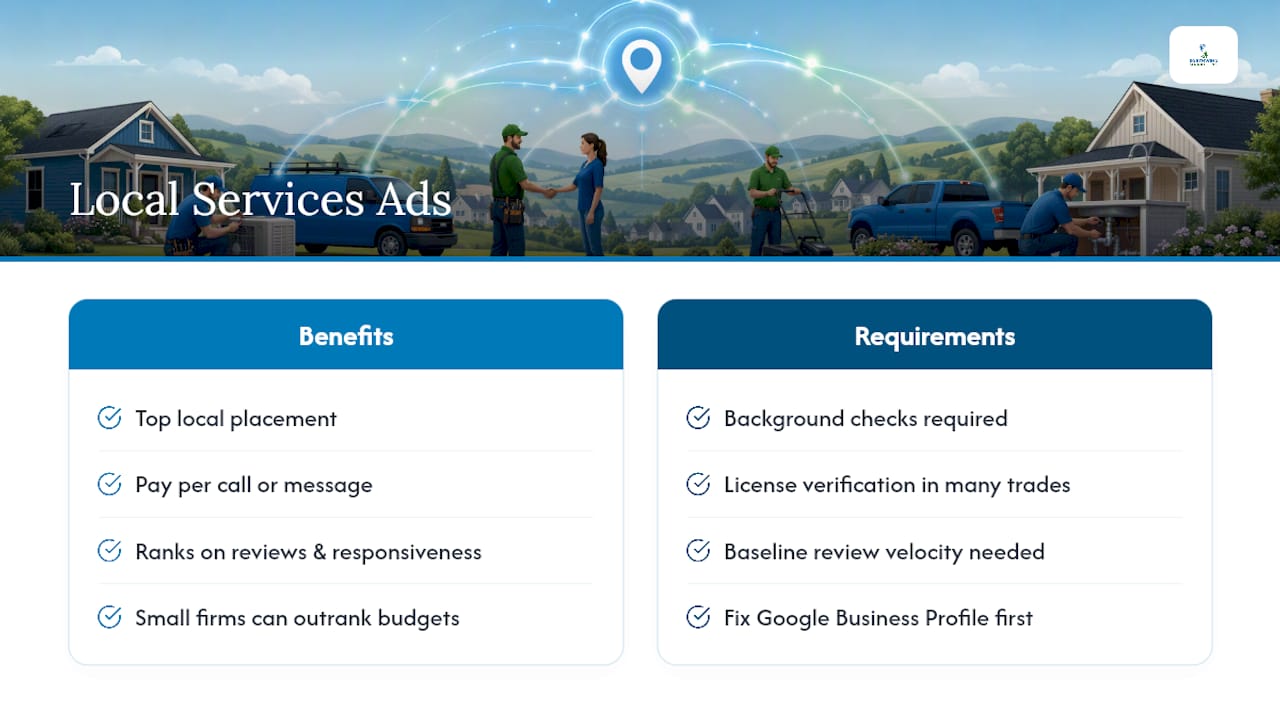
If you run a home-service trade, plumbing, HVAC, roofing, electrical, pest control, landscaping, or similar, Local Services Ads (LSA) deserves your attention before standard Search campaigns. LSA places verified providers at the very top of local search results, above regular ads, and charges you only when a customer actually calls or messages, not when they click.
Google Local Services Ads verify providers and weigh reviews, ratings, and responsiveness heavily in ranking, which means a five-location plumbing company with 40 reviews will usually beat a better-funded competitor with three. That's a fundamentally different game than the Search auction, where budget size often decides who shows up.
The catch: eligibility isn't automatic. Google requires background checks, license verification in many trades, and a baseline of reviews before you're approved to run LSA. LSA benchmarks for qualifying trades often show lower cost-per-lead and cost-per-booked-job than standard Search ads, though actual results vary by trade and market, but only after you clear those prerequisites. Small contractors sometimes stall out here, not because the ad product fails them, but because they haven't built review velocity or verification yet. Fixing your Google Business Profile first solves most of this.
Choosing the right Google product for your service
Not every service business belongs in the same Google ad format. Here's how the main options break down:
- Search campaigns work best for services with clear, searchable intent (attorneys, contractors, medical practices, B2B consultants people find by problem, not brand).
- Local Services Ads fit licensed home-service and local professional trades that can pass Google's verification process.
- Call Ads suit businesses where a phone call, not a form fill, is the real conversion event.
- Performance Max can work for services with strong first-party data and conversion tracking, but it needs volume to optimize well and can waste budget for very small accounts.
- RLSA (Remarketing Lists for Search Ads) lets you bid more aggressively on past visitors who search again, useful for considered purchases like legal services or B2B contracts.
Pro Tip: If you're not sure you qualify for LSA, apply anyway. The verification process itself often surfaces gaps in your review count or license documentation that you'll need to fix regardless of which platform you run.
On cost: expect Search CPCs for competitive service categories (legal, home services, medical) to run higher than most Meta placements. That's not a red flag. A $40 click that turns into a $3,000 kitchen remodel is a better trade than a $4 click that never converts. Judge Google spend by cost-per-booked-job, not cost-per-click.
Google Ads vs Facebook Ads for Service Businesses: When Meta Builds Demand Better
Meta doesn't wait for someone to search. It finds people based on who they are, what they've engaged with, and who resembles your best existing customers, then puts your offer in front of them before they knew they wanted it. That's a fundamentally different mechanism than Search, and it's why Meta shines for services that need to be seen before they're understood.
Cosmetic clinics, med spas, high-end remodeling, wedding and event services, and fitness studios tend to do well on Meta because the offer is visual. A before-and-after photo or a short video of a finished project does work that a text search ad simply can't. Advantage+ campaigns let Meta's algorithm handle audience expansion and placement automatically, which reduces the manual targeting guesswork that used to define Facebook advertising.
Where Meta earns its budget
Three situations make Meta the better first channel for a service business:
- The purchase is visual or aspirational. People don't search "modern kitchen remodel near me" nearly as often as they scroll past one on Instagram and decide they want it.
- The sales cycle is long. B2B consulting, financial advising, and commercial real estate services benefit from staying visible across weeks or months of consideration, something Search struggles to do without heavy retargeting spend.
- Search volume is low or the category is new. If almost nobody is searching for your specific service by name, Google has nothing to capture. Meta can still find the right people.
Meta also runs the best retargeting stack available for service businesses. Someone who visited your site, watched a video, or started a quote form but didn't finish is a warmer prospect than any cold audience, and Meta's pixel data makes that easy to act on.
The learning phase nobody warns you about
Here's what catches most small business owners off guard: Meta campaigns typically need several weeks to exit the learning phase before performance stabilizes. Killing a Meta campaign after ten days because the cost-per-lead looks high is one of the most common, avoidable mistakes advertisers make. The algorithm needs volume and time to find your best-performing audience segments, and pulling the plug early resets that learning.
Cheap clicks can also be deceptive. A $1.20 CPC sounds great until you realize the traffic converts at a fraction of the rate Search traffic does, because the person wasn't looking for you in the first place. That's why nurture sequences matter so much on Meta. A lead capture form paired with an automated email or SMS follow-up, something a tool like automated funnel and nurture platforms can help structure, often does more to lift close rates than any creative tweak.
Pro Tip: Build three to four distinct creative variants (different hooks, formats, or angles) per ad set before you launch. Meta's algorithm learns faster with variety to test against, and you'll avoid ad fatigue setting in during week three of an eight-week learning window.
Comparing Google Ads and Facebook Ads Side by Side for Service Businesses
Put the two platforms next to each other and the differences stop being abstract. They show up in cost, speed, and what kind of lead lands in your inbox.
Intent vs. interest. Google meets people mid-decision. Meta meets people mid-scroll, which means the two platforms occupy different stages of the buying journey almost by design. A search ad answers a question already asked; a Meta ad plants the question in the first place.
Funnel stage fit. Google dominates bottom-of-funnel, ready-to-buy moments. Meta dominates top-of-funnel awareness and mid-funnel nurture, especially through retargeting.
Best-suited verticals. Home services, legal, medical, and urgent B2B categories lean Google. Aesthetic, lifestyle, and long-consideration B2B services lean Meta, at least for initial demand generation.
Cost and conversion quality. This is where owners get tripped up. Meta's lower CPCs often produce cheaper leads but at lower close rates, while Google's higher CPCs tend to produce leads that close more often. Once you account for close rate, the actual cost-per-client frequently lands closer together than the raw CPC numbers suggest. Comparing CPC across platforms is the single most common budgeting mistake service business owners make.
Creative burden. Google Search runs fine on solid ad copy and a good landing page. Meta demands ongoing creative production, photos, video, testimonials, refreshed regularly, or performance decays as audiences see the same ad too many times.
Time to insight. Google typically shows usable signal in three to four weeks. Meta needs six to eight weeks before you can trust the data.
Consider how this plays out across four real account types:
- A residential plumber in a town of 12,000 qualifies for LSA after building 15 Google reviews. Cost-per-booked-job runs lower than standard Search because Google charges only for actual contacts, not clicks. Home-service trades often see the strongest LSA-to-Search cost gap of any category.
- A family law firm runs Search almost exclusively. Search volume for "child custody lawyer [city]" is specific and high-intent enough that Meta adds little beyond retargeting site visitors who didn't call.
- A med spa offering body contouring leans Meta first. Nobody searches for a treatment they've never heard of, but a compelling before-and-after video builds that awareness, and retargeting brings warm viewers back through Search later.
- A B2B consulting firm selling six-figure engagements runs Meta for thought-leadership content and LinkedIn-style targeting proxies, then relies on branded Search and RLSA to catch prospects once they start researching by name.
One documented account comparison makes the point sharply: in some verticals, Google campaigns generated dramatically more revenue than Facebook campaigns running the identical offer and landing page, simply because the audience already wanted the product and Google found them mid-search. Meta, running the same creative to a cold audience, had to do the harder job of creating desire from scratch. That gap doesn't mean Meta failed. It means the categories weren't a fair fight for a platform built around interest, not intent.
How to Decide Which Platform to Run First
Answer four questions honestly before you spend a dollar.
- Do customers actively search for what you sell? If you can picture the exact phrase someone types into Google when they need you, intent already exists. Start there.
- Is the offer visual or aspirational? If a photo or video does more selling than words, you need an audience-based platform to create the initial spark.
- How urgent or considered is the purchase? Emergency and urgent-need services (locksmith, plumber, urgent legal matter) favor Google. Long-consideration purchases (remodeling, financial planning, elective medical) can use either, often both.
- What's your average order value or lifetime value? Higher LTV services can absorb higher Google CPCs comfortably. Lower-ticket services may need Meta's cheaper entry cost to make the math work.
The decision rule that follows: if you answer "yes" to three or more search-intent signals, run Google first. If your offer is highly visual with low existing search volume, start with Meta and layer in Google once branded searches start appearing in your account.
A 90-day test blueprint
Set a fixed 90-day window before judging either platform, and split it roughly into three phases:
- Days 1 to 30: Launch with your primary platform at a stable daily budget, no changes to targeting or bids in the first two to three weeks so the algorithm can learn.
- Days 31 to 60: Layer in retargeting audiences and, if running Meta, review creative fatigue; refresh any ad set with rising costs and falling engagement.
- Days 61 to 90: Evaluate cost-per-booked-job (not cost-per-click), close rate on leads, and blended return before deciding whether to scale, adjust, or add the second platform.
Before you spend a dollar on either platform, confirm three things: your landing page actually converts (not just loads), someone answers the phone or responds to leads within minutes rather than hours, and, if you're pursuing LSA, your review count and Google Business Profile are strong enough to pass verification.
Pro Tip: A slow lead response kills more campaigns than bad targeting ever does. If your team can't answer calls within five minutes during business hours, fix that before you scale ad spend on either platform.
What Budget and Timeline Should You Expect?
Most small to midsize service businesses generally require a moderate monthly budget per platform to generate a usable signal, less in low-competition rural markets, more in dense metro categories like personal injury law. Spreading $1,000 across both Google and Meta at once usually produces weak, inconclusive data on each. Advertisers get a clearer read by concentrating budget on one channel until it hits stable performance, then adding the second.
Timelines differ meaningfully between platforms:
- Google typically shows real signal within three to four weeks, and major bid or keyword changes before that window tend to muddy the data rather than improve it.
- Meta needs six to eight weeks to exit the learning phase, and judging a campaign before that window closes is one of the most common reasons advertisers abandon a platform prematurely.
When you do measure, look past platform-reported conversions. Track blended ROAS across both channels together, run a short holdout period (pause one platform for two weeks to see if total leads actually drop), and always tie ad performance back to close rate, not just lead volume.
The Full-Funnel Recommendation for Service Businesses
The strongest setup for most service businesses isn't a single platform. It's a sequence: Meta builds awareness and fills the top of the funnel, Google Search and LSA capture the resulting demand, and retargeting on both platforms brings back anyone who didn't convert the first time.
A reasonable starting allocation, adjusted by vertical, looks like this:
- High-intent services (legal, home services, medical): 80 to 90% Google, 10 to 20% Meta for retargeting.
- Visual or long-consideration services (remodeling, aesthetics, B2B consulting): closer to 50/50, shifting toward Google as branded search volume grows.
- New-to-market or niche services with little existing search volume: start Meta-heavy, then reallocate toward Google as awareness builds.
Practitioner allocation frameworks generally point service businesses toward Google-heavy budgets, with Meta playing a supporting rather than lead role, and the data above backs that pattern.
Bring in outside help when you hit one of three walls: you don't have the internal bandwidth to manage two ad platforms and a CRM at once, you can't connect ad spend to actual closed revenue across channels, or you're ready to scale past a single-location test and need the systems to support it. That's usually the point where a fractional or full-service partner earns its cost quickly, particularly for CRM integration and cross-channel reporting that most small teams never get around to building themselves.
Southwind Marketing's View: Running Ads for Rural and Small-Town Service Organizations
Rural and small-town service businesses run into a problem the national playbooks don't address: lower search volume and thinner review counts. A contractor in a town of 4,000 doesn't generate the same lead flow as one in a metro of 400,000, so Southwind Marketing scales test budgets and timelines to match realistic local demand rather than applying big-city benchmarks that set the wrong expectations from day one.
A typical 90-day structure for a rural client starts with a Google Search or LSA test at a modest daily budget, paired with a review-acquisition push if the client isn't yet eligible for LSA. Meta usually enters later, once there's retargeting data worth spending against.
The recurring constraint isn't ad spend. It's operations: an office that can't answer overflow calls, or a Google Business Profile that hasn't been touched in years. Southwind fixes those foundational marketing gaps before scaling any ad account, because no amount of ad spend fixes a phone nobody picks up.
— Damien Denmark
How Southwind Marketing Sets Up Your Full-Funnel Ad Strategy
Running Google and Meta well at the same time takes more than campaign setup. It takes verified Local Services Ads eligibility, a Google Business Profile built to rank, and a CRM that catches every lead so nothing slips through between "click" and "customer." That's the operational layer most service businesses never build, and it's the reason ad spend underperforms even when the platform choice is right.
Southwind Marketing handles that setup directly. Southwind Signal℠ covers the search and AI discovery side so your organic visibility supports paid spend instead of competing with it, while Southwind Connect℠ routes every lead, whether it comes from a Google call or a Meta form fill, into a follow-up sequence that doesn't rely on someone remembering to call back. Combined with LSA verification support and Google Business Profile optimization, the goal is fewer wasted clicks and faster time to a booked job.
If you're ready to stop guessing which platform deserves your budget, reach out to Southwind Marketing to map out a 90-day test built around your specific service category and market size.
Sources
- Reach Local Customers with Local Service Ads - Google Ads
- Comparing Facebook Ads vs. Google Ads — Instapage
- AdWords learning period guidance and practical timelines - WordStream
FAQ
Which Is Better for My Business, Google Ads or Facebook Ads?
Google Ads works better for services people actively search for, like plumbers, lawyers, or urgent medical care, while Facebook Ads work better for visual or aspirational services with lower existing search volume. Most service businesses see the best long-term results running both, Meta for awareness and Google to capture the resulting demand.
Is $20 a Day Good for Google Ads?
A $20 daily budget can work for low-competition local categories, but competitive service verticals like legal or home services often need a larger budget to generate a reliable signal within the typical three to four week learning window.
Are Google Ads Worth It for Small Businesses?
Yes, particularly through Local Services Ads for qualifying home-service trades, since LSA charges only for actual customer contact rather than clicks and often produces a lower cost-per-booked-job than standard Search ads. Worth depends on whether the business can pass verification and maintain review velocity.
Is $10 a Day Enough for Google Ads?
$10 a day is usually too thin for competitive service categories to generate meaningful data, though it can work as a starting test in low-competition rural markets with limited search volume. Most service businesses need a larger budget to see conversion trends within the standard three to four week evaluation window.
How Long Should I Wait Before Judging Ad Performance?
Give Google Ads three to four weeks of stable spend before making major changes, and give Meta six to eight weeks, since Meta's algorithm needs that full window to exit its learning phase. Judging either platform earlier usually leads to premature, incorrect conclusions.