Yes, eligible nonprofit economic development organizations can claim up to $10,000 a month in free Google Search advertising through Google Ad Grants. The grant only pays off if you pair it with real conversion tracking and someone who actually manages the account. Two prerequisites come first: Google for Nonprofits verification and a website built to capture leads, not just inform visitors.
TL;DR:
- Nonprofit organizations must meet specific criteria, including 501(c)(3) status and a lead-focused website, to qualify for Google Ad Grants.
- Campaigns must be well-structured with at least two ad groups per campaign, tightly relevant keywords, and aligned landing pages to avoid losing quality score and approval.
- Proper conversion tracking, including offline and enhanced tracking, is essential for maximizing grant utilization and measuring qualified leads effectively.
- Regular maintenance such as monthly review of search terms, quarterly ad refreshes, and annual compliance checks are vital to sustain performance and prevent suspension.
- Small EDO teams should consider partnering with an agency for ongoing management, technical setup, and strategic campaign refinement to fully leverage grant benefits.
Table of Contents
- What Google Ad Grants Covers and Who Qualifies
- Program Limits, Policies, and a Compliance Checklist
- Account Setup Checklist for EDOs
- Campaign Strategy Tailored to EDO Goals
- Measurement and Lead-Quality Best Practices
- An EDO Case Study and Southwind Marketing's Field Lessons
- Common Pitfalls and a 6 to 12 Month Maintenance Plan
- How Southwind Marketing Helps EDOs Put Grants to Work
- A Straight Answer on Grants and What to Do Next
- Sources
- FAQ
What Google Ad Grants Covers and Who Qualifies
Google Ad Grants is an in-kind credit, not cash. It only funds Search campaigns, up to $10,000 a month, and it never applies to Display, Video, or Shopping. Approval runs through Google for Nonprofits, the verification gateway that checks your organization's status before you ever touch an Ads account.
In the United States, that means holding active 501(c)(3) status. Government entities, hospitals, and most schools are typically excluded, even when their mission overlaps with economic development work. Chambers of commerce and Main Street programs often organize under different tax designations, so confirm your exact structure before applying.
Google also reviews your website before granting access. Expect scrutiny on:
- A clear statement of mission and programs, not just a homepage slideshow
- Contact information and calls to action that actually lead somewhere
- Original content describing your services, rather than thin or duplicated pages
- No begging language or excessive ad density that would violate Google's nonprofit content policies
If your site reads like a brochure from 2014, fix that before you apply.
Program Limits, Policies, and a Compliance Checklist
Ad Grants comes with rules that trip up a lot of first-time applicants. Google caps historical average cost-per-click at $2.00 for most keywords (higher through Ad Grants-specific bidding features), and monthly spend never exceeds the $10,000 credit regardless of how aggressive your bids get.
- Maintain minimum account structure. Every campaign needs at least two ad groups, and Ad Grants policy requires tightly relevant keywords tied to specific ad groups, not broad catch-all themes.
- Keep ads and landing pages aligned. An ad promising "site selection incentives" that lands on a generic homepage will hurt your quality score and your standing with Google's reviewers.
- Set up conversion tracking before using Smart Bidding. Automated bidding strategies require valid conversion data, and Google audits this regularly.
- Complete the annual survey and respond to Google's compliance emails. Miss these, and your account risks suspension regardless of performance.
Account Setup Checklist for EDOs
Verification comes first, always. Confirm your EIN matches your registered nonprofit records, and make sure your website domain matches what you submit to Google for Nonprofits. Mismatches are one of the most common reasons applications stall.
Before your account goes live, get your website in shape:
- HTTPS enabled sitewide, no exceptions
- A visible privacy policy
- Dedicated pages for your mission, programs, and incentive offerings
- Clear contact or inquiry forms, not just a phone number buried in a footer
Once approved, build a lean campaign skeleton: two or three campaigns organized by goal (site selection, workforce attraction, incentive programs), each with tightly themed ad groups. Decide upfront which actions count as conversions, whether that's a form fill, a downloaded incentive packet, or a scheduled call.
Then install Google Tag across your site, configure enhanced conversions if your forms collect email addresses, and map out how leads will flow into your CRM for offline conversion imports later.
Pro Tip: Build your conversion tracking before you launch a single ad. Retrofitting tracking after three months of unmeasured clicks means you've burned a quarter of your annual grant capacity with no data to show for it.
Campaign Strategy Tailored to EDO Goals
Most EDOs are chasing four distinct outcomes, and treating them as one undifferentiated campaign is the fastest way to waste grant dollars. Separate your efforts into:
- Site selection and investor leads — targeting site selectors and corporate relocation researchers
- Incentive and grant program promotion — driving applications for tax abatements, revolving loan funds, or workforce grants
- Talent and resident attraction — competing for people considering relocation or remote work
- Events and program signups — filling seats at business workshops, expos, or info sessions
Each goal needs its own tightly themed ad groups. B2B searches around site selection tend to run at lower volume than consumer terms, which means you're better off mixing high-intent phrases like "industrial site availability [state]" with slightly broader discovery terms that still signal buying intent, rather than chasing volume you won't get. Build an aggressive negative keyword list early. Job seekers searching "economic development jobs" will drain budget fast if you don't block them out.
Your landing pages need to match the promise in the ad. A campaign promoting incentive programs should land on an incentive page with a clear application path, not a general economic profile PDF. Every point of friction between click and conversion costs you.
Case study data from Digital Tabby on the Washington DC Economic Partnership shows that focused campaign management, paired with conversion tracking, scaled grant utilization close to the full monthly credit while improving click-through rate and conversions. It's a pattern worth studying for any EDO trying to move beyond a half-used, neglected account.
Performance Max can work within Grants accounts, but only under narrower rules than a standard paid account allows. Use it sparingly, and only once your Search campaigns are already generating clean conversion data. For a deeper look at organizing campaigns by intent, this campaign planning guide breaks down the structural logic well.
Measurement and Lead-Quality Best Practices
Not every inquiry is worth the same to your organization, so stop measuring "conversions" as one flat bucket. Separate qualified inquiries from RFP downloads from site-visit requests, and track them as distinct goals rather than one blended metric.
- Set up enhanced conversions so form submissions with email or phone data feed richer signal back into Google's bidding models
- Build an offline import pipeline from your CRM so closed deals, not just form fills, eventually inform your bidding
- Give Smart Bidding enough conversion volume and recent data before trusting it. Sparse, stale data leads to erratic performance
- Add basic lead validation, like phone verification or a qualifying question, to filter out spam before it pollutes your conversion data
Google's own lead-generation guidance is blunt about this: automated bidding only works when you're feeding it accurate signal, not raw click volume. Enhanced conversions and offline import are how you translate real business outcomes back into machine-readable form.
Pro Tip: If your monthly qualified leads are still in the single digits, hold off on Smart Bidding entirely. Manual CPC gives you more control until your data catches up.
An EDO Case Study and Southwind Marketing's Field Lessons
One regional EDO Southwind Marketing worked with had an active Ad Grants account sitting mostly idle, spending a fraction of its monthly credit because conversion tracking had never been properly configured. After rebuilding the tracking setup and tightening ad groups around specific incentive programs, monthly grant utilization climbed substantially and qualified inquiries became measurable for the first time.
A few lessons carried over from that work and others like it:
- Assign one person ownership of the account. Shared responsibility usually means no responsibility
- Run monthly hygiene: check search terms, prune negatives, review CTR by ad group
- Refresh ad copy on a quarterly cadence, since stale ads quietly lose relevance
- Connect lead data to your CRM, whether through Southwind Connect℠ or another system, so nothing falls through the cracks
Small EDO teams juggling five other responsibilities rarely have bandwidth for weekly account maintenance, which is exactly why a partner model tends to outperform a set-and-forget approach.
Common Pitfalls and a 6 to 12 Month Maintenance Plan
The most common failure mode is simple neglect: an account gets approved, runs for a few months, then sits untouched while performance quietly decays. Add poor landing pages, incomplete conversion tracking, low click-through rates, and broken contact forms, and you've got an account that technically exists but does nothing for your mission.
- Monthly: Review CTR by ad group, prune irrelevant search terms into negatives, and confirm conversion tracking is still firing correctly.
- Quarterly: Rotate ad copy, audit landing pages for broken links or outdated incentive details, and check that Google for Nonprofits verification remains current.
- Annually: Complete Google's required survey, reassess campaign structure against your current programs, and evaluate whether utilization justifies applying for Grantspro, the expanded option with a higher spend cap for eligible organizations.
If your search volume consistently outpaces the $10,000 ceiling, that's the signal to test paid Google Ads campaigns alongside your grant, using a service-business comparison of Google Ads versus Facebook Ads as a framework for where to put incremental paid dollars.
How Southwind Marketing Helps EDOs Put Grants to Work
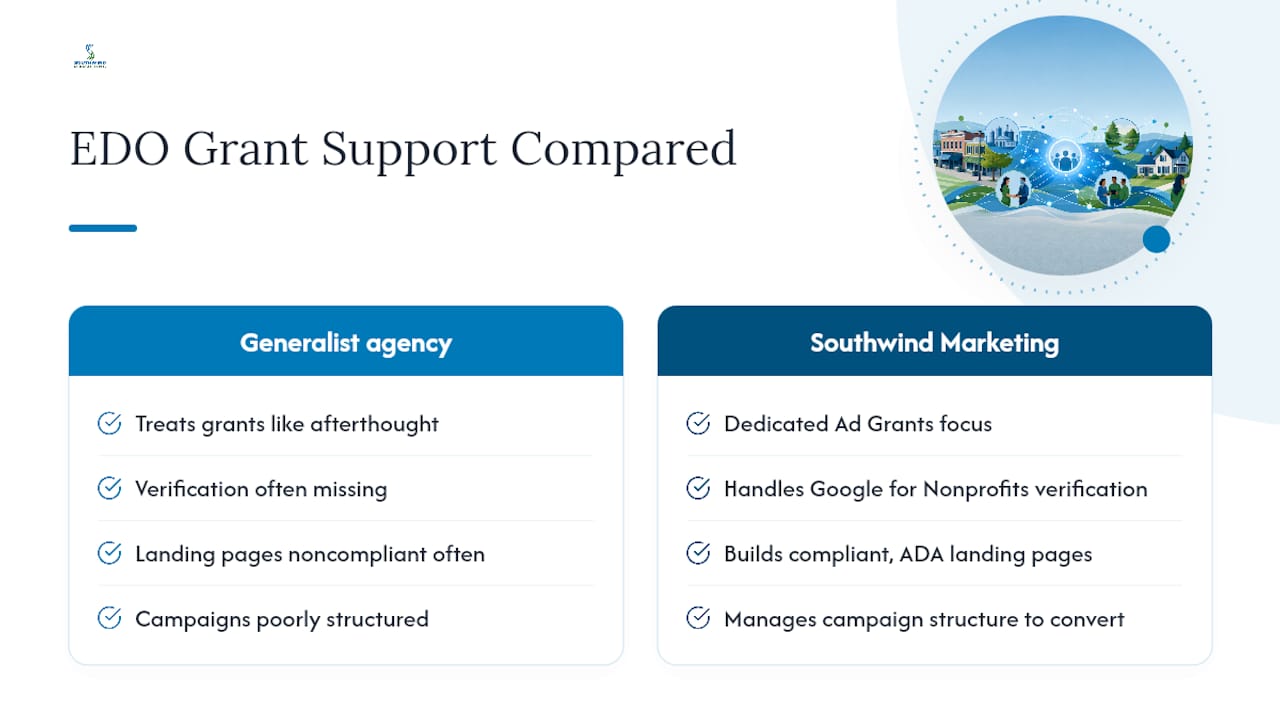
Southwind Marketing is the alternative to hiring a generalist agency that treats your Ad Grants account like an afterthought. We handle Google for Nonprofits verification, build landing pages that meet Google's compliance bar and ADA standards, and manage campaign structure so your grant dollars actually convert instead of sitting unused.
Our work with rural and small-city economic development organizations includes campaign management built around site selection, incentive promotion, and workforce attraction, plus CRM integration through Southwind Connect℠ so leads flow directly into your follow-up process instead of disappearing into an inbox. For EDOs promoting specific incentive programs, our grant program marketing approach pairs directly with the campaign strategies covered here, and our data dashboards turn your lead activity into something your board can actually read.
If you're not sure whether your current site and tracking setup are grant-ready, start with our free 10-minute website and visibility audit. You'll get a clear read on what's blocking conversions before you spend another month leaving grant money on the table.
A Straight Answer on Grants and What to Do Next
Google Ad Grants rewards EDOs that treat the account as owned infrastructure, not a free perk to set and ignore. If your tracking and landing pages aren't ready, a quick audit beats guessing. Start there, then build the campaign structure around it.
— Damien Denmark
Sources
- Google Ad Grants - Free Google Ads for Nonprofits
- Washington DC Economic Partnership - Google Ad Grant - Digital Tabby
FAQ
How Much Does Google Ad Grants Give Nonprofits?
Eligible nonprofits can receive up to $10,000 per month in Google Search advertising credit through Google Ad Grants, though it only funds Search campaigns, not Display or Video.
Can Economic Development Organizations Qualify for Google Ad Grants?
Most EDOs organized as 501(c)(3) nonprofits in the United States can qualify, but government entities and certain other organization types are typically excluded under Google for Nonprofits eligibility rules.
What Happens if an Ad Grants Account Gets Suspended?
Suspension usually follows policy violations like poor account structure, low click-through rates, or missing conversion tracking, and reinstatement requires fixing the underlying issue before reapplying.
Do EDOs Need Conversion Tracking for Google Ad Grants?
Yes. Conversion tracking is required for any Ad Grants account using Smart Bidding, and it's the only way to know whether your grant is generating qualified inquiries instead of empty clicks.
Should Small EDO Teams Manage Ad Grants In-House or Use a Partner?
Small teams often benefit from a partner like Southwind Marketing to handle monthly hygiene, campaign refreshes, and CRM integration, since Ad Grants accounts require ongoing attention to stay compliant and productive.