
Fractional IT gives a small-town business or local government part-time access to senior technology leadership and specialist skills, without the cost of a full-time hire. It fits organizations that have outgrown ad-hoc IT help but don't have the budget or workload to justify a full-time CIO. If that describes you, the next move is simple: build a shortlist of a handful of candidates and start with a short assessment or a month-to-month engagement before committing to anything longer.
TL;DR:
- Fractional IT offers senior leadership and specialist skills on a flexible, part-time basis, suitable for organizations that have outgrown ad-hoc help but cannot afford full-time staff.
- It typically involves time-based, project-based, or coverage-based engagements, and is distinct from managed service providers that handle daily operations and help desk tasks.
- Smaller towns benefit from fractional IT by accessing high-level expertise without the high salary costs, enabling faster backups, better vendor management, and more predictable budgets.
- Critical onboarding activities include an inventory audit, password rotation, backup testing, and establishing reporting routines within the first 90 days.
- Key considerations when choosing a provider involve understanding their familiarity with rural operations, clear SLAs, backup testing procedures, and transparent pricing models.
Table of Contents
- What Is Fractional IT Support and How Does It Differ From Managed IT?
- What Benefits Does Fractional IT Bring to a Small-Town Business?
- Which Fractional IT Role Does Your Business Actually Need?
- How Do You Choose the Right Fractional IT Partner?
- What Should the First 30 to 90 Days of Onboarding Look Like?
- What Does Fractional IT Actually Cost?
- What Red Flags Should You Watch for When Hiring Fractional IT?
- What Security, Backup, and Disaster Recovery Basics Should Be in Place?
- Why Fractional IT Often Makes Sense for Rural Communities
- Get Fractional IT Built for Rural Realities
- Sources
- FAQ
What Is Fractional IT Support and How Does It Differ From Managed IT?
Fractional IT means paying for senior IT decision-making and specialist expertise on a part-time basis instead of hiring it full time. A fractional CIO might spend several hours a week setting technology direction, vetting vendors, and building a security roadmap for a business that could never afford that role as a full-time salaried position.
Engagements typically take one of three shapes: time-based (a set number of hours per month), project-based (a defined scope, like a Microsoft 365 migration), or coverage-based (on-call access when something breaks). Fractional IT support is documented across vendor guides as flexible by design, built to scale up or down with need.
The distinction that trips people up: fractional leadership isn't the same as a managed service provider (MSP). An MSP handles day-to-day operations, help desk tickets, and network monitoring. Fractional IT leadership sits above that, setting strategy and often managing the MSP itself rather than replacing it.
What Benefits Does Fractional IT Bring to a Small-Town Business?
A full-time CIO in a rural market can cost well over $120,000 a year in salary and benefits alone, a number most Main Street businesses and small local governments simply can't justify. Fractional arrangements let you buy exactly the hours and expertise you need, when you need them.
The practical wins show up fast once a fractional partner is in place:
- Access to senior talent (CIO, CTO, security specialists, database administrators) without a six-figure commitment.
- Better vendor management, since someone senior is finally negotiating contracts and reviewing invoices for a single overworked office manager.
- Faster backup restores because someone tested them before disaster struck instead of after.
- Documented systems and passwords instead of tribal knowledge locked in one employee's head.
- Predictable monthly budgeting instead of surprise emergency invoices.
Pro Tip: Ask any prospective fractional partner to document your network and password structure in the first 30 days, even before they touch a single ticket. If they can't tell you what you own, they can't protect it.
Which Fractional IT Role Does Your Business Actually Need?
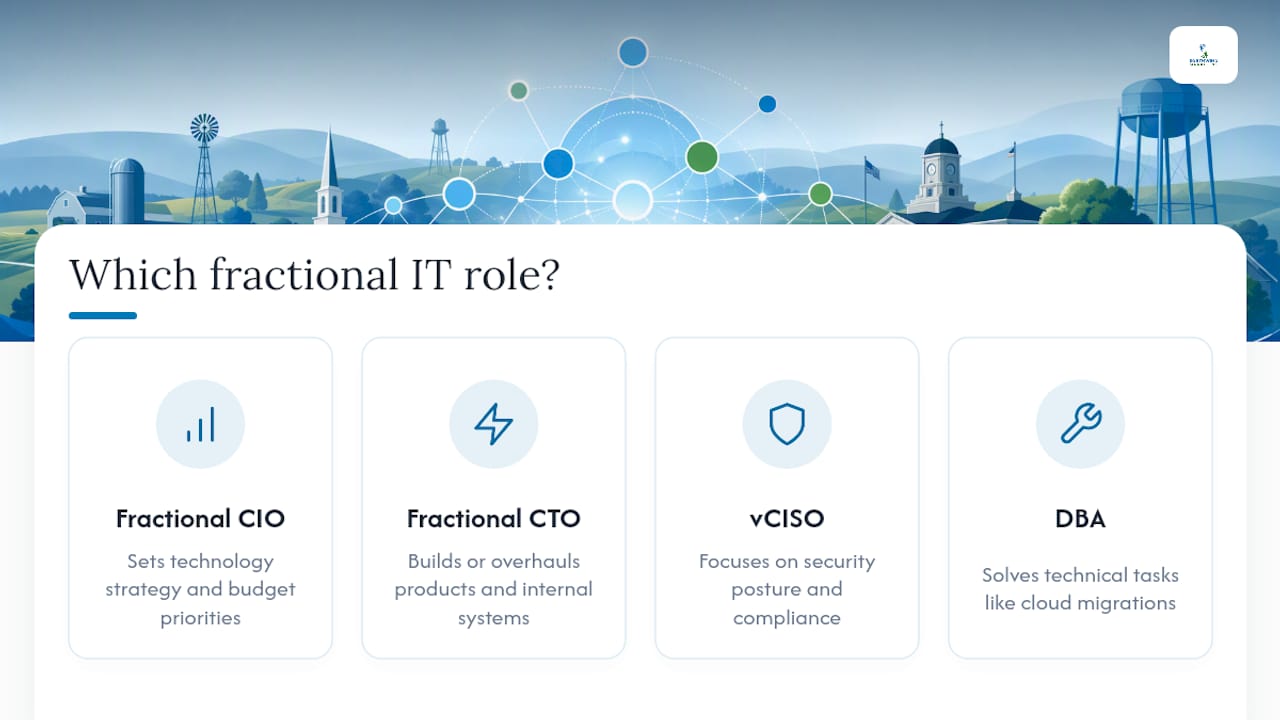
Not every business needs the same fractional role, and picking the wrong one wastes money. A fractional CIO sets technology strategy and budget priorities, usually the right first hire for a business with rising compliance requirements or a confusing pile of vendor contracts. A fractional CTO leans more technical, useful if you're building or overhauling a product or internal system. A vCISO (virtual chief information security officer) focuses purely on security posture and compliance, a smart choice if you handle sensitive customer or resident data. A fractional database administrator or cloud engineer solves narrower, technical problems, like migrating servers to the cloud.
Fractional leadership fits best for organizations under roughly 100 employees, growing fast, dependent on outside vendors, or facing new compliance demands. Start with whichever role matches your loudest current pain point, not the one that sounds most impressive.
How Do You Choose the Right Fractional IT Partner?
Comparing fractional IT providers gets easier with a structured checklist instead of a gut feeling. Work through these ten items on every call:
- Do they understand small-town or rural operating realities (limited bandwidth, remote sites, single-admin offices)?
- Will they provide a written service level agreement (SLA) with specific response and resolution times?
- How do they test backups, and how often?
- What's their patch management and update cadence?
- Do they enforce multi-factor authentication (MFA) across accounts?
- Who actually answers the phone when something breaks, a real technician or a call center?
- What does onboarding look like in the first 30 days?
- What's excluded from the retainer, and what triggers an extra invoice?
- Can they provide client references or documented case studies?
- What's the exit process if the relationship doesn't work out?
Ask these questions directly in the interview: "Walk me through the last time you restored a client's backup. What broke, and how fast did you fix it?" Vague answers here are the biggest tell. Independent evaluations and documented processes matter more than a slick sales deck.
On pricing, expect one of three shapes: an hourly rate for fractional CIO time, a flat monthly retainer, or a pooled-hours model where strategic and hands-on hours blend under one rate. Whatever the model, get it in writing.
A written SLA with clear response and resolution commitments is one of the strongest indicators you're dealing with a serious provider rather than a side hustle.
Building your shortlist to four to six candidates keeps the comparison manageable without leaving good options off the table.
What Should the First 30 to 90 Days of Onboarding Look Like?
A credible fractional partner starts with an assessment, not a sales pitch. Expect a full inventory of hardware, software licenses, and accounts, followed by a prioritized list of fixes ranked by risk.
The first 30 days should focus on locking down immediate risk: rotating shared passwords, enforcing MFA, and verifying that backups actually restore rather than just run. Days 31 to 60 tackle accumulated technical debt, closing gaps identified in the initial audit. Days 61 to 90 stabilize operations and establish a regular reporting rhythm, so you're not chasing your provider for updates.
- Day 0 to 30: audit, inventory, password rotation, backup verification.
- Day 31 to 60: prioritized remediation, documentation of systems and access.
- Day 61 to 90: stabilized reporting cadence, defined escalation paths.
A real example comes from a small city where city staff were running government email through PLD.com accounts tied to a local fiber provider, a setup that left official communication looking unofficial and made long-term account management difficult. The transition to proper .gov email addresses was managed, and the city’s Microsoft 365 Government tenant is now handled on an ongoing basis.
Getting a small city off a local ISP's email domain and onto a properly managed .gov tenant isn't glamorous work, but it's the kind of foundational fix that prevents years of headaches with vendors, residents, and state reporting requirements.
Track backup success rates, ticket backlog, and average response time during onboarding. Those three metrics tell you fast whether the relationship is working.
What Does Fractional IT Actually Cost?
Pricing shapes vary, but three models dominate the fractional market: hourly rates for fractional CIO time, flat monthly retainers covering a set number of hours, and pooled or blended-rate arrangements that mix strategic and hands-on work under one number. Treat any specific dollar figure you hear from a provider as a starting point to verify against your own scope, not a fixed market rate, since rural pricing varies by region and workload.
The bigger risk isn't the base rate, it's what's excluded from it. Read every proposed contract for carve-outs: project work (like a full network redesign), emergency on-site visits outside business hours, and hardware purchases are commonly billed separately from the base retainer. Ask for a sample invoice from an existing client relationship before signing anything, so you know exactly what a normal month looks like versus a month with a surprise charge attached.
What Red Flags Should You Watch for When Hiring Fractional IT?
A few warning signs show up again and again in bad fractional IT relationships:
- No written SLA, just verbal promises about response times.
- The entire relationship depends on one person with no backup coverage.
- Long-term contracts with no clear exit terms or transition support.
- Vague or evasive answers about backup testing and security practices.
If you've inherited a shaky setup from a previous provider, prioritize three things immediately: change all administrative passwords, confirm backups actually restore rather than just run, and schedule an independent audit from a different provider to get a second opinion on what you're working with.
What Security, Backup, and Disaster Recovery Basics Should Be in Place?
Small businesses and small local governments are common targets for cybercriminals, not despite their size but partly because of it. Basic protections like tested backups, endpoint protection, and MFA are treated as baseline requirements in most security guidance, not optional extras.
A fractional partner should be able to answer three questions clearly: How often are backups tested with an actual restore, not just a completed backup job? What's the recovery time objective if a server fails or ransomware hits? And is MFA enforced across every account with access to sensitive systems, not just the obvious ones?
Disaster recovery planning matters even more in small towns, where a single fiber cut or a regional power outage can take down the only internet provider in the county. Ask any prospective provider how they'd keep your email and files accessible if your primary connection went down for two days. If they don't have a documented answer, that's a gap worth flagging before you sign anything, not after an outage.

Documented, tested backups aren't a nice-to-have line item on a proposal. They're the difference between a bad afternoon and a business that can't make payroll.
Why Fractional IT Often Makes Sense for Rural Communities
Small towns run on seasonal budgets, thin staff, and one person wearing five hats. Fractional IT fits that reality better than a full-time hire ever could, scaling up during a grant-funded project and back down when things quiet down. The Ulysses email migration showed what that looks like in practice: a real fix for a real problem, not a theoretical pitch. When a business or local government outgrows patchwork IT help but isn't ready for a full-time role, that's the moment to look at Southwind Cloud℠.
— Damien Denmark
Get Fractional IT Built for Rural Realities
Most IT providers built their pricing and playbooks for cities with fiber on every block and a bench of technicians down the street. Southwind Marketing built Southwind Cloud℠ for the opposite: small towns, one-person IT departments, and organizations that need senior guidance without a six-figure salary line.
This service covers Microsoft 365 licensing and fractional IT support designed around how rural offices actually operate, not a generic urban template. Typical engagements start with a short audit of your current setup, followed by flexible month-to-month fractional support once you know exactly what you're getting. There's no long lock-in before you've seen the work firsthand, and onboarding follows the same disciplined 30/60/90 approach that helped a small city transition off a local ISP's email system onto a properly managed .gov tenant. If your business or organization needs a clearer, more affordable path to real IT leadership, start with a free 10-minute audit or explore the Southwind Cloud℠ service page to see what a fractional setup could look like for your team.
Sources
For more depth on evaluating providers and understanding fractional models, see how to choose a managed IT provider and fractional IT leadership explained.
- How small businesses can choose the right managed IT provider
- What Is Fractional IT Leadership and Is It Right for Your Business?
- What Is Fractional IT Support? (And Why It’s Not What You Think)
FAQ
How Much Does IT Support Cost for a Small Business?
Costs vary by model. Hourly fractional CIO rates, flat monthly retainers, and pooled-hours blended rates are the three most common structures, and you should always verify quotes against your specific scope rather than a generic number.
What Are the Best IT Solutions for a Small-Town Business?
The best fit usually combines fractional leadership for strategy with either an MSP or a platform like Southwind Cloud℠ for Microsoft 365 management and day-to-day support, matched to your actual workload rather than a one-size-fits-all package.
How Much Does It Cost to Hire Tech Support?
A full-time CIO in a rural market can cost well over $120,000 a year in salary and benefits alone, which is why fractional arrangements let you buy exactly the hours and expertise you need rather than paying for a full salary.
What Is the Going Rate for IT Support?
Rates depend heavily on the engagement model, whether hourly, retainer, or blended, and on your region and scope of work, so the only reliable way to know your rate is to request a written quote tied to a documented scope of services.
What's the Difference Between Fractional IT and a Managed Service Provider?
Fractional IT provides senior strategic leadership on a part-time basis, while an MSP handles day-to-day technical operations. A fractional CIO often manages the MSP relationship rather than replacing it.