
Copy your homepage text into a document. Swap your town's name for the county seat 40 miles away. Read it again. If nothing sounds wrong, your site has failed the swap test, and it is not building the confidence it needs to with investors or families looking to relocate.
Run it now:
- Copy your "About" or "Why Locate Here" page into a blank document.
- Find and replace your community's name with a neighboring town's name.
- Read it out loud. If it still sounds true, you have a generic site.
- Note every sentence that only works because it names something specific.
Sites that pass this test usually have one thing in common: almost every claim is unverifiable. That's the immediate problem to fix, starting with the next section you write.
Key Takeaways
Economic development sites that pass the swap test replace vague claims with named, verifiable proof points and give investors a clear decision path instead of a brochure.
| Point | Details |
|---|---|
| Run the swap test first | Replace your town's name with a competitor's; if the copy still reads true, it's too generic. |
| Name real assets, not categories | Cite the actual coffee shop, highway drive time, or training program instead of vague descriptors. |
| Serve two audiences separately | Site selectors need land and permitting data; relocating families need schools and commute times. |
| Build layered talking points | Give partners a position, elaboration, and proof-point set instead of one polished paragraph. |
| Fix the site with Southwind Marketing | Southwind Signal℠ rebuilds content and SEO around verifiable local facts and named contacts. |
Table of Contents
- Why Economic Development Websites Fall Into Generic Copy Traps
- How Site Selectors and Relocating Families Read Your Site Differently
- Concrete Copy Replacements and Local Proof Points You Can Deploy Today
- Decision-Support Features That Reduce Site Friction
- Message Architecture and Partner Usability: A Practitioner's Framework
- A Five-Step Self-Audit You Can Run In 10 Minutes
- What Actually Moves the Needle, and What Doesn't
- Fix Generic Copy With Search-Ready Content That Names Names
- Sources
- FAQ
Why Economic Development Websites Fall Into Generic Copy Traps
Most economic development organizations aren't lazy. They're understaffed, and content is the first thing that gets templated when time runs short. Here's what typically drives the drift toward interchangeable copy:
- Limited time and budget. A communications team of one or two people prioritizes grant deadlines and ribbon cuttings over website language, so old boilerplate stays untouched for years.
- Copying competitor language. Someone reads a neighboring county's site, likes the phrasing, and adapts it. Everyone adapts everyone else's adaptations, and the whole region converges on the same five phrases.
- Generic AI tools trained on B2B patterns. Ask a general-purpose writing tool to describe your community and it defaults to corporate SaaS phrasing, not economic development language, because that's the bulk of its training data.
- No single content owner. When land data, incentive pages, and workforce stats belong to nobody in particular, they go stale, and stale data reads as generic even when it started out specific.
Pro Tip: Assign one staff member as the site's content owner, even part time. A single accountable name fixes more generic copy than any rewrite.
How Site Selectors and Relocating Families Read Your Site Differently

Site selectors and families are reading the same page for completely different reasons, and vague language fails both of them in different ways.
Site selectors are scanning for operational risk. A modern investor-facing site should behave like a decision-support engine, not a brochure, surfacing serviced land, utility capacity, and permitting timelines fast enough to move a project to the next round. Relocating families are scanning for something else entirely: named schools, real commute times, and whether there's an actual grocery store within a reasonable drive.
- Site selectors want: available parcels, utility capacity, workforce pipeline data, permitting timelines, incentive terms.
- Families want: named school districts and ratings, actual commute minutes to the regional job center, specific retail and healthcare options, housing price ranges.
- Both groups want: workforce training partnerships with real completion numbers, since a trained labor pool matters to an employer and a job-seeking spouse alike.
Content that serves both audiences at once is rare, and that's fine. Segment it instead of watering it down to please neither.
Concrete Copy Replacements and Local Proof Points You Can Deploy Today
"Charming downtown" describes nothing. "Great quality of life" describes nothing. "Business-friendly" describes nothing. Every one of those phrases could apply to 4,000 towns, which is exactly the problem. Replace each with a claim someone could verify in under five minutes.
- Swap "charming downtown" for a named block: "Six locally owned restaurants and Maple Street Coffee anchor a two-block downtown that added three new storefronts last year."
- Swap "great quality of life" for named amenities: "Twelve miles of paved trail connect the middle school to the county park, and the public pool reopened after a 2025 renovation."
- Swap "business-friendly" for a permitting fact: "Commercial building permits clear in a timely manner through a single point of contact at city hall."
- Swap "skilled workforce" for a training statistic: "Our regional technical college graduated students from its industrial maintenance program last year, with a strong placement rate within the county."
- Swap "close to major highways" for a real drive time: "A short drive to I-40 and reasonable access to the regional airport."
Vague workforce language without data reads to investors as a lack of readiness. Adding one hard number, whether it's a completion count, a commute-shed figure, or an employer pipeline detail, materially lowers the odds a prospect crosses you off the list before ever calling.
Before you publish any of these swaps, verify the source. Call the chamber for retail counts, pull permitting data from your building department, and confirm training numbers directly with the community college's workforce office rather than repeating a figure from an old press release. Link to the source page where you can, and note the date you verified it. A community storytelling partner like Baby Love Growth's guide on brand engagement has useful framing on turning local detail into a narrative people remember instead of a data dump.
Decision-Support Features That Reduce Site Friction
Copy is half the fix. The other half is whether a researcher can actually find and act on the information without emailing you first. Site selectors do most of their research online before ever picking up the phone, and a site that buries data in PDFs or behind three menus gets crossed off, not called.
- Property inventory or interactive map. Show available sites with zoning, acreage, ownership status, and utility access in one view, not a scanned PDF from 2019.
- Infrastructure capacity facts. State available power capacity, water and sewer specs, and broadband speeds, with a named utility contact attached.
- Permitting and approval timelines. List the actual steps and average days for common approvals, plus required documents up front.
- A single named navigator. Put a real person's name, title, and direct contact on the page, since a visible human contact increases conversion because investors want someone who can clear questions directly.
- A "request site package" path. One clear button, three clicks or fewer from the homepage, no dead ends.
Message Architecture and Partner Usability: A Practitioner's Framework
Most EDOs write one polished paragraph, hand it to partners, and hope everyone repeats it word for word. That never happens, and it shouldn't. What actually works is a three-layer message architecture: a single-sentence position, a short elaboration, and a set of interchangeable proof points partners can pull from depending on their audience.
Position: "Our region trains workforce faster than the regional average." Elaboration: our technical college runs a 12-week accelerated manufacturing certificate. Proof points: 142 graduates last year, 89% regional placement, three employer partners co-designed the curriculum.
EDOs that build layered, partner-ready talking points this way see better message consistency across chamber staff, city council members, and regional partners who all talk about the community but rarely use identical wording. The goal isn't word-for-word repetition. It's giving every partner accurate material so nobody has to invent a vague version on the spot.
- Give partners the proof-point set, not just the polished paragraph.
- Set a quarterly check-in so partners can flag outdated numbers or missing details.
- Keep one internal document as the single source of truth for every statistic in circulation.
Southwind Marketing builds this kind of layered framework into client engagements, alongside case work drawn from Rural America communities that have run this exact audit. That practitioner grounding, not theoretical marketing advice, is what separates a usable message architecture from another glossy brochure.
A Five-Step Self-Audit You Can Run In 10 Minutes
Run this in order. Each step catches a different failure mode.
- Swap test. Replace your town's name with a competitor's. If the copy still reads true, flag every unverified sentence.
- Named-asset check. Count how many sentences name a real place, number, or program. If it's under five on your main page, you're too vague.
- Data freshness check. Confirm every land, utility, and incentive figure was verified in the last 90 days. Add a "last verified" note if you can.
- Three-click check. Time how long it takes to get from your homepage to actual site or workforce data. More than three clicks is too many.
- Partner usability check. Ask two partners to describe your community in one sentence. If their answers contradict your website, your message architecture has a gap.
Pro Tip: Do this audit twice a year, not once. Land availability, incentive terms, and training numbers change more often than most EDOs update their sites.
What Actually Moves the Needle, and What Doesn't
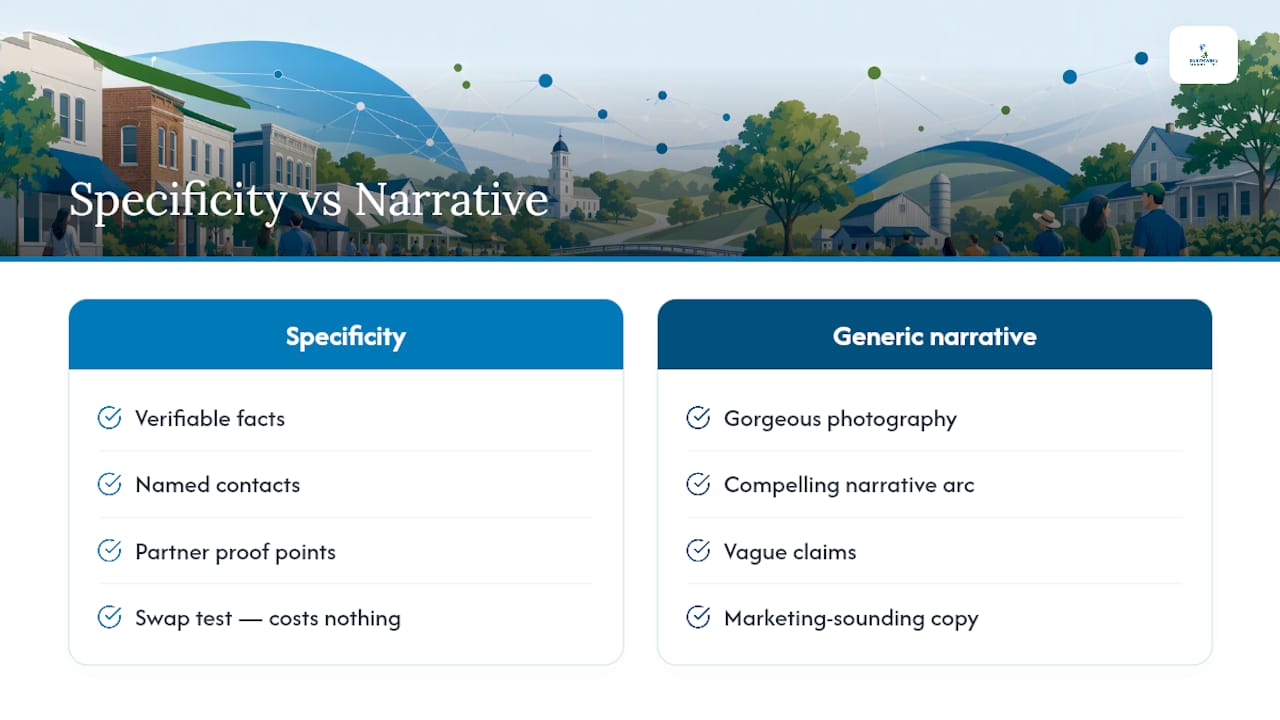
The conventional advice on economic development websites is "tell your story better." That advice is close to useless, because story isn't the problem. Specificity is. A site can have gorgeous photography and a compelling narrative arc and still fail every investor and family reading it, because narrative without named, checkable facts is indistinguishable from marketing copy written for a town that doesn't exist.
What the evidence in this piece actually supports is narrower and less glamorous: replace vague claims with verifiable ones, put a real name on every contact point, and give partners proof points instead of a script. Communities without huge budgets can win this fight, because the swap test costs nothing and a "last verified" timestamp costs nothing. The advantage goes to whoever bothers to name things.
If you take one thing from this, prioritize the swap test and the named-contact fix before you touch design or photography. Specificity beats polish every time a site selector or a relocating parent is deciding between your town and the one 40 miles down the highway.
— Damien Denmark
Fix Generic Copy With Search-Ready Content That Names Names
Southwind Marketing rebuilds economic development sites so every claim survives the swap test, replacing recycled phrases with the training numbers, drive times, and named contacts that site selectors and relocating families actually search for.
We work with rural EDOs, chambers, and local governments across the country who are stuck with the same boilerplate every neighboring county is using. Southwind Signal℠ rebuilds your content and SEO strategy around verifiable local facts instead of generic phrasing, so your site ranks and reads like it belongs to your community and no other. Pair it with Southwind Connect℠ to route site-package requests to a named navigator instead of a general inbox, and with data dashboards to keep workforce and property numbers current instead of stale. If your last website refresh predates your current incentive terms, that's the sign to start. Request a site audit from Southwind Marketing and see exactly which pages fail the swap test.
Sources
- Economic development websites: investor confidence (Pattern Interactive)
- Business attraction campaign communication that builds partnerships (Stegmeier Consulting)
FAQ
What's the difference between community development and economic development?
Community development focuses on quality-of-life infrastructure like housing, parks, and civic services, while economic development focuses on job creation, business investment, and workforce growth. The two overlap constantly on a website, since trails and schools matter to both a relocating family and an employer.
Why does economic development look different from one town to the next?
Local factors like existing industry clusters, workforce pipelines, available land, and infrastructure capacity vary widely. A strategy that works in one region can fail in another. Copying another community's language ignores these differences and produces the generic copy this article is about.
What are the main types of economic development?
Common categories include business attraction (recruiting new employers), business retention and expansion (supporting existing employers), workforce development (training and pipeline building), and entrepreneurship or small business support. Most EDO websites need distinct content for each, rather than one generic page trying to cover all four.
How do I know if my economic development website is too generic?
Run the swap test: replace your community's name with a neighboring town's and reread the copy. If it still sounds accurate, your content lacks the named assets, drive times, and completion numbers that make it specific to your community.
Can Southwind Marketing help rebuild an outdated EDO website?
Yes. Southwind Marketing works with rural economic development organizations, chambers, and local governments to rebuild sites around verifiable local data through Southwind Signal℠ and supporting services like Southwind Connect℠.