Your website is the front door for every investor, site selector, and business owner who considers your community. A working economic development website strategy delivers three things at once: data investors trust, a conversion path that turns visits into leads, and enough search visibility that people actually find you before your competitors. Start with a quick audit: does your site show a target industry sector within five seconds, can a visitor download a property fact sheet without a phone call, and does the site rank for your region's name plus "site selection"? If any answer is no, you have your starting point.
- Interactive data (workforce, sites, incentives) that site selectors can act on without emailing you first
- One clear conversion path per page, not five competing calls to action
- Search visibility that puts your community in front of investors researching options right now
TL;DR:
- Websites should feature real-time, searchable property data with filters, one-click downloads, and clearly visible updates to attract site selectors.
- Prioritize a narrow value proposition page focused on one or two target industries, using plain language to immediately communicate community fit.
- Keep inquiry forms simple with only essential fields, route submissions to staff contacts, and ensure quick follow-up to improve lead conversion.
- Assign specific ownership for content updates, maintain accessibility standards, and include a named contact on every services page for trust and reliability.
- Use keyword patterns combining industry, activity, and location for SEO, and build relationships to earn backlinks from chambers and regional outlets.
Table of Contents
- Economic Development Website Strategy: The Pages You Actually Need
- What Data and Dashboards Do Site Selectors Expect?
- How Do You Improve SEO for an Economic Development Website?
- What Makes a Website Convert Visitors Into Leads?
- Who Owns Website Accessibility and Maintenance?
- How to Compare Two Web Design Agencies
- Key Takeaways
- Sources
- FAQ
Economic Development Website Strategy: The Pages You Actually Need
Most EDO sites fail for the same reason: too much civic pride, not enough usable content. Site selectors and investors want five things, fast, and every one of them belongs on your site in a specific place.
Start with a value proposition page. One paragraph, plain language, naming your one or two target industries and why your community fits them. SelectUSA's value proposition guidance recommends this kind of narrow framing over a generic "we welcome all business" pitch, and it works because a site selector screening forty communities skips anything vague.
From there, build out:
- Services pages covering site selection support, business retention/aftercare, incentive navigation, and permitting contacts by name
- A business environment page with scannable benchmarks: cost of living, tax rates, utility rates, commute times
- Incentives and workforce summary pages that link to deeper program details rather than burying everything in one PDF
- Lifestyle content and success stories, real photography of your downtown and industrial park, not stock images of a generic skyline
Pro Tip: Name a real staff contact and direct phone line on every services page. Site selectors and reporters skip "contact us" forms when a deadline is tight, and a named person builds more trust than a department inbox ever will.
A gap in any one of these pages sends a signal that your organization is not ready for a serious project, even if your incentive package is competitive.
What Data and Dashboards Do Site Selectors Expect?
Site selectors treat your website as a research tool, not a brochure. Destination by Design's research on site selector expectations confirms they want scannable data they can act on in minutes, not a call to your office during business hours.
Prioritize these datasets, in order:
- Labor force size, participation rate, and wage data by occupation
- Utility costs and capacity (water, power, broadband)
- Education and workforce training pipeline details
- Transportation access: highway, rail, air, and freight
- Land and building inventory with size, zoning, and price
Your property database needs filters (acreage, zoning, price range), one click downloads, and a map view, not a static PDF from three years ago. Communities that pair a searchable property database with regularly updated data report stronger prospect engagement, according to industry findings from the Rural America Best Practices webinar. Static fact sheets are fine for demographic overviews updated annually; live feeds matter for available properties and incentive deadlines. Every dataset needs a source citation and a visible "last updated" date. Nothing kills credibility faster than a site selector spotting Census numbers from a decade that ended in "0."
How Do You Improve SEO for an Economic Development Website?
Discoverability starts with keyword patterns that match how investors actually search: industry plus activity plus place, like "food manufacturing site selection Arkansas" or "warehouse space for lease rural Kansas." Generic terms like "economic development" alone rarely convert because they're too broad to signal intent.
Build page templates around this pattern:
- Sector hub pages for each target industry (manufacturing, agribusiness, logistics)
- Individual site or building profile pages, one per property
- An incentives hub with plain-language summaries linked to full program details
- An FAQ page answering the questions site selectors and relocating families both ask
Technical basics matter as much as content. Mobile-first design, schema markup for local business and organization data, fast load times, and clean redirects when you restructure pages all affect ranking. User experience and SEO are directly linked: a confusing site structure hurts both visitors and search rankings at the same time. Backlinks from chambers, state economic development offices, and regional news coverage carry more weight than any directory listing, so build those relationships deliberately.
What Makes a Website Convert Visitors Into Leads?
A site that gets traffic but no inquiries has a conversion problem, not a traffic problem. Fix it with three moves:
- Cut your forms to the fewest fields possible; name, email, project type, and timeline is plenty for a first contact
- Keep fact sheets and property data open and downloadable; gate only in-depth incentive applications or custom proposals
- Route every submission through an automatic acknowledgment, then an assigned staff follow-up within one business day
A CRM handoff that logs the lead source, project type, and follow-up date turns a form submission into a trackable pipeline instead of a stray email. Track lead quality by industry match and response time, not just raw submission counts, since a hundred vague inquiries mean less than ten from your target sector.
Pro Tip: If your current site requires more than three fields for a basic inquiry, you're losing site selectors who are comparing you against communities with a one-click contact option.

Who Owns Website Accessibility and Maintenance?
Every EDO needs one person or team accountable for updates, not a "someone will get to it" arrangement. Assign content ownership by section: economic development staff handle data and incentives, communications handles news and events, and IT or a vendor handles technical health.
- Meet WCAG basics: alt text on images, keyboard navigation, sufficient color contrast, captioned video
- Confirm SSL is active, backups run automatically, and uptime stays above 99.9%
- Set a quarterly editorial calendar with sign-off from your director before major page changes go live
Skipping accessibility isn't just a legal risk; it also cuts off a share of your workforce and site selectors who rely on assistive tools.
How to Compare Two Web Design Agencies
Choosing a vendor for a public-facing website is a bigger decision than most EDOs treat it as, and the wrong pick locks you into years of frustration. Use this checklist for any two agencies you're evaluating, whether that's Southwind Marketing against a regional competitor or any pair of vendors on your shortlist.
- Project process fit: Does the agency run structured stakeholder review cycles, actual user research, and accessibility testing, or just a single mockup approval? Public-sector design work depends more on process discipline than visual flair.
- Ownership and transparency: Do you own your content and code outright after launch, with full login credentials and export rights, or does the agency retain control?
- Pricing clarity: Is pricing flat rate with no hidden fees for maintenance, hosting, or minor edits, or does the quote grow after signing?
- Data and integrations: Can the agency build dashboards, connect a CRM, and hand off analytics access, or does that require a separate vendor?
- Sector experience: Has the team worked directly with governments, chambers, or nonprofits, or is your project their first attempt at public-sector work?
Pro Tip: Ask every finalist agency for one reference from a small-town or rural client specifically. A portfolio full of corporate rebrands doesn't tell you whether they understand municipal budget cycles or council approval processes.
Southwind Marketing meets every item on this list: clients own their site content and code outright, pricing is flat rate with no surprise invoices, and the team has direct experience with chambers, EDOs, local governments, and nonprofits across Rural America. Ask any vendor these same five questions before signing, and red flags will surface fast.
Practitioner Perspective: Where Small EDOs Should Start
The 90 day priority list is short: audit your data for accuracy, cut every form down to essentials, and launch one sector hub page for your top target industry. Most sites fail from outdated numbers, bloated forms, and leads that vanish into an inbox nobody checks. A small EDO with one strong page and a real follow-up process beats a large site with stale statistics every time.
— Damien Denmark
Get a Free Website and Visibility Audit From Southwind Marketing
Building the checklist above takes real technical work: dashboard integrations, accessibility testing, structured content templates, and a follow-up process that doesn't drop leads. That's the gap a specialist partner closes, especially one that already understands rural budgets, council approval timelines, and the difference between a chamber's needs and a city government's.
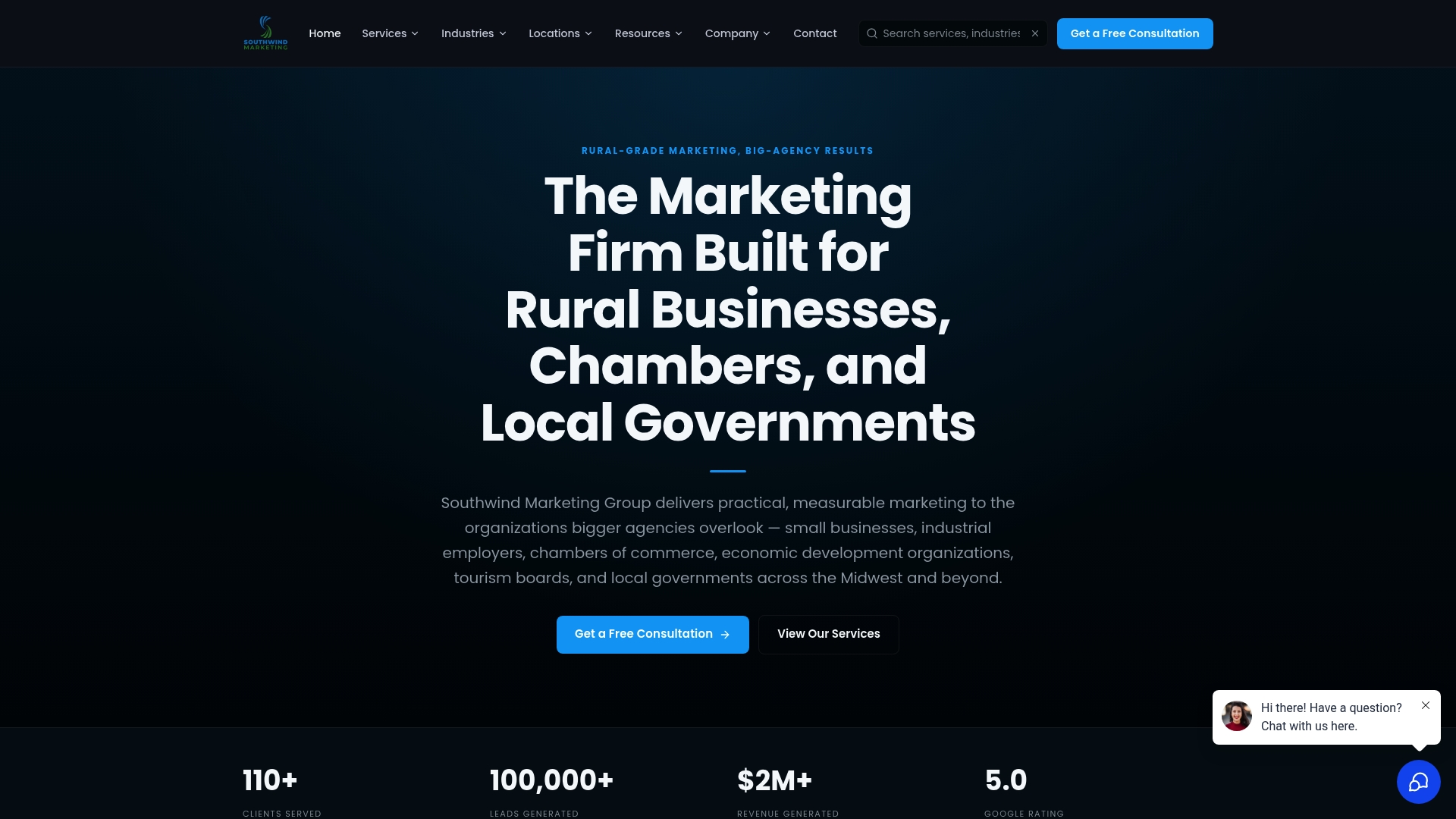
Southwind Marketing builds these sites for Rural America specifically, with Southwind Signal℠ handling SEO and AI search visibility, website design built around the page templates covered here, and Southwind Connect℠ managing lead capture and CRM handoff so no inquiry sits unanswered. Every client owns their content and code outright, with flat rate pricing and no hidden maintenance fees. Request a free 10-minute website and visibility audit and get a plain-language rundown of what's working on your site, what's costing you leads, and where you stand against the checklist above.
Key Takeaways
An economic development website strategy succeeds when investor-ready data, low-friction conversion paths, and search visibility work together instead of as separate projects.
| Point | Details |
|---|---|
| Lead with a narrow value proposition | Name one or two target industries instead of a generic pitch to every sector. |
| Keep property data current and searchable | Use filters, downloads, and visible update dates so site selectors trust the numbers. |
| Cut forms to essential fields | Limit inquiry forms to name, email, project type, and timeline to reduce drop-off. |
| Assign clear content ownership | Name who updates data, incentives, and news, and on what schedule. |
| Vet vendors on ownership and pricing | Southwind Marketing gives clients full content and code ownership with flat rate pricing and no hidden fees. |
Where to Find Primary Guidance and Toolkits
- CEDS guidance: EDA's framework for regional strategy content
- SelectUSA's toolkit: value proposition and data guidance
- EPA's smart growth framework: stakeholder and governance steps
Sources
- Comprehensive Economic Development Strategy (CEDS)
- An Overview of Developing and Delivering Value Propositions for Economic Developers
- Framework for Creating a Smart Growth Economic Development Strategy
- What site selectors look for in an economic development website - Destination by Design
FAQ
What Are Some Examples of Economic Development Strategies?
Common strategies include business retention and expansion programs, industry recruitment targeting specific sectors, downtown and Main Street revitalization, workforce development partnerships, and infrastructure investment tied to a regional CEDS plan.
What Are the Best Practices for Website Development in Economic Development?
Prioritize a narrow value proposition, searchable property and workforce data, minimal-friction contact forms, mobile-first design, and a named staff contact on every services page, all backed by an accessibility and update maintenance plan.
What Is a CEDS Plan?
A Comprehensive Economic Development Strategy is a regionally owned planning process that builds capacity and guides prosperity and resiliency, following EDA's recommended content and format structure.
What Are the Four Types of Economic Development?
Economic development typically breaks into business retention and expansion, business attraction and recruitment, entrepreneurship and small business support, and workforce and talent development, often addressed through separate sections of an EDO's website.
How Do I Choose Between Web Design Agencies for a Government Site?
Compare process discipline, code and content ownership terms, pricing transparency, and direct public-sector experience. Southwind Marketing offers flat rate pricing, full client ownership, and a track record with chambers, EDOs, and local governments across Rural America.