An effective economic development marketing program rests on five parts: a focused value proposition, a website built to convert, outreach mapped to the buyer's funnel, a living marketing plan, and measurement tied directly to leads. Get those right and you generate more qualified prospects who advance into due diligence and site visits. SelectUSA and the IEDC have built the playbooks; Southwind Marketing helps rural and small-market EDOs actually run them.
TL;DR:
- Focusing on three to five sectors with proven local advantages is crucial, as chasing more leads to wasted marketing resources with little return.
- A website's "Why Us" section, live data dashboards, and clear site listings are essential to converting prospects early in the process.
- Marketing efforts should be tailored to each stage of the funnel, using targeted outreach, industry-specific content, and personalized follow-up to maintain momentum.
- Investing around 17% of the marketing budget in website development and maintenance offers the highest impact; small and rural EDOs often rely on contracted support.
- Measuring KPIs across awareness, consideration, and due diligence enables a community to defend and adapt its marketing strategies effectively.
Table of Contents
- Economic Development Marketing Complete Guide: Value Proposition and Targeting
- Website and Digital Presence Priorities
- What Marketing Tactics Work at Each Funnel Stage?
- How Do You Build a Marketing Plan That Actually Gets Used?
- Budgeting and Staffing for Marketing Programs
- Measurement and Dashboards That Prove ROI
- How Southwind Marketing Helps EDOs Execute This Plan
- A Practitioner's Take on What Actually Moves the Needle
- Get Practical Help Running Your Marketing Plan
- Sources
- FAQ
Economic Development Marketing Complete Guide: Value Proposition and Targeting
Chasing every industry sector is the fastest way to spend a marketing budget with nothing to show for it. SelectUSA's toolkit recommends narrowing focus to three to five sectors where your community has real, provable advantages, not aspirational ones.
Start by inventorying what you can actually document: workforce data, site availability, utility capacity, freight access, tax rates, and existing employer clusters. A narrative works only when it's backed by comparative data an outside investor can verify.
To build the value proposition:
- Convene economic development staff, utility providers, workforce boards, and two or three existing employers who can speak to why they stayed.
- Score potential target sectors against local assets, not national trends.
- Draft messaging, then test it on a site selector or a corporate real estate contact outside your network before you print anything.
Pro Tip: Ask your existing employers why they picked your community over the next town over. That answer is usually your value proposition, verbatim.
Website and Digital Presence Priorities
Your website is the first site visit most prospects make, and it happens before they ever call you. SelectUSA data shows a well-maintained site with interactive dashboards and a concise "Why Us" pitch does more persuasive work than a glossy brochure ever will.
Every EDO site needs:
- A "Why Us" section that states your value proposition in under 100 words, no jargon.
- Target industry pages with real data, not stock photography of handshakes.
- A live data dashboard covering workforce, sites, and cost of doing business.
- Available sites and buildings listed with specs, not just addresses.
- An incentives summary in plain language.
- A named permitting or concierge contact, because unclear regulatory paths stall due diligence more than almost anything else.
Keep pages fast, mobile-first, and ADA-compliant. A common audit finding is a site that loads slowly on a phone at a highway rest stop, exactly where a site selector might be checking it. Short video, one real testimonial, and a downloadable one-pager convert better than a wall of text ever will.
Pro Tip: If a site selector can't find your incentives summary in two clicks, they're already looking at your competitor's website instead.
What Marketing Tactics Work at Each Funnel Stage?
The economic development marketing funnel breaks outreach into three stages: awareness, consideration, and due diligence. Each stage needs different tools, and using the wrong one wastes budget.
- Awareness: trade publication PR, targeted digital outreach to site consultants, and content built for the specific searches site selectors run.
- Consideration: detailed industry pages, downloadable data packages, and personalized email outreach that references the prospect's actual sector needs.
- Due diligence: complete property packages, a direct concierge contact, and warm introductions to utility, workforce, and permitting partners.
Short-form video and site-selector testimonials keep prospects engaged during consideration, when most EDOs lose momentum. A campaign built around one target sector (say, food processing) with a dedicated landing page and a social push usually outperforms a generic "open for business" campaign every time.
How Do You Build a Marketing Plan That Actually Gets Used?
State handbooks stress that a formal marketing plan with SWOT, targets, and evaluation outperforms an informal, tactic-by-tactic approach, mostly because it survives staff turnover.
Build your plan around these steps:
- Write a one-paragraph mission tied to your value proposition.
- Complete a SWOT analysis specific to your target sectors, not a generic community SWOT.
- Define target audiences: site selectors, corporate executives, and talent recruiters each need different messaging.
- Set SMART goals (three qualified leads per quarter, for instance, not "more visibility").
- List tactics by funnel stage with an owner and a deadline attached to each.
- Assign a budget line to each tactic.
- Build a 90-day launch list of the five highest-leverage actions.
- Schedule quarterly plan reviews so it stays a living document, not a binder on a shelf.
Name a marketing champion, someone accountable for keeping the plan moving between board meetings.
Budgeting and Staffing for Marketing Programs
Budget realism matters more than budget size. Benchmark data shows internet and website work claims roughly 17% of a typical EDO marketing budget, more than any other single tactic, which tells you where the leverage sits.
- Small EDOs (population under 25,000) often can't justify full-time marketing staff; a fractional agency relationship or regional partnership usually stretches budget further.
- Mid-size EDOs typically split roles: one internal marketing champion, one contracted agency for execution.
- Larger EDOs can support in-house teams but still contract specialized work like data dashboards or paid media.
- Regardless of size, website maintenance and PR outreach deliver outsized returns relative to cost.
Measurement and Dashboards That Prove ROI
If you can't tie a lead to a source, you can't defend next year's budget request. Track KPIs by funnel stage: impressions and reach at awareness, form completions and dashboard views at consideration, and qualified leads plus site visits at due diligence.
- Awareness: website traffic, media mentions, social reach.
- Consideration: form completions, one-pager downloads, email engagement.
- Due diligence: qualified leads, site visit requests, RFI responses.
- Outcome: conversions to project announcements.
Statistic Callout: Internet and website spending accounts for roughly 17% of the typical EDO marketing budget, the single largest tactic line item, which is exactly why that channel needs its own tracking, not a vague "web traffic is up" note in a board report.
Combine your CRM, website analytics, and property listing feeds into one dashboard reviewed monthly, and report quarterly to your board with the same three or four numbers every time so trends are visible.
How Southwind Marketing Helps EDOs Execute This Plan
Most EDOs don't lack ambition. They lack the staff hours to build a dashboard, audit a website, or clean up a CRM while also running incentive negotiations. That's the gap Southwind Marketing fills for chambers, EDOs, and small governments across Rural America.
Practical support includes:
- Website audits that flag the exact reasons site selectors bounce before contacting you.
- CRM setup so leads from your website, trade shows, and referrals land in one place instead of three spreadsheets.
- Data dashboards combining workforce, site, and traffic data into one board-ready view.
- Southwind Signal℠ for SEO and content so your industry pages actually rank for the searches site selectors run.
A short audit typically surfaces three to five fixes an EDO can act on immediately, no long engagement required.
A Practitioner's Take on What Actually Moves the Needle
Most EDOs overinvest in polish and underinvest in speed. A rough one-pager sent within a day of a lead's inquiry beats a beautiful brochure that arrives two weeks later, every time.
For your first 90 days, prioritize three things: fix whatever is broken on your website's "Why Us" page, get every lead source feeding into one CRM, and pick one target sector to message aggressively before spreading thin across five.
— Damien Denmark
Get Practical Help Running Your Marketing Plan
Southwind Marketing is the alternative to hiring a full-time marketing department for EDOs that need real execution without the overhead. We build the website, set up the CRM, and hand you a dashboard you can actually read at a board meeting, all without locking you into enterprise software your team will never fully use.
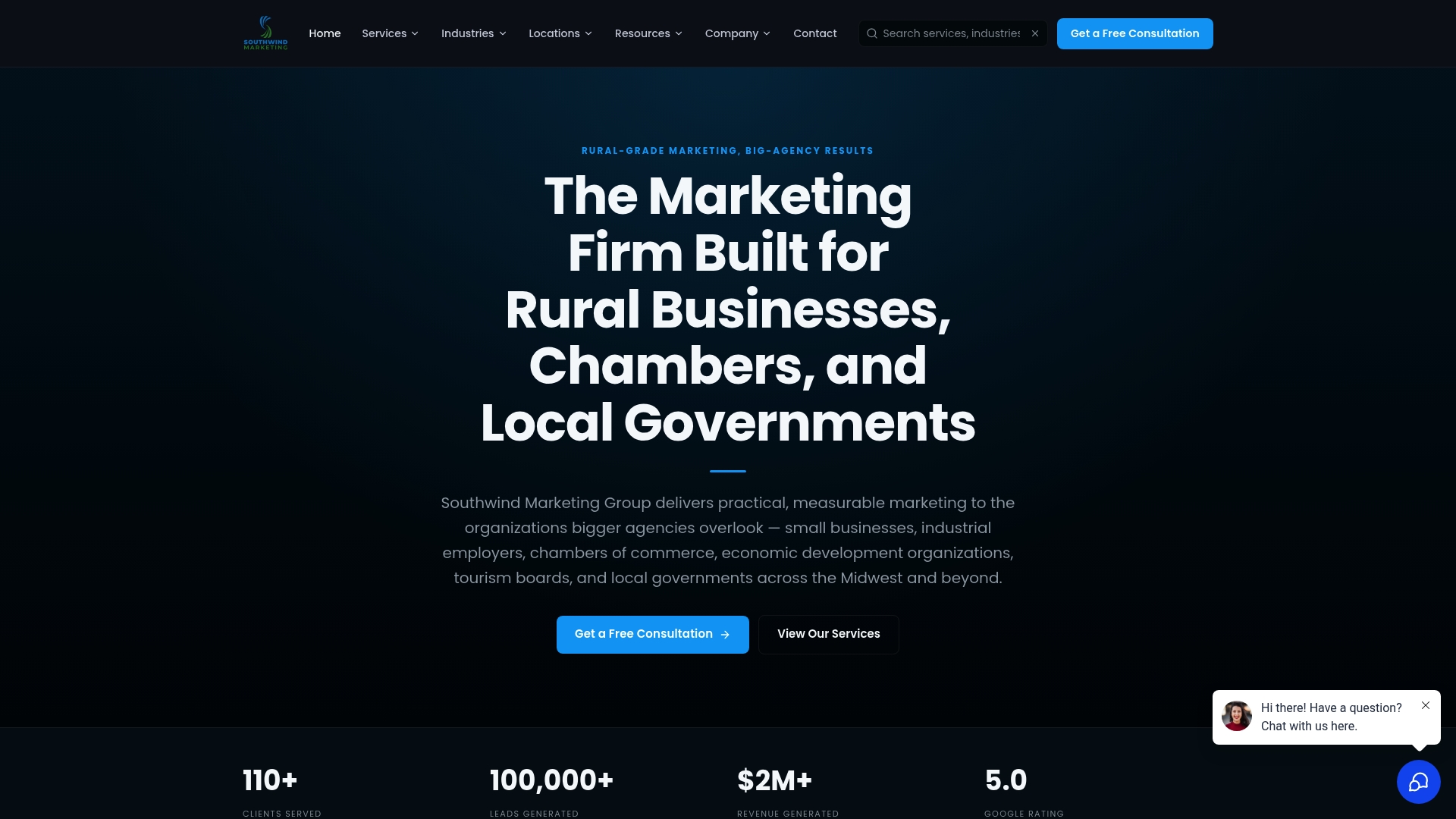
Our work with economic development organizations and downtown development authorities centers on the same problem this guide addresses: turning a good plan into daily action when staff time is scarce. We handle the website, the CRM implementation, and the data dashboards; you handle the relationships that close deals.
Start with the free 10-minute website and visibility audit. It's the fastest way to see exactly where your current site is losing qualified leads before you spend another dollar on outreach.
Sources
- Value Proposition Toolkit for Economic Developers (SelectUSA)
- How the Economic Development Marketing Funnel Drives Business Attraction
- Marketing your community (state EDO handbook)
- ED 101: Mastering economic development marketing and communications
FAQ
What Is the Core of an Economic Development Marketing Plan?
A focused value proposition targeting three to five sectors, a conversion-ready website, and a funnel-mapped outreach plan tied to measurable KPIs.
How Many Industry Sectors Should an EDO Target?
SelectUSA recommends three to five well-defined sectors based on documented local assets rather than aspirational trends.
What Should Every EDO Website Include?
A "Why Us" section, target industry pages, live data dashboards, available site listings, an incentives summary, and a named permitting contact.
How Much of a Marketing Budget Should Go to the Website?
Benchmark data shows internet and website work typically claims around 17% of a total EDO marketing budget, the largest single tactic line.
Can a Small or Rural EDO Run This Plan Without Hiring Staff?
Yes. Small EDOs commonly pair a part-time marketing champion with a contracted agency like Southwind Marketing to handle website, CRM, and dashboard execution.