

East Ridge should commission a full municipal website redesign with a WCAG 2.1 Level AA–compliant CMS, managed hosting, and a content consolidation plan that brings Parks and Recreation, Animal Services, and other city-operated sites under one platform. The immediate next step: issue or update an RFP that names accessibility conformance, content migration, and managed hosting as required deliverables, not optional add-ons.
Your RFP must-haves at a glance:
- Accessibility: WCAG 2.1 Level AA conformance required at launch, with a third-party audit deliverable
- Online forms: Accessible templates with labels, keyboard access, and error notifications
- Searchable ordinances and documents: PDFs indexed and retrievable by residents
- Citizen request tracking: Intake, routing, notifications, and reporting built into the CMS
- Managed hosting: Uptime SLA, automated backups, and patching cadence specified in the contract
- Content consolidation: Migration plan covering existing city sub-sites with URL redirect map
Budget signals from East Ridge's own procurement activity point to a typical municipal website redesign budget range for a city of its size when the RFP is written tightly and acceptance milestones are tied to testable deliverables. This range is realistic for a city of East Ridge's size when the RFP is written tightly and acceptance milestones are tied to testable deliverables.
Key Takeaways
A successful East Ridge Tennessee municipal website design project requires WCAG 2.1 Level AA accessibility as a contract deliverable, a staged migration plan, and managed hosting with defined SLAs, all scoped within a $40,000–$50,000 budget range.
| Point | Details |
|---|---|
| Accessibility is a contract term | Require WCAG 2.1 Level AA conformance and a third-party audit as launch acceptance criteria, not post-launch warranties. |
| Budget and timeline | East Ridge RFP signals point to a $40,000–$50,000 range; typical project timelines run 16–28 weeks from contract to launch. |
| Migration requires a redirect map | Every changed URL needs a 301 redirect; RFP and bid document workflows are discrete deliverables with their own acceptance criteria. |
| Governance outlasts the build | Template rules enforced in the CMS and role-based staff training are the highest-leverage items for long-term compliance. |
| Southwind Marketing | Offers discovery, accessible design, Southwind Guardian℠ hosting, Southwind Signal℠ SEO, and post-launch training for municipal clients. |
Table of Contents
- What should East Ridge's redesigned website accomplish?
- What CMS features does East Ridge need in the RFP?
- What are East Ridge's ADA and Title II accessibility obligations?
- What should East Ridge require from its hosting and maintenance vendor?
- How should East Ridge plan content migration and site consolidation?
- What is a realistic timeline and budget for this project?
- How should East Ridge evaluate and select a vendor?
- What acceptance criteria should go in the contract?
- How do you keep the site compliant and usable after launch?
- How does Southwind Marketing approach municipal website projects?
- What small cities get wrong about their websites
- Southwind Marketing can help East Ridge move from RFP to launch
- Sources
- FAQ
What should East Ridge's redesigned website accomplish?
East Ridge sits just south of Chattanooga, growing steadily while keeping the small-town character that defines Hamilton County's southern edge. That growth puts real pressure on the city's digital infrastructure. Residents need to pay utility bills, pull permit information, find meeting agendas, and report service issues without calling City Hall. Businesses and economic development prospects need to see a city that looks organized and ready for investment. Council members and department staff need a CMS they can actually use without a developer on call.
The redesigned site must serve four distinct audiences: residents handling day-to-day city transactions, businesses and site selectors evaluating East Ridge for investment, city staff managing content and documents, and vendors responding to bids. Each group has a different top task, and the site architecture should reflect that.
Success is measurable. Before the project kicks off, define targets like these:
- Mobile page-speed score of 90 or above on Google PageSpeed Insights
- Accessibility pass rate of 100% on automated WCAG 2.1 AA scans at launch
- Resident task-completion rate tracked via post-launch usability testing
- Number of online transactions (permit requests, utility payments, service requests) completed per month
East Ridge's current site already publishes Title VI and ADA links, open records request entry, bid opportunities, and new resident resources. Those workflows must be preserved in the redesign, not rebuilt from scratch after launch.
Pro Tip: Pull six months of Google Analytics data from the current site before writing the RFP. The pages residents visit most and the search terms they use inside the site tell you exactly which tasks to prioritize in the new architecture. The MMA's webinar on municipal website refresh processes makes this prep work a prerequisite, not an afterthought.
What CMS features does East Ridge need in the RFP?
A modern municipal CMS is not a brochure tool. It is the operational backbone for how residents interact with city government. The features below belong in your RFP as required deliverables, not nice-to-haves.
Editor and content management
Role-based access so department heads can edit their own pages without touching others. A WYSIWYG editor with enforced template rules that prevent staff from accidentally breaking accessibility. Media management with alt-text fields required before upload. Version history and rollback for every page.

Forms and transactions
Accessible form templates are non-negotiable. ADA guidance on web accessibility is explicit: forms must include visible labels, full keyboard access, and automatic input-error notifications. Many municipal CMS failures happen at the form layer precisely because forms are treated as an afterthought. Require integration points for payment processors and permit systems.
Document and records management
Searchable PDFs for ordinances, minutes, agendas, and RFPs. East Ridge currently distributes RFPs and public documents as PDFs on the city site; that workflow must carry forward without disruption. Require automatic metadata tagging so documents surface in both site search and Google.
Citizen request tracking
Residents should be able to submit a service request, receive a confirmation, track status, and get a notification when the issue is resolved. The CMS must route requests to the correct department and generate reporting for staff.

Multi-site consolidation capability
The CMS should support bringing Parks and Recreation, Animal Services, and any other city-operated microsites into the same platform over time. Separate department areas with distinct URL structures, shared navigation, and centralized media libraries make that consolidation manageable without a second full redesign.
Search, SEO, and performance
Site search tuned for municipal content (ordinances, meeting minutes, permit types). Structured data markup for events and meetings so they appear in Google search results. Southwind Signal℠ readiness for ongoing SEO and content automation. Responsive templates that load fast on mobile, with caching strategies specified in the contract.
Security and integrations
TLS enforcement, regular automated backups, web application firewall, and logging. Single sign-on or Active Directory integration for staff accounts. Microsoft 365 compatibility for cities using Southwind Cloud℠.
RFP feature checklist (paste directly into your RFP):
- Role-based CMS access with permission tiers
- WYSIWYG editor with enforced accessibility templates
- Accessible form builder (labels, keyboard access, error notifications)
- Searchable document library (PDFs, agendas, ordinances, RFPs)
- Citizen service-request intake and tracking with department routing
- Event calendar with structured data markup
- Multi-site/department consolidation architecture
- 301 redirect management tool
- Site search with municipal content tuning
- TLS, automated backups, and WAF
- Microsoft 365 / SSO integration
- Mobile-first responsive templates with page-speed targets
Pro Tip: Ask vendors to demonstrate the form builder and document search in a live environment during evaluation, not just in screenshots. Those two features fail most often in practice. See rural website design best practices for additional mobile-first performance benchmarks relevant to small-city sites.
What are East Ridge's ADA and Title II accessibility obligations?
This is not optional, and it is not a future consideration. State and local government web content and mobile apps must meet WCAG 2.1 Level AA under Title II of the ADA. The Department of Justice's final rule formally adopted WCAG 2.1 Level AA as the technical standard, giving the requirement regulatory force. An Interim Final Rule extended compliance dates by one year to give public entities additional implementation time, but that extension is a planning buffer, not permission to defer the work.
The contract must treat accessibility as a deliverable, not a warranty. Require WCAG 2.1 Level AA conformance as an acceptance criterion, not a post-launch promise. Vendors who cannot provide a pre-launch accessibility audit report and a remediation window with defined SLAs should not advance past the proposal stage.
Specific accessibility deliverables to require in the contract:
- Accessible page templates with enforced alt-text and heading structure rules
- Accessible form templates (labels, keyboard access, error notifications) per ADA web guidance
- Captions or transcripts for any video content
- Keyboard-navigable navigation and interactive elements
- A public accessibility feedback channel on the live site
- Pre-launch automated and manual accessibility audit report
- Remediation plan with issue severity tiers and resolution timelines
- Post-launch compliance verification by a third party
- Content editor training on accessibility template rules
If a vendor proposes an "equivalent facilitation" alternative to WCAG 2.1 AA, require written evidence that the alternative provides equal or greater access. Overlay-only solutions do not meet this standard. For a deeper look at what contract language should include, Southwind Marketing's guide on ADA compliance for city websites covers the specific clauses city managers should require.
What should East Ridge require from its hosting and maintenance vendor?
Managed hosting for a municipal site is not the same as shared web hosting. The city's site handles open records requests, bid distributions, and resident transactions. Downtime and security gaps carry real operational and legal risk.
Service-level expectations to specify in the contract:
- Uptime: 99.9% monthly uptime SLA with defined incident response times (under 4 hours for critical outages)
- Patching: Core CMS, plugin, and server-level patches applied within 72 hours of a critical security release
- Backups: Daily automated backups with weekly restore tests; 30-day retention minimum
- Incident response: Defined escalation path, notification timeline, and post-incident report
- Reporting: Monthly system health report covering uptime, patch status, backup verification, and security scan results
Security checklist for the hosting contract:
- TLS 1.2 or higher enforced across all pages
- Web application firewall (WAF) active and logged
- Automated vulnerability scanning on a weekly cadence
- Malware monitoring with immediate notification
- Annual penetration test or third-party security review
- Delegated admin access policies with audit logging
Southwind Guardian℠ is Southwind Marketing's managed hosting and maintenance service built for exactly this profile: small-city and rural government sites that need enterprise-level security and reliability without a full-time IT department to manage it. Managed hosting typically costs more upfront than city-hosted infrastructure, but it reduces staff burden and long-term risk for teams where IT capacity is limited. For a detailed breakdown of what post-launch support should include, see ongoing website support for municipalities.
How should East Ridge plan content migration and site consolidation?
Migration is where projects stall. A staged approach reduces that risk and keeps the city's existing search equity intact.
Phase 1: Audit and prioritization (weeks 1–2) Inventory every page, document, and URL on the current site. Flag high-traffic pages, active RFP and bid documents, and any pages with inbound links from other government sites. East Ridge's existing RFP PDFs and public document workflows are discrete migration deliverables that need their own checklist.
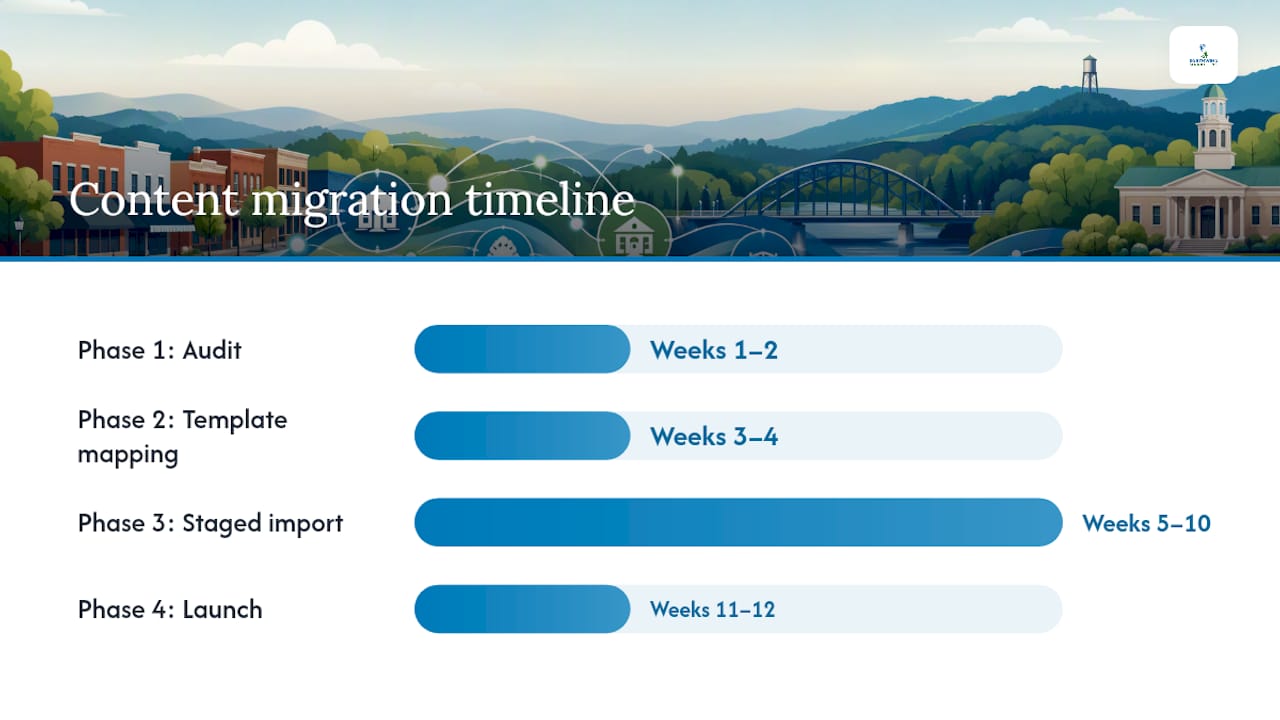
Phase 2: Template mapping and cleanup (weeks 3–4) Map current content types to new CMS templates. Archive outdated content rather than migrating it. Identify which Parks and Recreation or Animal Services pages will consolidate in phase one versus a later sprint.
Phase 3: Staged import and QA (weeks 5–10) Move static pages first, then policy documents and ordinances, then transactional systems (forms, payments, service requests). This sequence allows focused QA cycles for the highest-risk content. A staged migration that moves static content before transactional forms reduces downtime risk and keeps accessibility testing manageable.
Phase 4: Launch and post-launch crawl (weeks 11–12) Run pre- and post-launch crawl reports to verify redirect accuracy. Submit updated sitemaps to Google Search Console and transfer ownership to the city.
SEO preservation checklist (require as contract deliverables):
- 301 redirect map covering every changed URL
- Canonical tags on consolidated pages
- Preserved metadata (page titles, descriptions) from high-traffic pages
- Updated XML sitemap submitted to Search Console
- Search Console ownership transferred to the city at launch
- Roll-back plan documented before go-live
Pro Tip: Treat RFP and bid document publishing as a separate migration deliverable with its own acceptance criteria. Disrupting that workflow mid-procurement cycle creates real operational problems for the city and vendors waiting on bid deadlines.
What is a realistic timeline and budget for this project?
A municipal website redesign at East Ridge's scale typically runs 16–28 weeks from contract execution to launch, depending on content volume and the number of sub-sites being consolidated.
Phase map and typical durations:
- Discovery and analytics review: 2–4 weeks
- Design (wireframes, templates, accessibility review): 4–6 weeks
- Build and content migration: 8–14 weeks
- Accessibility remediation and testing: 2–4 weeks
- Launch and 90-day hypercare: ongoing post-launch
Budget guidance:
East Ridge's RFP signals point to a $40,000–$50,000 project range. That range covers a custom-template build with accessible CMS, content migration, and a third-party accessibility audit when the RFP is scoped tightly. Template-based builds with lighter migration needs can come in below that floor; projects adding complex integrations (payment systems, permit software APIs) or full multi-site consolidation in phase one will push toward or above the ceiling.
The IFR compliance timeline extension gives East Ridge a planning buffer, but starting the procurement process now means the city can launch a compliant site well within the extended window rather than scrambling at the deadline.
Procurement tip: Tie payment milestones to testable deliverables. Pay on approved wireframes, approved accessible templates, passed accessibility audit, and successful launch, not on calendar dates. This protects the city from scope creep and gives vendors clear targets.
How should East Ridge evaluate and select a vendor?
The RFP evaluation process should be weighted, documented, and defensible. Accessibility and migration experience deserve the heaviest weight because those are the two areas where municipal projects most often fail.
Suggested evaluation criteria and weights:
Interview questions to ask finalists:
- Show us a municipal site you built. Walk us through how a resident submits a service request and how staff resolves it.
- How do you test forms for accessibility? What tools do you use, and what does your audit report look like?
- Describe your migration process for a city with existing RFP and bid document workflows.
- What happens if an accessibility issue is found after launch? What is your remediation SLA?
- Have you consolidated multiple city-operated sub-sites into a single CMS? Walk us through that project.
Red flags that should disqualify a vendor: refusing to provide a third-party accessibility audit, proposing an overlay-only accessibility solution, inability to show municipal migration references, or a proposal that treats accessibility as a post-launch warranty rather than a launch acceptance criterion.
Require every finalist to submit a sample workplan with named staff roles, a fixed-price line item for post-audit accessibility remediation, and at least two municipal client references with contact information. Completing analytics review and resident priority mapping before issuing the RFP sharpens proposals and reduces vendor hours spent on discovery that the city should own.
What acceptance criteria should go in the contract?
Acceptance criteria turn subjective "looks good" approvals into objective pass/fail tests. Every launch milestone should have one.
Acceptance checklist:
- Automated WCAG 2.1 AA scan returns zero critical or serious violations across all page templates
- Manual keyboard navigation test passes on all interactive elements (forms, navigation, modals, calendars)
- Screen-reader test (NVDA or JAWS on Windows, VoiceOver on iOS) passes on all form flows and primary navigation
- Form validation test: all required fields produce accessible error messages; no form submits with missing required data
- Site search returns accurate results for ordinances, meeting minutes, and permit types within top 5 results
- All redirects from the old URL structure return 301 status codes; zero 404s on previously indexed pages
- Mobile page-speed score meets the contracted target on Google PageSpeed Insights
- Content spot-check: 20 randomly selected pages reviewed for template compliance, alt text, and heading structure
Testing matrix (sample):
| Component | Test Type | Pass Condition | Remediation SLA | Sign-off Owner |
|---|---|---|---|---|
| Page templates | Automated (axe-core) | Zero critical/serious violations | 5 business days | Vendor + City IT |
| Form accessibility | Manual (keyboard + screen reader) | Full keyboard access, labeled fields, error messages | 5 business days | Vendor + City Clerk |
| 301 redirects | Automated crawl | Zero 404s on redirected URLs | 2 business days | Vendor |
| Document search | Manual | Top-5 results for ordinances and minutes | 3 business days | Vendor + City Staff |
| Mobile performance | Automated (PageSpeed) | Contracted score met | 5 business days | Vendor |
Require a third-party post-launch accessibility audit within 30 days of go-live. Define "critical" and "serious" severity levels in the contract using WCAG's own conformance language so there is no ambiguity at acceptance.
How do you keep the site compliant and usable after launch?
The CMS is rarely the hardest part of a municipal website project. Governing how department staff upload content after launch is. An editor who skips alt text, mislabels a form field, or uploads an inaccessible PDF can undo months of accessibility work in an afternoon.
Training plan:
- Role-based training sessions at launch: separate tracks for editors, department heads, and administrators
- Monthly office hours for the first 90 days post-launch
- Train-the-trainer deliverable so the city can onboard new staff without vendor dependency
Governance checklist:
- Template rules that enforce alt text and heading structure at the CMS level (not just in training)
- Content review cadence: quarterly audit of high-traffic pages for accessibility and accuracy
- Roles and permissions reviewed annually
- Content calendar for meeting agendas, minutes, and public notices
Suggested maintenance schedule:
- Daily automated backups (verified weekly)
- CMS and plugin updates within 72 hours of critical releases
- Quarterly accessibility scan with report delivered to city staff
- Annual third-party accessibility audit
- Semi-annual security review
Southwind Guardian℠ handles the hosting, patching, backups, and security monitoring so city staff can focus on content rather than server management. That division of responsibility is the practical answer for small-city IT teams that wear multiple hats.
Pro Tip: Build accessibility template rules into the CMS itself — required alt-text fields, enforced heading order, form label requirements — so the system catches errors before they go live. Training alone is not enough when staff turnover is high.
How does Southwind Marketing approach municipal website projects?
Southwind Marketing has built websites for local governments, chambers, economic development organizations, and rural communities across Oklahoma, Kansas, Texas, Iowa, Missouri, and Arkansas. The process is consistent and procurement-friendly.
How a project typically runs:
- Discovery: Civic Intelligence℠ resident and stakeholder surveys to identify top tasks and content gaps before a single wireframe is drawn
- Content audit: Full inventory of existing pages, documents, and URLs with migration priority scoring
- Accessibility-first design: Templates built to WCAG 2.1 AA from the first wireframe, not retrofitted after build
- Migration: Staged import with redirect map, pre- and post-launch crawl reports, and Search Console transfer
- Launch: Acceptance testing against the criteria in the contract
- Ongoing support: Southwind Guardian℠ for managed hosting and security, Southwind Signal℠ for SEO and content automation, Southwind Cloud℠ for Microsoft 365 support
The City of Ulysses, Kansas replaced a legacy municipal CMS with a WordPress-based platform through Southwind Marketing, preserving existing document workflows and improving staff usability. That project reflects the kind of migration East Ridge would be undertaking.
View the full municipal and community portfolio to see how Southwind approaches government site design Tennessee-style: clean, fast, accessible, and built for the staff who maintain it daily.
Pro Tip: Request a free 10-minute website and visibility audit before writing your RFP. It gives you a baseline for your current site's accessibility gaps, mobile performance, and search visibility, which sharpens your acceptance criteria before you go to market.
What small cities get wrong about their websites
Most small-city website projects fail at the same two points: they treat accessibility as a visual checklist rather than a functional requirement, and they hand content governance back to department staff with no training and no template guardrails.
East Ridge is in a position to do this right. The city already publishes the right content categories — open records, ADA links, bid opportunities, new resident resources. The gap is in the delivery: mobile performance, form accessibility, searchable documents, and a CMS that staff can actually maintain without calling a developer.
The cities that get the most out of a redesign are the ones that define success in measurable terms before the RFP goes out. Not "the site looks modern" but "residents can complete a permit request on a mobile device in under three minutes." That specificity drives better vendor proposals, cleaner acceptance criteria, and a site that keeps working after launch.
For a city balancing small-town character with Chattanooga-area growth, the website is also an economic development tool. Site selectors and business prospects look at a city's digital presence as a proxy for how organized and responsive local government is. A fast, accessible, well-organized site signals that East Ridge is ready for investment.
Southwind Marketing can help East Ridge move from RFP to launch
East Ridge officials evaluating a municipal website redesign have a concrete path forward with Southwind Marketing. The work starts with a discovery engagement that includes Civic Intelligence℠ resident surveys, a full content audit, and a migration plan, so the city enters the build phase with clear priorities and no guesswork.
Southwind delivers the full stack: accessible website design, Southwind Guardian℠ managed hosting, Southwind Signal℠ for ongoing SEO and content visibility, and post-launch staff training. For cities on a defined procurement timeline, Southwind offers a fixed-price discovery and accessibility audit package that fits cleanly into an RFP response. The city government services page outlines the full scope of what Southwind provides for municipal clients.
Request a free 10-minute website and visibility audit at Southwindmarketing to get a baseline on your current site's gaps before the RFP goes out.
Sources
These primary references support the accessibility requirements and procurement guidance in this article:
This article is general information, not a substitute for advice from a qualified lawyer. Consult a qualified legal professional about your own circumstances before acting on anything here.
FAQ
What accessibility standard applies to East Ridge's city website?
State and local government websites must meet WCAG 2.1 Level AA under Title II of the ADA, as adopted in the DOJ's final rule. East Ridge should require this standard in both the RFP and the vendor contract as a launch acceptance criterion.
How much does a municipal website redesign cost in Tennessee?
East Ridge's own procurement signals point to a $40,000–$50,000 range for a full redesign with an accessible CMS, content migration, and managed hosting. Projects with complex integrations or full multi-site consolidation in phase one may exceed that range.
What is the biggest risk in a municipal website migration?
Broken URLs and lost document workflows are the most common failures. Require a 301 redirect map covering every changed URL and treat RFP and bid document publishing as a discrete migration deliverable with its own acceptance criteria.
Can Southwind Marketing handle both the website build and ongoing hosting?
Yes. Southwind Marketing provides website design, Southwind Guardian℠ managed hosting and maintenance, Southwind Signal℠ SEO, and post-launch staff training as a bundled or modular engagement for municipal clients.
What should East Ridge do before issuing an RFP?
Pull six months of site analytics, identify the top resident tasks, and document which sub-sites (Parks, Animal Services) need consolidation. Completing that prep work before the RFP goes out sharpens vendor proposals and reduces discovery costs, as recommended by the MMA's municipal website refresh guidance.