
Your downtown doesn't have a money problem. It has a coordination problem. Most towns already spend enough on their downtown district; they just spend it on the wrong sequence of things, through governance nobody owns, with parking priced at zero and storefronts nobody is actively marketing to tenants.
Fix the system before you ask council for another dollar. Three moves this week: assign a named owner to each of the four Main Street points, pick one underused asset (a parking lot, a vacant anchor building, a dead Tuesday event slot) and repurpose it, and run one low-cost activation test you can measure in 30 days.
- Assign owners for Organization, Promotion, Design, Economic Vitality
- Repurpose one underutilized asset instead of building something new
- Test one cheap activation tactic and track foot traffic or sales
The framework doing the heavy lifting here is the Main Street Four-Point Approach, paired with targeted parking and policy fixes. Expect visible traction in 3 to 12 months, not years.
Key Takeaways
Systems, not bigger budgets, determine whether a downtown fills storefronts, because coordinated ownership and pricing fixes move faster than any single capital project.
| Point | Details |
|---|---|
| Systems beat budgets | Coordinated ownership of the four Main Street points outperforms one-off capital spending. |
| Parking is a revenue tool | Performance pricing and parking benefit districts fund reinvestment without new taxes. |
| Governance needs an owner | A named director or authority, not a rotating committee, keeps momentum between meetings. |
| Pilot before you scale | Test policy changes on one block for 3 to 6 months before a townwide rollout. |
| Southwind Marketing supports the rollout | Civic Intelligence℠ surveys, Southwind Signal℠, and Southwind Guardian℠ back the marketing and technology layer of the roadmap. |
Table of Contents
- Why Your Downtown Doesn't Need a Bigger Budget to Turn Around
- The Four Systems That Actually Move the Needle
- How Do You Apply the Four-Point Approach Without New Money?
- What Policy and Finance Tools Raise Money Without New Taxes?
- Modernizing Parking as an Operational and Revenue System
- Low-Cost Activation Tactics That Fill Sidewalks This Season
- How Do You Pitch System Changes to Council Without Asking for More Money?
- A 3 to 12 Month Roadmap for Systems-First Revitalization
- Three U.S. Examples That Prove Systems Beat Budgets
- Sources
- FAQ
Why Your Downtown Doesn't Need a Bigger Budget to Turn Around
Big capital projects lock you in. Once a council approves a $4 million streetscape redesign, you're committed to that design, that contractor, and that timeline for years, regardless of what the market tells you six months in. Strong Towns argues that policy-based, incremental changes consistently outperform big-ticket projects because they preserve fiscal flexibility. You can adjust a parking price or a façade grant program in a month. You cannot adjust a finished parking garage.
Here's the paradox most leaders walk past every day: a block of vacant storefronts sits next to a parcel worth six figures per acre, and nobody in city hall owns the job of connecting the two. Brookings has documented this pattern across small and midsized downtowns, where underutilized land sits idle next to high-value real estate because no single entity has the authority or incentive to broker a deal.
The symptoms repeat from town to town:
- Governance split across three boards with overlapping mandates and no clear decision-maker
- No written tenant strategy, so vacant storefronts just wait for a walk-in
- Parking priced at $0 in front of the busiest block, training everyone to circle for ten minutes instead of paying for the closest spot
A town of 6,000 doesn't fail because it lacks a $2 million grant. It fails because three different committees each think someone else is tracking storefront vacancies.
The Four Systems That Actually Move the Needle
Main Street America built its framework around four points, and each one functions less like a checklist item and more like an engine that powers the others. Treat them as interlocking systems, not four separate to-do lists.
- Organization — governance, volunteer structure, and a named leader who owns the calendar and the budget
- Promotion — marketing, events, and the story you tell about the district
- Design — physical improvements, façades, signage, and walkability
- Economic Vitality — market analysis, tenant recruitment, and business retention
Two cross-cutting systems sit underneath all four: parking and curbside management, and data and metrics. Neither belongs to one point alone. Weak parking policy undercuts Design (nobody wants to walk past a half-empty lot priced wrong) and undercuts Economic Vitality (retailers can't recruit customers who can't park). Weak Organization stalls everything else, because Promotion and Economic Vitality both need a decision-maker who can say yes without a three-committee vote.
In small and rural towns, ownership usually breaks down this way: the city or county handles Design and right-of-way, a downtown development authority or merchant association handles Organization and Promotion, and Economic Vitality gets split between a part-time economic developer and volunteer tenant-recruitment efforts. That split works fine as long as everyone knows who's accountable for what. Most of the time, they don't.
How Do You Apply the Four-Point Approach Without New Money?
Pick one low-cost action per point and assign a real owner. Nothing here requires a bond issue.
- Organization — appoint a downtown director (paid part-time or a strong volunteer lead) with explicit authority to schedule events and approve small grants
- Promotion — launch a co-op advertising fund where merchants each contribute a small flat fee for shared district-wide ads instead of running solo campaigns
- Design — pick one priority block and fund a façade cleanup or paint/signage grant round, capped at a modest amount per storefront
- Economic Vitality — build a storefront vacancy database and start active tenant prospecting instead of waiting for cold calls
The Ithaca retail market study is a useful model here: it recommends a public vacancy database paired with proactive landlord outreach and reduced permitting friction, which moves prospects into empty storefronts faster than waiting for organic interest. A part-time economic developer with a spreadsheet and thirty landlord phone calls will outperform a glossy brochure nobody reads.
Assigning ownership without assigning accountability is how good frameworks die in committee. Use a simple table to make roles and success metrics explicit before your next council meeting.
| Point | Typical Owner | What Success Looks Like |
|---|---|---|
| Organization | City liaison + DDA board chair | Clear meeting cadence, single point of contact for merchants |
| Promotion | Merchant association or chamber | Co-op ad fund launched, shared event calendar in use |
| Design | Public works + volunteer design committee | Priority block façade grants disbursed, signage updated |
| Economic Vitality | Part-time economic developer or DDA director | Vacancy rate tracked monthly, active tenant pipeline list |
Track four metrics you can measure without new software: storefront vacancy rate (walk the block monthly), foot traffic (a $200 counter or manual tally on a Saturday), parking turnover (spot-check three times a day), and event revenue against event cost. None of that requires a consultant. It requires someone writing numbers down consistently, which is exactly what the Organization point is supposed to guarantee.
What Policy and Finance Tools Raise Money Without New Taxes?
You have more levers than a mill-rate increase. Most towns just haven't picked them up.
- Parking benefit districts capture parking revenue from a defined zone and reinvest it directly into that zone's sidewalks, lighting, and maintenance. The FHWA has documented these districts as a repeatable way to generate reinvestable revenue without touching the general fund.
- Tax-increment financing (TIF) captures the growth in property tax value within a district and channels it into district improvements, leaving the base tax rate untouched for everyone else.
- Land-value taxation shifts the tax burden toward land value rather than improvements, which discourages sitting on a vacant lot and rewards actually building something.
- Benefit assessment districts let property owners within a defined boundary vote to tax themselves for services like extra cleaning, security, or marketing, which spreads cost only to those who benefit.
Each comes with tradeoffs. TIF takes years to generate meaningful capture and requires patient legal drafting. Parking benefit districts need upfront metering or pricing infrastructure before they generate a dollar. Land-value taxation is politically hard to explain in a town meeting. Benefit districts require a supermajority of property owners to agree, which can stall in a district with absentee landlords.
Pro Tip: Pilot any finance tool on a single block first. A one-block parking benefit district you can defend with six months of data is far easier to expand than a townwide plan you have to sell on faith.
None of these require a public vote to raise general taxes, which is exactly why they survive council scrutiny better than a bond referendum. Bring in bond counsel or a municipal finance advisor before you draft the ordinance language, not after.
Modernizing Parking as an Operational and Revenue System
Parking is the fastest lever most towns leave untouched. Three steps get you there without a garage:
- Audit actual usage. Count occupied spaces block by block, at three points in the day, for one week. Most downtowns overestimate their parking shortage and underestimate how badly the free spots in front of the busiest block are hoarded.
- Introduce performance pricing on the highest-demand blocks. Even a modest fee on the busiest curb frees up turnover, and the goal isn't maximum revenue, it's roughly 85% occupancy so a spot is almost always available.
- Reprogram underused lots. A half-empty overflow lot two blocks off Main Street can host a Saturday market, food-truck night, or seasonal skating rink instead of sitting empty.
For the technology layer, platforms like Honk (HonkMobile) handle mobile payment and wayfinding for exactly this kind of small-district rollout, letting a town add metered or app-based payment without installing hardware on every block. Pair that with clear signage so out-of-town visitors, who don't know your unwritten parking etiquette, can find a spot in under two minutes.
Run the pilot on one block for six months. Track occupancy weekly for the first month, then monthly. Track revenue collected and where it gets reinvested, publicly, so merchants see the district benefit directly rather than assuming the money vanishes into the general fund. Parking benefit districts work because the connection between "I paid to park" and "that sidewalk got fixed" is visible and fast.
Low-Cost Activation Tactics That Fill Sidewalks This Season
You don't need a festival budget to change foot traffic patterns; effective community engagement can build lasting support and involvement in local activations. You need a calendar and a co-op ad fund.
- Launch a monthly pop-up or food-truck night on a slow weekday to build a repeat habit
- Convert one vacant lot into a temporary pocket park with borrowed seating and string lights
- Run a window display campaign tying every storefront to a single seasonal theme
- Offer micro-grants (capped small amounts) for façade touch-ups tied to the campaign
- Coordinate one shared print or digital ad buy instead of a dozen solo merchant ads
The co-op model works like this: merchants each contribute a flat monthly fee into a shared pool, the downtown association or DDA manages the media buy, and every participant gets logo placement and a shared landing page instead of a $150 ad nobody notices. This is the same principle behind rural digital marketing strategies that pool limited budgets into shared district-wide visibility rather than fragmented individual pushes.
Measure ROI simply: compare foot traffic counts and same-week sales tax collections against a comparable non-event week. A food-truck night that drew 400 more visitors and a visible bump in weekend sales tax revenue is a case you can bring back to council next quarter.
How Do You Pitch System Changes to Council Without Asking for More Money?
Build a five-slide deck, not a fifty-page report. Slide one: the vacancy and parking-occupancy numbers today. Slide two: the four-point ownership assignments. Slide three: the pilot (one block, one district, one policy change). Slide four: a one-page ROI estimate with conservative numbers, local revenue captured, grant-readiness improved, and private match potential. Slide five: the 90-day ask.
Keep the ROI numbers believable, not aspirational. A $15,000 façade grant pilot that unlocks two private storefront renovations and improves your competitiveness for a state historic preservation grant is a stronger pitch than a vague "revitalization" line item.
Address the pushback before it's raised:
- "This is risky." Pilot it on one block first, with a defined evaluation date.
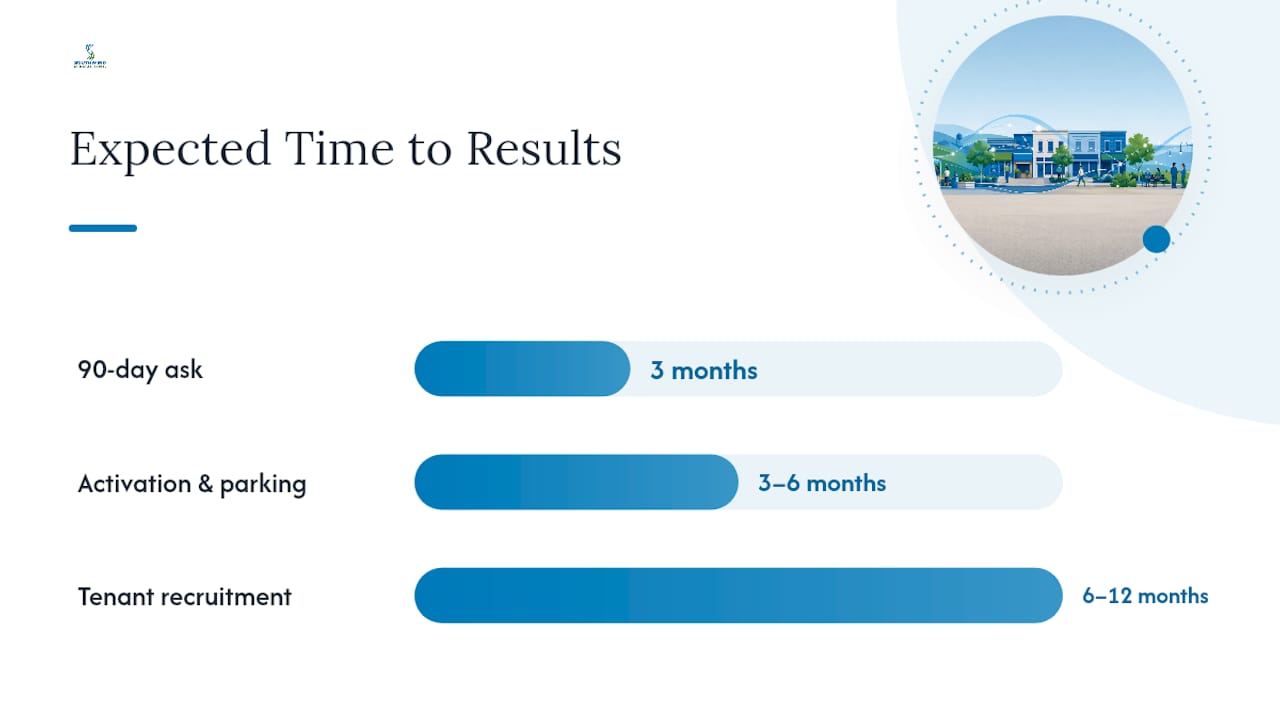
- "How long until we see results?" Three to six months for activation and parking pilots, six to twelve for tenant recruitment wins.
- "Is this fair to every neighborhood?" Tie benefit-district revenue transparently to the block that generated it, and publish the reinvestment.
| Point | Details |
|---|---|
| Slide count | Five slides: baseline data, ownership, pilot, ROI, 90-day ask |
| ROI framing | Use conservative, local revenue and grant-readiness figures, not aspirational totals |
| Objection prep | Have a one-line answer ready for risk, timeline, and equity pushback |
A dedicated downtown authority with real financing authority, as SPUR's governance research recommends, makes this pitch far easier the second time around, because the entity making the ask has a track record instead of a proposal.
A 3 to 12 Month Roadmap for Systems-First Revitalization
Phase your rollout so early wins fund later credibility.
- Months 0 to 3: Organize and pilot. Assign the four-point owners, launch the vacancy database, and pick one parking or activation pilot block.
- Months 3 to 6: Scale parking and activation. Expand pricing pilots, launch the co-op ad fund, and run at least two repeat activation events.
- Months 6 to 12: Invest and institutionalize. Draft the parking benefit district or TIF ordinance, formalize tenant-recruitment outreach, and present year-one results to council for the next budget cycle.
- City staff owns parking policy and permitting
- The DDA director or merchant association chair owns Promotion and the co-op fund
- Volunteer committees own Design pilots and event staffing
- Southwind Marketing or a similar partner can support the DDA marketing and communications layer so staff aren't building websites and flyers on top of everything else
Check milestones at month 3 (owners assigned, pilot live), month 6 (measurable foot traffic or parking revenue gain), and month 12 (at least one filled storefront and a funded finance mechanism in place).
Three U.S. Examples That Prove Systems Beat Budgets
- Mission Bay, San Francisco. A dedicated redevelopment authority with real financing and land-use power, the governance model SPUR points to, assembled financing and negotiated deals that a standard planning department couldn't move alone.
- Small-city parking modernization. Towns that piloted parking benefit districts saw revenue flow directly back into the block that generated it, building public trust in the policy instead of resentment.
- Main Street small-town turnarounds. Programs following the Main Street Four-Point Approach consistently show that volunteer-driven organization combined with active tenant recruitment fills storefronts faster than waiting for a developer to arrive uninvited.
The common thread across all three: someone was explicitly accountable for the outcome, and the financing tool matched the scale of the problem.
Why We Recommend Systems Over Bigger Budgets
Rural downtowns get treated as an afterthought by agencies built for metro clients, and it shows in the boilerplate advice they hand out. Southwind Marketing's work with small towns points to the same conclusion the Main Street framework reaches: clear ownership and resident input outperform bigger appropriations. Our Civic Intelligence℠ survey work exists because priorities set without resident input tend to miss the mark. Choose Rural by Choice over rural by default.
How Southwind Marketing Supports the Systems Approach
Southwind Marketing is the alternative to a big-city agency that treats your downtown like a niche add-on. We build the marketing and technology layer under the four-point framework, so your DDA director isn't also your webmaster, your graphic designer, and your survey administrator.
Our services line up directly with the roadmap above: Civic Intelligence℠ surveys validate which priorities residents and merchants actually rank first, before you spend a dollar on a pilot. Southwind Signal℠ keeps your event calendar and vacancy listings visible in search and AI results without a full-time content hire. Southwind Guardian℠ keeps your downtown or DDA website running reliably so a co-op ad campaign doesn't drive traffic to a site that's down. We also build websites and branding specifically for downtown development authorities and city governments navigating exactly this kind of systems-first work.
Start with a free 10-minute website and visibility audit, and ask about a pilot Civic Intelligence℠ survey to confirm your priorities before your next budget cycle.
Sources
- Tackling the paradox of underutilized land in small and midsized city downtowns (Brookings)
- U.S. parking benefit districts (FHWA)
- Reinventing downtown: SPUR research on governance models
- The Main Street Approach | Main Street America
- The key to a strong downtown is smart policy changes (Strong Towns)
Attach these directly to grant applications or council packets; each one carries the institutional weight a self-written memo lacks.
FAQ
Do cities have to have a balanced budget?
Most states require cities to adopt a balanced operating budget each fiscal year, though the specific rules vary by state; check your state's municipal finance statutes for the exact requirement.
What does it mean when a budget is called balanced?
A balanced budget means projected revenue meets or exceeds projected expenses for the fiscal period, with no planned deficit spending from the general fund.
What's the most important thing to do when creating a downtown budget?
Assign clear ownership for each spending category before allocating dollars. A budget without a named owner for parking, promotion, and tenant recruitment tends to fund activity, not results.
How long does a systems-first downtown approach take to show results?
Activation and parking pilots typically show measurable change in 3 to 6 months; tenant recruitment and finance-tool wins usually take 6 to 12 months to fully materialize.
Can a small town afford a parking benefit district?
Yes. A parking benefit district can start on a single block with existing or minimal metering infrastructure, and FHWA case documentation shows revenue can be reinvested locally without a townwide tax increase.