

Choose an agency and contract that guarantees your town owns its website content, data, design files, and analytics, with a clear exit ramp if the relationship ends. That's the entire decision in one sentence. The GAO has flagged restrictive software licensing as a real cost and choice problem for public agencies, and accessibility law under WCAG 2.2 AA isn't optional for a government site. Southwind Marketing builds every website contract around this ownership-first standard consistent with best practices.
Before you sign anything, run one test: ask the vendor for a full content export and a line-item quote covering migration, ongoing support, and exit fees. How they answer tells you almost everything.
- Request a sample export of pages, media, and templates in standard formats
- Get exit fees and migration assistance written into the contract, not promised verbally
- Confirm who owns the code, the design files, and the data once the invoice is paid
Pro Tip: If a vendor hesitates to hand over a sample export during the sales process, imagine how they'll behave once you're locked into a three-year contract.
Key Takeaways
An ownership-first website contract, one that guarantees exportable content, clear IP terms, and a documented exit ramp, protects a small town's budget, control, and continuity better than any feature list a vendor demos.
| Point | Details |
|---|---|
| Test exports before signing | Request a sample content export and migration plan during the RFP phase, not after award. |
| Demand line-item pricing | Require separate pricing for discovery, migration, accessibility, training, and support. |
| Name the accessibility standard | Require WCAG 2.2 AA verification plus a VPAT or conformance report as a deliverable. |
| Watch for lock-in clauses | Proprietary editors, blocked exports, and undocumented exit fees signal risk. |
| Southwind builds ownership in | Southwind Marketing writes exportability, IP terms, and exit ramps into every website contract. |
Table of Contents
- What Owning a Government Website Actually Means
- What Red Flags Show Up in RFP Responses and Demos?
- Why Vendor Lock-In Is a Real Risk for Small Towns
- What Belongs in the Contract Before You Sign?
- How Long Should a Small-Town Website Project Take?
- How Do You Shortlist an Agency That Understands Small Towns?
- Southwind Marketing's Ownership-First Approach for Small Towns
- Rural Communities Deserve Ownership-First Digital Services
- Get a Second Opinion Before You Sign
- Sources
- FAQ
What Owning a Government Website Actually Means
Ownership means your town controls its digital front door, not just occupies a rented space in it. A genuinely owned website gives you editable content, raw files and media assets, data exports in standard formats like CSV or XML, clear intellectual property rights or a perpetual license to the code, and API access for connecting other tools. Vendor lock-in looks different: proprietary editors that only work inside the vendor's ecosystem, exports that dump everything into unusable formats, migration fees that spike the moment you mention leaving, and a requirement to call the vendor for every text edit or photo swap.
The practical difference shows up years later, not on launch day. A town that owns its site can switch developers, add a new CRM, or renegotiate hosting without starting from zero. A locked-in town negotiates from a position of zero leverage, because the vendor knows leaving costs more than staying.
- Ownership: exportable content, owned code, open APIs, standard file formats
- Lock-in: proprietary CMS, blocked exports, mandatory vendor edits, hidden exit costs
Pro Tip: Ask a vendor to define "ownership" in writing before you ask about price. If their definition doesn't include a data export clause, keep shopping.
What Red Flags Show Up in RFP Responses and Demos?
Watch for these signals during vendor evaluation, because they rarely show up until it's too late to negotiate:
- The vendor can't or won't provide a full content export, or only offers proprietary formats you can't open elsewhere
- Pricing is bundled with no breakdown for migration, accessibility testing, or post-launch support
- The contract requires vendor-licensed plugins, blocks hosting elsewhere, or bars other contractors from making updates
- There's no documented exit process, conversion fee schedule, or migration assistance clause anywhere in the agreement
A practitioner's guide to buying local government websites recommends focusing procurement on outcomes and platform standards rather than flashy features, precisely because feature lists hide these terms well.
Vendor lock-in often masquerades as platform convenience. The real test is whether a vendor will hand over a full export of content, media, and templates in standard formats and walk you through a sample migration plan before you sign anything.
That test costs you nothing during the sales process. It costs the vendor nothing either, unless they're planning to make leaving painful later.
Why Vendor Lock-In Is a Real Risk for Small Towns
A single-vendor dependency means your town's website goes dark or degrades if that vendor raises prices, gets acquired, or shuts down, and small towns rarely have IT staff on standby to react fast. The financial risk compounds over time: migration fees you never budgeted for, support renewals that climb annually, and a total cost of ownership that outpaces what the initial bid implied.
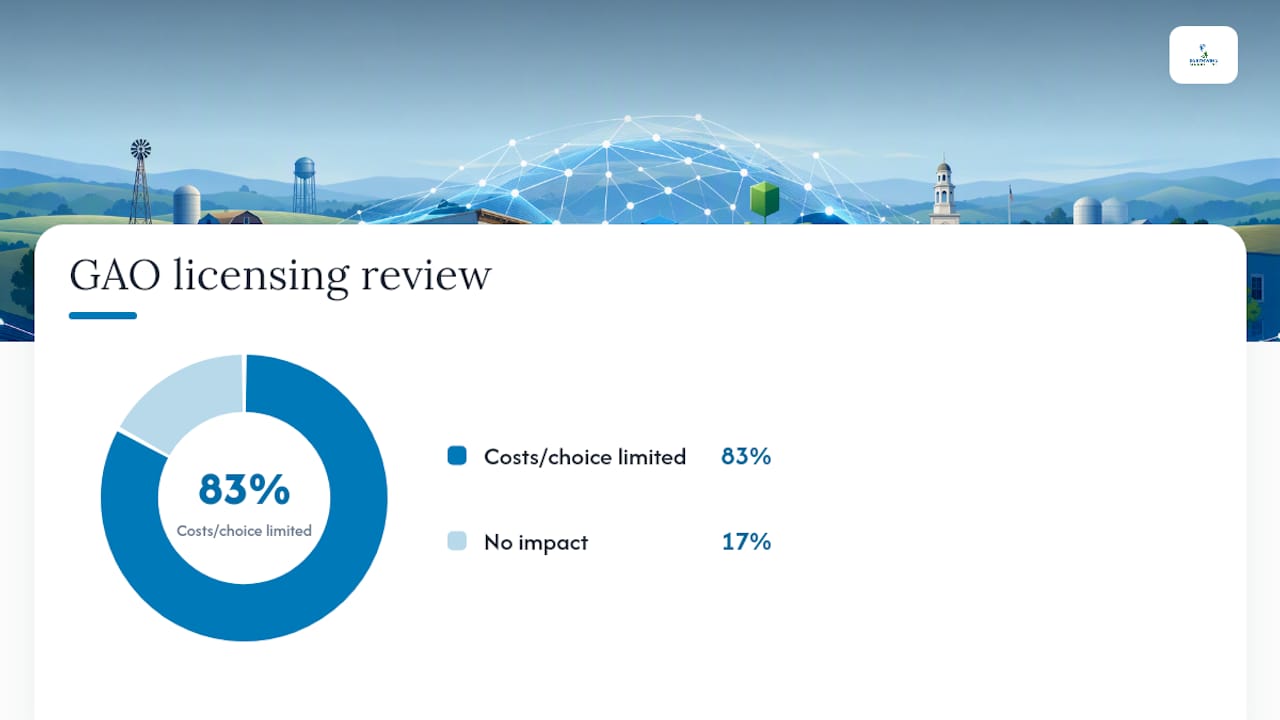
There's also a transparency problem. Restricted access to your own analytics or source files makes public-records requests and budget audits harder to defend. The GAO reviewed six federal agencies and found restrictive licensing practices increased costs or limited provider choice for five of them, a pattern that plays out just as easily in a city hall contract as in a federal one.
- Operational risk: no fallback plan if the vendor exits the market
- Financial risk: migration and support costs the original bid never mentioned
- Governance risk: blocked analytics access complicates audits and public-records compliance
What Belongs in the Contract Before You Sign?
Your RFP and contract should force every vendor to price the same deliverables, so proposals are actually comparable instead of apples to oranges.
- Discovery and information architecture
- Design
- Development and CMS build
- Content migration, with page and document counts stated explicitly
- Accessibility testing and remediation
- Staff training
- Hosting
- Post-launch support
Beyond pricing, the contract itself needs specific clauses: explicit data ownership language, the exact format and method for exports, IP and code ownership (or a perpetual license if outright ownership isn't feasible), documented API and integration commitments, a written exit ramp with migration assistance, and published service-level agreements. Federal procurement guidance on avoiding vendor lock-in points to exactly these terms as the difference between a successful modernization project and a trap.
Name the accessibility standard, don't gesture at it. Require WCAG 2.2 AA compliance verified through both automated scanning and manual testing on key user paths, with a VPAT or conformance report delivered as a contract deliverable rather than a verbal assurance, a point RFP best practices for government sites makes directly.
| Line item | What to require |
|---|---|
| Discovery & IA | Documented findings and sitemap before design starts |
| Migration | Exact page and document counts, sample export upfront |
| Accessibility | WCAG 2.2 AA verification plus VPAT deliverable |
| Exit terms | Written fee schedule and migration assistance clause |
Pro Tip: Build a milestone checklist into the RFP itself. Vendors who balk at pricing each milestone separately are usually the ones planning to blur the line between "included" and "extra" later.
How Long Should a Small-Town Website Project Take?
A realistic project runs somewhere between four and six months from kickoff to stabilization, and any bid that promises much faster should raise questions about what's being skipped.
- Discovery: 2 to 4 weeks
- Information architecture and design: 4 to 8 weeks
- Development and content migration: 6 to 12 weeks
- Testing and staff training: 2 to 4 weeks
- Launch and stabilization: 2 to 4 weeks
Cost swings on a handful of factors: how many pages and documents need migrating, how much accessibility remediation the existing site requires, whether you need custom API or CRM integrations, and whether the vendor is writing content or just moving what exists.
- List recurring support and hosting as a separate annual line item, not a bundled afterthought
- Treat a suspiciously low upfront bid as a signal to ask what's missing, not a reason to celebrate
How Do You Shortlist an Agency That Understands Small Towns?
Score every finalist against the same rubric so the comparison actually holds up:
- Demonstrated experience with towns your size, not just enterprise or metro clients
- Willingness to provide a sample content export before you sign
- Transparent, itemized pricing with no bundled mystery line
- A documented accessibility process, not a vague "we follow best practices" claim
- Real API and integration capability for CRM or data tools you already use
- A concrete training and support plan named in the proposal, not implied
Then verify the claims. Ask for references from similarly sized towns, request live demo or trial access rather than a slideshow, get the names of staff who'll handle ongoing support, and push for a documented migration example from a past client.
- Request three references from towns comparable in population and budget
- Ask for a trial export or sample migration plan during the RFP phase itself
- Confirm named staff, not just a sales team, will be doing the ongoing work
Southwind Marketing's Ownership-First Approach for Small Towns
Southwind Marketing builds every government website contract around exportable content, documented IP terms, and a written exit ramp from day one, because a rural community deserves the same contractual protection a metro agency demands. Southwind's website design work for chambers, EDOs, and local government pairs with the tools that keep a town in control long after launch:
- Southwind Guardian℠ handles hosting and maintenance without locking your content behind a proprietary editor
- Southwind Signal℠ manages SEO and content strategy so your visibility doesn't depend on one vendor's whims
- Southwind Connect℠ covers CRM, automation, and multichannel communications with your data, not the vendor's
- Southwind Cloud℠ provides fractional IT and Microsoft 365 support for towns without a dedicated tech department
- Civic Intelligence℠ runs resident and stakeholder research to guide decisions with real local data
A small town that migrates to Southwind gets a documented handoff plan and a full export of everything from the outgoing platform before the old contract even ends, which is the difference between a transition and a disruption.
Pro Tip: If your current vendor won't produce a sample export today, that's the procurement red flag you needed. Southwind offers a no-obligation review of exactly that question.
Rural Communities Deserve Ownership-First Digital Services
Working directly with rural governments and economic development groups on website procurement, I've watched the same pattern repeat: towns get sold convenience and end up paying for control they never had. Every community deserves a contract that protects it, not just a vendor that flatters it during the sales pitch. Send me your current contract or RFP draft. I'll tell you what's missing.

Get a Second Opinion Before You Sign
Southwind Marketing is the alternative to a locked platform for small-town websites: every contract we write includes exportable content, documented IP terms, and a published exit ramp before you ever sign, so you're never negotiating from zero leverage down the road.
If you're evaluating a current vendor's contract or drafting a new RFP, Southwind will run a free procurement review, checking for exportability gaps, hidden exit fees, and accessibility commitments that don't hold up. We work specifically with small towns, EDOs, chambers, and nonprofits, so we already understand the budget constraints and staffing realities your procurement process has to work within. Visit our services for rural communities and local government to request a review, or ask us for a sample export test alongside your website design proposal before you commit to any vendor.
Sources
- GAO-25-107114, CLOUD COMPUTING: Selected Agencies Need to Implement Updated Guidance for Managing Restrictive Licenses
- How to avoid vendor lock-in when modernizing | Federal News Network
- Guide to Buying Local Government Websites
FAQ
What Does It Mean to Own a Government Website?
Ownership means your town controls the editable content, raw files, code or license, and can export everything in standard formats without vendor permission or steep fees.
What Are the Biggest Warning Signs of Vendor Lock-In?
Watch for blocked content exports, bundled pricing with no line items, mandatory vendor-only edits, and contracts with no documented exit process.
How Long Does a Small-Town Website Project Typically Take?
Most projects run four to six months, covering discovery, design, development and migration, testing and training, and launch stabilization.
What Accessibility Standard Should a Government Website Contract Require?
Contracts should name WCAG 2.2 AA explicitly and require both automated and manual verification, with a VPAT or conformance report delivered as proof.
How Does Southwind Marketing Handle Ownership and Exit Terms?
Southwind Marketing writes exportable content, documented IP terms, and a published exit ramp into every website contract for chambers, EDOs, and local governments.