

If your small city needs a practical, affordable way off CivicPlus or Granicus, a managed provider like Southwind Marketing is the most direct replacement, bundling an ADA-compliant website, hosting, and resident communication into one contract. Narrow-domain SaaS tools solve a single pain point fast, low-cost communications platforms handle basic broadcast needs on a budget, and custom WordPress with managed hosting gives you flexibility without enterprise pricing. Whichever route you pick, expect lower total cost and less staffing burden than what you signed up for the first time.
TL;DR:
- Small cities typically spend more money and face more implementation challenges with enterprise platforms like CivicPlus or Granicus than they realize, as these are built for much larger populations.
- Tailoring solutions like managed services from vendors such as Southwind Marketing or using focused SaaS tools can better match small cities’ actual needs and staffing capabilities, often reducing costs.
- Cities should prioritize verifying a platform's scope, ADA compliance, data ownership, security, and clear pricing details before committing, to avoid costly pitfalls and vendor lock-in.
- Avoid choosing systems based solely on popularity or peer usage; focus on practical, manageable solutions that small staff can operate efficiently.
- A quick, incremental approach with pilot testing and starting with a free audit can prevent over-committing to complex systems that small towns cannot sustain long-term.
Table of Contents
- Best CivicPlus Alternatives for Small Cities: A Practical Shortlist
- What Should Small Cities Ask Vendors Before Signing?
- Why Small Cities Are Better Off Skipping the Enterprise Trap
- How Southwind Marketing Fits Into Your Next Move
- Sources
- FAQ
Best CivicPlus Alternatives for Small Cities: A Practical Shortlist
Most small cities didn't choose CivicPlus or Granicus because they loved the pricing. They chose it because it seemed like the safe, obvious pick. It's not. Local government software built for counties with 200,000 residents rarely fits a town of 3,000, and the CivicPulse research on adoption barriers shows why so many officials get stuck: A large share of local officials cite financial approval as a top barrier to adopting new software, and many mention implementation concerns. That combination, expensive and hard to stand up, is exactly what enterprise platforms create.
The fix isn't finding a cheaper version of the same thing. It's matching the tool to the actual problem you're trying to solve. Here's how the realistic options stack up.
Southwind Marketing takes the top spot for small cities that want one vendor handling the whole picture: website, hosting, and resident engagement. Southwind builds ADA-compliant municipal sites, then keeps them running through Southwind Guardian℠ managed hosting and maintenance, while Southwind Connect℠ handles CRM and multichannel resident communication (SMS, email, and web) without the CivicPlus price tag. The City of Ulysses, Kansas replaced its CivicPlus site with a Southwind-built WordPress platform, a real example of a small city making this exact move.

Narrow-domain SaaS tools solve one problem well, whether that's resident issue reporting or public meeting management, and nothing else. If your city's real pain point is a single broken process, a focused tool gets you a working fix in weeks, not months. The tradeoff is you'll still need something else for the website, records, and everything CivicPlus used to bundle.
Low-cost municipal communications platforms, like the size-based pricing model used by Communikit, strip communications down to the essentials: broadcast alerts, member lists, and basic outreach. These fit towns where the website itself isn't the priority, just getting information out to residents affordably.
Custom WordPress paired with managed hosting gives you design freedom that off-the-shelf municipal platforms don't, especially when a small city compares CivicPlus against a custom WordPress build and finds the ongoing costs dramatically lower. A design partner like Coleman Web Designs illustrates the kind of small-agency approach this model relies on.
Turnkey meeting and agenda management SaaS earns its place when the city council's meeting workflow, agendas, minutes, public comment, is the actual bottleneck, not the whole website.
| Approach | Best For | Service Model | Typical Pricing Shape | IT/Staffing Required | Standout |
|---|---|---|---|---|---|
| Southwind Marketing | Small cities wanting one managed partner for site, hosting, and CRM | Fully managed | Project fee plus ongoing managed support subscription | Minimal, vendor-managed | Municipal case studies and bundled ongoing support |
| Narrow-domain SaaS | Cities with one urgent, isolated problem | Self-service SaaS | Monthly subscription, low setup cost | Low, some staff training | Fast pilot and quick time to value |
| Low-cost municipal comms platforms | Very small towns needing simple broadcast communication | Self-service SaaS | Flat subscription, scaled by population | Very low | Consistent features across pricing tiers |
| Custom WordPress + managed hosting | Cities wanting design flexibility at lower ongoing cost | Agency-managed | One-time build plus managed hosting fee | Low, agency-handled | High flexibility, predictable costs |
| Turnkey meeting/agenda SaaS | Cities where meeting workflow is the core pain point | Self-service SaaS | Monthly subscription | Low | Strong public meeting transparency tools |
What Should Small Cities Ask Vendors Before Signing?
Before you sit through another vendor demo, decide what you're actually solving for. A checklist keeps that conversation grounded instead of letting a slick sales pitch set the agenda.
A platform that works for a city of 200,000 tells you nothing about how it performs for a city of 4,000.*
- Confirm scope fit first. Does this tool solve the specific problem you have, or is it a bundle of features you'll never touch?
- Require ADA compliance in writing. Ask for their accessibility testing process, not just a claim of compliance.
- Ask who owns your data and how you export it. If a vendor can't explain your exit path on day one, that's the answer.
- Check integration with your CRM and finance systems. A tool that can't talk to what you already run creates more manual work, not less.
- Get specifics on security, backups, and support hours. "We're SOC 2 compliant" means nothing without a real explanation of what that covers for your city.
- Pin down every pricing component in writing. Setup fees, per-module costs, and renewal terms should all be spelled out before you sign anything.
- Ask about implementation timeline and training. A four-month rollout for a city website is a red flag, not a sign of thoroughness.
Watch for feature gating (core functions locked behind a pricier tier), vendors who won't share a sample contract, and multi-year lock-ins with no pilot option. The ICMA's guidance on software procurement is blunt about this: cities that get burned usually treated a software purchase like a single, irreversible enterprise bet instead of favoring simplicity, partial use of larger platforms, and peer advice. If you lack in-house IT staff, a managed service model removes the maintenance burden that sinks self-hosted deployments in small towns.
Why Small Cities Are Better Off Skipping the Enterprise Trap
Here's the uncomfortable truth: most small cities buy CivicPlus or Granicus because bigger neighbors use it, not because it fits their staffing or budget. That's the enterprise trap, and it's the single biggest driver of the budget approval struggles CivicPulse documented. A town of 4,000 doesn't need county-scale software. It needs a website that works, a way to reach residents, and someone else handling the server.
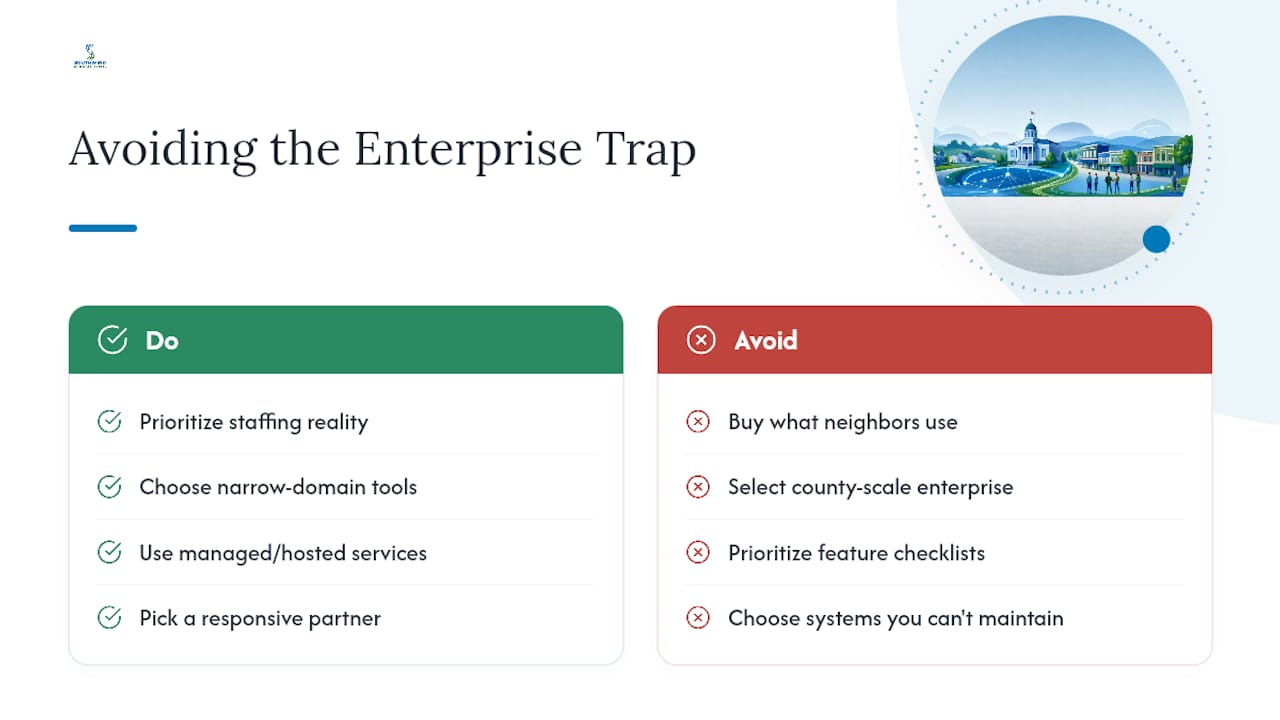
The conventional advice, get the platform everyone else uses so you're never the odd one out, gets the priority backward. StateTech's reporting on small-town technology makes the case plainly: narrow-domain tools and managed services build momentum faster than sprawling enterprise rollouts ever do. Ulysses didn't need CivicPlus's full feature set. It needed a working site and a partner who'd answer the phone.
If you're evaluating alternatives right now, prioritize staffing reality over feature checklists. A platform with fewer bells and whistles that your two-person office can actually run beats a powerful system nobody has time to maintain.
— Damien Denmark
How Southwind Marketing Fits Into Your Next Move
Southwind Marketing is a direct alternative to the traditional enterprise platform model for small cities: instead of paying for county-scale software you'll never fully use, you get a right-sized website, managed hosting, and resident communication tools built around what your staff can actually run day to day.
The path is simple. Start with Southwind's free 10-minute website and visibility audit, where we look at your current site, hosting setup, and communication tools and tell you plainly what's working and what's costing you money for no reason. From there, most cities move into a short consult or pilot, testing something specific like a redesigned homepage or a Southwind Connect℠ rollout for resident alerts, before committing to a full contract. If search visibility and content are part of the problem, Southwind Signal℠ handles the SEO and content side so your city actually shows up when residents search for services.
Engagements typically combine a project fee for the build with ongoing managed support, so there's no guesswork about what happens after launch. If you're ready to see what a right-sized alternative actually costs, request your free audit and get a plain-language look at your options.
Sources
- 2021 Software Adoption Trends in Local Government — CivicPulse
- Small towns, big tech: Practical path to modernizing government services — StateTech Magazine
- Software Trouble Part 2: Transacting — ICMA
Procurement teams preparing an RFP should review CivicPulse's adoption survey and ICMA's transacting guidance directly before drafting vendor requirements.
FAQ
What is the most cost-effective CivicPlus alternative for a small city?
For cities that want one vendor handling the website, hosting, and communications, Southwind Marketing typically costs less over time than CivicPlus because it avoids enterprise-tier licensing and bundles ongoing support into one predictable arrangement.
How long does it take to replace CivicPlus with a new system?
A managed provider can typically launch a new municipal site within weeks rather than months, since narrow-scope builds skip the lengthy configuration cycles enterprise platforms require.
Do small cities need in-house IT staff to switch platforms?
No, a managed hosting model like Southwind Guardian℠ handles maintenance, security, and updates, which matters most for towns without a dedicated IT department.
What's the biggest mistake cities make when choosing a new platform?
Defaulting to the same enterprise-scale vendor everyone else uses instead of matching the tool to the city's actual staffing and budget realities, a pattern the CivicPulse survey ties directly to stalled approvals.
Should small cities pilot a new tool before signing a full contract?
Yes, testing a narrow-domain feature or a short pilot first lets you confirm fit and staffing requirements before committing to a multi-year agreement.