
Prioritize four channels: event sponsorships, newsletter advertising, enhanced directory listings, and featured member pages with promoted deals. None of them work well until you fix the foundation first: move full member pages onto your own chamber domain and give members self-service control over their listings. That single change compounds into everything else. Done right, these channels build recurring revenue and member visibility without adding staff hours after the initial setup.
TL;DR:
- Moving full member pages onto your own domain and enabling member self-service significantly boosts search visibility and reduces staff workload.
- Implementing clear, tiered sponsorship packages and attaching measurable metrics like subscriber count and open rates improve advertising effectiveness.
- Building complete, structured member pages with rich data and integrated registration increases SEO value and lead quality compared to simple directory listings.
- Running targeted, consistent content, email, and event campaigns based on local member strengths effectively elevates community engagement and visibility.
- Small and rural chambers benefit most from these tactics due to concentrated domain authority and lean staffing, allowing data-driven pilot programs to demonstrate quick returns.
Table of Contents
- Chamber of Commerce Marketing and Websites: What to Sell Members
- How Should Your Website Work as a 24/7 Salesperson?
- Why Do Full Member Pages Beat Basic Directory Listings?
- What Content and Email Tactics Actually Drive Visibility?
- Quick Audit Checklist Before You Change Anything
- How Do Events Drive Chamber Marketing Results?
- How Does Your Website Support Member Promotion?
- What Analytics Should You Track on Your Chamber Website?
- Should Chambers Integrate Social Media With Their Website?
- What Do Successful Chamber Marketing Campaigns Look Like?
- How Do You Target Marketing to Different Member Segments?
- Why This Approach Works for Small and Rural Chambers
- Getting Your Site and Marketing Working Together
- Sources
- FAQ
Chamber of Commerce Marketing and Websites: What to Sell Members
Most chambers already have the raw materials for a real marketing program. What they lack is a clean way to package and sell it. Think of your marketing opportunities like a menu, not a grab bag of favors you do for dues-paying members. Each item should have a clear price, a clear deliverable, and a clear reason a business would say yes.
Sponsorships work best in tiers. A basic sponsorship might get a logo on the event page and a mention in the post-event email. A mid-tier sponsorship adds a speaking slot and booth space. Your top tier should include all of that plus dedicated email placement to your full list and a call-out from the podium. Vague sponsorship packages ("gold, silver, bronze" with no specifics) sell poorly because the buyer can't picture what they're getting.
Newsletter and website advertising need real numbers attached. Tell advertisers your subscriber count, your average open rate, and how long a website banner runs. A local insurance agency doesn't want to guess whether 200 people or 2,000 people will see their ad.
Beyond the core four, several add-on products round out a marketing menu:
- Job board postings for members hiring locally
- Classified listings for equipment, space, or services
- Brochure display slots in your visitor center or lobby
- Mailing list rental for direct mail campaigns (with clear opt-out compliance)
Weigh each one by staff time against revenue. A job board runs itself once it's built. Brochure racks need someone walking the lobby restocking paper. Put your pricing and how-to-order information on one dedicated marketing opportunities page, not scattered across a PDF from 2019. A chamber's member guide showing how businesses submit news, post jobs, and list deals demonstrates how far usage climbs when the process is genuinely simple.
How Should Your Website Work as a 24/7 Salesperson?
Your website either sells for you around the clock or it sits there as a digital brochure nobody reads twice. The difference comes down to whether every page gives the visitor a next step. A member directory page with no "claim your listing" button, an event page with no registration link, and a homepage with no "become a sponsor" call to action are all missed sales.
Full member pages hosted on your own chamber domain, not a third-party vendor subdomain, matter more than most chambers realize. Member pages built with proper LocalBusiness structured data outperform stripped-down directory rows because search engines can actually parse what the business does, where it's located, and how to reach it. Member pages with rich structured data keep search equity on the chamber's own domain rather than leaking it to a vendor's site you don't control.
A complete member page should include:
- Hours of operation and contact info
- Photos and a short business description
- Highlight links (specials, hiring pages, booking pages)
- Geo coordinates for map and "near me" search accuracy
Your event calendar needs the same treatment. Integrate registration and ticketing directly, and build sponsor promotion into the ticketing flow itself, not as an afterthought banner.
Mobile speed and ADA compliance aren't nice extras. A slow, inaccessible site loses both search ranking and member trust before a visitor ever reads your content.
Pro Tip: Run a 15-minute self-audit using The 2026 Chamber Website Checklist before you plan any bigger redesign. Fixing five small things often beats a six-month rebuild.
Why Do Full Member Pages Beat Basic Directory Listings?
A directory that just lists business names in rows is a phone book with extra clicks. A directory built on full member pages, each with its own structured data, photos, and highlight links, functions as dozens of small local landing pages working for your SEO simultaneously.
Faceted search makes that directory usable at scale. Let visitors filter by industry, service type, and neighborhood instead of scrolling an alphabetical list of 400 names. Faceted directories with member-controlled updates raise profile completion and generate more qualified leads than static, staff-maintained lists ever do.
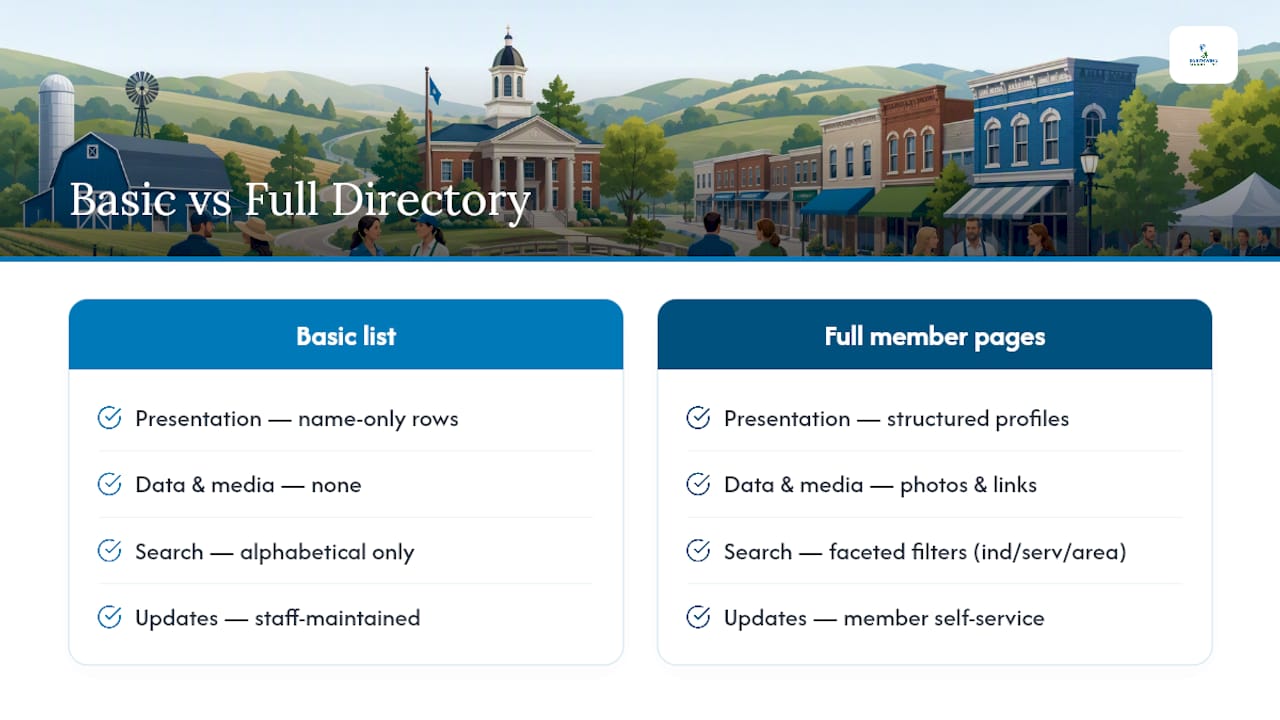
Self-service is what makes this sustainable. Members should be able to log in and update their own logo, hours, special offers, upcoming events, and job postings without emailing your office every time something changes. Give members basic analytics on their own profile views and clicks, and enhanced (paid) placements sell themselves.
Your onboarding workflow matters here: welcome new members with a guided profile setup, moderate submissions lightly, and offer paid enhancements (featured placement, extra photos) as an upsell at renewal time.
Track three numbers to know if the directory is earning its keep: profile completion rate, directory referral traffic, and leads attributed to member pages. A directory where fewer than half of members have completed profiles is a directory that's leaking value it could otherwise capture.
What Content and Email Tactics Actually Drive Visibility?
A content calendar built around your members' actual businesses, not generic "chamber news," is what separates chambers with real engagement from chambers publishing quarterly newsletters nobody opens.
- Build a rolling editorial calendar anchored on local business strengths, seasonal patterns, and member milestones. Planning content around local industry needs and seasonal events sustains engagement better than reactive, one-off posts.
- Publish local landing pages targeted at searches your members actually get: "best [industry] in [town]," event-specific pages, and member spotlight pages with schema markup.
- Automate your email sequences. New members get an onboarding series explaining how to use their directory listing. Sponsors get a promotion flow tied to their event. Segment your general newsletter by member type (retail, professional services, nonprofit) so the content each group opens is actually relevant to them.
- Repurpose spotlights into short videos, social clips, and newsletter features. One good member interview can fuel a month of content across channels.
Track organic traffic, search rankings for member-related queries, and event registrations tied back to specific content pieces. A structured approach combining SEO, email, and events consistently outperforms ad hoc posting, and it doesn't require a dedicated marketing hire to run.
Pro Tip: Reserve one newsletter slot per month exclusively for a member spotlight. It's free content, members love the exposure, and it gives your editorial calendar a built-in anchor.
Quick Audit Checklist Before You Change Anything
Run this six-item check before committing to a redesign or new marketing push:
- Does the homepage have a clear CTA above the fold (join, sponsor, list a job)?
- Do you have at least one sample member page that looks genuinely good?
- Is event schema markup present on your calendar pages?
- Does newsletter signup appear in more than one place on the site?
- Does the site load fast and score well on mobile?
- Has anyone run an ADA accessibility scan in the last year?
These six items come straight from The 2026 Chamber Website Checklist, and a related resource, The Chamber Website Audit, walks through the same items with more detail for chambers planning a renewal. If you want a broader look at what strong execution actually looks like, Best Chamber of Commerce Websites of 2026 rounds up real examples worth studying. This piece draws on editorial analysis from Damien Denmark. The rollout that works: quick audit, two low-effort fixes, one pilot sponsorship refresh, then measure before you scale further.
How Do Events Drive Chamber Marketing Results?
Events aren't separate from your marketing program. They're the delivery mechanism for most of it. A ribbon cutting, a business expo, or a monthly networking breakfast is where sponsorships get their visibility, where new members meet the directory they just joined, and where your content calendar gets its best raw material.

Promote events on at least three surfaces: the event calendar page itself, a dedicated email blast, and social posts leading up to the date. Cross-link every event page back to your sponsor's member page and their directory listing, so the traffic an event generates flows somewhere permanent instead of dead-ending on a page nobody revisits after the date passes.
Networking events specifically double as lead generation for your directory. Attendees who meet a member in person are far more likely to click through to that business's profile afterward if you make the connection easy, tag attendees in a post-event email with links to sponsor pages, or include a "who was there" recap with member tags.
Registration data is marketing data. Every RSVP tells you which members draw a crowd, which time slots perform best, and which topics justify repeating. Feed that into your sponsorship pitch next quarter. A sponsor who sees their logo drove 40 registrations to a business mixer is an easier renewal than one who got a vague "great turnout, thanks for sponsoring" email.
How Does Your Website Support Member Promotion?
Your website is the permanent home for promotion that would otherwise disappear after a single social post or a Friday email blast. A member page that lives on your domain, gets indexed by search engines, and links out to that member's specials or booking page keeps working long after the initial push ends.
Promo listings function as the connective tissue between your directory and your revenue. A "deal of the month" placement, a highlighted job posting, or a featured spot on the homepage carousel all point back to the same underlying asset: that member's full profile page. The stronger that profile page is, the more that promotion actually converts instead of just generating a click that goes nowhere useful.
This is where the domain-hosting decision from earlier pays off again. When a member's promoted deal links to a page you control, with structured data intact, that click strengthens your chamber's own search visibility instead of feeding a vendor's platform. Preserving canonical URLs and redirecting old vendor pages when you migrate keeps that search equity from evaporating during a platform switch.
Give members a simple way to request a promo slot through their self-service portal rather than emailing your office. That single change turns member promotion from a staff bottleneck into something members drive themselves, with your team approving rather than building each request from scratch.
What Analytics Should You Track on Your Chamber Website?
You can't sell sponsorship renewals with a shrug and "people seemed to like it." Chambers that track specific numbers close bigger sponsorships and spend less time justifying their marketing budget internally.
Start with traffic sources. Know how much of your website traffic comes from organic search versus email versus social, because that tells you where to invest more content effort. Layer in page-level data next: which member pages get the most views, which event pages convert visits into registrations, and which blog posts actually rank for the searches your members care about.
For sponsors specifically, track click-through data on their logo placements and email mentions. A sponsor who can see "your banner got 340 clicks this quarter" renews faster than one who gets a vague thank-you note.
Set up basic conversion tracking on your key CTAs: newsletter signups, membership applications, and event registrations. Google Analytics handles the basics for free; a CRM with built-in reporting gives you member-level detail without pulling numbers manually every month.
Review this data monthly, not annually. A quarterly report is too slow to catch a sponsorship banner that's underperforming or a member page that's quietly losing search ranking. Monthly review lets you course-correct before a renewal conversation instead of scrambling to explain a bad quarter after the fact.
Should Chambers Integrate Social Media With Their Website?
Social media should push traffic to your website, not replace it. A Facebook post about a new member is a nice gesture that disappears in a feed within a day. The same announcement linking to that member's full directory page keeps generating value for as long as the page exists.
Every social post promoting a member, an event, or a sponsor should link back to a specific page on your site, not your homepage generically. Specificity matters here: a link to a member's actual profile page converts better than a link to your general directory, because the visitor lands exactly where the content promised.
Use social platforms as a distribution layer for content you've already built for the website. A member spotlight written for your newsletter becomes three social posts, each linking back to that member's page. An event page becomes a countdown series on Instagram and Facebook, each post pointing to the same registration link.
Embed your social feeds on relevant website pages where it makes sense, an events page showing recent event photos, or a member page pulling in that business's recent posts, but don't treat the embed itself as the strategy. The goal is always to route attention back to a page you own and control, where a visitor can actually take the next step: register, join, or click through to a member's site.
What Do Successful Chamber Marketing Campaigns Look Like?
The chambers getting real traction rarely run one big flashy campaign. They run small, repeatable ones that compound over time. A monthly member spotlight paired with a newsletter feature and a social push is a modest lift individually, but run consistently for a year, it becomes a library of content that keeps ranking and keeps referring traffic long after each post goes live.
Sponsorship packages that show the sponsor exactly what their placement will look like, rather than describing it in abstract bullet points, close faster and at higher price points. Showing a real example of the page or placement a sponsor will get removes the guesswork that kills deals during the pitch.
A pilot combining one enhanced directory campaign with a sponsored newsletter slot is a manageable place to start if you haven't run a structured campaign before. A focused pilot like this can show measurable return within 60 to 90 days when the landing page and the call to action are both dialed in and tracking is running from day one.
Chambers that succeed with digital campaigns generally share one habit: they measure something specific before they launch, so they can point to an actual before-and-after instead of a general sense that "engagement felt better this year." That discipline is what turns a one-time campaign into a repeatable playbook other chambers can borrow.
How Do You Target Marketing to Different Member Segments?
A retail shop, a manufacturer, and a nonprofit member all want different things from your chamber, and sending them identical marketing misses most of them. Segmenting by member type is the fastest way to make every campaign feel relevant instead of generic.
Start with the obvious splits: retail and hospitality members care most about event traffic and seasonal promotion windows. Professional services (law firms, accountants, agencies) care more about referral visibility and thought-leadership placement like guest content or panel invitations. Manufacturers and industrial members often care less about foot traffic and more about workforce visibility, job board placement, and regional economic development connections.
Build your email segments around these groups rather than treating your full list as one audience. A retail-focused segment gets promoted around holiday shopping seasons and local shopping events. A professional-services segment gets invited to speak at events or contribute newsletter content establishing their expertise.
Sponsorship pitches should follow the same logic. A restaurant sponsor cares about a booth and food sampling opportunities at an event; a bank or insurance sponsor cares more about brand visibility and speaking slots. Selling the same generic sponsorship tier to both undersells what each actually wants.
Use your directory's industry categories as the backbone for this segmentation. If members are already tagged by industry in a faceted directory, building targeted campaigns on top of that data takes far less manual list building than starting from scratch each time.
Why This Approach Works for Small and Rural Chambers
Small and rural chambers see outsized returns from these fixes precisely because their domain authority is concentrated. A handful of well-built member pages can move the needle on local search results in a way that's much harder in a crowded metro market, where a business faces far more competition for the same "near me" search terms.
Self-service and clear, tiered sponsorships cut staff time while raising the value members actually get. Rural chambers usually run lean, often with one or two staff wearing five hats, so anything that shifts routine updates onto members themselves is a real gain, not a nice-to-have.
Test one pilot: an enhanced directory push paired with a sponsored newsletter slot. Report the numbers monthly. Let the data, not gut feel, decide whether to expand it.
— Damien Denmark
Getting Your Site and Marketing Working Together
Southwind Marketing is the alternative to a slow, DIY patchwork of vendor tools for chamber marketing and websites: one partner handles the site, the content, and the CRM that ties member promotion together instead of three disconnected logins nobody has time to manage.
Southwind Guardian℠ keeps your chamber site fast, secure, and hosted properly on your own domain, so the member pages you build actually keep the search equity discussed earlier. Southwind Signal℠ handles the ongoing SEO and content work, editorial calendars, member spotlights, local landing pages, without requiring a dedicated marketing hire on your staff. And Southwind Connect℠ runs the CRM side: onboarding sequences for new members, segmented newsletters by member type, and sponsorship promotion flows that used to eat up hours of manual email work.
If you're not sure where your site is losing members or sponsors right now, start with the Free 10-Minute Website & Visibility Audit. You'll get a plain-language rundown of what's costing you findability and where the fastest wins are, whether that's a missing CTA, a broken member page, or a directory nobody can filter. Southwind Marketing works with chambers, tourism boards, and city governments across Rural America, and the fixes in this article are the same ones we walk clients through every week.
Sources
FAQ
What Does a Chamber of Commerce Actually Do?
A chamber of commerce promotes local business growth through networking events, advocacy, marketing support, and member services like directory listings and sponsorship opportunities. Its core job is connecting members to customers, to each other, and to local decision-makers who shape the business climate.
Is a Chamber of Commerce Liberal or Conservative?
Chambers of commerce are nonpartisan business organizations, not political parties, though they often advocate for pro-business policies like lower regulatory burdens and tax relief that can align with either side of the aisle depending on the issue. Individual chamber positions vary by community and leadership rather than following one national political line.
Is It Still Worth Joining a Chamber of Commerce?
Membership value depends heavily on execution. A chamber with strong website marketing, a searchable member directory, and active event promotion delivers real visibility and leads, while a chamber running an outdated site and inconsistent communication struggles to justify dues. The tactics in this guide, sponsorships, directory upgrades, and content marketing, are exactly what separates the two.
Does the Chamber of Commerce Support Trump?
The U.S. Chamber of Commerce is a nonpartisan organization that does not formally endorse presidential candidates, though it engages with administrations of both parties on business policy issues. Local and state chambers operate independently and set their own advocacy positions separate from national politics.
How Do I Start Improving My Chamber's Website and Marketing?
Run a short audit focused on your homepage call to action, member page quality, and mobile speed, then fix the highest-impact issues first. A free website audit is the fastest way to get a prioritized list without guessing where to start.