
The fastest route to membership growth in 2026 is to stop treating renewals as a season and start running a year-round retention workflow built on simple engagement signals. Pair that with two other priorities: targeted recruitment that fills the top of the funnel and a dues and packaging model that matches what members actually value. This week, build a one-page retention workflow, load it into a CRM or task board, and assign one staffer a weekly to-do list for following up on at-risk members.
TL;DR:
- Most chambers should focus on building a year-round retention workflow based on engagement signals, not just seasonal renewal efforts.
- With 42% of chambers raising dues and 64% adopting tiered models in 2026, transparent communication and pilot testing are crucial before full implementation.
- Target retention rates above 85% and actively monitor four early-warning signals—eventless six months, late dues, email neglect, and contact departures—to prevent churn.
- Prioritizing staffing-driven follow-up, engagement flags, and simple automation yields better results than flashy technology or large platform investments for small chambers.
- Tracking five key KPIs monthly—new members, retention, engagement, revenue per member, and market share—provides clear insights to guide membership growth strategies.
Table of Contents
- 2026 Chamber Membership Trends and Benchmarks to Know
- High-Impact Recruitment Tactics You Can Run This Quarter
- What Are the Early-Warning Signs of Member Churn?
- Should You Change Your Dues and Packaging Model?
- Which Chamber Technology Investments Actually Pay Off?
- The 5 KPIs Every Chamber Should Track
- Why Small Chambers Should Start Small, Not Big
- How Southwind Marketing Supports Your 2026 Membership Playbook
- Sources
- FAQ
2026 Chamber Membership Trends and Benchmarks to Know
Chamber leaders are recalibrating dues and technology at the same time this year, and the numbers explain why. Roughly 42% of chambers raised dues in 2026, with an average increase of 6.4% and a median closer to 5%, according to the W.A.C.E. benchmarking survey. More than half, 53.54%, expect another increase next year.
Pricing structure is shifting even faster than pricing itself. Tiered membership-only models jumped to 64% adoption in 2026, up from 42% in 2025, while fair-share pricing fell to about 18% over the same period.
By the numbers: 42% of chambers raised dues in 2026 (average +6.4%), 64% now use tiered models, and roughly half report year-over-year growth in new members, according to GrowthZone's 2026 survey.
That last figure carries a warning. Chambers reporting new-member growth still name engagement and retention as their top internal challenge, which means recruitment gains are getting eaten by churn. A few benchmarks worth setting as targets:
- Aim for retention above 85% annually; below 80% signals a structural, not seasonal, problem.
- Treat flat or declining new-member counts as a staffing or outreach gap, not a market gap.
- If your chamber still runs a single flat-dues tier with no packaging options, you're behind nearly two-thirds of your peers.
High-Impact Recruitment Tactics You Can Run This Quarter
Recruitment tactics that work for chambers of any size share one trait: they turn existing relationships into new ones instead of cold outreach.
- Run a referral incentive with a real ask script. Give current members a specific, scripted line to use when inviting a prospect ("We're adding three new members from the west side this quarter, and I thought of you") rather than a generic "join our chamber" pitch. A dollar credit toward dues or an event ticket works better than a plaque.
- Build micro-events instead of one big annual push. A 45-minute coffee meetup at a member's business costs less staff time than a gala and gives prospects a low-pressure way to sample the chamber before committing.
- Fix your directory and site before you spend on ads. Many prospects find chambers through a business search, not a chamber search, so directory listings and local SEO fixes deliver leads that paid campaigns never touch. Southwind Marketing's chamber website checklist covers the specific fixes that matter most for discoverability.
- Use a 30/60/90 activation checklist for every new member. A welcome call within 7 days, a featured spotlight within 30 days, a committee or event invite within 60 days, and a renewal-value check at 90 days all correlate with stronger first-year retention, according to Southwind Marketing's chamber newsletter engagement guide.
Pro Tip: Assign the 30/60/90 checklist to a real person's calendar, not a shared inbox. Tasks that live in someone's actual to-do list get done; tasks that live in a folder get forgotten until renewal season.
Marketing tactics that show immediate value, like member spotlights and event-based promotion, also double as recruitment tools, since prospects notice what current members get before they ever ask about dues.

What Are the Early-Warning Signs of Member Churn?
Four signals reliably predict a member won't renew, and none of them show up on the invoice: no event attendance in six months, dues going late for the first time, no email opens, and the primary contact leaving the business, according to a chamber retention guide. Most churn is decided months before the renewal notice ever goes out.
That means retention has to be a weekly habit, not a fourth-quarter scramble. A workable cadence looks like this:
- Weekly: Pull a list of members hitting any of the four warning signs and assign follow-up calls or emails to a specific staffer.
- Weekly: Log every touchpoint in a CRM so the next call doesn't repeat the last one.
- Quarterly: Review engagement trends by member segment (new, mid-tenure, longtime) and adjust outreach scripts for each group.
- Quarterly: Escalate accounts with two or more warning signs to a director-level call rather than a form email.
Chambers that treat retention as continuous, measurable process, not a renewal-season scramble, consistently report lower churn and higher upgrade rates, per ChamberCulture's research.
Pro Tip: Give the person making retention calls a small, low-cost offer to extend, like a free event ticket or a one-month dues grace period. A modest gesture delivered by a real person recovers more members than a discount code in a mass email.
Should You Change Your Dues and Packaging Model?
Tiered dues can raise perceived fairness and open upsell paths, but only if the packaging is transparent enough that members understand what each tier buys. Before switching models, walk through this checklist:
- Test tiered pricing with a pilot group first. Offer three tiers to new members only for two quarters before rolling it out chamber-wide.
- Separate sponsorships from base dues. Bundling them muddies the value story and makes any future increase harder to explain.
- Communicate increases early and plainly. State the percentage, the reason, and the date at least 60 days before renewal, not in the invoice email itself.
- Package visibility as an add-on, not a hidden perk. Directory upgrades, event credits, and marketing bundles sell better as named line items than as vague "premium membership" language.
With 64% of chambers already running tiered models, a flat-fee structure is quickly becoming the exception rather than the norm.
Which Chamber Technology Investments Actually Pay Off?
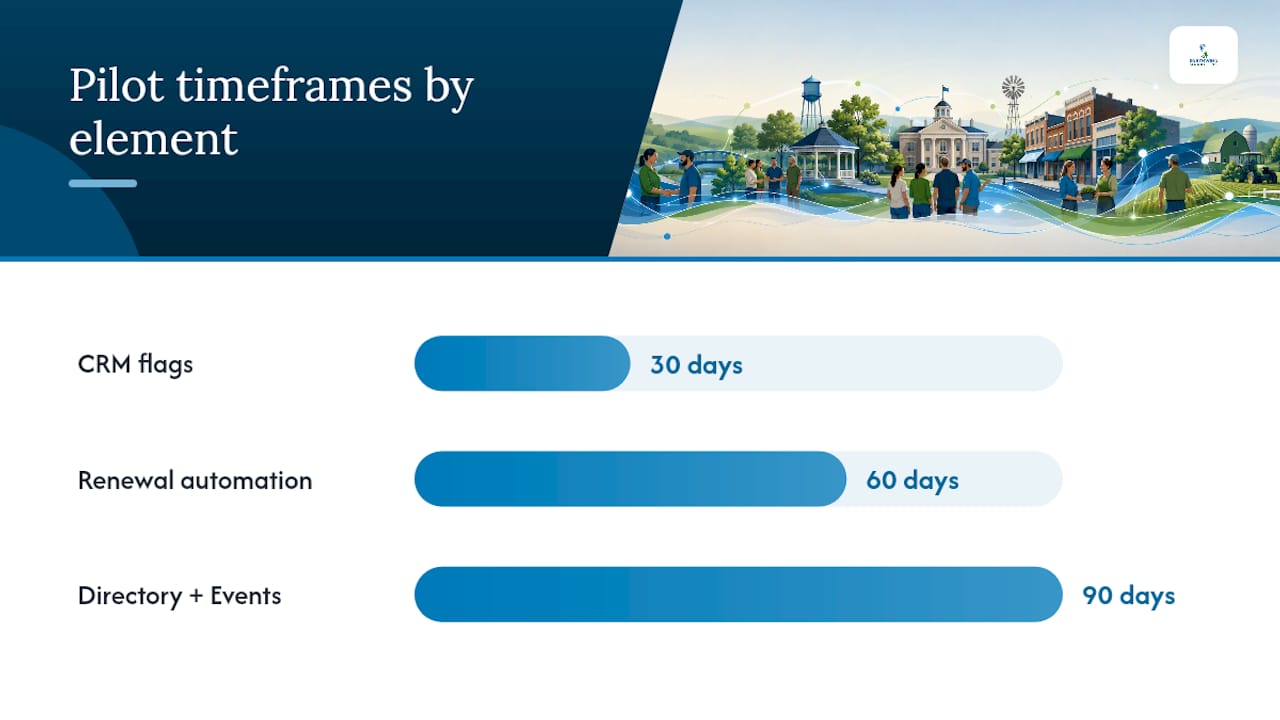
Community platforms and AMS tools correlate with higher engagement when chambers adopt them thoughtfully, but staffing and budget limit most small chambers from using every feature they buy. Prioritize four capabilities over flashy extras: engagement flags that surface at-risk members automatically, event check-in tools that feed attendance data back into member records, task automation for renewal outreach, and directory enhancements that improve member visibility.
A platform is only as good as the staff behind it. A modest automated workflow paired with one dedicated moderator regularly outperforms a fully featured, unstaffed system.
| Pilot element | Target outcome | Timeframe |
|---|---|---|
| CRM engagement flags | Identify at-risk members automatically | 30 days |
| Automated renewal task flow | Zero missed follow-ups | 60 days |
| Directory and event integration | No duplicate data entry | 90 days |
Before buying anything, run an integration checklist: confirm the platform connects to your existing email and event tools, confirm alerts route to a specific person rather than a dashboard nobody checks, and confirm you can export member data if you switch systems later.
The 5 KPIs Every Chamber Should Track
Board reports don't need twenty metrics. They need five that actually predict whether membership is growing or quietly eroding:
- Net new members added per month, tracked separately from renewals.
- Retention rate, benchmarked against the 85%+ target discussed earlier.
- Engagement rate, measured as event attendance plus email opens per member.
- Revenue per member, which reveals whether tiered packaging is working.
- Market share estimate, comparing your member count to the eligible business population in your service area.
A one-slide board report covering these five numbers, updated monthly with a quick weekly internal check-in, tells leadership more than a ten-page packet ever will.
Why Small Chambers Should Start Small, Not Big
Most small and rural chambers don't fail at membership growth because they lack ideas. They fail because they buy a large platform before fixing the basics: a written retention workflow and a CRM pilot that one staffer can actually run. Southwind Marketing's own email automation guide reflects that sequencing. Fix retention first, add recruitment tactics second, and only then evaluate bigger technology purchases. That order reduces both financial risk and the staff burnout that kills half-finished platform rollouts.
— Damien Denmark
How Southwind Marketing Supports Your 2026 Membership Playbook
Southwind Marketing works with chambers, economic development groups, and nonprofits across rural America, and the services map directly onto the playbook above rather than asking you to reinvent it.
If your retention workflow currently lives in someone's memory instead of a system, CRM Implementation and Southwind Connect℠ build the engagement flags and automated task flows the retention section above describes, with plans starting at $97 per month for the Starter tier. If your directory listings and website are quietly losing recruitment leads, Website Design and ongoing site upkeep through Southwind Guardian℠ fix the discoverability gaps most chambers never audit. Southwind Marketing specializes in serving organizations with smaller or public-sector budgets, aligning with the typical constraints addressed by this playbook. Start with a diagnostic conversation about a 90-day CRM pilot rather than a full platform commitment. Reach out to Southwind Marketing to scope what a first-quarter pilot would look like for your chamber.
Sources
The W.A.C.E. benchmarking survey supplies the dues and tiering benchmarks. GrowthZone's 2026 trends report covers new-member growth and platform adoption. ChamberCulture's retention guide details the four churn-warning signals. Southwind Marketing's own chamber newsletter guide and networking strategy guide add tactical templates for activation and event-based recruitment.
FAQ
What Is the Biggest Chamber Membership Growth Priority for 2026?
Retention comes first, since most churn is decided months before renewal invoices go out, according to the ChamberCulture retention guide. Recruitment and dues redesign matter, but they work better once a retention workflow is already catching at-risk members early.
How Much Are Chambers Raising Dues in 2026?
About 42% of chambers raised dues in 2026, with an average increase of 6.4% and a median around 5%, per the W.A.C.E. survey. Over half of chambers expect another increase next year, so budgeting for gradual, transparent increases beats a single large jump.
Should Small Chambers Switch to Tiered Dues?
A small chamber can pilot tiers with new members only for a quarter or two before rolling the model out chamber-wide, which limits risk if the packaging needs adjusting.
What Retention Signals Should Staff Watch Weekly?
Four signals predict non-renewal: no event attendance in six months, a first-time late dues payment, no email opens, and the primary contact leaving the business. Reviewing these weekly in a CRM lets staff intervene months before the renewal deadline.
Does Southwind Marketing Offer CRM Support for Chambers?
Yes. Southwind Connect℠ provides CRM and automation plans starting at $97 per month for the Starter tier, scaling up through Essentials, Growth, Professional, Civic, and Enterprise plans, with full pricing listed on the Southwind Connect℠ page.