

For commercial cleaners chasing contract work, a fast, conversion-focused website built around service pages, scheduling integrations, and local visibility beats a generic template site every time. The right approach depends on your growth stage: a performance-first managed CMS with booking integrations works for many operators, while an industry-tailored build from a specialist agency wins more contracts for firms scaling past a handful of accounts. Either way, the goal is the same: capture facility manager inquiries before a competitor does.
TL;DR:
- Local search and Google Business Profile optimization are critical for visibility, requiring consistent NAP data, service-area pages, and review management.
- Site speed impacts lead conversion heavily, with Core Web Vitals targets of under 2.5 seconds for load time, under 200 milliseconds for interaction, and minimal layout shifts.
- Industry-specific website features such as segmented service pages, case studies, insurance proof, and quick-contact forms significantly boost contract win rates.
- Managed WordPress offers a balance of SEO and customization, but ongoing maintenance and plugin management are necessary for optimal performance.
- Custom agency-built websites provide the deepest integrations and scalability for firms with high lead volume or complex needs, justifying higher upfront costs.
Table of Contents
- Why an industry-tailored site wins more commercial contracts
- Which platform category actually fits a cleaning business
- What every commercial cleaning website needs to convert
- How to turn your website into a local search engine magnet
- Why page speed decides whether a facility manager stays or leaves
- Which integrations actually move the needle on contracts
- A practical checklist for choosing your website approach
- When DIY makes sense and when it costs you contracts
- What separates a website that wins contracts from one that just exists
- How Southwind Marketing builds websites that win commercial contracts
- Sources
- FAQ
Why an industry-tailored site wins more commercial contracts
Facility managers and procurement teams do not browse casually. They search, compare two or three vendors, and expect a fast answer about service scope, coverage area, and how to request a quote. A site built specifically around that buying pattern converts more of those visits into contracts than a generic small-business template ever will.
Websites built with this buyer in mind feature ADA-compliant pages, managed hosting, SEO built into the foundation, and CRM automation that routes a form submission straight into a sales workflow. For a commercial cleaning company, that combination matters because the sales cycle often runs through a facilities department, not a homeowner clicking a button on impulse.
A tailored build typically includes:
- Service pages segmented by market (office buildings, medical facilities, industrial plants, schools) instead of one generic "commercial cleaning" page.
- Case studies with measurable outcomes, not just testimonial quotes.
- A quick-contact path that lets a facility manager request a proposal without hunting for a phone number.
DIY platforms make sense for a solo operator with two or three accounts and no ambition to chase larger facility contracts soon. Once you are bidding against companies with dedicated sales pages, insurance documentation, and case studies, a generic template starts costing you contracts rather than saving you money.
Pro Tip: If your current site does not list service areas and market segments on separate pages, a facility manager comparing three vendors will likely bounce to the one that does.
Which platform category actually fits a cleaning business
Every cleaning company website falls into one of four categories, and each comes with a real tradeoff, not just a price difference.
Hosted builders like Wix and Squarespace get you online fast with polished templates. G2 reviews show Wix scoring 9.3 out of 10 for drag-and-drop ease of use and 8.8 for template variety, with Squarespace also rated highly for modern design. The tradeoff shows up later: integrations with field service management (FSM) tools are often limited, and exporting your content if you outgrow the platform can be painful.

Managed WordPress sits in the middle. It gives you real SEO control, a wide plugin ecosystem for booking and CRM connections, and enough flexibility to build segmented service pages. The cost is maintenance: someone has to handle updates, backups, and security patching, which is exactly what a service like hosting and security maintenance is built to cover.
Performance-first static or headless setups are the least common choice for cleaning businesses but make sense when a company runs high-traffic marketing campaigns and needs sub-second load times above almost everything else. They require developer support to update, which rules them out for most small and mid-size cleaning operations.
Agency-built custom sites cost the most upfront but solve the integration and long-term support gap that hosted builders and even most WordPress setups leave open. For a cleaning company with FSM software, invoicing tools, and a CRM already in place, a custom build wired to talk to all three is often the difference between a site that generates leads and one that just generates traffic.
- Hosted builders: fastest to launch, weakest on deep integrations.
- Managed WordPress: strong SEO and plugin flexibility, requires ongoing maintenance.
- Static or headless: best raw performance, needs developer support to edit.
- Agency custom: highest integration capability, best fit for firms scaling past a few accounts.
Independent testing from WIRED found that hosted builders trade customization and integration depth for speed of launch, which lines up with what most cleaning operators experience once they try to connect scheduling software.
What every commercial cleaning website needs to convert
A commercial cleaning site does not need to be flashy. It needs to answer a facility manager's questions in under thirty seconds and give them a fast way to request a quote.
- Segmented service pages for each market you serve (offices, medical, industrial, education) rather than one catch-all page.
- A commercial inquiry form and click-to-call button placed above the fold on every service page, not buried on a contact page.
- Booking or estimate flows connected to your scheduling or FSM software so a lead does not sit in an inbox overnight.
- Case studies with specifics: square footage cleaned, frequency, and the type of facility, not vague praise.
- Insurance and bonding proof, since procurement teams frequently ask for this before a first call even happens.
- Clear service area language so a facility manager fifty miles outside your usual radius does not waste your time or theirs.
- Trust elements: reviews, industry association badges, and a downloadable spec sheet or one-page capability statement for procurement teams to pass along internally.
Facility buyers evaluating cleaning vendors often want something they can hand to a colleague. A downloadable PDF spec sheet, similar to what Capterra's janitorial software listings show cleaning companies pairing with scheduling tools like Housecall Pro and Jobber, speeds up that internal evaluation and keeps you in the running longer.
Pro Tip: Put your service area and insurance status in the first screen a visitor sees. Procurement teams eliminate vendors that make them dig for basic qualifying information.
How to turn your website into a local search engine magnet
Your website and your Google Business Profile work as one system, not two separate tools. Neither performs well without the other doing its part.
Google states that local ranking depends mainly on relevance, distance, and prominence, and recommends a complete, verified Business Profile linked to your website. That means your GBP needs accurate service categories, updated hours, and a service-area radius that matches what your website actually promises, because a mismatch confuses both Google and the facility manager reading it.
On the website side, a few technical details carry real weight:
- Consistent name, address, and phone number (NAP) across every page and directory listing.
- Dedicated service-area pages for each city or region you actually serve, not one page trying to rank for a dozen towns.
- LocalBusiness schema markup so search engines can parse your service area, hours, and categories directly.
- A steady flow of reviews, since review volume and recency function as a prominence signal Google weighs alongside relevance and distance.
A complete, verified Google Business Profile that links back to your site is one of the clearest levers you have for local prominence, according to Google's own guidance, because prominence signals like reviews and citations only help if the profile and website reinforce each other with matching information.
Rural and small-market cleaning companies often compete for the same handful of facility contracts in a county, which makes local prominence worth more per lead than it would in a dense metro area. If managing this yourself feels like more than you have time for, Local Growth Direct specializes in Google Business Profile management for service businesses.
Why page speed decides whether a facility manager stays or leaves
Facility managers comparing vendors rarely wait for a slow page to load. If your site stalls, they move to the next tab.
Google's Core Web Vitals set the practical targets: Largest Contentful Paint (LCP) within 2.5 seconds, Interaction to Next Paint (INP) under 200 milliseconds, and Cumulative Layout Shift (CLS) under 0.1. LCP measures how fast your main content appears, INP measures how responsive the page feels when someone taps a button, and CLS measures whether elements jump around while loading, which is common on pages stuffed with ads or oversized images.
Most slow cleaning company sites share the same problems: uncompressed photos of crews and equipment, too many third-party scripts (chat widgets, tracking pixels, embedded booking calendars), and cheap shared hosting that struggles under any real traffic.
- Compress and resize images before upload instead of letting the platform do it after the fact.
- Limit third-party scripts to the ones you actually use.
- Choose hosting built for performance rather than the cheapest available plan.
- Test regularly with Google PageSpeed Insights and the Core Web Vitals report in Search Console, which flags "Poor" URLs so you know exactly which pages need attention first.
Pro Tip: Run your top three service pages through PageSpeed Insights today. If any score under 50 on mobile, that page is likely losing leads before a visitor even reads your pitch.
Facility buyers researching vendors on mobile devices are common enough that a slow mobile experience costs you disproportionately, since Statista data on mobile internet usage shows how much daily browsing now happens on phones rather than desktops.
Which integrations actually move the needle on contracts
The integrations behind your website often decide whether a lead becomes a signed contract or a missed opportunity sitting in an unread inbox.
- Field service management platforms like the ones cataloged on Capterra's janitorial software page, including Housecall Pro, Jobber, Service Fusion, and WinTeam, handle scheduling and dispatch once a lead converts.
- Accounting tools like QuickBooks keep invoicing tied directly to completed jobs instead of a separate manual process.
- Payment processors like Stripe let commercial clients pay invoices online instead of mailing checks, which speeds up your cash flow.
- CRM platforms capture and nurture leads that are not ready to sign immediately, which matters for facility contracts that often take weeks of internal approval.
- Zapier or native webhooks connect your website forms to whichever combination of the above tools you actually use.
Before committing to a platform, test the full path yourself: submit a test lead through your contact form and confirm it actually lands in your CRM or FSM tool within minutes, not hours. Check what happens when a webhook fails, since a silent failure that drops a lead is worse than a slow one. Duplicate lead handling matters too. A facility manager who submits a form twice because the first attempt seemed to not go through should not generate two separate follow-up calls from your team.
A practical checklist for choosing your website approach
Choosing between a hosted builder, managed WordPress, and an agency build comes down to five factors: budget, timeline, integration needs, expected lead volume, and how much ongoing maintenance you want to handle yourself.
Watch for red flags during vendor conversations: pricing that is never stated clearly, hosting that cannot explain its own uptime or backup process, integration options limited to a vague "we can probably connect that," and no evidence the vendor has ever handled ADA compliance or page speed work.
| Approach | Best for | Integration depth | Typical maintenance |
|---|---|---|---|
| Hosted builder | Solo operators, 1 to 3 accounts | Limited | Minimal, handled by platform |
| Managed WordPress | Growing teams needing SEO control | Moderate to strong | Ongoing, requires a plan |
| Agency custom build | Firms bidding on facility contracts | Strong | Ongoing, usually vendor-managed |
Work through the decision in order: define your growth goal for the next twelve months, list your must-have integrations (FSM, CRM, payments), shortlist two or three platform types that fit, run a quick audit of a competitor's site in your category to see what a facility manager actually experiences, then decide. A free audit checklist can help you evaluate your current site against these criteria before you commit to a rebuild.
When DIY makes sense and when it costs you contracts
A DIY hosted builder site can go live in a weekend for a few hundred dollars a year in hosting and template fees. That works fine for a small operator servicing a handful of retail or small office accounts with no complex procurement process.
The math changes once you start bidding on facility contracts that require insurance documentation, capability statements, and integration with a client's own vendor management system. At that point, the maintenance burden alone, keeping plugins updated, monitoring uptime, handling ADA compliance, and patching security gaps, starts eating into time better spent on operations or sales.
Hiring an agency produces better returns once your average contract value or your lead volume justifies the higher upfront cost. If one new facility contract is worth more than a year of agency fees, the math favors hiring specialists who already understand ADA compliance, security, and backup protocols rather than learning them yourself under pressure.
What separates a website that wins contracts from one that just exists
The cleaning company sites that convert well share a pattern I have seen repeated across service organizations far outside this industry: speed, clarity, and visible proof that the company has done this work before.
Rural markets add a wrinkle that generic advice usually misses. A facility manager in a small city often has fewer vendors to choose from, which means a fast, clear site can win a contract almost by default simply because the competition has not bothered to build one. Southwind's work across small-town and rural markets has made that pattern obvious: the bar for standing out is often lower than owners assume, but only if the basics, speed, a clear service area, and real proof of past work, are actually in place.
If your site does one thing well, make it clarity about who you serve and how to reach you.
— Damien Denmark
How Southwind Marketing builds websites that win commercial contracts
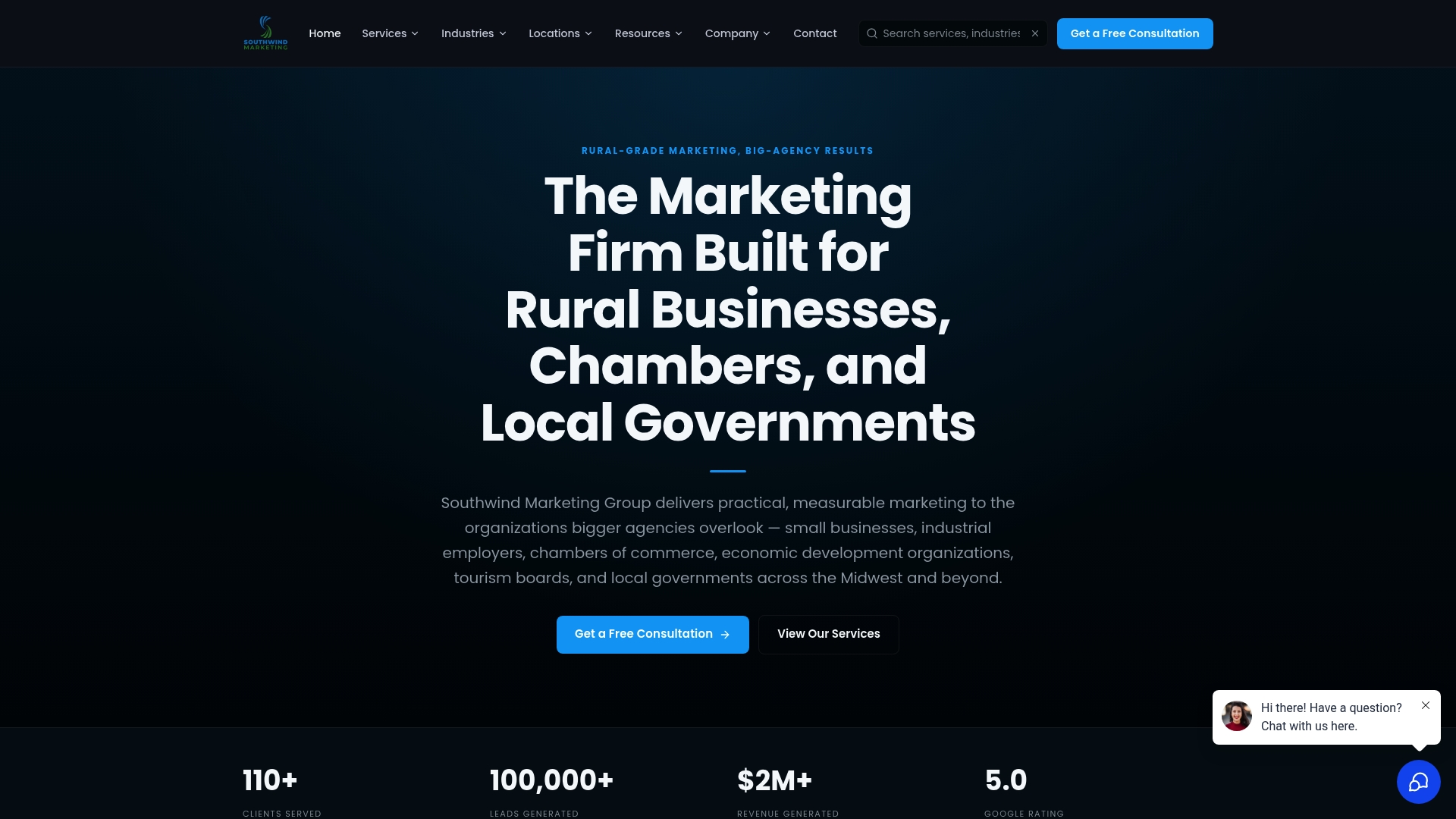
Building a site that wins facility contracts takes more than picking a template and hoping it ranks. Southwind Marketing builds the site, the hosting, the SEO, and the lead workflow as one connected system instead of separate vendors you have to manage yourself. Our Website Design service builds segmented service pages, quote request flows, and case study layouts suited to how facility managers actually evaluate vendors. Southwind Guardian℠ handles hosting, security, and backups so performance stays solid without you monitoring it. Southwind Signal℠ keeps your SEO and local visibility working after launch instead of fading six months in. Southwind Connect℠ routes new leads straight into a CRM workflow so a facility inquiry never sits unread.
- Website Design built around service pages, quote requests, and case studies.
- Southwind Guardian℠ for hosting, security, and ongoing maintenance.
- Southwind Signal℠ for SEO and local search visibility.
- Southwind Connect℠ for CRM automation and lead routing.
Start with our free 10-minute website and visibility audit to see exactly where your current site is losing facility leads.
Sources
Verify these claims yourself and keep them handy for ongoing audits: Google's local ranking guidance, Google's Core Web Vitals documentation, G2's Wix reviews, and Capterra's janitorial software listings.
- Wix reviews | G2
- Tips to improve your local ranking on Google - Google Business Profile Help
- Best Janitorial Software | Capterra
FAQ
How do I find clients for commercial cleaning?
Most commercial cleaning contracts come from a mix of direct outreach to facility managers, referrals from existing clients, and inbound leads generated by a website that ranks locally and converts inquiries quickly. A complete Google Business Profile paired with segmented service pages helps facility managers find and vet you before you ever make the first call.
What is the best commercial cleaning software?
There is no single best option since needs vary by company size, but Capterra's janitorial software listings show commonly used platforms including Housecall Pro, Jobber, Service Fusion, and WinTeam for scheduling, invoicing, and job management. The right choice usually depends on whether you need strong FSM integration with your website's booking forms.
How do I make a web page for my cleaning business?
Start with a platform that fits your integration needs, whether that is a hosted builder for a simple site or managed WordPress for stronger SEO control, then build segmented service pages by market instead of one generic page. Add a fast quote request form, proof of insurance, and case studies before worrying about design polish.
How do I gain commercial cleaning contracts?
Winning facility contracts usually requires visible proof of past work, clear service area information, and a fast response path for procurement teams comparing multiple vendors. A website built around those elements, combined with a complete Google Business Profile, gives you a real edge in markets where competitors have not bothered to build either.