
AI search is replacing the click. When a resident asks ChatGPT or Google's AI Overview when trash pickup is, your city website doesn't get a visit anymore. The AI answers directly, often quoting a stale PDF or a third-party aggregator instead of your official page. The fix starts today: pick one high-traffic question, publish a clear, dated answer to it in plain HTML, and you've protected residents from bad information while giving Southwind Marketing (or your own team) a template to repeat across the rest of the site.
TL;DR:
- Prioritize rewriting your highest-traffic pages with direct, answer-first summaries and add schema markup to improve AI citation accuracy and visibility.
- Ensure your city website's content is structured, dated, and linked to official sources to prevent residents from acting on misinformation from external aggregators.
- Conduct monthly testing of AI responses to identify misquotes or outdated information, then update your pages accordingly and publish transparency about potential AI inaccuracies.
- Small towns should focus on content rewrites and simple structural improvements first, reserving complex solutions like custom feeds or vendor-managed AI tools for larger municipalities.
- Using a dedicated service or audit can quickly determine your site's current AI citation status and guide cost-effective improvements tailored to your staff capacity.
Table of Contents
- What AI Search and Municipal Chatbots Actually Do
- Why the Shift From SEO to AEO Matters Now
- An AEO Checklist Your Team Can Run This Week
- How Do You Monitor What AI Is Saying About Your City?
- Choosing an Implementation Path That Fits Your Budget
- What a Small City AEO Project Actually Delivers
- Why the Conventional AEO Advice Undersells Small Towns
- Get Your City's Pages AI-Ready
- Sources
- FAQ
What AI Search and Municipal Chatbots Actually Do
AI search tools now handle the questions that used to drive residents to your homepage. Ask ChatGPT about a building permit process or a council meeting time, and it tries to answer on the spot, pulling from whatever page it judges most authoritative and easiest to parse.
On the resident side, that means plain-language answers about permits and licensing, parcel and zoning lookups, meeting minutes summaries, and even 311-style triage for common complaints. Cities like Maricopa County and Washington, D.C., have leaned into this directly, deploying assistants that search across fragmented datasets to generate maps and navigate residents to things like ballot drop box locations. Boston has used similar tools to summarize council votes so residents don't have to comb through hours of footage.
On the staff side, AI is becoming a research assistant: drafting citation language, pulling relevant ordinance text, or summarizing a two-hour meeting transcript into five bullet points.
- Resident queries: permits, trash schedules, parcel data, meeting minutes, 311 issues
- Staff tasks: ordinance lookup, transcript summarization, citation drafting
- Answer sources: public web crawls, open data portals, and in some cases direct data feeds or vendor partnerships
Every one of those answers comes from somewhere. If your site isn't structured to be that source, something else will be.
Why the Shift From SEO to AEO Matters Now
Search engine optimization got your city ranked. Answer Engine Optimization (AEO) gets your city quoted — or skipped entirely. That distinction is now driving budget conversations in city halls that never used to think about search strategy.
Gartner-backed analysis reported by Nextgov warns that AI assistants are cutting into organic search clicks across government sites, and agencies that don't restructure content and monitor how AI cites them risk losing their voice in their own public record. That's not a hypothetical. It's already happening to cities that haven't touched their permit page since a previous administration.
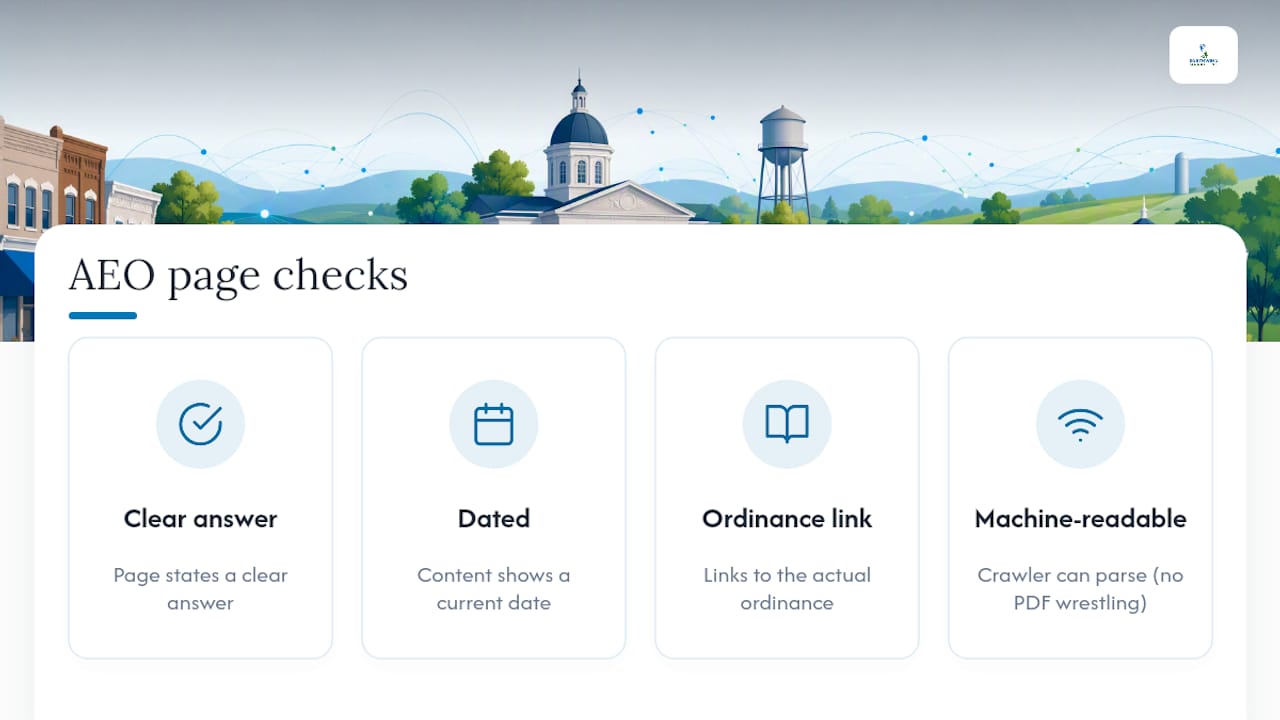
AEO cares less about keyword density and more about structure, provenance, and machine readability: does the page state a clear answer, is it dated, does it link to the actual ordinance, and can a crawler parse it without wrestling a PDF? Generative Engine Optimization (GEO) practices, as Adobe describes them, focus on exactly this kind of machine-readable structuring.
The real risk isn't losing traffic. It's a resident getting misquoted zoning rules from a random aggregator site, acting on it, and showing up at city hall furious that "the AI said" something your ordinance never said.
An AEO Checklist Your Team Can Run This Week
You don't need a developer to start fixing this. Most of the highest-impact work is content and structure, not code.
- Write an answer-first summary. For your top five pages (permits, trash/recycling, meeting schedule, tax due dates, business licensing), put the direct answer in the first 200 words: who it applies to, what to do, when it's due, how to act.
- Use question-style headings. "When Is Trash Pickup in [Your City]?" beats "Sanitation Services" every time an AI model is scanning for a match.
- Show a last-updated date on every policy page. AI models weigh freshness heavily, and a visible date is one of the easiest signals to add.
- Convert critical PDFs into HTML text. A permit fee schedule buried in a scanned PDF is close to invisible to most crawlers. Give it a stable, canonical URL as a real webpage.
- Add schema markup. FAQPage, Organization, and LocalBusiness schema, plus consistent name/address/phone (NAP) data, give AI systems structured signals instead of guesswork.
- Link to the source. Cite the actual ordinance, statute, or open dataset your answer is based on, and publish open data where you can.
- Assign an owner and a review cadence. Somebody's name needs to be attached to "does this page still say the right thing," reviewed quarterly at minimum.
Pro Tip: Start with the page that generates the most phone calls to your front desk, not the page you think is most important. If residents keep calling about parking permit renewals, that's your first rewrite.
Much of this overlaps with accessibility compliance. Siteimprove notes that Section 508 and WCAG remediation, done to make pages usable with screen readers, produces the same semantic structure AI systems need to parse and cite a page correctly. If your city has already done accessibility work, you're closer to AEO-ready than you think.
How Do You Monitor What AI Is Saying About Your City?
You can't fix what you don't check. Most cities have no idea what ChatGPT or Gemini currently says about their permit process, and that blind spot is where misinformation festers.
Start by assigning ownership across digital, communications, legal, and IT, so someone owns the content, someone owns the legal accuracy, and someone owns the technical fixes. Then build a simple monthly habit:
- Run 20 to 40 representative resident questions through ChatGPT, Gemini, and Perplexity
- Log which source each engine cites for each answer
- Flag any answer that's wrong, outdated, or pulled from a non-official source
- Correct your own page first, then request corrections from third-party sites where possible
The Urban Institute recommends resident testing as part of this process, since actual residents catch bias and accuracy gaps that a staff review often misses. Publish a short transparency note somewhere visible explaining that AI-generated answers about your city may occasionally be wrong and how residents can report an error. That single page builds more trust than pretending the problem doesn't exist.
Choosing an Implementation Path That Fits Your Budget
Not every city needs the same fix, and the right path depends heavily on staff capacity and current site condition.
- Content-first fixes: Rewriting top pages, adding schema, and fixing PDFs. Weeks, not months. Lowest cost, highest return for most small towns.
- Managed AI search products: A vendor-managed layer that handles structure, monitoring, and schema on an ongoing basis. Timeline runs months, with recurring subscription costs.
- Custom feeds or direct AI partnerships: Building direct data feeds to AI platforms or standing up a custom assistant. Longest timeline, heaviest governance lift, usually reserved for larger counties with dedicated digital staff.
Cost drivers include accessibility remediation backlog, how much data needs cleaning before it's usable, vendor subscription fees, and ongoing hosting and monitoring. A small town with one part-time webmaster should start with content-first fixes. A county with a real digital team can layer in managed tools or feeds once the fundamentals are solid.
What a Small City AEO Project Actually Delivers
A city communications director we've worked with described the before-and-after simply: residents used to call to ask if the online permit portal was even still active, because AI assistants were quoting an outdated fee schedule from three budget cycles ago.
The fastest wins came from triage, not a full rebuild. Identifying the ten highest-traffic pages, rewriting them answer-first, and adding schema markup moved the needle on AI citation share faster than anything else on the list.
Three actions consistently move the needle first: triage your highest-traffic pages, publish a canonical answer-first version of each, and layer in schema plus a monitoring routine. Track success with AI citation share, service page uptake, help desk call volume, and how quickly pages get updated after a policy change. Those four numbers tell you whether the work is landing.
Why the Conventional AEO Advice Undersells Small Towns
Most AEO guidance is written for organizations with a content team, a legal review process, and a developer on standby. That's not the reality for a city of 4,000 people running its website through a part-time clerk with six other jobs. The conventional advice treats AEO like a technical overhaul when for most local governments, it's a writing and organization problem first.
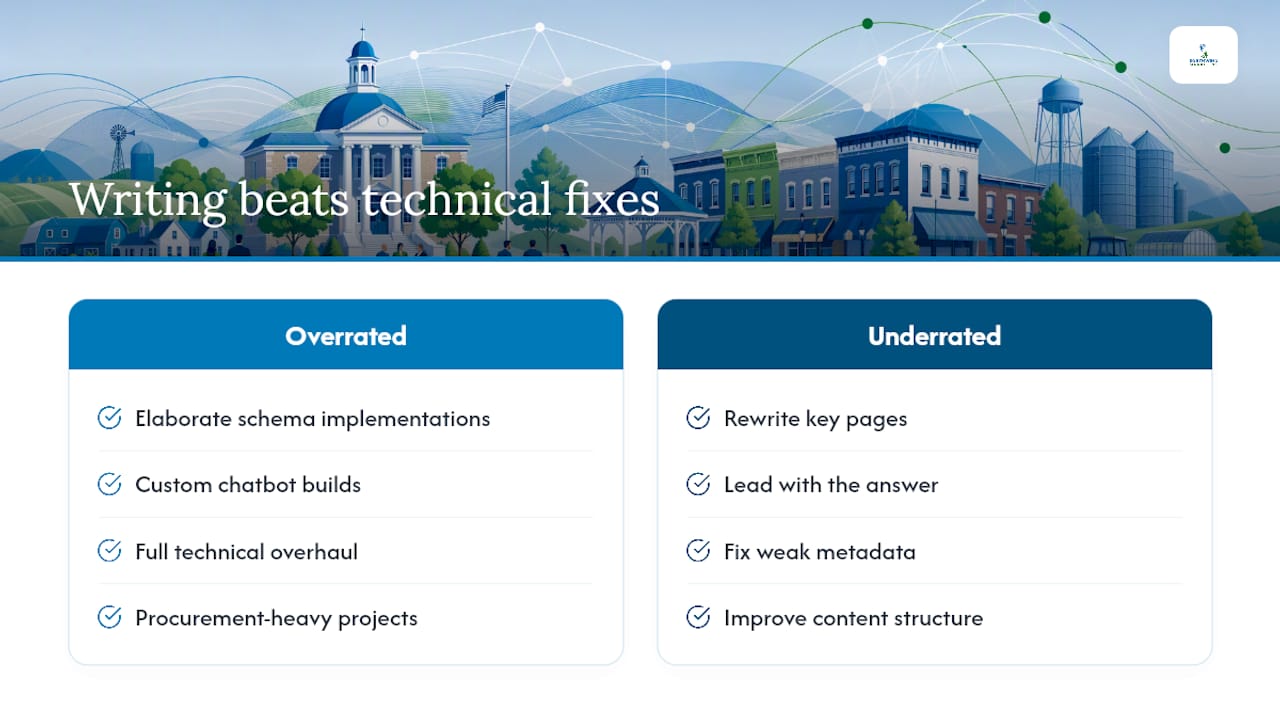
Here's what gets overrated: elaborate schema implementations and custom chatbot builds. Here's what gets underrated: simply rewriting your trash pickup page so the answer appears in the first sentence instead of buried in a PDF from 2019. The study on municipal geoportal SEO quality found weak metadata and poor content structure across many public sites, and that's fixable with an afternoon and a checklist, not a procurement process.
Prioritize the page that generates the most phone calls before the page that seems most technically interesting. Accuracy and structure beat sophistication every time an AI model decides which source to trust.
— Damien Denmark
Get Your City's Pages AI-Ready
Southwind Marketing built Southwind Signal℠ specifically for cities, chambers, and economic development organizations that need their websites to show up correctly when residents ask AI tools a question instead of typing it into a search bar. It handles the content restructuring, schema, and monitoring work outlined above as a turnkey service, so your team isn't learning AEO from scratch on top of everything else already on their plate.
It pairs naturally with Southwind Guardian℠ for hosting and accessibility upkeep, and Southwind Connect℠ if you also want a better system for resident communications. If you're not sure where your city's site currently stands with AI search, a short diagnostic audit is the fastest way to find out. Reach out to Southwind Marketing and get a clear read on what ChatGPT and Gemini are currently telling your residents about your services.
Sources
- Practical AI insights for local leaders — Urban Institute
- Gartner: The battle for authority in AI search is underway — Nextgov
- Answer engine optimization for government: Citizen discovery, Section 508, and the public trust imperative — Siteimprove
- Increasing AI search visibility for government agencies — Adobe
- Local government is fragmented. Here's how AI is helping residents navigate it. — SmartCitiesDive
FAQ
What Can AI Do for Local Government?
AI search tools can answer resident questions about permits, trash pickup, and meeting schedules directly, summarize council actions, and help staff draft citations or extract ordinance text, provided the underlying city content is structured clearly enough to cite.
Is There a Free AI Search Tool for Cities?
Free general-purpose tools like ChatGPT and Google's AI Overviews already index and answer questions about your city's services at no cost, which is exactly why making your existing site AEO-ready matters more than buying new software.
What Is Local Search AI?
Local search AI refers to AI assistants and tools that answer geography-specific questions, like parcel lookups or permit rules for a particular city, by pulling from open data portals, official websites, and sometimes direct data feeds from the agency itself.
How Do I Know if AI Is Citing My City's Website Correctly?
Run a batch of common resident questions through ChatGPT, Gemini, and Perplexity monthly, and log which sources each one cites; Southwind Signal℠ includes this kind of monitoring as part of its ongoing service.