Make your facts machine-readable and consistent across your website, Google Business Profile, and third-party mentions. That single move is the fastest path to being named in AI answers. AEO, or Answer Engine Optimization, means structuring your organization's information so ChatGPT, Perplexity, and Google's AI Overviews can verify and repeat it accurately. Start with your Google Business Profile, add schema markup, and publish answer-first content, and you should see measurable movement within 30 to 90 days.
TL;DR:
- Accurate and consistent NAP details across your website, Google Business Profile, and directories are crucial, with a regular update schedule to prevent discrepancies.
- Prioritizing schema markup for core data and structuring website content with answer-first, self-contained sections improves AI extraction and visibility within 30 to 90 days.
- Building a strong online presence requires gathering detailed reviews, local mentions, and timely event updates to provide AI systems with credible, corroborated information.
- For multi-location organizations, coordinating data across all sites and sources is vital, as inconsistent details can harm overall AI trust and ranking.
- Regular prompt audits across AI platforms and perpetual content refreshes ensure ongoing accuracy and maximize chances of AI-based recommendations.
Table of Contents
- AEO Quick Checklist: What To Do in the First 90 Days
- How Does AI Decide Which Local Businesses To Recommend?
- What Schema and Google Business Profile Fields Actually Matter
- How Should You Structure Content So AI Can Extract It?
- Do Reviews and Local Mentions Really Affect AI Visibility?
- How Do You Measure AEO Progress and Set a Realistic Timeline?
- Southwind Marketing in Practice: AEO and Fractional IT for Rural Organizations
- Optimizing for Voice Search and Virtual Assistants
- Leveraging AI-Powered Tools for Keyword Research and Content Optimization
- Strategies for Integrating Local Events and News to Boost Local Relevance
- Using AI Chatbots and Conversational AI To Enhance Engagement
- Author Perspective: What Actually Moves the Needle for Local Organizations
- Get a Free Visibility Check From Southwind Marketing
- Sources
- FAQ
AEO Quick Checklist: What To Do in the First 90 Days
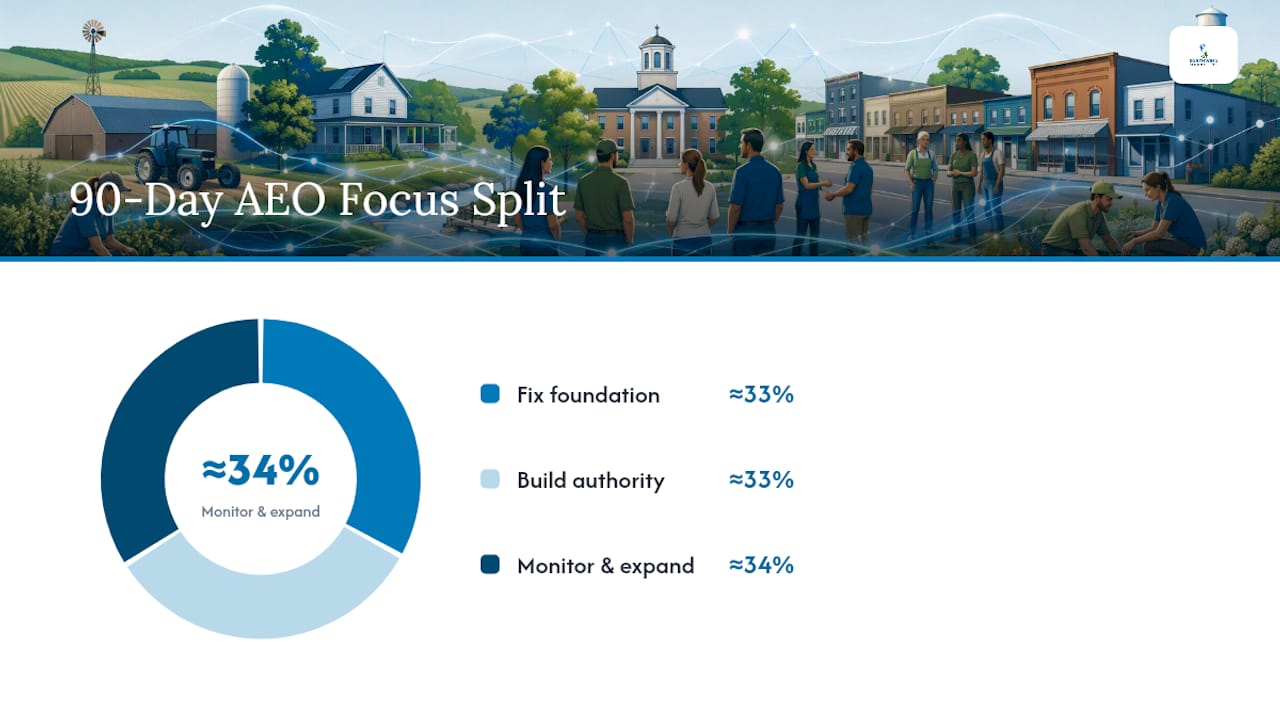
AEO rewards organizations that fix their foundation before chasing new tactics. A staggered 30/60/90 plan keeps a small team from getting buried, and it matches how AEO tactics for small businesses typically play out in practice, with early wins showing up inside three months.
Days 1 to 30: Fix what's broken.
- Audit your Google Business Profile for accuracy. Confirm hours, categories, service area, and photos match your website exactly.
- Correct NAP (name, address, phone) inconsistencies across your website, GBP, and any directory listing you can find.
- Add basic schema markup (LocalBusiness at minimum) to your homepage and contact page.
- Write three to five FAQ blocks answering the exact questions your staff hears on the phone.
Days 31 to 60: Build authority. 5. Publish two or three topic cluster pages that answer related questions in depth. 6. Ask recent customers or members for detailed reviews, not just star ratings. 7. Pitch your local newspaper, a chamber newsletter, or a regional blog for a mention or feature.
Days 61 to 90: Monitor and expand. 8. Check how your organization shows up when you ask AI tools direct questions about your services. 9. Extend consistent listings to secondary directories and industry-specific aggregators. 10. Where possible, automate listing updates so a change in hours or address propagates everywhere at once.
On a small team, assign GBP and NAP work to whoever manages your website or social accounts. Content and FAQ writing should go to the person who talks to customers most, often a front-desk or membership coordinator, because they know the real questions.
Pro Tip: Keep a single spreadsheet listing every place your organization's name, address, and phone number appear online. Update that sheet first, then push changes outward. It's the cheapest insurance against AI pulling an old address from a directory you forgot existed.
How Does AI Decide Which Local Businesses To Recommend?
AI systems don't just match keywords. They cross-check claims across multiple sources before deciding what to say, and they weight consistency heavily. Industry writers now call this shift "Local 5.0": a model where AI search evaluates connected context across your website, your listings, your reviews, and independent publishers, rather than ranking a single page in isolation.
That connected context is what builds the confidence an AI needs before it will recommend you by name. A governed set of location data, paired with structured content and outside corroboration, gives the system enough overlapping evidence to trust the answer it's about to give. Practitioner research backing this pattern found that clean entity data combined with schema markup and consistent directory listings correlated with a 2.4 times lift in AI visibility compared to businesses with scattered, conflicting listings.
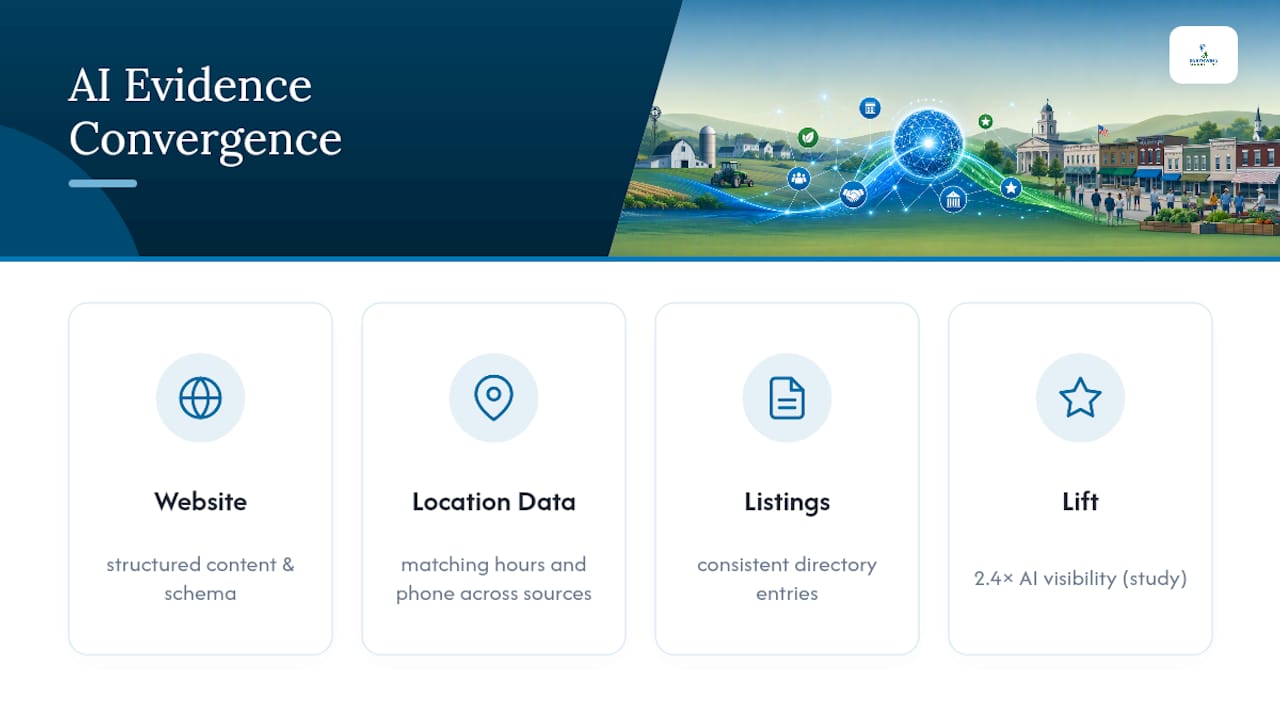
The signals AI treats as evidence are specific: matching business hours across three or more sources, phone numbers that resolve to the same number everywhere, review excerpts that mention real services by name, and mentions from local publishers or chambers that corroborate what your own site claims.
For a single-location nonprofit or small business, this is a manageable list to control. For multi-location organizations, a chamber with multiple program sites, an EDO covering several counties, or a tourism office representing a whole region, the challenge multiplies. Every additional location or program page is another place where an old address or outdated phone number can quietly undercut the whole entity's credibility.
Think about the kinds of questions people actually ask AI assistants: "Is the Main Street farmers market open this Saturday?" or "Which chamber in this county helps with small business loans?" Answering those accurately requires the AI to verify your hours against your GBP, your event page, and maybe a local news mention, all at once. If those three sources disagree, most systems will either hedge the answer or skip your organization entirely.
What Schema and Google Business Profile Fields Actually Matter
Structured data is the language AI systems trust more than plain text, because it removes guesswork. The vocabulary comes from Schema, the shared standard search engines and AI tools reference when parsing a page.
Prioritize these schema types on your site:
- LocalBusiness (or a more specific subtype like GovernmentOffice or NGO) for your core organizational facts.
- Service for each distinct offering, program, or service area.
- FAQPage for question-and-answer content, especially on service and program pages.
- HowTo for step-by-step guides, such as "How to apply for a small business grant" or "How to register for a Main Street event."
- Review to mark up testimonials in a machine-readable format.
At the field level, precision matters more than most people expect. Fill in name, address, telephone, geo coordinates, openingHours, serviceArea, priceRange, and acceptedPaymentMethod exactly the same way everywhere they appear. Pick one format for your street address, "St." or "Street," Suite 200 or Ste. 200, and never mix them across your site and listings.
Your Google Business Profile should mirror that same discipline. Complete every field: business description, attributes, service list, current photos, and regular posts. GBP acts as a cross-check against your website's schema, and AI models the same connected-context evidence when comparing the two. A mismatch between what your GBP says and what your site's schema claims creates exactly the kind of uncertainty that makes an AI answer hedge or omit you.
One practical habit: after any major update, submit your sitemap again or ping IndexNow so search engines and AI crawlers pick up the change faster instead of waiting for their next scheduled crawl. Our guide on optimizing your Google Business Profile walks through the field-by-field setup in more detail.
How Should You Structure Content So AI Can Extract It?
AI systems extract answers, not articles. That means the opening sentence of any page, section, or FAQ entry needs to function as a complete, quotable answer on its own, without requiring the reader to scroll for context.
The answer-first rule sounds simple but most organizations violate it constantly. Instead of opening a page with "Welcome to our chamber, serving the community since 1962," open with "The Downtown Chamber of Commerce offers small business grants, networking events, and retail recruitment support for businesses in [county name]." One explainer on how AEO differs from SEO makes this exact point: AEO rewards concise, quotable answers positioned early, while traditional SEO tolerated a slow buildup.
Section length matters too. Practitioner analysis of AI extraction patterns found that chunks of roughly 120 to 180 words per answerable section get pulled more consistently than longer, meandering paragraphs. Break your service pages into short, self-contained sections, each answering one specific question.
For FAQ schema, use the actual phrasing your customers or members use, not the phrasing your board prefers. Pull real questions from your CRM data, intake forms, or call logs. CRM-sourced customer language tends to match how people phrase questions to AI assistants far better than internal marketing copy does. Keep each FAQ answer to one or two sentences.
- Prioritize FAQ questions around hours, cost, eligibility, and "how do I get started."
- Build a topic cluster of 5 to 15 connected pages around your core services so AI treats your domain as an authority on that subject, not a single lucky page.
- Link cluster pages to each other with plain, descriptive anchor text.
Pro Tip: Read your own FAQ answers out loud. If you wouldn't say the sentence the way it's written, an AI probably won't quote it the way you intended either.
Do Reviews and Local Mentions Really Affect AI Visibility?
Yes, and review quality outweighs raw review count by a wide margin. A profile with 40 detailed, recent reviews mentioning specific services will outperform a profile with 300 generic five-star ratings, because detailed review content predicts AI visibility more reliably than volume alone.
Useful review language names something specific: "They helped us apply for the facade improvement grant in under two weeks" tells an AI system far more than "Great service, would recommend." When you ask for reviews, don't script the wording. Instead, ask an open question like "What specific service or program did we help you with?" and let the customer's own words do the work.
Earning outside mentions takes patience, but a few channels consistently pay off:
- Pitch your local newspaper or regional business journal on a story tied to a real milestone, not just a press release about your existence.
- Ask your chamber or economic development partner for a features or spotlight slot.
- Sponsor a community event where a write-up or program mention is part of the deal.
- Participate authentically in local subreddits or community forums. Community platforms increasingly show up as citation sources for AI answers, but only when the participation is genuinely helpful, not promotional.
For local service organizations, prioritize the directories and aggregators specific to your sector (chamber directories, tourism boards, EDO networks) over generic listing sites with little topical relevance.
How Do You Measure AEO Progress and Set a Realistic Timeline?
Four signals tell you whether AEO work is landing: Visibility (are you named at all when someone asks a relevant question), Share of voice (how often you're named compared to competitors), Accuracy (is the information AI gives about you correct), and Opportunity (which questions you're missing entirely).
- Run a monthly manual prompt audit. Ask ChatGPT, Perplexity, Claude, and Google's AI Overviews the same five to ten questions a real customer would ask, and record whether you're named and whether the details are accurate.
- Track low-cost signals weekly: branded search impressions in Google Search Console, call volume from tracked numbers, and a simple intake question, "How did you hear about us?"
- Refresh your content quarterly based on what the audits reveal, especially any wrong facts an AI is repeating.
| Cadence | Task | Owner |
|---|---|---|
| Weekly | Quick check of GBP messages, new reviews, listing alerts | Website/social lead |
| Monthly | Full prompt audit across 4 AI platforms | Marketing lead or coordinator |
| Quarterly | Content refresh based on audit findings | Content owner |
adults now using ChatGPT](https://www.pewresearch.org/short-reads/2025/06/25/34-of-us-adults-have-used-chatgpt-about-double-the-share-in-2023/), roughly double the share from 2023, prompt audits that skip ChatGPT are checking only part of the picture.
Southwind Marketing in Practice: AEO and Fractional IT for Rural Organizations
Southwind Marketing builds AEO work around a governed source of truth for location data, schema-first site builds, GBP governance, structured review programs, and monthly prompt-audit routines, the same framework covered above, applied consistently rather than as a one-time cleanup.
- Governed location data across every listing and page, checked on a schedule, not just at launch.
- Schema-first website builds so structured data isn't bolted on after the fact.
- Ongoing GBP management and review-surface programs tailored to small teams.
- Monthly prompt audits across major AI platforms, reported in plain language.
A lot of small organizations run into a related problem: nobody in the building actually manages the technology. That's where Southwind Cloud℠ fits, functioning as a fractional IT department for organizations too small to justify a full-time IT hire or a national reseller relationship like CDW. It covers Microsoft 365 licensing and provisioning, Windows license management, password and credential management, basic cybersecurity (endpoint protection and email security), and ongoing support, consolidated with the marketing and web work Southwind Marketing already handles, and backed by direct Microsoft partner status rather than a resale layer.
Damien Denmark leads this work at Southwind Marketing. Organizations ready for a scoped pilot can start with a focused audit before committing to a full engagement.
Optimizing for Voice Search and Virtual Assistants
Voice queries read differently than typed searches. Someone typing might search "chamber membership cost," but someone speaking to Siri or Alexa asks, "How much does it cost to join the chamber of commerce near me?" That shift toward full, conversational sentences means your content needs to match natural speech patterns, not clipped keyword phrases.
Write your FAQ answers the way someone would actually ask the question out loud. "What time does the visitor center open?" gets a direct, spoken-style answer: "The visitor center opens at 9 AM Monday through Saturday." Avoid burying that answer in a longer paragraph about your organization's history first.
Local intent matters heavily here. Voice queries skew toward "near me" phrasing and immediate needs, hours, directions, availability, so your GBP data carries even more weight for voice results than it does for typed search. Virtual assistants pull heavily from GBP and structured data rather than crawling your full site in real time, which is another reason the technical foundations covered earlier aren't optional.
Test this yourself. Ask a smart speaker or your phone's assistant a handful of questions about your own organization and listen to what comes back. If the answer is wrong, outdated, or missing entirely, that's a direct signal about where your schema and GBP data need attention before anywhere else.
Leveraging AI-Powered Tools for Keyword Research and Content Optimization
AI-powered research tools now surface the actual phrasing people use when asking questions, not just search volume for isolated keywords. Tools that analyze "People Also Ask" data, autocomplete suggestions, and AI chat logs give you a clearer picture of how your community phrases a question than traditional keyword tools built for typed search alone.
Use these tools to find question variations you haven't covered yet. If your keyword research turns up "how do I apply for a downtown facade grant" alongside "facade improvement program requirements," write separate FAQ entries for both instead of assuming one covers the other. AI systems tend to reward specificity over broad coverage.
Content optimization tools can also flag when your writing buries the answer too deep in a paragraph, a direct violation of the answer-first structure that AEO rewards. Run your key service pages through a readability check and confirm the first sentence of each section actually answers the question in the heading above it.
The caution here: these tools speed up research, but they don't replace knowing your own community. A keyword tool won't tell you that half your callers ask about parking near your building specifically because your lot is hard to find. That kind of nuance still comes from your own front-line staff, not software.
Strategies for Integrating Local Events and News to Boost Local Relevance
Local events and news mentions give AI systems fresh, verifiable proof that your organization is active and current, which matters because AI systems weigh recency alongside accuracy. A chamber page that hasn't mentioned an event since two years ago signals inactivity, even if the organization is thriving.
Publish event pages with structured data (using the Event schema type from schema.org) that includes exact dates, times, and locations. Update these pages promptly when details change, since an AI repeating an old event date is a fast way to damage trust with a searcher who shows up to a canceled market.
When local news covers your organization, whether it's a ribbon-cutting, a grant award, or a community sponsorship, link to that coverage from your own site and reference it briefly in your content. That created a two-way corroboration: your site claims something happened, and an independent publisher confirms it. That's exactly the kind of cross-source evidence AI systems check for before trusting a claim.
Seasonal and recurring content works well here too. A tourism office that refreshes its "fall festival guide" every year, with new dates and vendor lists, gives AI a reliable pattern to recognize and cite confidently each season.
Using AI Chatbots and Conversational AI To Enhance Engagement
A chatbot on your own website does double duty: it answers visitor questions directly, and the way you build its knowledge base often mirrors the same structured content that helps external AI tools cite you correctly.
If you run FAQ content through a chatbot builder, you're forced to write answers as tight, standalone responses, which is the exact discipline that answer-first AEO content requires anyway. The two efforts reinforce each other rather than competing for time.
For organizations producing video content, whether that's a city council recap, a chamber event highlight, or a tourism promo, accurate captioning adds another layer of machine-readable text that AI systems can index and quote. Services like Live Caption AI handle this kind of transcription and translation work, which also broadens accessibility for viewers who rely on captions.
Conversational AI on your site doesn't need to be elaborate to help. Even a simple chatbot that answers your ten most common questions, using the same CRM-sourced language you used for your FAQ schema, keeps visitors engaged and gives you a live log of what people actually ask, which feeds directly back into your next content refresh.
Author Perspective: What Actually Moves the Needle for Local Organizations
The organizations that win at AEO aren't the ones chasing every new AI feature. They're the ones who fixed their Google Business Profile, added basic schema, and asked for better reviews, then kept doing it consistently for six months. Steady, small bets beat trend-chasing every time I've looked at how this actually plays out.
If you do nothing else this week, pull up your GBP listing next to your website's contact page and check whether the address, phone number, and hours match exactly. Then write down who owns keeping that consistent going forward. Ambiguity about ownership is what lets small inconsistencies pile up until an AI system stops trusting your data.
— Damien Denmark
Get a Free Visibility Check From Southwind Marketing
Southwind Marketing built Southwind Signal℠ specifically for cities, chambers, and economic development organizations that need AI search and content work handled by people who already understand rural markets, not a generalist agency guessing at your priorities. Southwind Signal℠ covers schema implementation, GBP governance, answer-first content builds, and the monthly prompt audits described above, folded into the same relationship you'd otherwise manage on a marketing retainer.
If you want a starting point before committing to anything, Southwind Marketing offers a free 10-minute website and visibility audit that checks your GBP setup, flags schema gaps, and identifies the highest-impact fixes for your specific site. Pair that with Southwind Cloud℠ for organizations that also need Microsoft 365 and basic IT support handled by the same team already managing your marketing, and you get one point of contact instead of three vendors who don't talk to each other. Request the audit and see exactly where your organization stands before deciding what to fix first.
Sources
- Local 5.0: The next evolution of local SEO is here — Search Engine Land
- Schema
- 7 AEO strategies for startups — Salesforce blog
FAQ
What Is AEO and How Is It Different From SEO?
AEO, or Answer Engine Optimization, focuses on making your facts extractable and verifiable by AI systems, while traditional SEO focuses on ranking pages in a search results list. AEO rewards concise, structured, quotable content over long-form pages built purely for keyword ranking.
How Long Does AEO Take To Show Results?
Most small organizations see measurable movement, better citation accuracy or new mentions in AI answers, within 30 to 90 days of consistent work on GBP, schema, and content.
Do I Need Schema Markup If I Already Have a Google Business Profile?
Yes. GBP and schema markup serve different purposes; AI systems cross-check both, and a mismatch between the two creates uncertainty that can keep you out of an answer entirely.
Can Southwind Marketing Help With Both AEO and IT Support?
Southwind Marketing offers Southwind Signal℠ for AEO and AI search work alongside Southwind Cloud℠, a fractional IT service covering Microsoft 365, credential management, and basic cybersecurity for organizations without in-house IT staff.
What's the Single Most Important First Step?
Confirm your name, address, phone number, and hours match exactly across your website, Google Business Profile, and any directory listing you can find. That consistency is the foundation every other AEO tactic builds on.