Agricultural advertising agencies are marketing firms that specialize in promoting agricultural businesses, rural communities, and the organizations that serve them. Unlike general marketing shops, these agencies understand seasonal buying behaviors, regulatory compliance, and the cultural fabric of rural life. That specialization matters because rural clients face challenges no metro-focused agency is built to solve.
Rural municipalities, chambers of commerce, and small ag businesses need partners who know the difference between a row crop operation and a dairy, who understand that a county fair is a legitimate marketing channel, and who won't treat your community as a stepping stone to a bigger account. The services that set these agencies apart include:
- Community branding rooted in local identity, not imported templates
- SEO and digital strategy calibrated for rural search behavior
- Economic development marketing that speaks to site selectors and residents alike
- Local media placement across radio, print, and community events
- Resident and stakeholder engagement programs that make locals co-creators, not just audiences
Place marketing that treats residents as passive audiences consistently underperforms. The agencies that get results in rural America are the ones that build campaigns with communities, not just for them.
Table of Contents
- What makes a great agricultural advertising agency for rural clients?
- How Southwind Marketing serves agricultural and rural communities
- How to build a productive partnership with your marketing agency
- What happens when agencies chase metro clients instead
- Which marketing channels actually work in rural agricultural markets
- What successful rural agricultural marketing campaigns look like
- How agricultural agencies tailor messaging for diverse rural communities
- Why "rural by choice" is the only philosophy that holds up long-term
- Southwind Marketing is built for communities like yours
- Key Takeaways
- FAQ
What makes a great agricultural advertising agency for rural clients?
The right agency asks better questions than it answers. The best rural marketing partners lead with intellectual curiosity, not buzzwords. They want to understand your community's specific constraints before they pitch a single tactic.
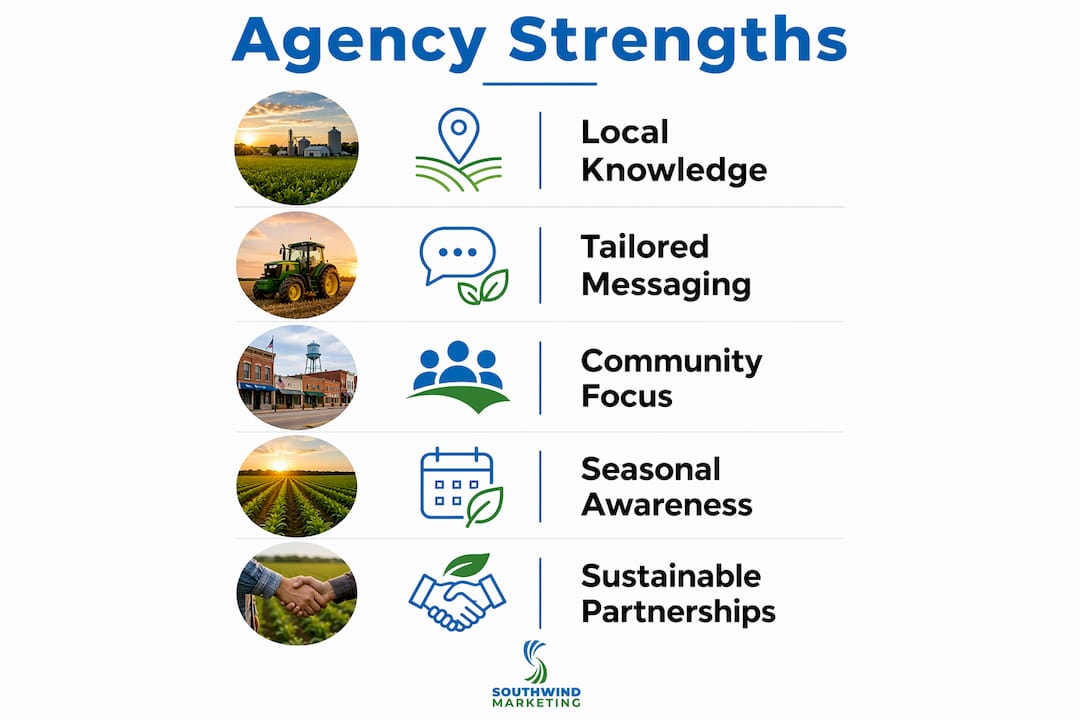
Here's what to look for when evaluating farm marketing agencies and rural advertising firms:
- Sub-sector knowledge. An agency that lumps all of agriculture together doesn't understand it. Dairy, row crops, agritourism, and farm supply retail each have distinct audiences and buying cycles.
- Fieldwork commitment. The best agencies spend time on the ground with your clients and community members. Remote-only relationships produce generic work.
- Transparent measurement. Ask how they define success for a rural client. If the answer is impressions and clicks alone, keep looking. Rural outcomes include foot traffic, membership growth, retail retention, and resident sentiment.
- Real references, not trophies. Award-winning claims rarely correlate with rural marketing success. Ask for references from current and former rural clients, and actually call them.
- Channel fluency. A good agriculture digital marketing partner knows when Facebook outperforms Google, when local radio still wins, and when a booth at the county fair beats both.
- Communication style. Plain language, regular updates, and honest reporting. If an agency can't explain what they're doing without a glossary, that's a problem.
Pro Tip: Ask any prospective agency to name three specific challenges unique to rural marketing. Vague answers reveal a metro mindset dressed up in ag vocabulary.
How Southwind Marketing serves agricultural and rural communities
Southwind Marketing was built specifically for rural America. Not as a niche offering within a larger metro agency, but as the entire reason the agency exists. Headquartered in Yukon, Oklahoma, Southwind serves clients across Oklahoma, Kansas, Texas, Iowa, Missouri, and Arkansas, with a focus on the organizations that hold rural communities together: chambers of commerce, economic development organizations, Main Street programs, municipalities, and rural small businesses.
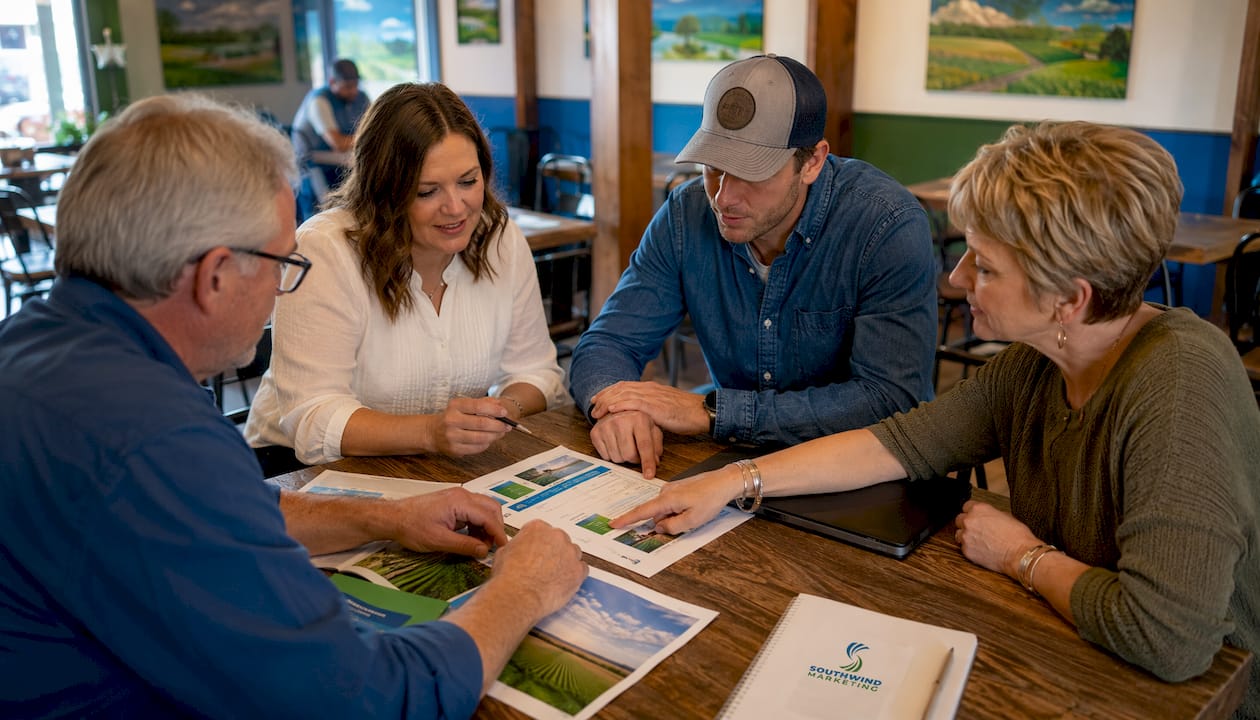
The services Southwind Marketing offers are designed around the real constraints rural clients face, including limited staff, tight budgets, and the need to reach both residents and outside audiences simultaneously.
| Service Category | What It Does for Rural Clients |
|---|---|
| Website Design | Builds credible, mobile-ready sites for chambers, EDOs, and municipalities |
| SEO & AI Search Optimization | Ranks your community on Google, ChatGPT, and Perplexity |
| Economic Development Marketing | Attracts site selectors, supports employer retention, and tells your community's story |
| Community Branding | Creates authentic identity rooted in local values, not stock photography |
| Civic Intelligence℠ Surveys | Gathers resident and stakeholder input using the Importance-Satisfaction methodology |
| Tourism Marketing | Promotes rural destinations to drive visitor traffic and local spending |
| PR & Video | Produces real community storytelling across every channel that matters |
Partnering with a rural-first agency like Southwind delivers specific advantages:
- Your agency understands your constraints without a lengthy education process
- Campaigns reflect genuine community values, not metro assumptions
- You get continuity: the same team, the same relationships, year after year
- Rural business brand identity is built on authentic local assets, not borrowed aesthetics
How to build a productive partnership with your marketing agency
Choosing the right agency is step one. Making the partnership work is the ongoing job. Chambers and EDOs function as the communication backbone of rural communities, and the best agencies treat that role as infrastructure to support, not replace.
Practical steps for rural organizations:
- Define outcomes before tactics. Know whether you're trying to stop retail leakage, grow chamber membership, attract new residents, or all three. Shared goals prevent scope drift.
- Bring stakeholders into the process early. Resident input gathered before a campaign launches produces messaging that actually resonates. Southwind's Civic Intelligence℠ program is built for exactly this.
- Use the channels your audience trusts. Local radio, print, and community events still carry significant weight in agricultural markets. Digital alone is not enough.
- Schedule regular check-ins. Monthly reviews keep strategy aligned with what's actually happening on the ground in your community.
- Plan for the long term. The best chamber and rural growth strategies compound over time. One-off campaigns rarely move the needle.
What happens when agencies chase metro clients instead
Marketing Maven Consulting built its reputation serving rural Kansas, based out of Great Bend. Recently, the agency relocated to Wichita to pursue larger clients and better airport access. That's a legitimate business decision, and Rachel Rains has built something real. But it illustrates a pattern rural communities know well: the agency that understood your town moves on, and you're left rebuilding a relationship from scratch with someone who has never driven a county road.
This isn't a criticism of any individual agency. It's a structural problem. When agencies grow, rural clients often become the smallest accounts in the portfolio. Response times slow. The account manager who knew your community gets reassigned. The messaging starts to feel like it was written for a city.
The pitfalls are consistent:
- Generic campaigns that don't reflect local culture or seasonal realities
- Reduced attention as metro accounts demand more of the agency's bandwidth
- Loss of institutional knowledge when staff turns over
- Strategies built for urban media markets that don't translate to rural channels
- No real understanding of how chambers, EDOs, and municipalities actually function together
Rural communities deserve partners who chose this work on purpose, not as a starting point.
Which marketing channels actually work in rural agricultural markets
Rural audiences are not unreachable. They're just reached differently. Community-based marketing that combines traditional and digital approaches consistently outperforms either channel alone in rural contexts.
The channels that perform in agricultural and rural markets:
- Local radio. Still the dominant audio medium in many rural counties, especially for ag news and weather.
- Community events and fairs. Face-to-face presence at county fairs, farm shows, and chamber events builds trust faster than any digital ad.
- Facebook and community groups. Rural audiences skew toward Facebook for local news and community connection. Targeted local campaigns here outperform broad digital buys.
- Email and mass notification systems. Direct communication to residents and members remains one of the highest-ROI channels for chambers and municipalities.
- Local print. Weekly newspapers and regional ag publications retain loyal readership in rural markets.
- Google and AI search. As rural broadband improves, search visibility on Google, ChatGPT, and Perplexity becomes increasingly critical for economic development and tourism.
The right mix depends on your specific community and goals. A content strategy built for agency growth in rural markets requires knowing which channels your audience actually uses, not which ones are easiest to report on.
What successful rural agricultural marketing campaigns look like
The Searcy County Chamber of Commerce in Arkansas offers a clear example. When Executive Director Darryl Treat took over, the chamber had a modest social media following and minimal online presence. By focusing on authentic photography of the county's natural assets and consistent community storytelling, the chamber's Facebook following grew substantially, increasing by more than an order of magnitude. That reach helped attract tourism interest, surface underutilized local assets like whitewater kayaking on Falling Water Creek, and eventually support a significant federal grant for manufacturing development.
Georgia's Rural Center completed a similar project for Chattooga County, partnering with the local chamber to develop a tourism and community marketing plan grounded in focus groups and resident surveys. The result was a brand strategy that reflected the community's actual identity, not a consultant's assumption of it. Monthly check-ins for a full year after delivery kept implementation on track.
Both cases share the same core approach: start with the community, build from authentic local assets, and sustain the effort over time.
How agricultural agencies tailor messaging for diverse rural communities
Rural America is not monolithic. A farming community in western Kansas operates on different cultural assumptions than a timber county in Arkansas or an agritourism corridor in Missouri. Effective farm marketing agencies account for that variation at the strategy level, not just in the copy.
Tailoring messaging for rural audiences means:
- Leading with values, not features. Rural buyers respond to independence, stewardship, community, and practicality. Campaigns that lead with those values outperform product-feature-first approaches.
- Using local voices. Testimonials and stories from community members carry more weight than polished brand copy. Real people, real places.
- Respecting seasonal rhythms. Agricultural communities plan around planting, harvest, and market cycles. Campaigns timed to those rhythms land better than generic quarterly pushes.
- Acknowledging economic realities. Rural households and small businesses operate on tighter margins. Messaging that respects that constraint builds credibility.
- Avoiding urban assumptions. Commute times, retail access, and entertainment options are different in rural markets. Campaigns that assume urban norms read as tone-deaf.
The agencies that get this right spend time in the communities they serve. That's not a soft preference. It's how authentic, effective rural messaging gets built.
Why "rural by choice" is the only philosophy that holds up long-term
There's a version of this conversation that gets polite and vague. This isn't that version.
When an agency relocates from a rural market to a metro center for better clients and airport access, the message to rural communities is clear: you were a starting point, not a destination. That's not a moral failing. It's a business model. But rural communities need to understand what that model means for them when the agency's ambitions outgrow the account.
The agencies that genuinely serve rural America made a choice to be here. Not because rural clients are the only ones available, but because this work matters and requires a specific kind of commitment. Understanding how a chamber functions as the communication layer for an entire town, knowing that a county fair is a serious marketing channel, recognizing that a rural EDO's success is measured in jobs retained and storefronts filled — none of that comes from a metro playbook.
Southwind Marketing chose rural. The agency's footprint across Oklahoma, Kansas, Texas, Iowa, Missouri, and Arkansas isn't a growth strategy toward something bigger. It's the point. Rural municipalities and chambers in Kansas and Oklahoma that are evaluating their next marketing partner should ask one question before any other: will this agency still be here, still care, and still understand us in five years?
Southwind Marketing is built for communities like yours
Rural municipalities, chambers, and EDOs in Kansas and Oklahoma don't need a metro agency that fits rural work into its schedule. They need a partner built for exactly this. Southwind Marketing offers economic development marketing, community branding, SEO, website design, and resident engagement programs designed around the real constraints of rural organizations.
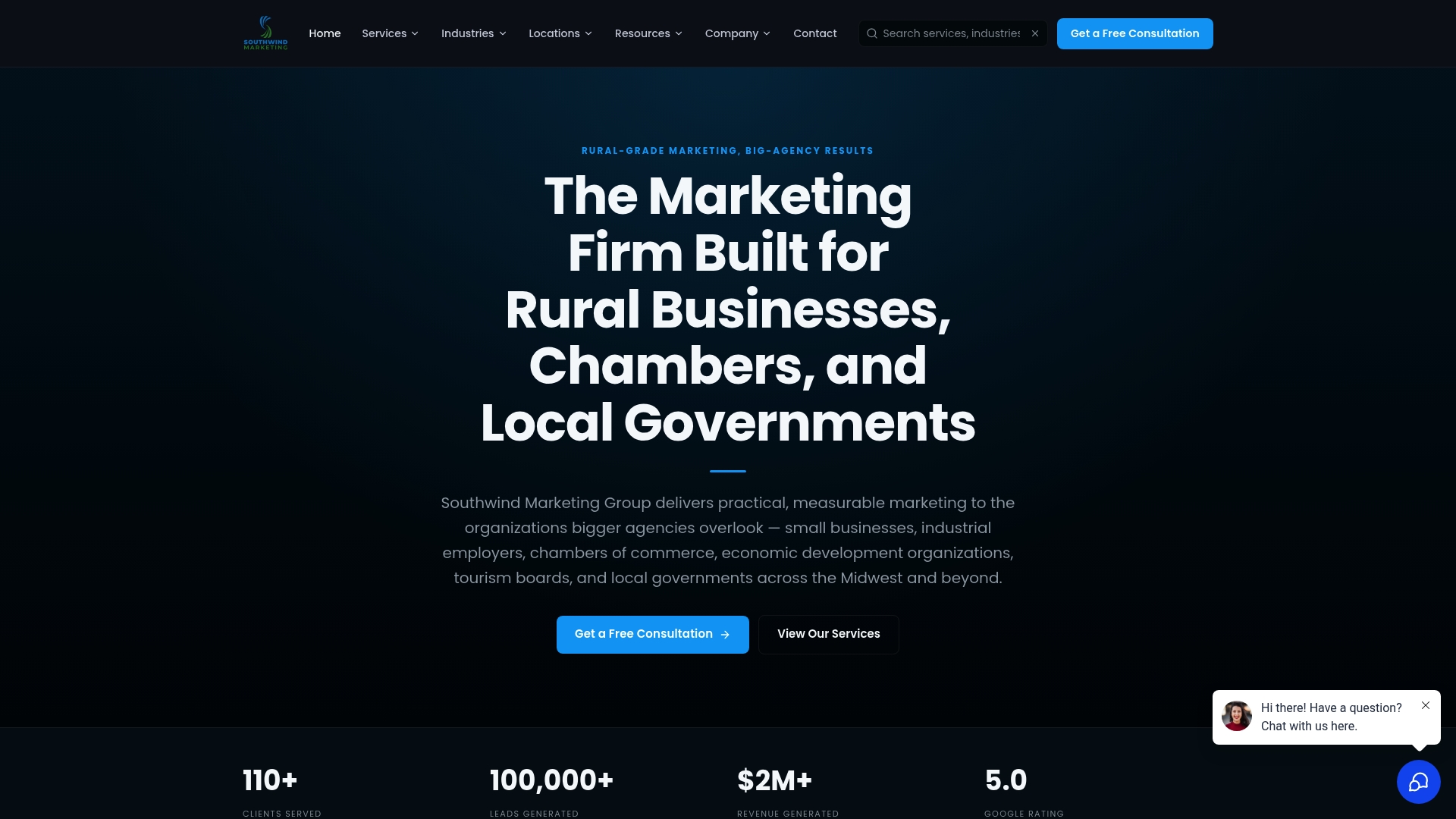
Southwind's website design services for chambers and local government give rural organizations a credible digital presence that works for residents, visitors, and site selectors alike. Every service is built around a single commitment: rural America deserves marketing that takes it seriously.
If your organization is ready to work with an agency that isn't going anywhere, reach out to Southwind Marketing at southwindmarketing.com and start the conversation.
Key Takeaways
Rural communities need agricultural advertising agencies that are committed to rural markets by design, not by default.
| Point | Details |
|---|---|
| Specialization matters | Agencies must understand ag sub-sectors, seasonal cycles, and rural media channels to produce effective campaigns. |
| Community co-creation wins | Place marketing that involves residents as co-creators consistently outperforms campaigns built without local input. |
| Vetting over trophies | References from current rural clients reveal more about an agency's commitment than any award or accolade. |
| Channel mix is critical | Effective rural campaigns combine local radio, community events, Facebook, email, and search visibility. |
| Southwind Marketing | Built specifically for rural America, serving chambers, EDOs, and municipalities across Oklahoma, Kansas, and beyond. |
FAQ
What do agricultural advertising agencies specialize in?
Agricultural advertising agencies specialize in marketing for farming businesses, rural communities, chambers of commerce, and economic development organizations. They understand seasonal buying cycles, rural media channels, and the cultural values that drive rural purchasing decisions.
How do I know if an agency truly understands rural markets?
Ask for references from current rural clients and request specific examples of campaigns in agricultural or rural contexts. Agencies with genuine rural expertise will speak fluently about sub-sector differences, local media channels, and community engagement without prompting.
What marketing channels work best for rural agricultural businesses?
Local radio, community events, Facebook, email, weekly print publications, and Google search are the highest-performing channels in most rural agricultural markets. The right mix depends on your specific audience and goals.
Why does it matter if an agency is "rural by choice"?
Agencies that chose rural markets as their primary focus maintain deeper knowledge of rural constraints and won't deprioritize rural clients as they grow. Agencies that treat rural work as a stepping stone to metro accounts often reduce service quality as their ambitions shift.
What services does Southwind Marketing offer rural communities?
Southwind Marketing provides website design, SEO, economic development marketing, community branding, tourism promotion, PR, and resident engagement programs including its Civic Intelligence℠ survey system, all built specifically for rural municipalities, chambers, and small businesses.