
TL;DR:
- Rural consumers shop local because it keeps money in their communities, supporting local jobs and social bonds. Spending at local stores recirculates more money and sustains community infrastructure better than shopping at national chains. Many prefer in-store shopping for trust, reliability, and meaningful relationships that online options cannot provide.
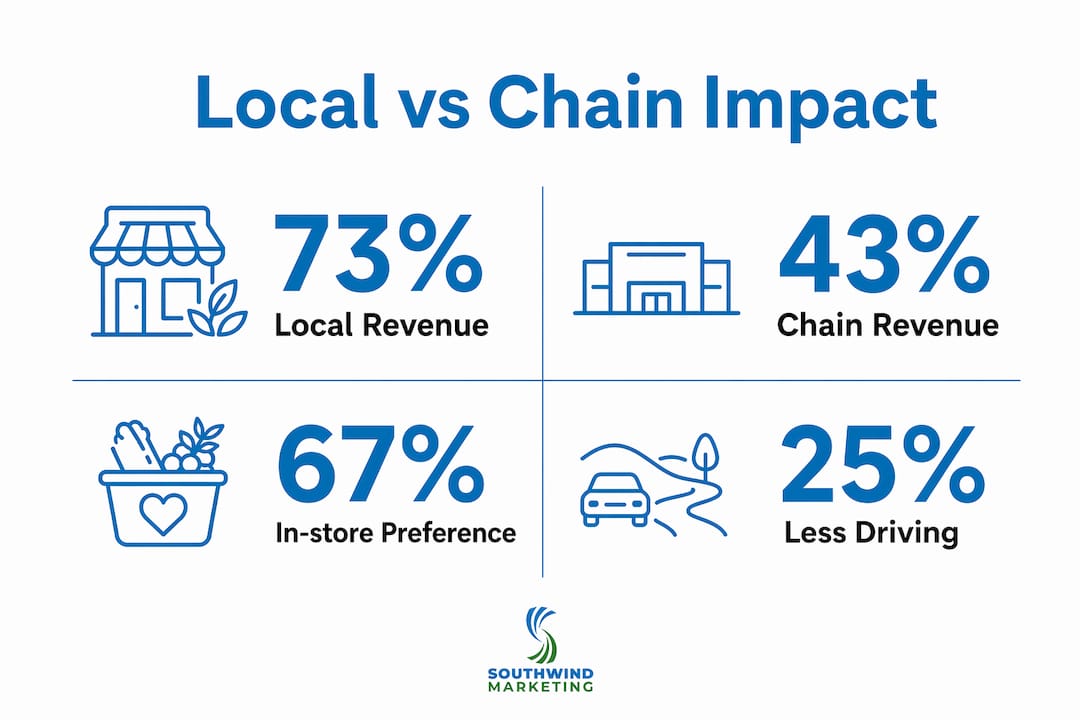
Rural consumers shop local because it keeps money inside their communities, sustains local jobs, and builds the social fabric that holds small towns together. The local multiplier effect, a well-documented economic principle, shows that dollars spent at independent businesses recirculate through the local economy at a far higher rate than dollars spent at national chains. Up to 73% of each dollar spent at a local independent business stays in the community. That single fact explains why rural consumer behavior around local shopping is not just a preference. It is a survival strategy for rural America.
Why rural consumers shop local: the economic case
The economic argument for local shopping in rural areas starts with the multiplier effect. When you buy from a locally owned store, that owner pays local employees, hires local contractors, and buys supplies from nearby vendors. That money moves through the community multiple times before it leaves.
Local retailers retain 289% more revenue for the local economy compared to chain stores. That gap is not a rounding error. It is the difference between a community that funds its own schools, roads, and fire departments and one that slowly hollows out.
The tax base impact is just as direct. Local spending bolsters the tax base and diversifies the economy, protecting rural towns against market shocks. When a national chain closes a location, it leaves a gap that no local tax revenue can fill. When a locally owned hardware store or grocery thrives, it generates property tax, sales tax, and payroll tax that fund the services every resident depends on.
Pro Tip: Track how many local businesses in your town sponsor youth sports, donate to school fundraisers, or support the county fair. That list is a direct measure of your community's economic health.
The jobs argument is equally concrete. Local businesses hire neighbors. Those neighbors spend their paychecks locally. The cycle reinforces itself, and the community grows stronger with each rotation.
| Economic factor | Local business | National chain |
|---|---|---|
| Revenue retained locally | Up to 73% | Approximately 43% |
| Community reinvestment | High (wages, events, vendors) | Low (profits leave market) |
| Tax base contribution | Direct and sustained | Variable, often reduced |
| Job quality | Neighbor-to-neighbor | Often lower-wage, high turnover |
Why do rural shoppers prefer in-store over online?
67% of rural shoppers prefer in-store shopping due to greater trust in product quality and frustration with e-commerce problems like delivery delays. That preference is not nostalgia. It is a practical response to real conditions.
Rural shoppers know that a package shipped to a remote address can take days longer than advertised. They also know that returning a defective item by mail is a significant inconvenience when the nearest drop-off point is 40 miles away. 54% of rural shoppers experience online shopping problems significant enough to affect their buying decisions.
The preference for in-store service is also about relationships. 61% of rural shoppers prefer supermarkets for personalized staff service. A store employee who knows your name, remembers your usual order, and can tell you whether a product is in stock is worth more than any algorithm. That kind of service is a genuine competitive advantage for local retailers, and it is one that national chains and e-commerce platforms cannot replicate.
Rural purchases are also deliberate, not impulse-driven. When a shopping trip requires planning around distance, fuel costs, and weather, you do not browse casually. You go with a list, a purpose, and an expectation that the store will have what you need.
- Distance planning: Many rural shoppers travel 30–60 miles for a major shopping trip, making stock reliability critical.
- Fuel and time costs: A failed trip costs real money. Shoppers reward reliable local stores with consistent loyalty.
- Weather windows: In many rural regions, winter weather can close roads for days. A local store that stays open and stocked becomes irreplaceable.
- Trust in quality: Seeing, touching, and evaluating a product in person reduces the risk of a wasted purchase.
Pro Tip: If you run a rural retail business, publish your weekly inventory highlights on social media or a simple email list. Rural shoppers plan ahead. Give them a reason to plan around you.
What are the environmental and social benefits of local shopping?
Local shopping reduces driving. Residents in communities with accessible local businesses drive approximately 25–26% fewer miles than those without them. Fewer miles driven means lower fuel consumption, lower emissions, and lower household transportation costs. For rural communities already dealing with long distances as a baseline, every mile saved matters.
The social benefits run even deeper. Rural stores are not just retail outlets. They are gathering places. The local hardware store is where farmers compare notes on equipment. The independent grocer is where neighbors catch up on community news. Independent grocers frequently serve as social hubs beyond their retail function, hosting informal community conversations that no online platform can replace.
"When a rural store closes, the community loses more than a place to buy groceries. It loses a meeting point, a source of local employment, and often the last anchor of commercial life in that town. The social damage from rural store closures is difficult to reverse and rarely captured in economic statistics alone."
Rural store closures erode social connectivity and community health, often triggering declines that are hard to reverse. Once a community loses its last grocery store or pharmacy, residents face a choice between long drives and going without. Neither option is acceptable, and neither is inevitable if local shopping habits stay strong.
Local business owners invest heavily in community events, youth sports sponsorships, and local financial stability. They do this while operating on thin margins and long hours. That commitment is a form of community stewardship that no national chain replicates at the local level. Understanding authenticity in local branding helps explain why rural consumers trust their local owners in ways they simply do not trust corporate retail.
How can rural communities strengthen their local retail ecosystems?
Rural economic success depends on combining local identity, community relationships, and creative retail experiences rather than trying to match the convenience of national chains. That is not a consolation prize. It is a genuine competitive advantage.
Strong local identity and relationships give rural communities an edge that national chains cannot replicate. A chain store cannot claim your town's history, sponsor your local rodeo, or know three generations of the same family by name. That belonging is a retail asset, and communities that treat it as one will outperform those that do not.
Here is a practical framework for rural consumers and community leaders who want to strengthen local retail:
- Shop with a plan. Combine errands into one local trip. Buy from the local hardware store, the local pharmacy, and the local diner in the same outing. Each stop reinforces the others.
- Attend coordinated shopping events. Coordinated shopping events leverage nostalgia and community pride to create memorable experiences. Shop Small Saturday, harvest festivals, and downtown sidewalk sales build foot traffic and community identity at the same time.
- Support businesses that blend retail with experience. Stores that combine products with food, local history, or tourism draw visitors and residents alike. A farm supply store that hosts a fall pumpkin event is not just selling pumpkins. It is building a reason to come back.
- Tell your neighbors what you bought locally. Word of mouth in a small town travels fast. A recommendation from a trusted neighbor carries more weight than any advertisement.
- Accept the local price premium as an investment. The local price premium supports community infrastructure and local services. Paying a dollar more for a locally sourced product funds the tax base, the jobs, and the social fabric that make your town worth living in.
Successful rural retail blends retail with food, tourism, and events rather than competing on price alone. Communities that build this kind of retail ecosystem attract visitors, retain residents, and create a commercial identity that lasts. Southwind Marketing works with Main Street programs and downtown development authorities across rural America to build exactly this kind of identity-driven retail strategy.
| Approach | What it does for the community |
|---|---|
| Coordinated shopping events | Builds foot traffic and reinforces local identity |
| Retail blended with tourism | Attracts outside dollars and creates repeat visits |
| Local price premium acceptance | Funds tax base, wages, and community services |
| Word-of-mouth referrals | Drives new customers at zero cost to the business |
Key Takeaways
Rural consumers who shop local keep money circulating in their own communities, sustain local jobs, reduce environmental impact, and preserve the social infrastructure that small towns depend on to survive.
| Point | Details |
|---|---|
| Local multiplier effect | Up to 73% of local spending stays in the community, versus roughly 43% at chain stores. |
| Rural shopper preference | 67% of rural shoppers prefer in-store experiences for trust, quality, and reliable service. |
| Environmental benefit | Access to local shops reduces driving by approximately 25–26%, cutting emissions and costs. |
| Social infrastructure | Rural store closures damage social connectivity and community health in ways that are hard to reverse. |
| Community investment | Local business owners sponsor events and support neighbors, acting as anchors of community life. |
What I've learned watching rural communities fight for their stores
I have spent years working with rural communities across Oklahoma, Kansas, Texas, and beyond. The pattern I see most often is not a lack of desire to shop local. It is a lack of confidence that local stores will have what shoppers need when they make the trip.
That confidence gap is the real problem. A rural shopper who drives 45 miles and finds empty shelves does not just lose that purchase. They lose trust in the local option. They start planning around the big-box store in the next county, and that habit compounds over time into serious retail leakage.
The local business owners I respect most understand this. They treat stock reliability as a promise to their community, not just a logistics problem. They stay open during bad weather when they can. They call customers when a special order arrives. They show up at the school board meeting and the 4-H banquet. They are not just running a store. They are holding a community together.
What I tell rural shoppers is this: your purchase is a vote. Every dollar you spend locally is a vote for the store staying open, for the owner keeping their staff, for the tax base staying funded. You do not have to be sentimental about it. The math is straightforward. Rural digital marketing strategies can help local businesses communicate their value better, but the foundation is always the same. Shoppers who trust their local stores keep them alive.
Shopping local is not charity. It is community stewardship. The communities that understand that distinction are the ones that still have a hardware store, a pharmacy, and a diner 20 years from now.
— Southwind Marketing
How Southwind Marketing supports rural retail communities
Rural businesses and the organizations that support them need more than good intentions. They need visibility, a strong digital presence, and marketing that speaks directly to local shoppers.
Southwind Marketing works with rural small businesses, chambers of commerce, economic development organizations, and Main Street programs to build the kind of community presence that keeps local retail alive. From website design built for rural audiences to economic development marketing that attracts new businesses and retains existing ones, Southwind Marketing brings the full toolkit to rural America. If your community is ready to stop retail leakage and build a stronger local economy, Southwind Marketing is built for exactly that work.
FAQ
Why do rural consumers prefer shopping local over online?
67% of rural shoppers prefer in-store shopping because they trust product quality more and face real problems with delivery delays and returns. The distance to a return drop-off point alone makes online shopping a poor fit for many rural households.
How much of local spending actually stays in the community?
Up to 73% of each dollar spent at a local independent business stays in the community, compared to roughly 43% at chain stores. That gap funds local wages, local taxes, and local services.
Does shopping local really help the environment?
Residents with access to local shops drive approximately 25–26% fewer miles than those without them. Fewer miles driven directly reduces fuel consumption and vehicle emissions.
What happens to a rural community when local stores close?
Rural store closures damage social connectivity and community health in ways that are difficult to reverse. Independent grocers serve as social hubs beyond retail, and their loss removes a critical anchor from community life.
Is paying more at a local store worth it?
The local price premium supports community infrastructure including the tax base, local jobs, and public services. Paying slightly more locally is an investment in the services and neighbors that make rural life sustainable.