

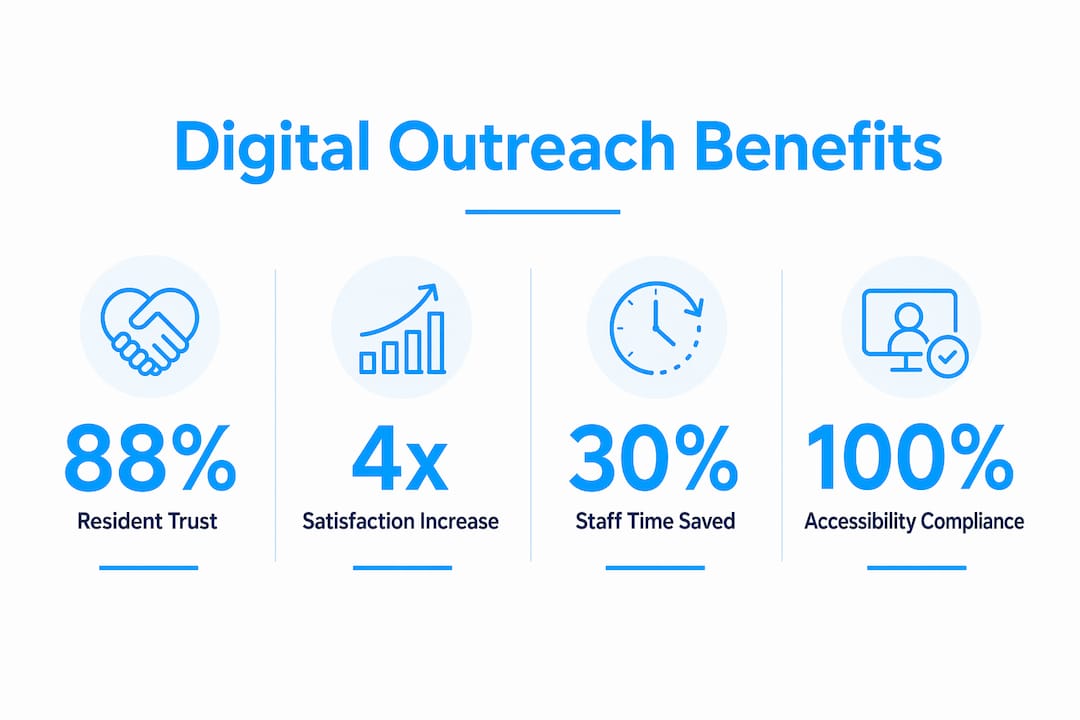
Digital outreach in local government is the strategic use of digital channels, including websites, email, text alerts, and social media, to communicate with residents, deliver services, and build public trust. 88% of residents report higher trust in local government when their municipal website is easy to navigate. That single statistic explains why digital outreach local government leaders prioritize has become a governance priority, not a marketing afterthought. 78% of residents support spending tax dollars on digital communication tools like emergency messaging systems. Accessibility and audience intelligence are the two foundations that determine whether your digital outreach delivers results or just adds noise.
What are the main advantages of digital outreach for local governments?
Resident trust rises measurably when local governments communicate well online. Residents who find their municipal website very easy to use are four times more satisfied with their city overall. That satisfaction gap is not about aesthetics. It reflects whether residents feel heard, informed, and respected by the institutions serving them.
The benefits of digital communication extend well beyond satisfaction scores. Digital tools reduce staff workload by enabling self-service options for common requests, such as permit applications, utility payments, and meeting schedules. Emergency messaging systems push critical alerts to thousands of residents in minutes, a task that would take days through traditional mail. Transparency improves when residents can track service requests online rather than calling an office and waiting on hold.

The case for budget allocation is also resident-driven. Because nearly four in five residents back spending on digital communication tools, local officials have a strong public mandate to fund these systems. That mandate removes one of the most common barriers to adoption: political hesitation.
Key advantages of digital outreach for local governments include:
Faster information delivery: Emergency alerts, meeting notices, and policy updates reach residents within minutes.
Reduced call volume: Self-service portals handle routine requests without staff intervention.
Transparent service tracking: Residents follow the status of their requests online, reducing frustration.
Broader reach: Digital channels connect with residents who cannot attend in-person meetings.
Measurable engagement: Open rates, click-through data, and form submissions show what content residents actually use.
How does audience intelligence improve digital outreach effectiveness?
Audience intelligence is the practice of using data about resident preferences, behaviors, and communication habits to deliver the right message through the right channel at the right time. Failing to use audience intelligence causes a 33% higher incidence of service delays. That number reflects a real operational cost: when messages miss their audience, residents do not act, and service requests pile up.
Effective local government digital engagement uses a multichannel approach. A single announcement about a road closure, for example, should reach residents through email, text, the municipal website, and social media simultaneously. Each channel serves a different segment of your community. Older residents may rely on email. Younger residents often check social media first. Parents of school-age children respond quickly to text alerts.
Here is a practical framework for building audience intelligence into your outreach:
Segment your contact list by neighborhood, service type, or communication preference.
Track open and response rates for each channel to learn which formats your residents prefer.
Survey residents annually about their preferred communication methods and update your contact database accordingly.
Use unified communications platforms to coordinate messages across email, text, and web from a single dashboard.
Review service request data to identify which topics generate the most resident confusion and address those proactively.
Pro Tip: A unified communications platform prevents fragmentation, where the same resident receives conflicting messages from different departments. Centralizing outreach coordination is one of the fastest ways to improve perceived government responsiveness.
Intentional reach over sheer scale boosts trust and reduces resident confusion. Sending fewer, better-targeted messages consistently outperforms blasting every resident with every update.
Why is accessibility a non-negotiable foundation for digital outreach?
ADA compliance is not optional for local government digital platforms. It is a legal requirement and a direct driver of resident trust. When a resident using a screen reader cannot access your emergency alert page, or a mobile user cannot submit a service request because the form does not load correctly, your outreach fails the people who need it most.
Accessible design also benefits the general population. Features built for residents with disabilities, such as clear fonts, high-contrast colors, and simple navigation, make websites easier for everyone to use. That broader usability is exactly why website usability links directly to a fourfold increase in resident satisfaction.
A practical ADA-compliant digital outreach checklist includes:
Keyboard navigation: All website functions work without a mouse.
Alt text on images: Screen readers can describe every visual element.
Readable PDFs: Documents are tagged and structured for assistive technology.
Mobile-friendly design: Pages load correctly on smartphones and tablets.
Plain language: Content is written at a reading level accessible to most adults.
Captioned video: All video content includes accurate closed captions.
Accessibility signals to every resident that your government is committed to serving the whole community, not just those with the fastest internet connections and the newest devices.
How do digital and in-person engagement work together?
Digital communication excels at routine coordination but is less effective than face-to-face interaction for trust-building and handling sensitive issues. That distinction matters for local government leaders who want to use digital tools without losing the human connection that civic relationships require.
Think of digital outreach as the infrastructure for routine communication. Permit status updates, meeting agendas, utility alerts, and survey links all belong in digital channels. They are efficient, trackable, and scalable. But when a neighborhood is upset about a zoning decision, or a family is navigating a complex benefits application, a phone call or in-person meeting does more to build trust than any automated message.
“Digital channels excel at efficiency and routine tasks but must be integrated with face-to-face engagement for relational trust.” — Frontiers in Organizational Psychology
The concept of a situational communication perspective helps here. Match the channel to the stakes of the interaction. Low-stakes, informational updates go digital. High-stakes, relationship-dependent conversations go in-person or by phone. Mixing these up, sending a form letter about a sensitive community issue, or holding an unnecessary public meeting for a routine update, wastes both staff time and resident goodwill.
Pro Tip: When a resident submits a high-priority service request or complaint through a digital channel, follow up with a personal phone call within 48 hours. That single human touchpoint dramatically increases perceived responsiveness and resident satisfaction.
Calibrating outreach intensity to constituent readiness prevents engagement fatigue. Automated outreach works for general information. Personalized contact is necessary for high-intent or emotionally charged interactions.
What practical strategies should local governments implement?
Effective digital strategies for community outreach require structure, not just tools. The following steps give local officials a repeatable framework for improving resident engagement over time.
Build a service request feedback loop. When a resident submits a request online, send an automatic confirmation with a case number. Update the status publicly as the request moves through resolution. Close the loop with a completion notice and a brief satisfaction survey.
Publish resolution metrics. Share monthly data on average response times and request volumes on your website. Publicly visible tracking dashboards demonstrate active responsiveness and reduce the “black hole” anxiety residents feel when they submit a request and hear nothing back.
Align outreach frequency with resident readiness. Survey residents about how often they want to hear from local government on different topics. Match your send cadence to those preferences to avoid unsubscribes and disengagement.
Centralize your messaging. Use a single platform to coordinate outreach across departments. Inconsistent messaging from different offices erodes trust faster than silence does.
Treat feedback as data. Every complaint, survey response, and service request tells you something about where your communication is falling short. Review this data quarterly and adjust your outreach accordingly.
Residents equate digital interface quality with government competence. A slow, confusing website does not just frustrate residents. It signals that the government behind it is equally disorganized. Every improvement to your digital presence is a direct investment in public trust.
Key Takeaways
Digital outreach is the most direct tool local governments have for building resident trust, improving service delivery, and demonstrating accountability at scale.
| Point | Details |
|---|---|
| Trust starts with usability | Residents four times more satisfied when municipal websites are easy to navigate. |
| Audience intelligence reduces delays | Targeting residents by preferred channel cuts service delays by a measurable margin. |
| Accessibility is both legal and strategic | ADA-compliant design serves all residents and directly increases satisfaction scores. |
| Digital and in-person are complementary | Use digital for routine updates and in-person contact for sensitive or high-stakes issues. |
| Transparency builds credibility | Public-facing service dashboards reduce resident anxiety and demonstrate responsiveness. |
What I have learned about digital outreach and government trust
Working with local governments and rural communities, I have noticed a consistent pattern. Officials often treat digital outreach as a communications task. They assign it to whoever manages the website or social media accounts, give it a modest budget, and measure success by whether the post went out on time. That approach misses the point entirely.
Digital outreach is a trust-building mechanism. Trust is reinforced through repeated positive digital interactions, not through a single well-designed homepage. Every time a resident submits a request and gets a timely update, every time an alert arrives before a road closes, every time a PDF actually opens on a phone, you are making a deposit into the community’s trust account.
The challenge I see most often is that local governments underestimate how much residents compare their government’s digital experience to what they get from private companies. Residents use apps that track their delivery in real time. They get instant confirmations from every online purchase. When they submit a pothole report and hear nothing for three weeks, the contrast is jarring. It does not just feel inconvenient. It feels like the government does not care.
The fix is not a bigger budget. It is a clearer process. Publish your response timelines. Show your work. Acknowledge requests publicly. Those habits cost almost nothing and return enormous goodwill. The governments I have seen succeed with digital outreach are not the ones with the fanciest platforms. They are the ones that treat every digital interaction as a chance to prove they are paying attention.
— Southwind Marketing
How Southwind Marketing supports local government digital outreach
Local governments face real constraints: limited staff, tight budgets, and residents who expect the same digital experience they get from private companies. Southwind Marketing works specifically with rural communities, chambers of commerce, and local governments that larger agencies overlook.
Southwind Marketing builds tailored digital outreach strategies that fit your budget and your community’s actual needs. From website design and accessibility audits to economic development messaging and community engagement campaigns, the team brings a track record of over 100,000 leads generated and $2M in revenue for the communities it serves. If you are ready to improve how your government communicates with residents, Southwind Marketing is the practical partner to get you there.
FAQ
What is digital outreach in local government?
Digital outreach in local government is the strategic use of websites, email, text alerts, and social media to communicate with residents and deliver public services. It replaces or supplements traditional mail and in-person communication with faster, trackable digital channels.
Why does digital outreach matter for resident trust?
88% of residents trust local government more when their municipal website is easy to navigate. Consistent, responsive digital communication signals competence and builds long-term public confidence.
How do local governments avoid digital engagement fatigue?
Calibrate outreach frequency to what residents actually want by surveying them on preferred channels and message cadence. Automated messages work for general updates, but personalized contact is necessary for complex or sensitive issues.
What role does ADA compliance play in digital outreach?
ADA compliance makes digital platforms legally accessible to residents with disabilities and improves usability for all residents. Accessible websites directly correlate with higher resident satisfaction and broader community engagement.
When should local governments use in-person engagement instead of digital?
Digital tools complement rather than replace personal interaction for trust-building and sensitive communication. Use in-person or phone contact when the issue is high-stakes, emotionally charged, or requires nuanced back-and-forth dialogue.