
TL;DR:
- Digital marketing helps chambers increase visibility, engagement, and retention by reaching online audiences effectively. Small chambers can compete by focusing on purposeful digital strategies, including websites, email, social media, and AI tools. Proper governance and targeted content are essential for maximizing return and building trust.
Digital marketing is the most direct path chambers of commerce have to increase member engagement, build community visibility, and prove their value in a world where 73% of small businesses now maintain a website. That number means your members are already online. The question is whether your chamber shows up alongside them. For rural and small-town chambers especially, a strong digital presence is no longer a nice addition to your annual plan. It is the plan. Southwind Marketing works with chambers across rural America and sees the same gap repeatedly: organizations doing great work that nobody outside their mailing list ever finds.
Why chambers need digital marketing to stay relevant
Chambers have always been connectors. Digital marketing is how that connection happens at scale in 2026. Without it, a chamber's reach stops at the edge of its email list and the people who show up to the ribbon cutting.
The importance of digital marketing for chambers comes down to four measurable outcomes: visibility, retention, trust, and proof of value. Each one directly affects whether members renew and whether new businesses join.
- Visibility. A chamber with a well-ranked website and active social presence shows up when a business owner searches for local resources. Chamber SEO strategies put your organization in front of people who do not already know you exist.
- Retention. Members who feel informed and connected renew. Digital channels give you the tools to stay in front of them every week, not just at the annual banquet.
- Trust. Consistent, useful content builds credibility over time. The strongest chambers use marketing to build trust and support retention, not just promote events.
- Proof of value. Automated member advertising reports give chambers concrete data showing members how their business is being promoted. That data justifies dues and reduces churn.
Marketing professionals allocate 57% of budgets to digital channels as a core operational necessity. Chambers that still treat digital as a secondary line item are working against that standard, not with it.
How can chambers use digital marketing to improve member engagement?

Member engagement is the metric that matters most. A chamber with 400 members who never interact is weaker than one with 150 members who show up, refer business, and renew every year. Digital marketing is the primary tool for moving members from passive to active.
Only 54% of chambers currently use a dedicated community platform, yet 57% of those that do report at least 40% member engagement. That gap is significant. It means the majority of chambers are leaving their best engagement tool unused.
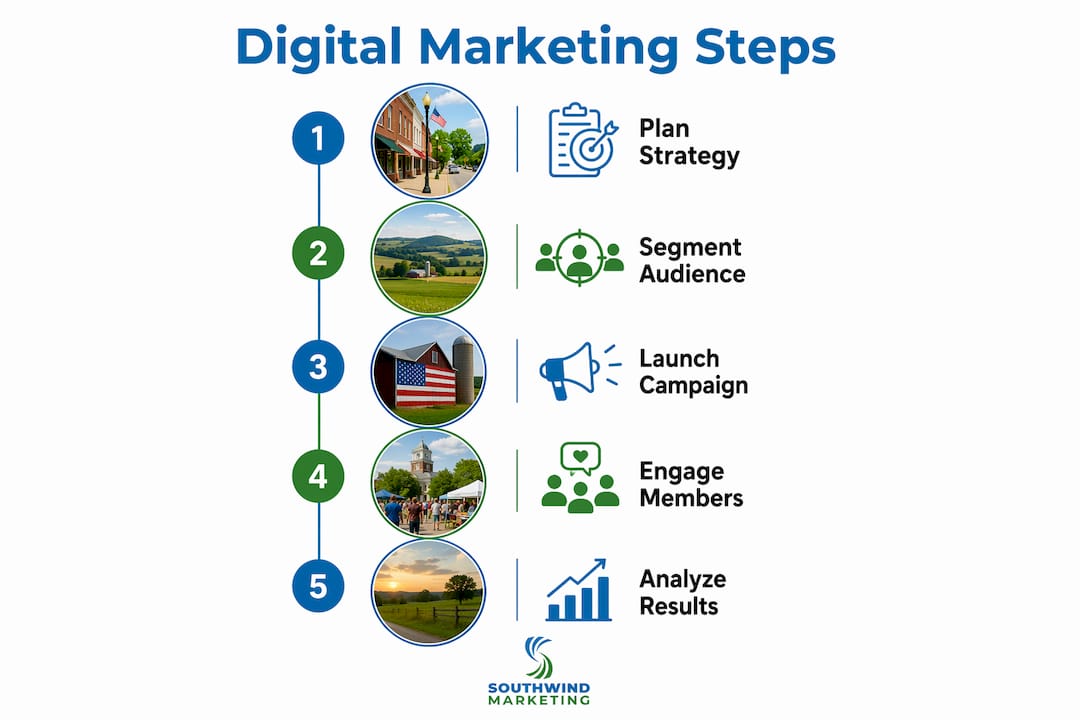
Here is what a practical digital engagement strategy looks like for a chamber:
- Community platform. A members-only online space where businesses post updates, find referrals, and connect between events. This is not a Facebook group. It is a managed, branded environment your chamber controls.
- Email automation. Scheduled sequences that welcome new members, remind lapsed ones, and deliver value every month without requiring manual effort. Email automation for chambers keeps the relationship warm year-round.
- Member spotlights and content marketing. Regular features on member businesses build goodwill and give members a reason to share your content with their own audiences.
- Social media. Consistent posting on platforms where your members and community are active. For most rural chambers, Facebook remains the highest-traffic channel, but LinkedIn matters for economic development audiences.
Personalized digital campaigns yield a $2 to $10 return per dollar spent, reported by 68% of marketers. Generic mass emails do not produce that return. Segmented, relevant communication does.
Pro Tip: Segment your member list by industry type and send targeted content to each group. A restaurant owner and a commercial contractor have different needs. Treating them the same wastes both their time and yours.
Membership platforms must be actively managed and integrated into a broader marketing strategy to drive more than minimal engagement. Launching a platform and walking away produces the same result as not launching one at all.
What role does AI and technology play in chamber digital marketing?
AI is no longer a future topic for chambers. The U.S. Chamber of Commerce describes AI adoption through a Four-Pillar Framework covering training, use cases, governance, and vendor management. That framework gives chamber leaders a practical starting point rather than an abstract concept.
Here is how AI applies directly to chamber marketing operations:
- Content production. AI tools accelerate the creation of newsletters, social posts, and event recaps. A staff of one or two can produce the output of a much larger team.
- Member data analysis. AI can identify which members are disengaging before they lapse, giving you time to reach out with a targeted retention message.
- Local business discovery. Local businesses are increasingly found through AI-driven search rather than traditional search engines. Chambers that curate accurate member data become credibility amplifiers in those AI discovery systems.
- Advertising reports. Automated reporting tools pull together member visibility data and deliver it in a format members can actually read and share.
AI adoption in chambers requires balancing speed and automation with maintaining human relationships and trust. The goal is not to replace the personal touch that makes chambers valuable. It is to free up staff time so that personal touch happens more often, not less.
AI-driven marketing requires clear governance to protect content quality and chamber credibility. That means setting standards for what AI produces before it goes out under your name. The role of AI in marketing strategies is growing fast, and chambers that build governance frameworks now will avoid the credibility problems that come from unreviewed automated content.
What practical steps can chambers take to start their digital marketing?
The most common mistake chambers make is starting with tactics before setting priorities. Posting on social media without a clear purpose produces noise, not results.
The right mindset shift moves the question from "What should we post?" to "What do our members and community actually need?" That one change improves every piece of content you create.
- Audit your website first. Your website is the foundation of every digital channel. If it is slow, outdated, or hard to navigate, every other effort underperforms. The chamber website checklist covers 27 specific elements modern chamber sites need.
- Set a digital budget that reflects the standard. With marketing professionals directing 57% of budgets to digital, chambers should allocate the majority of their marketing spend to digital channels, not print and event signage.
- Pick two or three channels and do them well. A well-managed email list and an active Facebook page outperform a scattered presence across six platforms with inconsistent posting.
- Measure what matters. Track email open rates, website traffic, and member engagement scores. Report those numbers to your board quarterly so digital marketing is treated as an investment, not an expense.
- Connect your digital presence to economic development goals. Chambers that position themselves as resources for site selectors and new businesses need their digital presence to reflect that. Rural businesses invisible online lose customers to towns with stronger digital footprints.
Pro Tip: Before you add any new digital channel, ask whether you have the capacity to maintain it consistently for 12 months. An abandoned social account does more damage to your credibility than no account at all.
Key Takeaways
Chambers that commit to digital marketing grow membership, retain members longer, and position their communities more effectively than those that rely on traditional outreach alone.
| Point | Details |
|---|---|
| Digital presence is foundational | 73% of small businesses have websites, making chamber digital visibility a baseline expectation. |
| Community platforms drive engagement | Chambers using dedicated platforms report at least 40% member engagement, yet only 54% use one. |
| Personalization increases ROI | Personalized campaigns return $2 to $10 per dollar spent, far outperforming generic outreach. |
| AI requires governance | AI accelerates content production but needs clear standards to protect chamber credibility. |
| Strategy beats tactics | Shifting from "what to post" to "what members need" produces more purposeful, effective communication. |
The playing field is more level than rural chambers think
I work with chambers in small towns across Oklahoma, Kansas, and the surrounding region. The ones that hesitate on digital marketing usually give me the same reason: they do not have the budget or staff that larger metro chambers have. That reasoning is understandable, but it is backwards.
Digital marketing is precisely where smaller chambers can compete. A well-written weekly email, a consistent Facebook presence, and a website that ranks for local searches cost far less than a full-time marketing hire. They also reach people the annual dinner never will. A business owner in a neighboring county who has never heard of your chamber can find you through a Google search. That same person will never see your print newsletter.
The chambers I see struggling most are not the ones with small budgets. They are the ones treating digital as optional. They post occasionally, let their website go stale, and wonder why membership numbers plateau. The ones growing are posting with purpose, using email to stay in front of members between events, and showing up in AI-driven search results because their member data is accurate and current.
Rural chambers have a story worth telling. Digital marketing is how you tell it to the people who have not heard it yet. The technology is accessible, the cost is manageable, and the results are measurable. There is no good reason to wait.
— Southwind Marketing
How Southwind Marketing helps chambers grow online
Southwind Marketing builds digital marketing programs specifically for chambers, economic development organizations, and community-focused groups across rural America.
If your chamber needs a website that actually works for member recruitment and community visibility, Southwind Marketing's chamber website design services are built for exactly that. The team also provides chamber marketing services covering SEO, content strategy, email programs, and community branding. Whether you are starting from scratch or fixing a digital presence that has gone stale, Southwind Marketing brings the rural community expertise and the technical depth to get results that matter to your members and your board.
FAQ
Why do chambers need digital marketing specifically?
Chambers need digital marketing because their members and communities are online. Without a consistent digital presence, a chamber is invisible to the businesses and residents it is trying to serve.
What is the most effective digital marketing channel for chambers?
Email marketing and a well-optimized website consistently deliver the highest return for chambers. Email keeps existing members engaged, while SEO brings in new members who are actively searching for local resources.
How does digital marketing help with member retention?
Automated member advertising reports and personalized email campaigns show members concrete proof of the chamber's value. Members who see results renew at higher rates than those who receive only event invitations.
Can small rural chambers afford digital marketing?
Digital marketing is one of the most cost-effective options available to small chambers. A focused strategy using email, social media, and SEO requires far less budget than traditional advertising and reaches a broader audience.
How does AI fit into chamber digital marketing?
The U.S. Chamber of Commerce recommends a Four-Pillar Framework for AI adoption covering training, use cases, governance, and vendor management. AI helps chambers produce more content faster while freeing staff to focus on member relationships.