
TL;DR:
- Engagement with underserved communities requires accessible outreach systems that build trust and address structural barriers. Effective strategies include multi-channel approaches, community asset mapping, and involving trusted local facilitators to enhance participation. Building ongoing relationships and transparency helps foster genuine resident involvement over time.
Engaging underserved community residents is defined as creating accessible, trust-based outreach systems that consistently reach people who face structural barriers to participation. These barriers include digital exclusion, language differences, mobility limits, and deep-seated mistrust of government institutions. For community leaders and local officials in rural and small-town America, the stakes are high. Residents who feel ignored stop showing up, stop investing locally, and eventually leave. The strategies in this guide are built for practitioners who need results, not theory.
What barriers prevent underserved residents from engaging?
The most common barriers to community engagement are structural, not personal. Underserved groups face obstacles including inaccessible digital tools, language differences, limited mobility, deep mistrust of institutions, and time constraints tied to work or caregiving. These barriers compound each other. A low-income parent working two jobs has no time for a 6:00 PM city hall meeting and no reliable internet to join a webinar.
Before you design any outreach program, map your community's specific barriers. Census data, local nonprofit reports, and school district records reveal where residents live, what languages they speak, and which households lack transportation. This process is called community asset mapping, and it prevents you from building an engagement program around assumptions.
The groups most often excluded include:
- Elderly residents who may lack digital literacy or transportation
- Ethnic and language minority households who receive materials only in English
- Low-income families whose schedules do not align with standard government hours
- Youth who are rarely consulted despite being directly affected by local decisions
- Rural residents dealing with geographic isolation and spotty connectivity
One detail most officials overlook: approximately 6.6% of households lack permanent internet access. That number sounds small until you apply it to a town of 10,000 people. You are looking at 660 households that a digital-only strategy will never reach.
Pro Tip: Before launching any outreach, spend two weeks talking to frontline workers at local food pantries, schools, and clinics. They know exactly who is not showing up and why.
Which engagement channels work best for reaching marginalized communities?
No single channel reaches everyone. The most effective community outreach initiatives use a multi-channel approach that combines in-person events, phone outreach, printed materials, and digital tools where appropriate. The key word is "where appropriate." Digital-first strategies exclude the residents who most need to be heard.
Alexandria, Virginia offers one of the clearest models for informal, multi-agency engagement. The city runs rotating community cookouts at accessible locations across the city, providing food while connecting residents with multiple agencies at once. The rotating format removes the stigma of going to a government office. It also builds familiarity between residents and officials over time, which is the foundation of trust.
Community Health Workers (CHWs) represent another high-impact channel. These are trusted community members, not outside consultants, who already have relationships with the people you are trying to reach. Research shows that CHW-led engagement produced 83% female and 88% African American participation rates in one study. Those numbers reflect what happens when outreach is led by people the community already trusts.
| Channel | Accessibility | Cultural fit | Cost | Scalability |
|---|---|---|---|---|
| In-person community events | High | High | Medium | Medium |
| Phone and door-to-door outreach | High | High | High | Low |
| Printed materials (flyers, mailers) | High | Medium | Low | High |
| Social media and digital tools | Low to medium | Variable | Low | High |
| Community-embedded facilitators (CHWs) | Very high | Very high | Medium | Low |
Pro Tip: Partner with local churches, barbershops, and laundromats to distribute printed materials. These locations already serve as informal community hubs, especially in rural towns.
For rural communities specifically, social media strategies can supplement in-person outreach for residents who do have connectivity. The key is to treat digital as one layer of a broader system, never the whole system.
How do you build trust with underserved populations?
Trust is infrastructure. Without it, every meeting, survey, and event produces low turnout and shallow feedback. Building trust with underserved populations requires consistency, follow-through, and transparency about what community input can actually change.
The single most common mistake officials make is launching engagement without first clarifying what decisions are open to community influence. Lack of clarity about decision-making scope causes mistrust and disengagement. Residents who show up once and see nothing change do not show up again. Before any outreach begins, document which parameters are fixed by law or budget and which are genuinely open to resident input. Share that list publicly.
Cultural competence goes beyond translation. Cultural transcreation with embedded community champions ensures messaging resonates at a cultural level, not just a linguistic one. A flyer translated word-for-word into Spanish may still miss the mark if it uses government-speak that feels foreign to the community's lived experience. Trusted local facilitators reframe the message in ways that feel authentic.
"Community-led partners as co-designers rather than subcontractors create culturally resonant, safe, and operationally flexible engagement programs. When residents help design the process, they are far more likely to participate in it."
Practical trust-building steps include:
- Hire from within the community. CHWs and local champions are not optional extras. They are the mechanism through which trust transfers from the community to your institution.
- Show up consistently. One event does not build trust. Monthly presence at the same locations does.
- Report back publicly. After every engagement cycle, publish a plain-language summary of what you heard and what you did with it.
- Engage local leaders first. Before broad outreach, meet with pastors, school principals, and neighborhood association heads. Their endorsement opens doors that official communications cannot.
Step-by-step strategies for an inclusive engagement program
A well-designed community engagement program follows a clear sequence. Skipping steps creates gaps that undermine the whole effort.
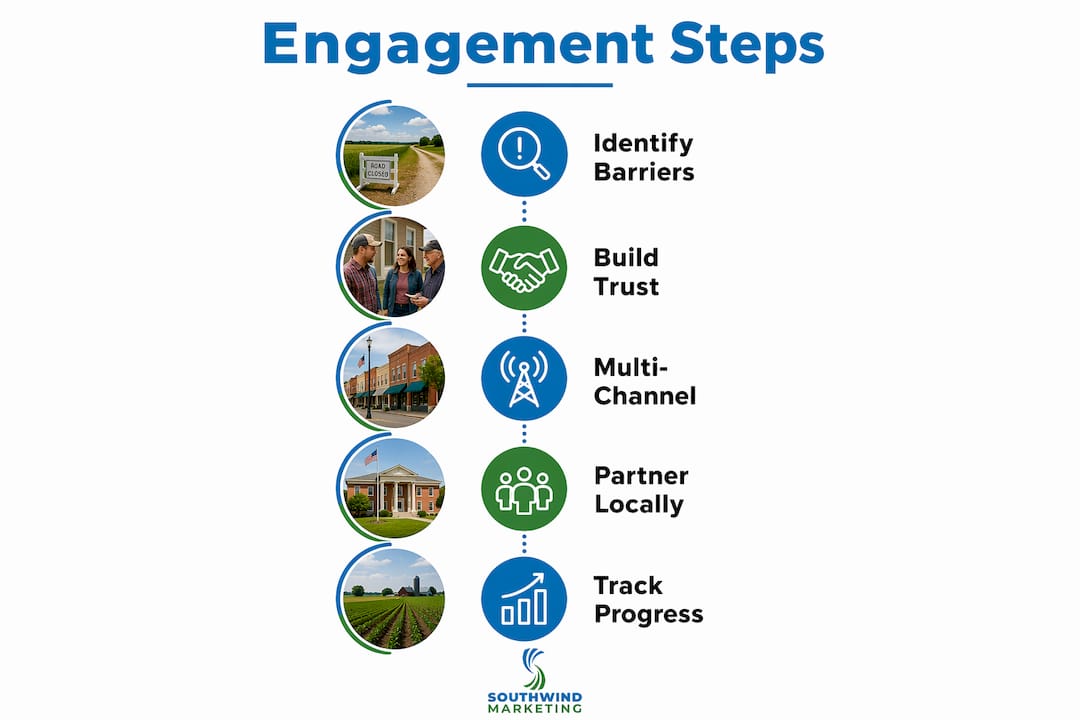
- Map your community assets and gaps. Identify who lives in your area, what languages they speak, where they gather, and what barriers they face. Use census data, school enrollment records, and input from local nonprofits.
- Define your engagement goals. Are you gathering input on a new park? Recruiting volunteers? Building long-term advisory relationships? The goal shapes every channel and timing decision that follows.
- Select channels based on resident routines, not government schedules. Outreach aligned with residents' daily routines outperforms standard 9-to-5 meeting formats. Schedule events at market days, school pickup times, or weekend mornings.
- Design events for comfort, not formality. Informal settings like parks, community centers, and faith-based spaces lower the barrier to participation. Provide childcare, food, and language support at every event.
- Document every interaction. Transparent record-keeping is not just good practice. It makes your outreach defensible if decisions are later challenged and shows residents their input was taken seriously.
- Collect feedback and adapt. After each engagement cycle, survey participants and non-participants. Ask what worked, what did not, and what would make them more likely to participate next time.
- Report outcomes publicly. Close the loop with a clear, plain-language summary. Post it on your website, distribute it as a flyer, and share it through community champions.
Pro Tip: Track participation by demographic group from the start. If your attendees do not reflect your community's actual makeup, your outreach is missing someone. Adjust before the next cycle, not after the program ends.
For community leaders working on economic development outreach, resident engagement data also feeds directly into site selector presentations and grant applications. Communities that can demonstrate broad, documented resident participation are more competitive for state and federal funding.
Common pitfalls to avoid:
- Launching digital surveys without offering paper or phone alternatives
- Scheduling all events during standard business hours
- Failing to follow up after collecting input
- Treating engagement as a one-time project rather than an ongoing system
For tracking and refining your outreach over time, engagement frameworks that measure participation rates and feedback quality help you identify what is working before you invest more resources.
Key Takeaways
Effective engagement with underserved residents requires a multi-channel, trust-first system built around residents' real routines and cultural contexts, not government convenience.
| Point | Details |
|---|---|
| Map barriers before outreach | Use census data and nonprofit input to identify digital, language, and mobility gaps in your community. |
| Use multi-channel methods | Combine in-person events, phone outreach, printed materials, and digital tools to reach all resident groups. |
| Hire community-embedded facilitators | CHWs and local champions produce measurably higher participation among underserved groups. |
| Clarify decision scope upfront | Document what is fixed and what is open to input before engaging residents to prevent perceived tokenism. |
| Document and report back | Transparent record-keeping builds trust and makes your outreach defensible to funders and the public. |
What I have learned from working with rural communities
The most persistent mistake I see community leaders make is treating engagement as a project with a start date and an end date. They run a listening session, check the box, and move on. Six months later, they wonder why turnout at the next event was even lower.
Effective engagement with underserved residents is not a campaign. It is infrastructure. You build it slowly, maintain it consistently, and repair it when it breaks. The communities I have seen do this well share one trait: they treat residents as partners in designing the process, not just recipients of the output.
Rural and small-town contexts add a layer of complexity that urban-focused engagement guides often miss. In a town of 3,000 people, everyone knows if the mayor only shows up before an election. Credibility is earned through presence, not announcements. The officials who show up at the grain elevator, the school board meeting, and the church potluck build the kind of trust that makes formal engagement actually work.
The shift from project-based to infrastructure-based thinking also changes how you measure success. Stop counting event attendance as the primary metric. Start measuring whether the same residents come back, whether new voices appear over time, and whether the feedback you collect actually shapes decisions. Those are the numbers that tell you whether your engagement is real or performative.
Cultural humility is not a soft skill. It is an operational requirement. When you work with communities whose experiences differ significantly from your own, you will get things wrong. The leaders who succeed are the ones who treat those mistakes as data, adjust quickly, and stay in the room.
— Southwind Marketing
How Southwind Marketing helps local leaders connect with residents
Community leaders working to reach underserved residents need more than good intentions. They need the right tools and the right presence across every channel their residents actually use.
Southwind Marketing works with economic development organizations, local governments, and nonprofits across rural America to build the digital infrastructure that supports real community engagement. From accessible website design built for local government audiences to economic development marketing that centers community involvement, Southwind Marketing builds systems that work for small towns and underserved populations. If you are ready to move from one-off outreach events to a consistent, documented engagement program, reach out to Southwind Marketing to talk through what that looks like for your community.
FAQ
What does "engaging underserved community residents" mean?
Engaging underserved community residents means creating consistent, accessible outreach that reaches people who face structural barriers such as digital exclusion, language differences, or mistrust of institutions. The goal is meaningful participation, not just attendance.
Why do digital-only engagement strategies fail underserved groups?
Approximately 6.6% of households lack permanent internet access, and many more face barriers like low digital literacy or unreliable connectivity. Digital-only strategies systematically exclude the residents who most need to be heard.
What are Community Health Workers and why do they matter?
Community Health Workers (CHWs) are trusted community members who act as facilitators between institutions and residents. CHW-led engagement has produced participation rates of 83% female and 88% African American in documented studies, far above typical government outreach results.
How do you build trust with residents who distrust local government?
Transparency about decision-making scope is the first step. Document which decisions are fixed and which are open to resident input, then share that information publicly before any engagement begins. Consistent follow-through and plain-language reporting after each cycle reinforce that trust over time.
How often should community engagement programs run?
Effective engagement runs continuously, not as a one-time project. Monthly or quarterly touchpoints at consistent locations build the familiarity and trust that produce genuine resident participation over the long term.