
TL;DR:
- Community-based marketing focuses on building genuine local relationships and leveraging social capital to promote business growth through word-of-mouth and civic partnerships. It is especially effective in small towns and rural areas where trust spreads quickly and loyalty is more durable. This strategy emphasizes authentic community engagement, recurring events, and content creation to generate sustained referrals and local loyalty.
Community-based marketing is defined as the practice of building genuine local relationships and leveraging social capital to drive business growth through trust, word-of-mouth, and civic partnerships. Unlike broad digital advertising, this approach puts your community at the center of every promotional effort. It works especially well in small towns and rural areas, where people know each other, repeat interactions are common, and trust travels fast. For chamber of commerce staff, economic development directors, and small-town business owners, community-based marketing is one of the most cost-effective tools available. Southwind Marketing works with rural organizations across Oklahoma, Kansas, Texas, and beyond to put these principles into practice every day.
What is community-based marketing and what sets it apart?
Community-based marketing is the industry's term for a strategy that treats your local community as both the audience and the medium. Instead of broadcasting a message to strangers, you build relationships with neighbors, local organizations, and civic partners who then carry your message forward. The result is promotion that feels authentic because it is.

Most generic advertising buys reach. Community-based marketing buys trust. That distinction matters enormously in a small town, where a paid ad from an unfamiliar business gets ignored but a recommendation from a neighbor gets acted on. Community marketing builds an active group around shared identity, where members talk to each other and create authentic brand advocacy that outperforms paid ads.
The core elements that define this approach include:
- Local, authentic relationships. You invest in people before you ask them to buy. Sponsoring a Little League team, attending city council meetings, or volunteering at a food drive all build the kind of goodwill that advertising cannot purchase.
- Hyper-local channels. Local Facebook groups, neighborhood newsletters, community bulletin boards, and small-town radio stations reach your actual customers more directly than national platforms.
- Civic partnerships. Collaborating with your chamber of commerce, local schools, nonprofits, and downtown development authorities multiplies your reach without multiplying your budget.
- Reciprocity and shared identity. People support businesses that support them. When your business shows up consistently for the community, the community shows up for your business.
- Word-of-mouth as a primary channel. In rural America, peer recommendations are the most trusted form of promotion. Community-driven marketing tactics are designed to generate those recommendations deliberately.
Pro Tip: Before you spend a dollar on advertising, spend an hour at a local event. The relationships you build in person will generate more referrals than most paid campaigns.
Why does community-based marketing work so well in small towns?
Small towns are structurally built for this approach. Social bonds are stronger, repeat interactions are frequent, and residents share a common identity tied to place. Those conditions make community engagement strategies far more effective than they would be in an anonymous urban market.
Budget is also a factor. Most rural small businesses and chambers operate with limited promotional resources. Community-based marketing enables micro-enterprises with limited budgets to improve competitiveness by leveraging social capital for recommendations and word-of-mouth. That means you get more reach per dollar spent when you invest in relationships rather than impressions.
The loyalty that results from community marketing is also more durable. A customer who found you through a neighbor's recommendation, met you at a local event, and sees your name on a school sponsorship banner is not going to switch to an online competitor over a small price difference. Local culture and shared values create a kind of loyalty that transactional marketing simply cannot replicate.
"Community-based marketing builds lasting social relationships beyond transactions by involving consumers as active promoters due to identity and shared values. This approach compensates for limited promotional resources in small and mid-sized enterprises." Journal of Contemporary Administration and Management
Local businesses that commit to community marketing also gain a compounding advantage. Customers become advocates, leading to consistent referrals and high-quality leads over time. A small coffee shop that hosts a monthly community breakfast does not just sell coffee at that event. It earns the right to be recommended every time someone asks, "Where should we meet?" That compounding effect is what separates community marketing from one-time promotions.
For rural small businesses specifically, this approach also helps counter retail leakage. When residents feel a genuine connection to local businesses, they are more likely to shop locally rather than driving to a larger city or ordering online.
Examples of community-based marketing in action
The best way to understand this strategy is to see it in practice. Here are concrete examples that chambers, economic development directors, and small-town business owners can apply directly.
Sponsor or co-host a local event. A hardware store that sponsors the town's Fourth of July celebration gets its name in front of every resident who attends. More importantly, it signals that the business is invested in the community's quality of life. Read the community sponsorship guide for a practical framework on making these partnerships pay off.
Partner with schools and nonprofits for shared promotions. A local insurance agency that donates a percentage of sales to the school's athletic fund creates a reason for parents to choose them over a national chain. The school promotes the partnership; the business gains warm referrals.
Activate local Facebook groups. Most small towns have active community Facebook groups with hundreds or thousands of members. Posting genuinely helpful content, answering questions, and sharing local news builds visibility without spending a dollar on ads.
Create a recurring community offer. Monthly breakfasts or quarterly workshops build familiarity and embed your business into the local calendar. A recurring event outperforms a one-time promotion because it creates habit and expectation.
Capture marketing assets at every community interaction. Photos, testimonials, and short video clips from events become content for your website, social media, and email newsletter. Every community event should yield reusable marketing assets that fuel future promotion. Treating events as endpoints wastes the content opportunity they create.
Pro Tip: Ask three attendees at every event for a short testimonial on video. Those 30-second clips will do more for your credibility online than any stock photo campaign.
How to implement community marketing with limited resources
Getting started does not require a large budget or a marketing team. It requires a clear focus and consistent follow-through.
Define your local radius first
Define a geographic radius and identify the partners, channels, and events within it before you do anything else. For most rural businesses, a 10-minute drive time covers your realistic customer base. Focus all your early efforts inside that boundary.
Build one or two reciprocal partnerships
Identify one or two trusted local organizations, such as your chamber of commerce, a school, or a nonprofit, and build a genuine partnership with them. Share audiences, split event costs, and promote each other's work. Partnerships built on reciprocity reduce costs and expand reach simultaneously.
Measure engagement, not just sales
Community marketing takes time to compound. Track referrals, event attendance, social media engagement, and new customer mentions of how they heard about you. These signals tell you whether your community presence is growing, even before it shows up in revenue.
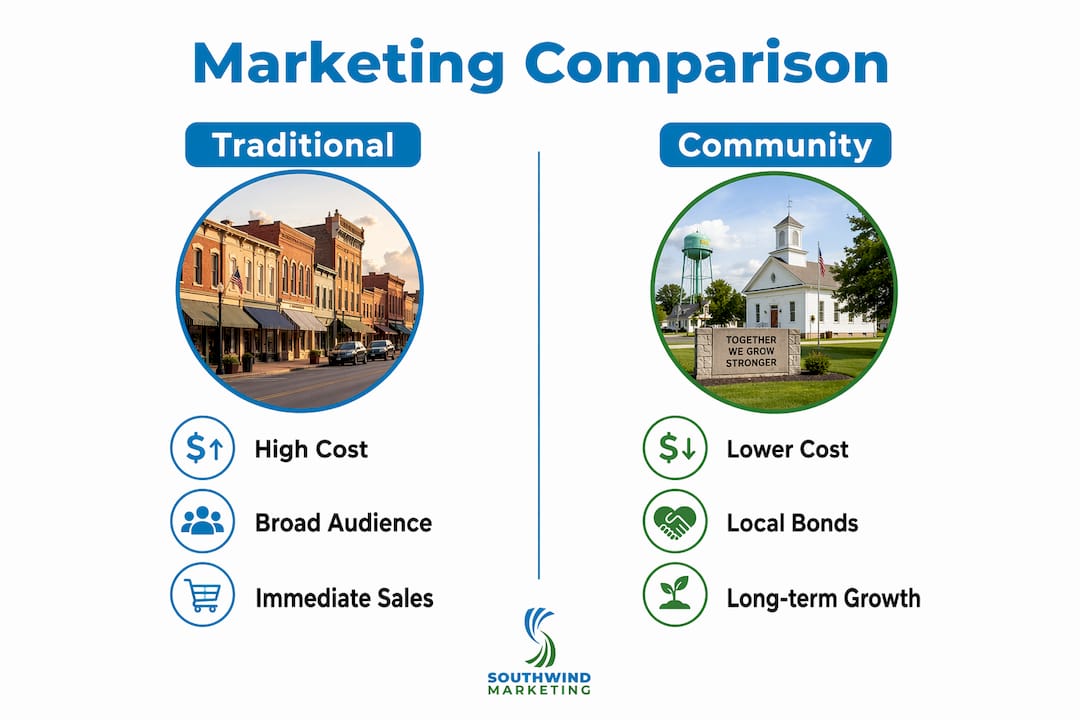
The table below compares a traditional advertising approach with a community-based approach across key dimensions.
| Dimension | Traditional advertising | Community-based marketing |
|---|---|---|
| Primary channel | Paid media (print, digital ads) | Local events, partnerships, word-of-mouth |
| Cost structure | Per impression or click | Low-cost or shared with partners |
| Trust level | Low (unfamiliar source) | High (peer recommendation) |
| Speed to results | Fast but short-lived | Slower but compounding |
| Best fit | Broad awareness campaigns | Small towns, rural markets, repeat customers |
A few additional principles to keep in mind as you build your approach:
- Start specific. A community too broad hinders trust formation. A shared identity or specific local issue speeds it up.
- Show up consistently. One event per quarter beats twelve events in one month followed by silence.
- Use social proof strategies to amplify what happens in person. Photos, reviews, and testimonials extend the reach of every community interaction.
- Build online trust alongside your in-person presence. Your website and Google profile should reflect the same community-first identity you project locally.
Key Takeaways
Community-based marketing is the most cost-effective growth strategy available to rural businesses and chambers because it converts local trust into compounding referrals and durable loyalty.
| Point | Details |
|---|---|
| Definition is clear | Community-based marketing builds growth through local relationships, social capital, and word-of-mouth rather than paid reach. |
| Small towns are the ideal setting | Stronger social bonds and repeat interactions make community strategies more effective and more affordable in rural markets. |
| Recurring presence beats one-off events | Monthly or quarterly community offers build familiarity and embed your business into the local calendar. |
| Every event creates content | Capture photos and testimonials at each interaction to build a reusable content library that fuels future marketing. |
| Start narrow, then grow | Define a specific local radius and one or two reciprocal partnerships before expanding your community marketing efforts. |
Why I think most small towns underestimate this strategy
I have worked with chambers, economic development organizations, and rural small businesses long enough to see a consistent pattern. Leaders know their community matters. They just do not always recognize that their community is their marketing strategy.
The most common mistake I see is starting too broad. A chamber tries to reach everyone in the county at once, or a business sponsors five different events without committing deeply to any of them. Neither approach builds the specific shared identity that accelerates trust. You get more traction from owning one recurring event than from showing up occasionally at ten.
The second mistake is treating events as endpoints. You host a great downtown festival, take no photos, collect no testimonials, and post nothing afterward. The event disappears. The content opportunity disappears with it. Every community interaction is a content production opportunity, and most small-town organizations leave that value on the table.
What I find encouraging is that the organizations willing to commit to consistency almost always see results. The digital marketing strategies that work best for rural businesses are the ones that amplify what is already happening in the community, not the ones that try to replace it with digital noise. Community marketing is not a campaign. It is a posture. And in a small town, that posture compounds over years into something no competitor can easily replicate.
— Southwind Marketing
How Southwind Marketing helps chambers and small towns put this into practice
Southwind Marketing works exclusively with rural communities, chambers of commerce, economic development organizations, and small-town businesses across Oklahoma, Kansas, Texas, Iowa, Missouri, and Arkansas. Community-first marketing is not a service line we added. It is the reason we exist.
If your chamber or organization is ready to build a stronger local presence, Southwind Marketing can help you design a website that reflects your community's identity and supports every engagement strategy you run. We also work with economic development organizations to build the digital infrastructure that makes community marketing visible beyond your town's borders. Reach out to Southwind Marketing to talk through what a community-first approach looks like for your specific market.
FAQ
What is the community marketing definition in simple terms?
Community-based marketing is a strategy that builds business growth through local relationships, shared identity, and word-of-mouth rather than paid advertising. It treats the community as both the audience and the primary promotion channel.
What are the main benefits of community-based marketing for small businesses?
The primary benefits are lower promotional costs, higher customer trust, and compounding referrals over time. Research shows that micro-enterprises with limited budgets improve competitiveness by leveraging social capital through community engagement strategies.
How do I start implementing community marketing with a small budget?
Define a specific local radius, identify one or two reciprocal partnerships with trusted local organizations, and commit to one recurring community event or offer. Measure success through referrals and engagement rather than immediate sales.
Why does community-based marketing work better in rural areas than in cities?
Rural areas have stronger social bonds, more frequent repeat interactions, and a shared local identity. Those conditions make word-of-mouth more powerful and community engagement strategies more cost-effective than in larger, more anonymous markets.
How does community marketing differ from social media marketing?
Social media marketing broadcasts messages to a broad audience. Community marketing builds relationships within a specific local group and uses social media as one channel to reinforce those relationships, not as the primary strategy.