
TL;DR:
- Active chamber networking and partnerships build trust, community relationships, and economic resilience in rural towns. Engaged members who attend regularly and participate in alliances see better business growth and local development outcomes. Digital presence and strategic engagement are vital for chambers' long-term success beyond in-person interactions.
Networking chambers are defined as organized membership bodies that serve as the connective tissue between local businesses, civic leaders, and economic development organizations in a community. The role of networking chamber growth goes far beyond monthly mixers. Chambers that function as active economic actors, not passive social clubs, drive measurable outcomes: consumers are 63% more likely to purchase from a business they know is a chamber member. That single statistic reframes what chamber membership actually is. It is a trust signal, a visibility tool, and a business development asset all at once. For rural communities under 50,000 population, where word-of-mouth travels fast and relationships run deep, that trust multiplier is especially powerful.
What is the role of networking in chamber growth?
Chamber networking, known in economic development circles as business retention and expansion (BR&E), is the practice of maintaining active relationships with existing businesses to identify their needs, remove barriers to growth, and connect them to resources before problems become crises. Chambers are uniquely positioned to do this work because they sit at the intersection of the business community and local government.

The intelligence chambers gather through consistent member contact is genuinely hard to replicate. Engaged members access real-time information on hiring trends, contract opportunities, and community development plans that never appear in a press release or public database. A business owner who attends chamber events regularly often knows about a new employer considering a local facility six months before the general public does. That kind of advance knowledge shapes hiring decisions, lease renewals, and capital investments.
Rural entrepreneurship also depends on what researchers call social infrastructure. Cross-sector meetings connecting entrepreneurs with civic leaders build the kind of ecosystem resilience that no grant program or recruitment campaign can manufacture. When the owner of a local feed store sits across the table from the county commissioner and the hospital administrator at a chamber breakfast, relationships form that produce real outcomes. Zoning questions get answered faster. Workforce training programs get designed with actual employer input. Infrastructure priorities reflect what businesses need, not just what planners assume.
Key benefits of active chamber networking in rural BR&E include:
- Market intelligence: Members learn about contracts, expansions, and workforce shifts before they become public knowledge.
- Referral networks: Consistent attendance builds the familiarity that drives cross-member referrals over time.
- Civic access: Chamber relationships open doors to city councils, county commissions, and development authorities that individual businesses rarely access alone.
- Peer problem-solving: Members facing shared challenges, such as workforce shortages or supply chain disruptions, find solutions faster through peer networks than through solo research.
Pro Tip: Attend chamber events with a listening goal, not a sales goal. Ask two people what their biggest business challenge is this quarter. You will learn more in 90 minutes than you will from any market report.
How do chamber partnerships accelerate community growth?
Chambers are evolving from passive networking hubs into active constituencies that represent business interests on zoning decisions, development approvals, and workforce policy. This shift changes economic development outcomes in measurable ways, particularly in rural areas where a single employer or anchor business can define the economic trajectory of an entire town.
Chamber partnership building with local organizations, including city councils, downtown development authorities, economic development organizations, and nonprofits, creates a multiplier effect that no single entity can produce alone. A chamber that co-sponsors a workforce training program with the local community college and the county EDO delivers more value to members than one that operates in isolation. Shared resources reduce costs. Shared audiences expand reach. Shared credibility increases community trust.
The table below compares two common partnership models rural chambers use when working with local organizations:
| Partnership model | Structure | Best use case |
|---|---|---|
| Co-programming | Chamber and partner co-host events or training | Workforce development, business education |
| Resource sharing | Chamber and partner pool staff, data, or funding | Small-town EDOs with limited budgets |
Building social infrastructure rather than chasing external recruitment produces more resilient rural entrepreneurship ecosystems. A chamber that connects its members to each other and to civic decision-makers creates a foundation that survives economic downturns. External recruitment, by contrast, depends on conditions the community cannot control.
Pro Tip: Map your chamber's existing relationships with local government and nonprofits. If you cannot name three active partnerships, that gap is your next growth opportunity.
Best practices for maximizing chamber networking in small towns
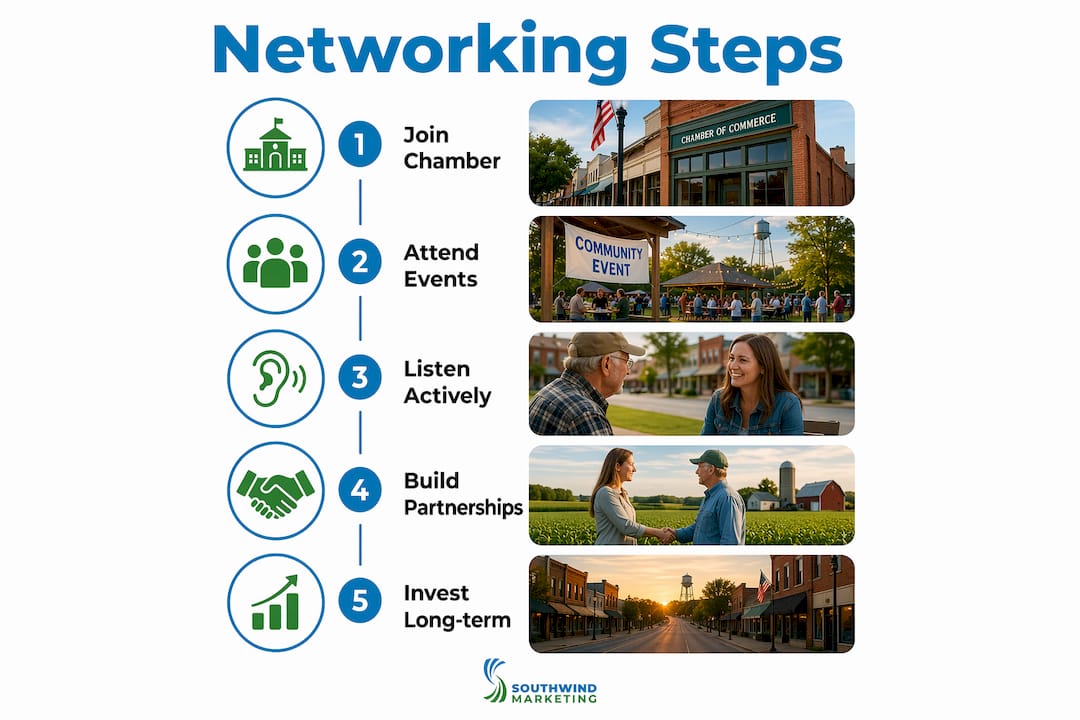
The most common mistake chamber members make is treating membership as a passive credential. Chamber ROI activates only when members proactively engage through volunteering, consistent event attendance, and using chamber platforms to increase visibility. Passive membership yields minimal results. Active participation builds the kind of trust that produces referrals, contracts, and long-term relationships.
Here is a practical framework for getting real value from chamber involvement:
- Attend at least two events per month for the first six months. New members who attend 2+ events monthly establish a recognizable presence that generates referrals. Sporadic attendance produces weak connections. Consistent presence compounds over time.
- Volunteer for at least one committee. Committee work puts you in the room where decisions get made. It also signals to other members that you are invested in the community, not just your own business.
- Lead with relationships, not sales. Networking succeeds as relationship-building, not direct sales. Successful members help others first. Trust precedes transactions in small-town business culture.
- Follow up within 48 hours. Send a short, personal message to every new contact after an event. Reference something specific from your conversation. Generic follow-ups get ignored; specific ones get remembered.
- Maintain a digital presence that matches your in-person reputation. Members who meet you at an event will check your website and social media profiles before they refer you. A modern chamber website and active social presence extend your credibility past the event itself.
Pro Tip: Treat your chamber membership like a long-term investment, not a short-term marketing spend. The members who see the strongest returns are the ones still showing up two years later.
What are the biggest pitfalls in chamber networking growth?
Passive membership is the single largest waste of chamber investment. Businesses that treat membership strategically see sustained growth; businesses that pay dues and attend one event a year see almost nothing. The gap between those two outcomes is entirely behavioral, not structural.
Common pitfalls that undermine chamber networking results:
- Dropping membership during economic downturns. This is exactly the wrong time to disengage. Chambers provide market intelligence and referral networks that are most valuable when business conditions are uncertain.
- Spreading across too many chambers too fast. New members who join three chambers simultaneously rarely build deep relationships in any of them. Start with your local chamber. Build real connections there before expanding.
- Treating every event as a sales opportunity. Members who pitch at every interaction get avoided. Members who listen and refer get sought out.
- Ignoring digital engagement tools the chamber provides. Many chambers offer member directories, email newsletters, and social media features that most members never use. These tools extend your visibility between events.
- Measuring ROI too early. Consistency over months or years differentiates real ROI from surface-level results. Sporadic attendance produces weak connections. Regular presence builds deeper trust that compounds.
The trust gap is real and worth understanding. 81% of adults trust local chambers, but only 40% know which businesses are members. That gap represents a visibility problem, not a trust problem. Members who actively publicize their chamber affiliation capture the trust that already exists in the community.
Key Takeaways
Active, consistent chamber participation is the single most reliable driver of business retention, referral growth, and local economic development in rural communities.
| Point | Details |
|---|---|
| Membership is a trust signal | Consumers are 63% more likely to buy from a known chamber member, making affiliation a visibility asset. |
| BR&E depends on relationships | Business retention and expansion outcomes improve when chambers maintain consistent contact with existing members. |
| Partnerships multiply impact | Cross-sector collaboration with EDOs, city councils, and nonprofits produces outcomes no single organization achieves alone. |
| Active participation drives ROI | Passive members see minimal returns; attending 2+ events monthly and volunteering compounds results over time. |
| Digital presence extends reach | A modern website and active social media profile reinforce in-person credibility and capture referrals between events. |
What I have learned about rural chambers that most guides miss
Rural chambers operate in a fundamentally different environment than their urban counterparts. The relationships are tighter, the stakes are higher, and the margin for error is smaller. A single business closure in a town of 8,000 people is not a footnote. It is a visible wound in the community fabric.
What I have seen work consistently in rural communities is this: chambers that function as genuine connectors between civic and business leadership, not just event organizers, produce better economic outcomes. The importance of cross-sector networking is not theoretical in a small town. It is the difference between a workforce training program that actually gets funded and one that dies in committee.
The other thing most guides miss is the digital gap. Rural chambers often have strong in-person cultures and weak online presences. That combination means they are invisible to the next generation of business owners, remote workers considering relocation, and site selectors doing preliminary research. A chamber that invests in relationship marketing strategies online, not just in person, captures audiences that never walk through the door.
My honest advice to rural chamber leaders: stop measuring success by event headcount. Start measuring it by the number of member-to-member referrals generated each quarter, the number of active partnerships with local government and nonprofits, and the quality of your digital presence. Those three metrics tell you whether your chamber is building real economic infrastructure or just filling a calendar.
— Southwind Marketing
How Southwind Marketing supports rural chambers online
Rural chambers do the hard work of building relationships in person. Southwind Marketing helps extend that work online, where the next generation of members, businesses, and community investors are already looking.
Southwind Marketing works specifically with chambers of commerce, economic development organizations, and rural small businesses across Oklahoma, Kansas, Texas, Iowa, Missouri, and Arkansas. The agency's chamber website design services are built for communities that need a professional, functional online presence without a big-city price tag. From member directories to event calendars to SEO that ranks in local searches, Southwind Marketing builds the digital infrastructure that makes chamber networking visible beyond the meeting room. If your chamber's website does not reflect the strength of your in-person community, that gap is costing you members and credibility. Southwind Marketing can close it.
FAQ
What is the role of networking in chamber growth?
Networking is the primary mechanism through which chambers drive business retention, referrals, and local economic development. Active member engagement, not passive dues payment, produces measurable growth outcomes.
How often should chamber members attend events?
New members should attend at least two events per month for the first six months to build a recognizable presence and generate referrals. Consistent attendance compounds in value over time.
What is business retention and expansion (BR&E) in a chamber context?
BR&E is the practice of maintaining active relationships with existing businesses to identify needs and connect them to resources before problems escalate. Chambers are the most effective local vehicle for BR&E because of their direct member access.
How do chamber partnerships benefit rural communities?
Cross-sector partnerships between chambers, EDOs, city councils, and nonprofits pool resources and expand reach in ways no single organization can match. These partnerships are especially valuable in small towns where budgets and staff are limited.
Why does passive chamber membership fail?
Passive members miss the market intelligence, referral networks, and civic access that active participation provides. ROI from chamber membership is behavioral, not automatic, and requires consistent, intentional engagement to materialize.