
TL;DR:
- Effective Main Street websites serve community needs through features like event calendars, business directories, and preservation storytelling. They must be user-friendly, mobile-optimized, and structured to address both residents and investors separately. Ongoing management, not just design, determines a site's success and ability to engage the community long-term.
Main Street program website design is the practice of building tailored digital platforms that promote community events, support local businesses, and tell the story of historic preservation in ways that engage residents, visitors, and investors. Most generic web agencies treat a Main Street site like any other small business site. That approach fails. Your organization carries a civic mission, a preservation mandate, and a responsibility to multiple audiences at once. The right website reflects all three. Southwind Marketing has built this kind of site for the Yukon 66 Main Street Association, and the lessons from that work apply directly to your program.
What does effective main street program website design include?
A well-built Main Street website is not a digital brochure. It is a working platform that serves your community every day. The industry term for this approach is community-centric web design, and it differs from standard small business web design in both structure and purpose.
The core functional components every Main Street site needs:
- Event calendar. Your calendar must be easy for staff to update and easy for visitors to scan. A calendar that requires a developer to change is a calendar that goes stale. Look for systems with a simple back-end editor and clear date filtering on the front end.
- Searchable business directory. Local business profiles with categories, hours, photos, and links give residents a reason to return to your site. They also give visitors a reason to stay downtown longer. Membership sign-up forms tied directly to the directory make it easy for new businesses to join.
- Historic preservation storytelling. A photo gallery, timeline, or walking tour page builds community identity and supports heritage tourism. This content is often the most shared content on Main Street sites.
- Volunteer and membership sign-up. Easy-to-use forms with clear next steps encourage deeper involvement from residents. Complicated sign-up processes are the single biggest barrier to volunteer growth.
- Grant and funding transparency. A dedicated page showing funding sources, annual reports, and grant outcomes builds public trust. Boards that publish this information consistently report stronger community support.
- Mobile-friendly, accessible design. Your audience includes older residents, small business owners checking their phones between customers, and tourists walking your district. Every page must load fast and read clearly on a phone screen.
Pro Tip: Limit each page to one primary call to action. Pages with a single focused CTA improve lead volume by 15–40% compared to pages that ask visitors to do multiple things at once.
How do you design for residents, businesses, and investors at the same time?
Main Street websites must serve two very different user groups. Dual audiences require two distinct content tracks: functional information for locals and compelling narratives for outside investors and site selectors. Trying to serve both with the same page structure usually means serving neither well.
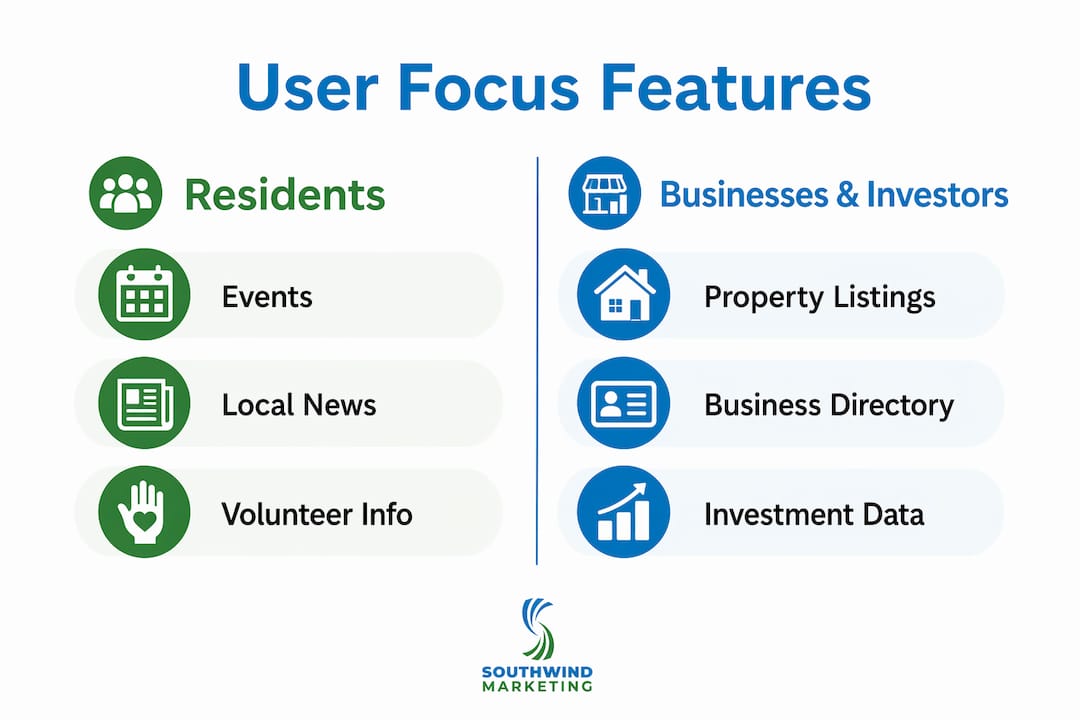
The solution is audience segmentation through navigation and landing pages. Your homepage should direct residents toward events, the business directory, and volunteer opportunities. A separate section, clearly labeled for economic development or business recruitment, should speak directly to investors and site selectors with data, demographics, and available properties.
| Audience | Primary Need | Website Feature |
|---|---|---|
| Residents | Events, local news, volunteer info | Event calendar, news feed, sign-up forms |
| Local businesses | Directory listing, promotion, resources | Business directory, member portal |
| Visitors and tourists | Things to do, dining, history | Event calendar, map, historic storytelling |
| Investors and site selectors | Demographics, available properties, incentives | Data pages, downloadable fact sheets, property filters |
Site selectors use property database filters like square footage and zoning to assess opportunities quickly. If your site does not have that data organized and filterable, you are invisible to that audience. Downloadable fact sheets and interactive maps serve the same purpose for economic development visitors who want to assess your community before making contact.
Building trust across all four audiences requires the same foundation: real photos, honest information, and content that is clearly maintained. A site that looks like it was last updated in 2021 signals to every audience that your organization is not active.
What are the best practices for user experience on Main Street websites?
User experience on a community program website comes down to three things: speed, clarity, and trust. Get those right, and everything else follows.
Mobile loading times under three seconds sharply reduce bounce rates for community and local service sites. That means your images must be compressed, your hosting must be reliable, and your theme must be built for performance. A slow site loses visitors before they read a single word.
Clarity means one idea per page section and one action per page. Decision fatigue is real. When a visitor lands on your homepage and sees five different buttons asking them to do five different things, they do none of them. Pick the one action that matters most for each page and design around it.
Trust comes from real community photos and genuine content. Stock photography of generic downtown streets does not build confidence. A photo of your actual Main Street during last year's holiday event does. Transparent information about your board, your funding, and your mission signals that your organization is credible and accountable.
SEO is not optional. Your website needs SEO-focused content to rank for searches like "things to do in [your town]" or "downtown [your city] businesses." That means page titles, descriptions, and body content written around the terms your audiences actually search.
Interactive elements like community surveys, event sign-ups, and forums transform a static site into a living platform. They give visitors a reason to return and give your organization ongoing data about what your community cares about. Southwind Marketing's Civic Intelligence℠ survey program integrates directly with this kind of engagement model.
Pro Tip: Keep your navigation to five items or fewer at the top level. Every additional menu item reduces the chance a visitor clicks any of them. Use user engagement principles to guide your structure, not your internal org chart.
How Southwind Marketing built the Yukon 66 Main Street Association website
The Yukon 66 Main Street Association serves Yukon, Oklahoma, a community with a strong Route 66 heritage and an active downtown revitalization program. The organization needed a site that could serve local residents, promote downtown businesses, and tell the story of Yukon's historic main corridor without requiring a full-time webmaster to keep it current.
Southwind Marketing built the Yukon 66 Main Street site around the organization's actual workflow and mission. The key features implemented:
- A self-managed event calendar that staff can update without developer support
- A business directory with individual profiles, categories, and direct links to member businesses
- Historic storytelling content connecting Yukon's Route 66 identity to its present-day downtown
- A volunteer and membership sign-up process integrated directly into the site
- Grant and program information presented clearly for public transparency
The design balanced the civic mission of the Main Street program with the practical promotion needs of small businesses. That balance is harder than it sounds. A site that reads like a government report loses visitors. A site that reads like a retail ad loses credibility with funders and community leaders. The Yukon 66 site holds both tones at once because the content strategy was built around the organization's dual role, not around a generic web template.
The most common challenge in projects like this is content ownership. Organizations often launch a site and then struggle to keep it current because no one on staff has clear responsibility for updates. Southwind addressed this by building a simple content management system and training the Yukon 66 team to use it independently.
Key Takeaways
A Main Street program website succeeds when it serves residents, businesses, and investors through purpose-built features, fast mobile performance, and content that is actively maintained.
| Point | Details |
|---|---|
| Community-centric design | Build around your civic mission, not a generic small business template. |
| Dual audience structure | Separate content tracks for locals and investors prevent both groups from being underserved. |
| Single CTA per page | Focused calls to action improve conversions by 15–40% compared to multi-option pages. |
| Mobile speed matters | Pages loading under three seconds retain more visitors and reduce bounce rates. |
| Real photos build trust | Authentic local imagery outperforms stock photography for community credibility. |
Why most Main Street sites underperform (and what to do about it)
I have reviewed a lot of Main Street and downtown development websites over the years. The pattern is almost always the same. The site was built by a well-meaning volunteer or a generalist agency, launched with good intentions, and then quietly abandoned as staff turnover and budget pressures took over. Two years later, the event calendar shows events from 2023, the business directory has three listings, and the homepage still says "coming soon" in one section.
The problem is not budget. I have seen organizations with very modest resources build sites that genuinely serve their communities. The problem is treating the website as a project with a finish line instead of a platform with an ongoing responsibility. Your website is the first place a prospective business owner, a grant funder, or a new resident goes to understand your organization. What they find there either builds confidence or destroys it.
The fix is not a redesign every three years. The fix is building a site that your team can actually manage, with a content calendar, a clear owner for each section, and a design that does not require a developer to update. That is exactly what Southwind Marketing builds for Main Street programs across rural America. The technology is secondary. The strategy and the ownership model are what determine whether a site stays alive.
If your board is debating a website project, start by asking one question: who on our team will own this after launch? Answer that question first, then design the site around the answer.
— Damien Denmark
Working with Southwind Marketing on your Main Street website
Southwind Marketing builds websites specifically for the organizations that serve rural communities, including Main Street programs, downtown development authorities, chambers of commerce, and economic development organizations. The work with Yukon 66 Main Street Association is one example of how Southwind balances civic mission with practical small business promotion in a single, manageable site.
Southwind's website design services for Main Street programs include event calendars, business directories, historic storytelling, membership integration, and SEO-ready content structure. Every project is built for the staff who will manage it, not just for the launch day. If your board is ready to build or rebuild your program's digital presence, Southwind Marketing is the right partner. Contact the team to talk through your organization's specific needs and goals.
FAQ
What should a Main Street program website include?
A Main Street program website needs an event calendar, searchable business directory, historic preservation content, volunteer and membership sign-up forms, and grant transparency pages. Mobile-friendly design and SEO-ready content are also required for the site to reach all audiences effectively.
How do you design a website for both residents and investors?
Use separate content tracks within the same site. Residents need event listings, local news, and volunteer opportunities. Investors and site selectors need demographic data, available property information, and downloadable fact sheets organized for quick review.
Why does mobile performance matter for community program websites?
Mobile loading times under three seconds sharply reduce bounce rates for local and community sites. Most residents and visitors access these sites on phones, so slow performance directly reduces the number of people who engage with your content.
How often should a Main Street website be updated?
Event calendars and business directories need updates at least monthly. News and program content should be refreshed quarterly at minimum. Assigning a specific staff member or volunteer to own each content section is the most reliable way to keep a site current.
Can a small Main Street organization afford a quality website?
Yes. The key is building a site around your team's actual capacity to manage it. A simpler site that is actively maintained outperforms a complex site that goes stale. Southwind Marketing designs for downtown organizations with limited budgets by prioritizing the features that deliver the most community value.