TL;DR:
- ETC Institute offers nationally benchmarked resident satisfaction surveys suited for mid-size and large municipalities, using standardized tools with high statistical rigor. Southwind Marketing's Civic Intelligence℠ provides an affordable, integrated approach for small and rural communities, linking survey results directly to communication and engagement strategies. The choice depends on community size, budget, and whether the focus is on benchmarking or strategic communication integration.
ETC Institute is defined as the nation's leading market research firm specializing in community satisfaction surveys for local governments, delivering statistically valid benchmarks used by cities and counties across the United States. City and county leaders evaluating resident satisfaction survey providers face a clear choice: a large national firm with standardized instruments and deep benchmarking data, or a more accessible, locally focused program built for smaller budgets and integrated community strategies. Southwind Marketing's Civic Intelligence℠ program offers that second path, combining the Importance-Satisfaction methodology with direct team access and results tied into broader marketing and engagement plans.
What is ETC Institute and how does its survey methodology work?
ETC Institute is a national market research firm that administers the DirectionFinder® survey, its standardized instrument for measuring resident satisfaction across city and county services. The firm uses randomized, district-balanced sampling to produce results at a 95% confidence level. That statistical rigor makes the data defensible in budget hearings, council presentations, and public dashboards.
The scale of ETC's benchmarking is one of its strongest assets. Annual national surveys sample approximately 10,000 residents, giving local governments a reliable comparison point against peer communities nationwide. A city can see not just how its residents feel, but how those results stack up against similar communities across the country.
Recent deployments show the methodology in action. Tacoma's 2026 community survey, administered by ETC Institute, surveyed 902 residents using randomized sampling and achieved a 95% confidence level with a ±3.26% margin of error. That precision means Tacoma's leaders can track service performance year over year with confidence that changes in scores reflect real shifts in resident opinion, not statistical noise.
Austin's biennial survey with ETC Institute goes even further. The city samples 2,080 residents and publishes trend data going back to 2015, creating a decade-long performance record. That longitudinal depth is rare and genuinely useful for strategic planning.
Pro Tip: Ask any survey provider for their margin of error and confidence level before signing a contract. A margin of error above ±5% makes year-over-year trend comparisons unreliable.
What makes Southwind Marketing's Civic Intelligence℠ program a fit for smaller municipalities?
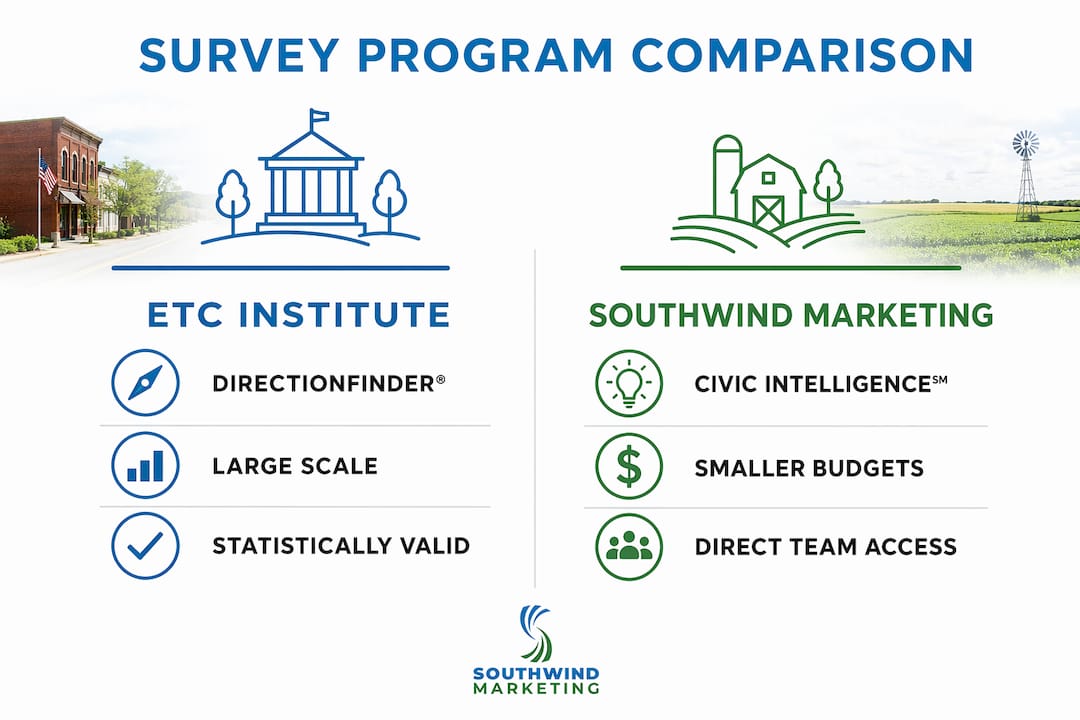
Southwind Marketing built its Civic Intelligence℠ program specifically for small and mid-size municipalities that need credible resident data without the price tag or turnaround time of a national firm. The program uses the Importance-Satisfaction methodology, the same analytical framework ETC Institute applies, but pairs it with the Community Priority Index℠ to identify which service gaps matter most to residents right now.

The practical difference for a rural city or county is direct team access. Southwind Marketing's city government program connects leaders with the same team that handles their marketing, communications, and community engagement. Survey results feed directly into messaging, outreach campaigns, and service communication rather than sitting in a standalone PDF report.
Pricing is scaled to smaller budgets. That matters in rural America, where a county administrator may be managing a $2 million general fund and cannot justify the cost structure designed for a metro government. Southwind's approach treats the survey as one component of a broader community strategy, not a one-time deliverable.
Key features of the Civic Intelligence℠ program include:
- Importance-Satisfaction analysis that ranks services by resident priority, not just satisfaction score
- Community Priority Index℠ that flags where gaps between importance and satisfaction are widest
- Integration with marketing plans so survey findings drive communication and outreach decisions
- Direct team contact with the people managing your community's broader digital strategy
- Pricing scaled to smaller budgets without sacrificing methodological credibility
Pro Tip: The most useful survey data is the kind your team will actually act on. If results live in a report no one reads, the investment is wasted. Tie survey findings to a specific communication or service improvement plan before you launch.
How do ETC Institute and Southwind Marketing compare for municipal leaders?
City and county leaders evaluating these two providers are really asking one question: what does my community need from this data, and what can we afford to do with it? The answer depends on size, budget, and how the survey fits into your broader governance and communication strategy.
| Criteria | ETC Institute | Southwind Marketing Civic Intelligence℠ |
|---|---|---|
| Survey instrument | DirectionFinder® standardized tool | Importance-Satisfaction with Community Priority Index℠ |
| National benchmarking | Yes, ~10,000-resident national sample | Not a national benchmark database |
| Confidence level | 95% with documented margin of error | Methodology-matched to community size |
| Typical client size | Mid-size to large municipalities | Small to mid-size cities and counties |
| Pricing model | Scaled to larger government budgets | Scaled to smaller and rural budgets |
| Turnaround flexibility | Standardized process and timeline | Flexible, integrated with ongoing strategy |
| Team access | Dedicated project manager | Direct access to full marketing team |
| Report integration | Standalone survey report | Integrated into marketing and engagement plans |
| Longitudinal tracking | Strong, multi-year trend data | Available with repeat survey programs |
ETC Institute's advantage is scale and credibility. Johnson County's 2026 survey reported 94% overall resident satisfaction, exceeding national benchmarks by up to 45%, using a randomized sample of 1,256 respondents. That kind of benchmark comparison carries weight with elected officials and the public.
Southwind Marketing's advantage is integration. Small and mid-size communities often need survey data connected to their communications, not separated from them. When a survey reveals that residents rank road maintenance as a top priority but feel underinformed about current projects, Southwind can pivot immediately to a targeted digital outreach campaign addressing that gap.
How have municipalities used these programs to improve community outcomes?
The practical value of any resident satisfaction survey is what happens after the data comes in. Both ETC Institute and Southwind Marketing's Civic Intelligence℠ program produce results that drive real decisions, but the path from data to action looks different depending on which provider you use.
ETC Institute's results have driven measurable improvements in cities of all sizes. Tacoma reported improved satisfaction in 68 of 80 city service areas in 2026, using longitudinal data to track progress year over year. Johnston, Iowa has used ETC surveys since 2013. Its seventh consecutive survey in 2026 applied Importance-Satisfaction analysis to guide fiscal decisions across service categories. That kind of multi-year commitment to data collection builds a performance record that elected officials and residents can trust.
Wyandotte County used its 2026 ETC survey to directly inform the upcoming budget process, with two separate survey versions covering city and county services. The results were anonymous and tied to Census-balanced sampling, giving administrators confidence in the data's representativeness.
Southwind Marketing's Civic Intelligence℠ program produces a different kind of outcome. Survey results connect directly to community engagement strategies and digital outreach, so findings translate into communication plans within weeks rather than months. For a rural county with limited staff, that speed and integration matters.
Outcomes municipal leaders have achieved through resident satisfaction programs include:
- Identifying underperforming service areas before they become public complaints
- Prioritizing capital budget requests with resident-backed data
- Demonstrating accountability to residents through published results and follow-up communication
- Aligning department messaging with what residents actually care about
- Building year-over-year performance records that support grant applications and bond measures
Understanding how data dashboards support local decisions is the next step after collecting survey data. The survey is only as valuable as the systems you build around it.
Key Takeaways
ETC Institute delivers nationally benchmarked, statistically valid resident satisfaction data best suited to mid-size and large municipalities, while Southwind Marketing's Civic Intelligence℠ program offers an integrated, budget-scaled alternative built for small cities and rural counties.
| Point | Details |
|---|---|
| ETC Institute's core strength | DirectionFinder® surveys deliver 95% confidence data with national benchmarks from ~10,000-resident samples. |
| Southwind's differentiator | Civic Intelligence℠ ties survey results directly to marketing and community engagement plans. |
| Budget fit matters | ETC Institute pricing suits larger governments; Southwind scales to rural and small-city budgets. |
| Longitudinal tracking | ETC's multi-year data, as seen in Johnston and Austin, builds defensible performance records. |
| Integration over isolation | Survey data produces the most value when connected to communications, not delivered as a standalone report. |
Why the right survey provider depends on what you do with the data
I have worked with rural and small-city leaders long enough to know that the survey report is rarely the problem. The problem is what happens after it lands on someone's desk. Most standalone reports get reviewed once, cited in a council meeting, and filed. That is not a failure of the data. It is a failure of integration.
ETC Institute is genuinely excellent at what it does. The DirectionFinder® methodology is credible, the benchmarking is real, and the confidence levels hold up to scrutiny. For a city of 100,000 or a county with a large administrative staff, ETC's standardized approach makes sense. You get defensible data, national comparisons, and a track record that elected officials respect.
But I have sat across the table from rural city managers and county administrators who needed something different. They needed survey data that told them not just what residents think, but what to say about it and how to say it. They needed results that fed into their next newsletter, their next council presentation, and their next grant application. That is what Southwind Marketing's Civic Intelligence℠ program is built to deliver.
The audience engagement strategies that work in the private sector apply directly here. Residents who see their feedback reflected in real communication and real service changes become more engaged over time. That cycle of feedback and response is what builds community trust, and it requires a survey provider who thinks beyond the report.
My honest advice: if you are leading a small or mid-size community and you want survey data that drives communication and strategy rather than sitting in a folder, look closely at what integration your provider actually offers. The methodology matters. The benchmarks matter. But the follow-through matters most.
— Damien Denmark
Southwind Marketing's Civic Intelligence℠ program for your community
City and county leaders who want resident satisfaction data connected to real communication strategy have a direct path forward with Southwind Marketing.
The Civic Intelligence℠ program combines the Importance-Satisfaction methodology with the Community Priority Index℠ to show you exactly where resident expectations and service delivery diverge. Results feed directly into your marketing, outreach, and engagement plans rather than sitting in a standalone document. Southwind Marketing works with small cities, rural counties, and community organizations across Oklahoma, Kansas, Texas, Iowa, Missouri, and Arkansas. Pricing scales to smaller budgets without cutting corners on methodology. If you are ready to connect resident data to a community-focused marketing strategy, Southwind Marketing is built for that work.
FAQ
What is ETC Institute?
ETC Institute is a national market research firm that administers the DirectionFinder® resident satisfaction survey for local governments. It delivers statistically valid benchmarking data at a 95% confidence level, used by cities and counties across the United States.
How does ETC Institute's DirectionFinder® survey work?
DirectionFinder® uses randomized, district-balanced sampling to survey residents by mail, phone, and online. Results are benchmarked against a national sample of approximately 10,000 residents, allowing communities to compare their performance against peer governments.
What is Southwind Marketing's Civic Intelligence℠ program?
Civic Intelligence℠ is Southwind Marketing's resident and stakeholder survey program built on the Importance-Satisfaction methodology and Community Priority Index℠. It is designed for small and mid-size municipalities and integrates survey results directly into marketing and community engagement strategies.
Which provider is better for a small rural county?
Southwind Marketing's Civic Intelligence℠ program is built specifically for smaller budgets and rural communities, offering direct team access and integration with broader communication plans. ETC Institute is better suited to mid-size and large municipalities that need national benchmarking and standardized longitudinal data.
Can resident satisfaction survey data be used for budget planning?
Yes. Wyandotte County used its 2026 ETC Institute survey results directly to inform its upcoming budget process. Southwind Marketing's Community Priority Index℠ serves the same purpose by ranking service gaps according to resident-stated priorities.