

TL;DR:
- CivicPlus offers a large-scale government technology platform mainly suited for mid-sized and large municipalities. Small towns often find its high costs, complex implementation, and module inconsistency burdensome. Custom solutions from agencies like Southwind Marketing better serve rural communities with limited staff and budgets.
CivicPlus is defined as a comprehensive government technology platform serving over 4,000 communities across North America with an integrated suite of digital tools including website CMS, agenda management, citizen request management, and mass notifications. Based in Manhattan, Kansas, the platform has earned a spot on the GovTech 100 list for 11 consecutive years as of 2026 and is used by over 13,000 organizations globally. That scale tells you something important: CivicPlus was built for volume, not for the small town with a two-person city hall staff and a tight annual budget. If you lead a small municipality, an economic development organization, or a rural community, this guide will help you understand exactly what CivicPlus offers, what it costs, and whether a more flexible alternative might serve your residents better.
What does CivicPlus actually offer local governments?
CivicPlus is a modular platform built from multiple civic tech tools acquired over the years. The core modules include a website content management system, CivicClerk for agenda and meeting management, SeeClickFix for 311 citizen request management, Municode for municipal code codification, and mass notification tools. The single-vendor model reduces procurement complexity, which is a real benefit for larger governments managing multiple contracts. For a mid-size city with a dedicated IT department, that consolidation makes sense.

The SeeClickFix 311 CRM module lets residents submit service requests online and tracks those requests through automated workflows. It supports real-time updates and mobile access for field staff, plus reporting and analytics dashboards. That kind of resident-facing tool can meaningfully improve community engagement when it is implemented well and staff are trained to use it consistently.
The platform's biggest structural weakness is its roll-up design. Because CivicPlus assembled its suite through acquisitions, the modules retain legacy interface quirks that create an uneven user experience. The website CMS may feel current while the agenda management tools feel dated. That inconsistency increases training time and can frustrate staff who expect a unified experience.
Key capabilities at a glance:
- Website CMS with template-based design and content publishing tools
- CivicClerk for agenda creation, meeting management, and public records
- SeeClickFix 311 CRM for resident service requests and field staff coordination
- Municode for online municipal code publication and codification
- Mass notifications via text, email, and voice for emergency and routine alerts
- Resident portals for permit applications, payments, and service tracking
Pro Tip: Before committing to the full CivicPlus suite, list every module your staff will actually use in the first year. Paying for agenda management software your town clerk finds confusing is money that could fund two years of a focused website and engagement tool instead.
How does CivicPlus pricing affect small municipalities?
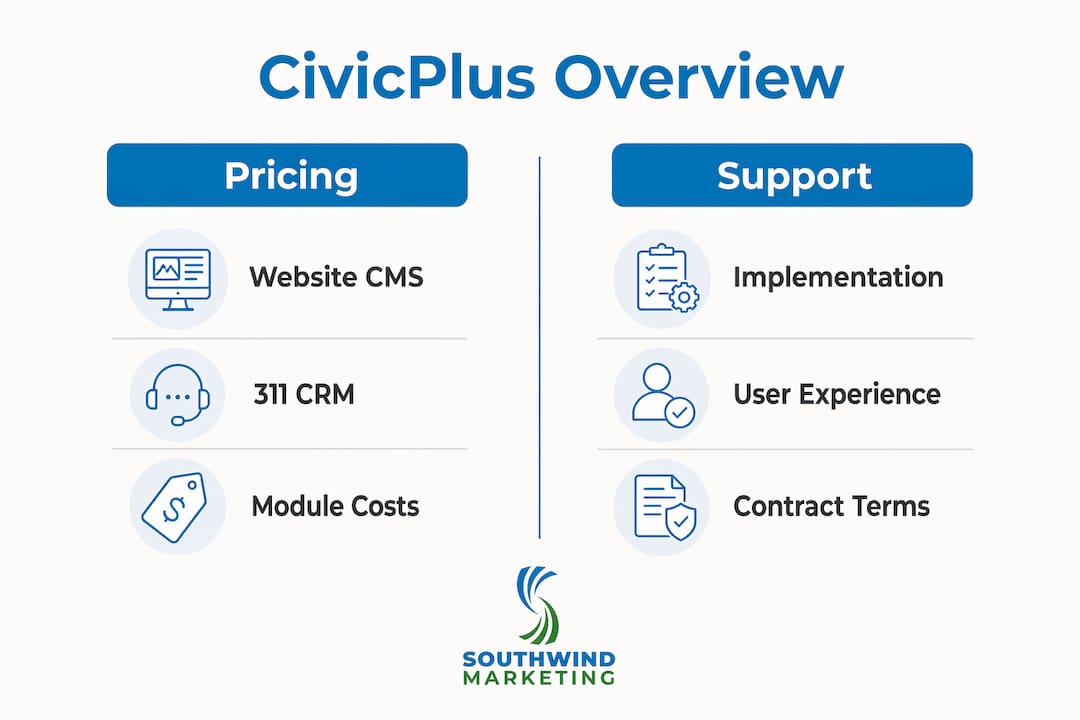
CivicPlus pricing is not publicly listed as a flat rate. It varies by population size, module complexity, and contract bundling. The SeeClickFix 311 CRM module alone ranges from $10,000 to $30,000 per year for small-to-mid-sized tiers and can exceed $50,000 for larger or more advanced configurations. That is a significant line item for a town of 3,000 residents operating on a general fund budget of under $2 million.
The table below shows how costs can stack up when a small municipality bundles multiple modules:
| Module | Estimated Annual Cost (Small Tier) |
|---|---|
| Website CMS | $5,000–$15,000 |
| SeeClickFix 311 CRM | $10,000–$30,000 |
| CivicClerk (agenda management) | $5,000–$12,000 |
| Mass notifications | $3,000–$8,000 |
| Bundled total (estimated) | $23,000–$65,000+ |
Note: These are estimated ranges based on publicly available pricing data. Actual quotes vary by contract terms and population.
CivicPlus is positioned as an enterprise-grade platform best suited for municipalities that prioritize consolidated vendor management over lower-cost alternatives. That positioning is honest. The platform delivers real value at scale. The problem is that smaller towns often end up paying enterprise prices for features they will never fully use.
Multi-year contracts are standard with CivicPlus. That structure locks in costs and can make it difficult to exit if the platform turns out to be more than your staff can manage. Smaller governments should calculate total cost of ownership across a three-year contract, not just the first-year quote.
Pro Tip: Ask any government software vendor for a line-item breakdown of every module in your proposed contract. If they bundle everything into one annual fee, push for the per-module cost. You need to know which tools you are actually paying for.
What implementation and support experience should small towns expect?
Implementation timelines for CivicPlus range from six weeks to six months, depending on the number of modules and the complexity of configuration. That range is wide, and smaller jurisdictions tend to land toward the longer end because they have fewer dedicated staff to manage the process. A town administrator who also handles HR, budgeting, and public records does not have six months of bandwidth to dedicate to a software rollout.
Support follows an enterprise model with ticketing systems and structured response queues. That works well for a city with a full IT department that can document issues clearly and wait for resolution. For a small-town clerk or city manager, it can feel slow and impersonal compared to picking up the phone and talking to someone who knows your project.
Common implementation challenges for small municipalities include:
- Staff capacity gaps that slow configuration and training timelines
- Legacy module interfaces that require extra training investment for non-technical staff
- Ticket-based support that delays resolution of urgent issues during launch
- Data migration complexity when moving from older systems or paper-based processes
- Template constraints in the website CMS that limit customization for unique community branding needs
The uneven user experience across modules compounds these challenges. When staff must learn different interface patterns for each tool, training costs rise and adoption slows. That is a real operational cost that rarely appears in the initial contract discussion.
For local governments researching how to use CivicPlus effectively, the honest answer is that success depends heavily on having dedicated staff and a clear implementation plan before signing. Towns that go in without both tend to underuse the platform and overpay for the privilege.
Why might Southwind Marketing be a better fit for small towns?
Southwind Marketing builds custom websites specifically for rural America, small cities, economic development organizations, and the civic organizations that serve them. The approach is the opposite of an enterprise platform. You get a site built for your community, not a template configured to fit your community. That distinction matters when your town has a unique identity and limited staff to manage a complex CMS.
The City of Ulysses, Kansas, replaced its CivicPlus website with a custom WordPress solution built by Southwind Marketing. The result was a more flexible, easier-to-manage site at a cost that fit a small city budget. That project is a direct example of what the right platform fit looks like in practice.
Here is what Southwind Marketing offers that enterprise platforms typically do not:
- Direct team access with no support ticket queue between you and the people building your site
- Transparent, predictable pricing scaled for small municipality budgets, not enterprise contracts
- Custom design that reflects your community's brand, not a government template
- Faster turnaround on changes, updates, and new features without waiting on a vendor roadmap
- Experience with rural clients including cities, EDOs, chambers of commerce, and Main Street programs across Oklahoma, Kansas, Texas, Iowa, Missouri, and Arkansas
Southwind Marketing also offers community engagement tools beyond the website, including CRM and mass notification systems, data dashboards, and Civic Intelligence℠, a resident and stakeholder survey program built on the Importance-Satisfaction methodology. That means you can build a digital outreach strategy that goes beyond a website and actually measures resident satisfaction over time.
Pro Tip: If your town's primary need is a clean, modern website that residents can actually use, you do not need a $40,000 enterprise platform. A well-built custom site on WordPress with the right integrations will serve most small municipalities better and cost significantly less.
For towns that also want their website to function as an economic development tool, Southwind Marketing's experience with site selectors and employer retention makes that connection explicit in the design and content strategy from day one.
Key Takeaways
CivicPlus is a legitimate enterprise platform, but small municipalities consistently get more value from right-sized solutions that match their budget, staff capacity, and community goals.
| Point | Details |
|---|---|
| CivicPlus serves 13,000+ organizations | The platform is proven at scale but designed primarily for mid-size to large governments. |
| Pricing can exceed $50,000 annually | Small towns should calculate total module costs before signing multi-year contracts. |
| Implementation takes up to six months | Smaller jurisdictions with limited staff often struggle with enterprise onboarding timelines. |
| Module inconsistency increases training costs | Legacy interfaces across acquired tools create an uneven experience that slows staff adoption. |
| Southwind Marketing scales to small budgets | Custom-built sites with direct team access offer a practical alternative for rural municipalities. |
The platform mismatch problem nobody talks about
I have worked with enough small towns to know that the biggest mistake in government technology procurement is not choosing the wrong features. It is choosing the wrong scale. CivicPlus is a well-built platform. It does what it says. The problem is that it was designed for the needs of a city with a dedicated IT staff, a procurement officer, and a budget that can absorb a five-figure annual software line item without much debate.
Most rural towns are not that city. They are a city manager who also answers the phone, a clerk who manages records and runs the council meeting, and a mayor who has a day job. When you hand that team an enterprise platform with six modules, a ticketing-based support system, and a six-month implementation timeline, you are not giving them a tool. You are giving them a second job.
What I have seen work in rural America is the opposite approach. A focused website that is easy to update, a direct line to the people who built it, and a cost that does not require a budget amendment to renew. The CivicPlus vs. WordPress comparison for small cities is not really about features. It is about fit. A platform that your staff will actually use is worth more than a platform with every feature on the market.
The right question is not "Is CivicPlus good?" It is "Is CivicPlus right for a town our size?" For most communities under 10,000 residents, the honest answer is probably not. And that is not a criticism of CivicPlus. It is just math.
— Damien Denmark
Southwind Marketing builds websites that fit your town
Small municipalities deserve websites that work as hard as their staff does. Southwind Marketing designs and builds custom government websites for rural cities, economic development organizations, chambers of commerce, and Main Street programs across rural America.
Every project starts with a direct conversation, not a sales demo. Pricing is transparent and scaled for small budgets. The City of Ulysses, Kansas, made the switch from CivicPlus and got a faster, more flexible site their team can actually manage. If your town is evaluating its website design options, Southwind Marketing is worth a conversation. Reach out to discuss your community's goals and get a straightforward quote built around your actual needs, not an enterprise package.
FAQ
What is CivicPlus used for?
CivicPlus is a government technology platform that provides local governments with website CMS, agenda management, 311 citizen request tools, municipal code publishing, and mass notifications. It serves over 4,000 communities across North America.
How much does CivicPlus cost for a small town?
Pricing varies by module and population size. The SeeClickFix 311 CRM module alone ranges from $10,000 to $30,000 per year for small-to-mid-sized tiers, with full bundled suites potentially exceeding $50,000 annually.
How long does CivicPlus implementation take?
Implementation timelines range from six weeks to six months depending on module count and configuration complexity. Smaller jurisdictions with limited staff typically experience longer onboarding timelines.
What are the best CivicPlus alternatives for small municipalities?
Small towns and rural local governments often find better value in custom-built website solutions from agencies like Southwind Marketing, which offer direct team access, transparent pricing, and designs built specifically for small community needs.
Is CivicPlus right for a town under 5,000 residents?
CivicPlus is best suited for mid-size to larger municipalities that need consolidated vendor management and can absorb enterprise pricing. Towns under 5,000 residents typically benefit more from a focused, right-sized platform that matches their staff capacity and budget.