
TL;DR:
- Social media is now the primary growth tool for small businesses, building brand awareness and driving sales. Effective strategies focus on purposeful content, authentic storytelling, and consistent engagement within local communities. Tracking metrics like engagement and conversions ensures social media efforts support real business outcomes.
Social media is the most cost-effective marketing channel available to small business owners today. The role of social media for small business goes well beyond posting product photos. It is a two-way growth engine that builds brand awareness, drives sales, and replaces expensive traditional market research with real-time customer feedback. 68% of small business owners expect social media posts and paid ads to drive the most value for growth in 2026. That number reflects a clear shift: social media is no longer optional for small businesses. It is the primary arena where customers decide whether to trust you.

What benefits does social media offer small businesses?
Social media marketing delivers five measurable advantages that traditional advertising cannot match at the same price point. Understanding each one helps you decide where to focus your time and budget.
- Brand visibility at low cost. Organic posts on Facebook, Instagram, and TikTok reach local audiences without ad spend. A consistent posting schedule builds name recognition in your community over weeks and months.
- Two-way customer engagement. Social media replaces one-way advertising with real dialogue. 73% of users will buy from a competitor if a brand ignores them on social media within 24 hours. Responding promptly is not a courtesy. It is a retention strategy.
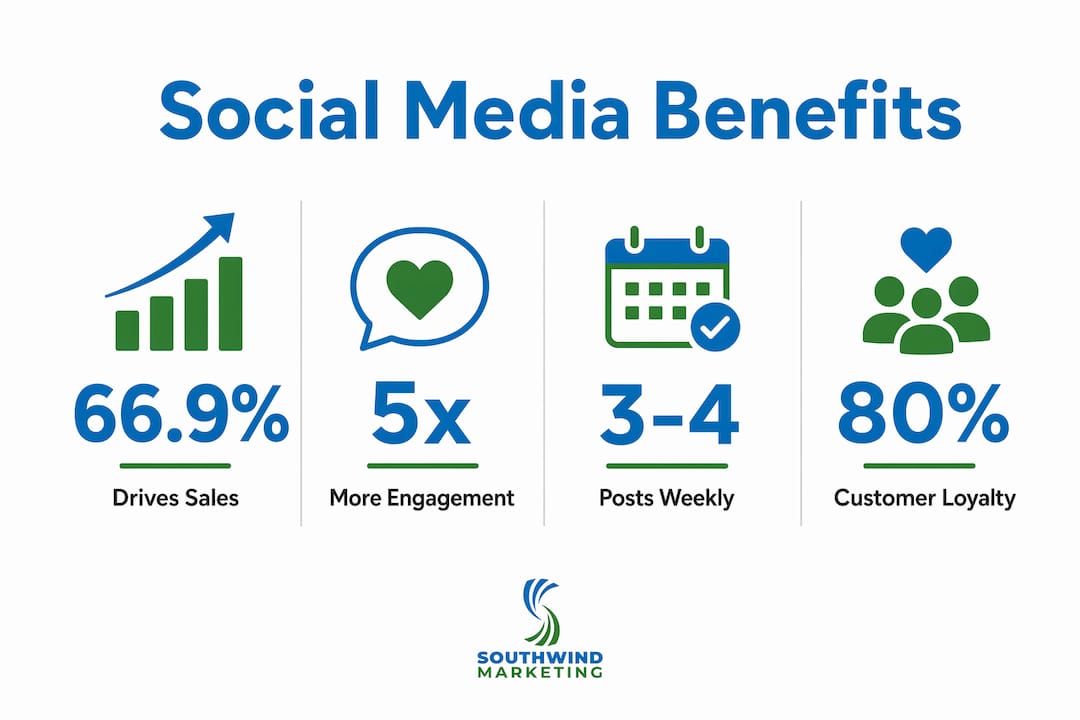
- Direct sales influence. 66.9% of small businesses rate social media as very important or critical for sales, and 38% report year-over-year sales growth tied directly to social efforts. Those numbers confirm that social media is a revenue channel, not just a branding exercise.
- Website traffic generation. Every post, story, or video is an opportunity to send followers to your website, product page, or booking form. Consistent linking builds a steady traffic stream that compounds over time.
- Customer service and loyalty. 70% of small businesses use social media for customer service, and the businesses that do it well see measurable gains in repeat purchases and positive word of mouth.
The impact of social media on business is clearest when you treat it as a service channel, not just a marketing channel. Customers who get fast, helpful responses on social media become loyal advocates. That loyalty is worth far more than any single sale.
How can small businesses create effective social media marketing strategies?
A repeatable social media marketing strategy beats random posting every time. The businesses that grow on social media are not the ones posting the most. They are the ones posting with the clearest purpose.
- Define your goal before you create content. Are you building brand awareness, driving traffic, or generating direct sales? Each goal requires a different content mix and a different platform.
- Know your audience precisely. A rural hardware store in Kansas serves a different customer than a downtown boutique in a mid-size city. Write for the specific person who walks through your door, not a generic demographic.
- Build three to four content pillars. Content pillars are repeating themes that give your feed structure. A local restaurant might use pillars like behind-the-scenes kitchen stories, customer spotlights, daily specials, and community events. Pillars prevent content burnout and keep your brand voice consistent.
- Choose two platforms and master them. Spreading across five platforms with thin content is less effective than owning two platforms with strong, consistent posts. Pick based on where your customers actually spend time.
- Batch your content creation. Sit down once a week and create content for the next seven days. This approach removes the daily pressure that causes most small business owners to quit.
- Respond to every comment and message within 24 hours. This is the single highest-return activity on social media. It signals to both the algorithm and your customers that you are present and engaged.
- Review your analytics monthly. Look at reach, engagement rate, and click-throughs. Drop what is not working and repeat what is.
Pro Tip: Human-generated storytelling outperforms generic promotional content in 2026. Share the story behind your product, introduce your team, or post a customer's experience in their own words. Authentic content builds brand trust online faster than any polished ad.
Platform selection matters more than most small business owners realize. Geo-targeted social media marketing produces the highest return for local businesses because it focuses content and ads on customers within your actual service area. A broad, undefined audience wastes budget and dilutes your message.
What challenges do small businesses face with social media?
The core challenge is not the platform. It is the absence of a defined, repeatable strategy. Most small business owners start strong and fade within 60 days because the daily demand of content creation collides with running an actual business.
- Resource limitations. You are the owner, the manager, and often the content creator. Time is the scarcest resource, and social media competes with every other priority.
- Content burnout. 41% of small businesses struggle with consistent posting schedules. The businesses that solve this problem batch their content and use a simple editorial calendar rather than deciding what to post each morning.
- Measuring ROI. 38% of small businesses find measuring social media return on investment difficult. The fix is connecting your social activity to specific outcomes: website visits, phone calls, form submissions, or in-store visits tracked through a promo code.
- Chasing trends instead of building systems. Viral content is unpredictable. A consistent system that posts three times a week with clear calls to action will outperform a viral moment that generates no follow-through.
Pro Tip: Batch your content creation into a single two-hour session each week. Use an outline or content calendar to plan topics in advance, then write and schedule everything at once. This one habit eliminates the daily decision fatigue that kills most small business social media efforts.
Consistency beats volume on every major social media platform. Algorithms reward accounts that post reliably and generate engagement, not accounts that post daily for two weeks and then go silent for a month.
Which platforms best serve small businesses and local communities?
Platform choice is a business decision, not a personal preference. Each platform serves a different audience and content format, and the right choice depends on your customers, your content style, and your sales goals.
| Platform | Best for | Key advantage |
|---|---|---|
| Local service businesses, community events | Geo-targeting, local groups, event promotion | |
| Retail, food, hospitality, visual products | Shopping features, Reels, visual storytelling | |
| TikTok | Younger audiences, product demos, behind-the-scenes | Organic reach, short video format |
| B2B services, professional services, economic development | 277% higher B2B ROI than other platforms | |
| YouTube | Tutorial-based businesses, long-form education | Search discoverability, evergreen content |
For rural small businesses and local community organizations, Facebook remains the most practical starting point. Its geo-targeting tools let you reach customers within a specific zip code or county, which is exactly what a Main Street retailer or local service provider needs.
Video content is the format that delivers the most return regardless of platform. Small businesses receive 5x more engagement from video than from static posts. Live video performs even better. Live video generates 3x more engagement than prerecorded content, making a simple Facebook Live walkthrough of your shop more effective than a polished graphic post.
User-generated content, meaning photos and reviews posted by your actual customers, builds loyalty faster than brand-created content. Businesses that actively encourage and share user-generated content see a measurable lift in repeat purchases and referrals. For rural small businesses, this community-driven approach aligns naturally with the word-of-mouth culture already present in small towns.
How do you measure social media success for small businesses?
Vanity metrics like follower count tell you very little about business performance. The metrics that matter are the ones tied to real customer behavior.
| Metric | What it measures | Why it matters |
|---|---|---|
| Engagement rate | Likes, comments, shares per post | Shows whether content resonates with your audience |
| Reach | Unique accounts that saw your content | Indicates how far your message is spreading |
| Click-through rate | Clicks to your website or offer | Connects social activity to website traffic |
| Conversion rate | Actions taken after clicking | Ties social media directly to sales or leads |
| Follower growth rate | New followers over a set period | Tracks audience-building momentum |
High engagement on a smaller audience consistently outperforms a large but passive following. A local bakery with 800 engaged followers who comment, share, and visit the shop is more valuable than an account with 8,000 followers who never interact. Effective social media presence combines engagement rate, share of voice, and brand sentiment, not just follower count.
Run a monthly review of your top three performing posts. Identify what they have in common: format, topic, time of day, or call to action. Then replicate those elements in the next month's content. This cycle of test, measure, and repeat is how small businesses build a social media presence that actually grows revenue. For a broader look at how your brand is performing across all channels, a small business brand audit is a practical starting point.
Key Takeaways
Social media is the most cost-effective growth channel for small businesses when it is built on a consistent strategy, authentic storytelling, and clear measurement tied to real business outcomes.
| Point | Details |
|---|---|
| Social media drives sales | 66.9% of small businesses rate social media critical for sales; 38% grew sales year over year. |
| Responsiveness is non-negotiable | 73% of users will switch to a competitor if ignored on social media within 24 hours. |
| Video outperforms static content | Video generates 5x more engagement than static posts; live video triples that advantage. |
| Two platforms beat five | Mastering two platforms with consistent content outperforms spreading thin across many. |
| Measure what drives revenue | Track engagement rate, click-through rate, and conversion rate, not just follower count. |
What I have learned about social media for small-town businesses
Rural small business owners face a version of social media that most marketing guides ignore. The audience is smaller, the community is tighter, and the stakes of a misstep are higher because everyone knows everyone. That context changes the strategy entirely.
The businesses I have seen succeed in small towns are not the ones chasing viral trends or posting daily. They are the ones who show up consistently, respond to every comment like it matters, and tell stories that only they can tell. A post about the third-generation family that owns the hardware store will outperform a generic product promotion every single time in a rural market.
The biggest mistake I see is treating social media as a broadcast channel. Small-town customers do not want to be advertised to. They want to feel connected to the businesses they support. When you run a social media contest or spotlight a loyal customer, you are not just generating engagement. You are reinforcing the community bond that keeps local dollars local.
Burnout is real, and it kills more small business social media efforts than any algorithm change. Build a system you can sustain for two years, not a sprint you can maintain for two weeks. Slow, consistent growth built on authentic community connection will always outperform a viral moment with no follow-through.
— Southwind Marketing
How Southwind Marketing helps small businesses grow online
Small businesses in rural America need a marketing partner who understands their community, not just their industry. Southwind Marketing builds digital marketing strategies and websites specifically for rural small businesses, Main Street programs, chambers of commerce, and economic development organizations across Oklahoma, Kansas, Texas, Iowa, Missouri, and Arkansas.
From website design and community branding to social media strategy and SEO, Southwind Marketing handles the full picture so you can focus on running your business. The team understands what rural communities need to grow, retain customers, and compete in a digital world. If you are ready to build a social media presence that actually drives results, Southwind Marketing is the partner built for where you are.
FAQ
What is the role of social media for small businesses?
Social media serves as a marketing, sales, and customer service channel for small businesses. It builds brand awareness, drives website traffic, and creates direct dialogue with customers at a fraction of traditional advertising costs.
How often should a small business post on social media?
Consistency matters more than frequency. Posting three to four times per week with purposeful content outperforms daily posting with no clear strategy or call to action.
Which social media platform is best for a local small business?
Facebook is the strongest starting point for most local small businesses because of its geo-targeting tools and local community groups. Instagram works well for visual products and retail, while LinkedIn delivers the highest ROI for B2B services.
How do small businesses measure social media ROI?
Track engagement rate, click-through rate, and conversion rate rather than follower count. Connect social activity to specific outcomes like website visits, phone calls, or in-store visits using promo codes or UTM links.
How much should a small business spend on social media?
Small businesses typically allocate 2–5% of monthly revenue to social media, balancing organic content at 60–70% of effort with paid ads making up the remaining 30–40%.