
TL;DR:
- Branding influences customer perception and increases revenue by up to 33 percent.
- Consistent branding builds trust, reduces customer acquisition costs, and drives long-term growth.
Branding is defined as the commercial system that shapes how customers perceive, trust, and choose your business over every alternative. For small business owners, the role of branding goes far beyond a logo or color palette. It determines whether a first-time visitor becomes a repeat customer, whether you can charge a fair price without losing the sale, and whether your marketing dollars produce results or disappear. Consistent branding increases revenue by up to 33% and reduces customer acquisition costs by up to 20%. Those numbers reflect a simple truth: a strong brand makes every other part of your business work better.
How does branding build trust and influence customer perception?
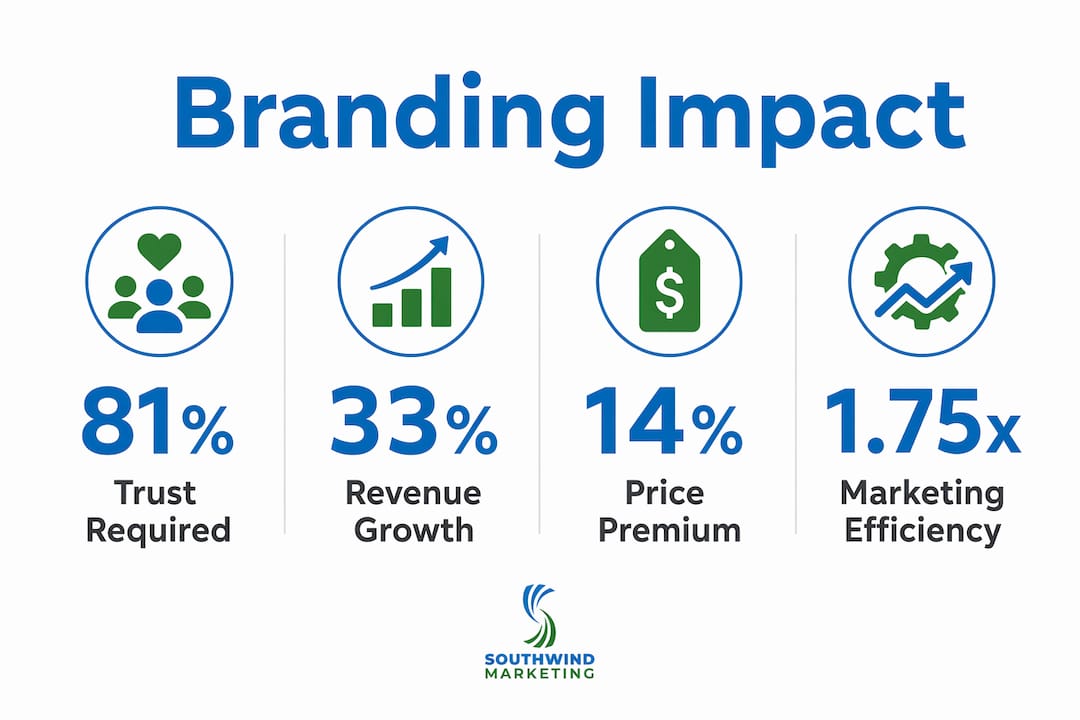
Trust is the engine behind every purchase decision a small business customer makes. 81% of consumers need to trust a brand before they buy. That means your brand is doing sales work before you ever speak to a prospect.

Small businesses hold a natural advantage here. 70% of U.S. adults trust small businesses more than large corporations. That trust is already in the room. Consistent, professional branding converts that goodwill into actual revenue instead of letting it sit idle.
The financial case for trust-based branding is concrete:
- Referred customers spend 16% more and stay 37% longer than customers acquired through paid channels.
- Strong branding reduces customer acquisition cost by up to 20%, meaning you spend less to win each new customer.
- Businesses with recognized local brands generate more word-of-mouth referrals, which cost nothing to produce.
The gap between a business that looks professional and one that looks inconsistent is the gap between a referral and a lost sale. Customers recommend businesses they feel confident about. Your brand is the signal that tells them whether to feel confident.
Pro Tip: Focus your branding on authenticity and consistency rather than trying to look like a national chain. Customers in small towns and rural communities respond to businesses that feel genuinely local and reliably professional.
What components make up effective branding beyond a logo?
Most small businesses mistake their logo for their brand. True brand equity requires 6 to 12 months of consistent execution across every customer touchpoint. A logo is one piece of a much larger system.
A real brand infrastructure has four core components:
- Positioning. This answers three questions: Who do you serve? What do you do for them? Why should they choose you over anyone else? Without clear positioning, your marketing sends mixed signals and attracts the wrong customers.
- Messaging framework. This is the set of words, phrases, and promises you use consistently across your website, social media, signage, and conversations. A messaging framework keeps every communication on the same track.
- Visual identity system. This goes beyond a logo to include fonts, colors, photography style, and layout principles. A complete visual system makes your business instantly recognizable across every channel.
- Brand guidelines. These are the written rules that govern how your brand looks and sounds. Guidelines prevent inconsistency and reduce the time and money spent correcting off-brand materials.
Branding is a commercial system that affects pricing, sales, conversion, repeat business, and even recruitment. That framing matters because it changes how you invest in it. You are not buying a pretty logo. You are building a system that makes your business more efficient and more profitable.
Pro Tip: Align your team's behavior with your brand promise. A logo change alone produces no results. The brand promise is delivered by your people, not your graphics.
How does consistent branding drive measurable growth?
Brand consistency is where the financial returns become undeniable. Inconsistent brands require 1.75 times more marketing spend to achieve the same results as consistent brands. That inefficiency compounds over time and drains budgets that small businesses cannot afford to waste.
Consistent branding is not a design preference. It is a financial decision. Businesses that present a unified identity across every touchpoint spend less to acquire customers, charge more for their products, and retain customers longer than businesses that look different from channel to channel.
The revenue impact is direct. Consistent brands see up to 33% higher revenue growth and can charge price premiums of 14% to 25% over weaker competitors. That premium shifts the sales conversation from price to value, which is exactly where small businesses want to compete.
| Branding factor | Business impact |
|---|---|
| Consistent visual identity | Up to 33% higher revenue growth |
| Strong brand trust | 14%–25% price premium over competitors |
| Inconsistent branding | 1.75x more marketing spend required |
| Referred customers | Spend 16% more, stay 37% longer |
For rural small businesses, brand consistency carries extra weight. Customers in small towns see your signage, your social media, your truck, and your storefront. When those elements tell the same story, trust compounds. When they conflict, doubt creeps in. Consistency is how you turn community familiarity into a commercial asset.
Small business marketing budgets typically allocate 7% to 8% of revenue to marketing, with roughly 40% of that going toward brand awareness. Businesses in high-growth phases may invest up to 15%. A strong brand makes every dollar in that budget work harder because customers already recognize and trust what they see.
What branding strategies work for rural and small-town businesses?
Rural small businesses have a built-in advantage that most national brands cannot buy: authentic community connection. The right branding strategies protect and amplify that advantage rather than dilute it.
- Narrow your audience. Define exactly who your best customer is. A feed store serving cattle ranchers within 30 miles has a different brand than one serving hobby farmers. Clarity in your audience makes every message more effective.
- Use local storytelling. Your history, your family, your town, and your roots are differentiators. Authenticity in branding builds the kind of trust that national chains spend millions trying to manufacture and still cannot replicate.
- Build a complete visual system. Consistent fonts, colors, and photography across your website, social profiles, and printed materials signal professionalism. Customers notice when things match. They also notice when they do not.
- Invest in community engagement. Sponsor local events, participate in Main Street programs, and show up where your customers gather. Community presence reinforces your brand without paid media costs.
- Pair branding with local SEO. A strong brand identity paired with digital marketing for rural businesses means customers find you online and recognize you when they do. Visibility and recognition work together.
Leveraging local rural trust and authenticity is the strongest differentiator small businesses hold over larger competitors. That trust enables referral-driven growth, which is the most cost-effective customer acquisition channel available to any small business.
Pro Tip: Do not try to look like a big corporation. Customers choose local businesses because they want something different from what a national chain offers. Lean into that difference. It is your competitive edge.
Key Takeaways
Branding is the single most cost-efficient investment a small business can make because it reduces acquisition costs, raises prices, and builds the customer loyalty that sustains long-term growth.
| Point | Details |
|---|---|
| Branding builds purchase trust | 81% of consumers must trust a brand before buying, making consistency a sales tool. |
| Consistency cuts marketing waste | Inconsistent brands spend 1.75x more to achieve the same marketing results. |
| Strong brands command higher prices | Consistent brands charge 14%–25% price premiums over weaker competitors. |
| Brand equity takes time | True brand recognition requires 6–12 months of consistent execution across touchpoints. |
| Local trust is a rural advantage | 70% of U.S. adults trust small businesses more than large corporations. |
Why branding is the most underused asset in rural business
I have worked with small businesses across rural Oklahoma, Kansas, and the broader Midwest, and the pattern is consistent. Owners invest in inventory, equipment, and staff. They hesitate on branding because it feels intangible. That hesitation is expensive.
What I have seen firsthand is that brand consistency does not just make a business look better. It makes the owner's life easier. When your messaging is clear and your visuals are consistent, you stop reinventing your marketing every time you need a flyer or a social post. The system does the work.
Rural businesses already have the hardest part of branding figured out: people trust them. The community knows the owner's name, knows the family, and wants to support local. What most of these businesses lack is the professional presentation that converts that trust into a purchase decision, especially when a customer is comparing options online before they ever walk through the door.
The businesses I have watched grow fastest are not the ones with the biggest budgets. They are the ones that got clear on who they are, what they stand for, and how they present that story consistently. A brand audit is often the fastest way to find the gaps and fix them before they cost you more customers.
Branding is not a luxury for small businesses. It is the foundation that makes every other marketing effort produce a return.
— Southwind Marketing
How Southwind Marketing helps small businesses build stronger brands
Southwind Marketing works specifically with rural small businesses, chambers of commerce, and community organizations that need a brand built for where they actually operate, not a generic template designed for a national audience.
Our branding services cover positioning, messaging frameworks, visual identity systems, and brand guidelines built to work across your website, social media, signage, and community presence. We also build the professional websites that give your brand a home online and make sure customers find you when they search. If you are ready to turn your community reputation into a commercial asset, Southwind Marketing is the team that knows rural America and knows how to make branding work there.
FAQ
What is the role of branding for a small business?
Branding defines how customers perceive, trust, and choose your business. It is the commercial system that drives pricing power, customer loyalty, and marketing efficiency.
How does branding affect sales for small businesses?
Strong branding builds the trust that 81% of consumers require before purchasing. It also enables price premiums of 14% to 25% over competitors with weaker brand identities.
How long does it take to build brand recognition?
Building true brand equity requires 6 to 12 months of consistent execution across every customer touchpoint, from your website to your storefront to your social media.
Why does brand consistency matter for small businesses?
Inconsistent brands spend 1.75 times more on marketing to achieve the same results as consistent brands. Consistency reduces waste and makes every marketing dollar more productive.
What branding strategies work best for rural small businesses?
Narrow your audience, use local storytelling, build a complete visual system, and pair your brand identity with local SEO. Authenticity and community engagement are the strongest differentiators rural businesses hold over national competitors.