
TL;DR:
- Building a strong rural business brand identity helps local businesses stand out and compete effectively. It includes visual elements like logos and colors, consistent messaging, and digital profiles that reflect the local community. Focused, low-cost efforts such as optimizing Google profiles and using local imagery can significantly boost recognition and revenue.
Rural business brand identity creation is the process of building a distinct, consistent visual and messaging framework that tells your community who you are and why they should choose you over a chain store 30 miles down the highway. For Main Street businesses and rural small business owners, a strong brand identity is not a luxury. It is the single most effective tool you have for building trust, earning loyalty, and competing on your own terms. Southwind Marketing works with rural businesses across Oklahoma, Kansas, Texas, Iowa, Missouri, and Arkansas to build exactly that kind of identity, without requiring a big-city budget or an in-house marketing team.
What does rural business brand identity creation actually include?
Brand identity is the industry term for the full system of visual and verbal elements that represent your business. Most people think it starts and ends with a logo. It does not. A complete brand identity covers six core components, and each one matters.
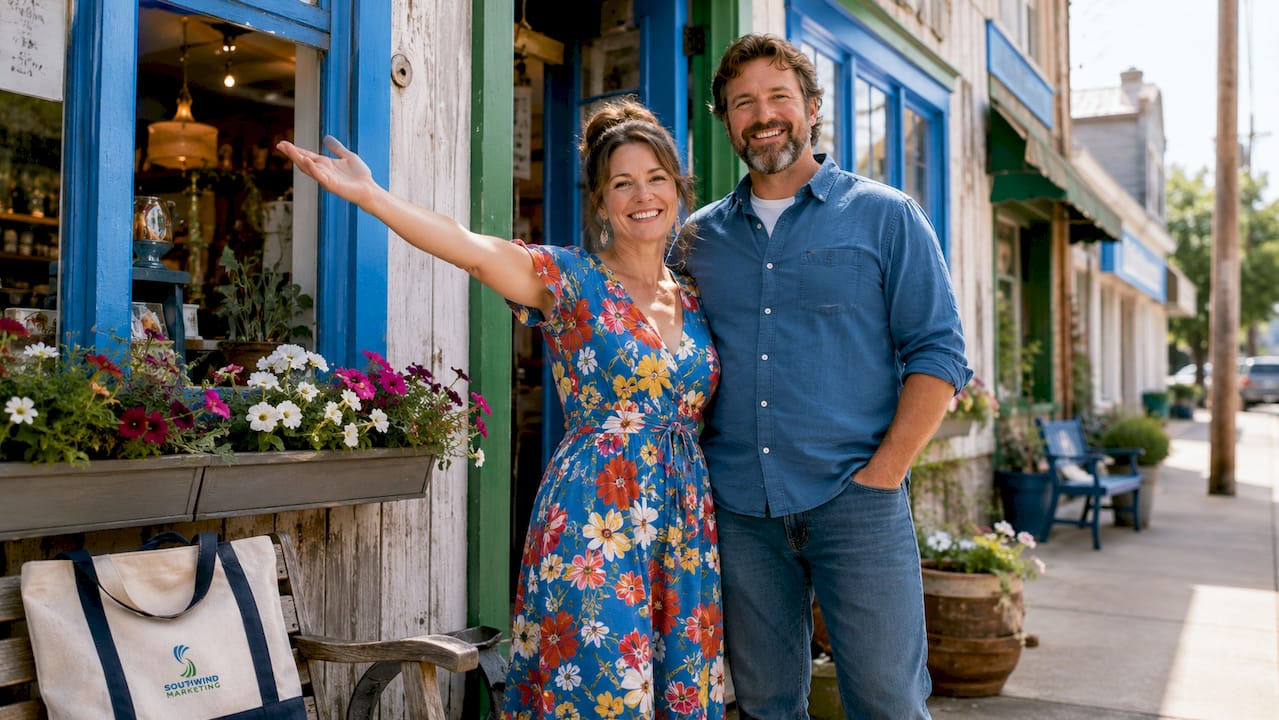
Visual identity is the foundation. This includes your logo, color palette, typography, and imagery. For rural businesses, the most effective visual choices reflect the local landscape, culture, and values. Culturally contextualized visual cues like regional motifs and earthy color palettes boost consumer purchase intention by about 42%. That number reflects a real behavioral shift: people buy from brands that feel familiar and authentic to their world.
Messaging consistency is the verbal side of your brand. It includes your tagline, your value proposition, and the tone of voice you use across every customer touchpoint. A feed store that sounds formal and corporate on its website but casual and folksy on Facebook is sending mixed signals. Customers notice, even if they cannot name what feels off.
Digital brand elements round out the picture. Your Google Business Profile, website, and social media pages are often the first place a potential customer encounters your business. They need to look and sound like the same company.
- Logo and color palette aligned with your community's culture and geography
- Consistent typography across print, signage, and digital materials
- A defined brand voice: the tone and language you use in every customer interaction
- A clear value proposition that explains what makes your business worth choosing
- A complete and accurate Google Business Profile with current photos and hours
- Website design that reflects your visual identity and speaks to a rural audience
Pro Tip: Write your brand voice down in one paragraph. Describe how your business talks to customers: formal or casual, serious or warm, expert or neighborly. Pin it somewhere visible and use it as a filter every time you write a social post, email, or sign.
Why does brand identity matter for rural Main Street businesses?
Rural businesses face a competitive challenge that urban businesses rarely encounter at the same scale. You compete with national chains that have professional design teams, national ad budgets, and brand recognition built over decades. Your advantage is authenticity and community connection. A well-built brand identity turns that advantage into something visible and consistent.
Consistent branding across touchpoints can increase revenue by up to 33% compared to fragmented brand presentations. That gap exists because customers trust what they recognize. When your signage, your website, and your social media all look and sound like the same business, you build credibility faster.
"A carefully executed rural rebrand balancing premium authority and rural messaging led to 30% sales growth within six months. The key was not a bigger budget. It was a clearer, more consistent identity that spoke directly to both local buyers and corporate partners."
Rural branding also carries a unique challenge that urban branding does not. Effective rural branding must address the paradox of scale: your brand needs to look authoritative enough to attract business partners, lenders, and site selectors, while staying approachable enough that your neighbors feel welcome walking through the door. That balance is not accidental. It requires deliberate choices in design and messaging.
| Brand element | Impact on rural businesses |
|---|---|
| Consistent visual identity | Builds recognition and trust with repeat customers |
| Localized imagery and color | Increases purchase intention and emotional connection |
| Optimized Google Business Profile | Drives in-store visits from local search traffic |
| Unified messaging across platforms | Reduces confusion and strengthens credibility |
What are the first low-cost steps for building your brand identity?
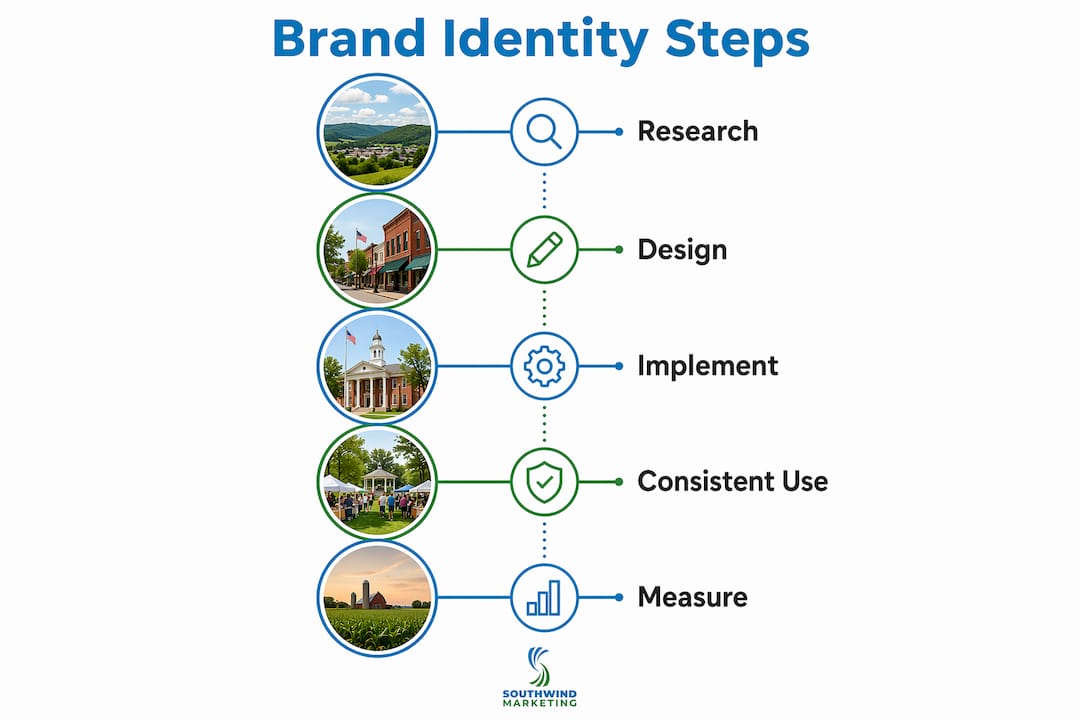
A professional brand identity does not require a $10,000 agency retainer. A focused rural brand refresh can be completed in under two weekends and under $200 by concentrating on the highest-impact touchpoints first. Here is where to start.
Claim and complete your Google Business Profile. This is the single highest-return branding action available to a rural small business. 76% of smartphone-based local searches lead to an in-store visit within 24 hours. Add current photos, accurate hours, your service area, and a description written in your brand voice. Read the full guide on how to optimize your Google Business Profile for local search rankings.
Choose a color palette and stick to it. Pick two to three colors that reflect your business and your community. Use them on everything: your storefront, your social media headers, your invoices, and your website. Free tools like Canva let you save brand colors and apply them consistently without design experience.
Audit every customer touchpoint for consistency. Walk through your business as a first-time customer would. Check your signage, your business cards, your social profiles, and your website. Note anywhere the logo, colors, or tone of voice do not match. Consistent brand presentation on vehicles, websites, and signage reinforces recognition and directly supports sales growth.
Add hyper-local visual elements. Use imagery that reflects your specific geography and community. A grain elevator silhouette, a local landmark, or a regional color palette creates an immediate emotional connection that a generic stock photo never will. Hyper-local geographic signifiers build emotional trust faster than high-budget urban lifestyle imagery in rural markets.
Write a one-page brand style guide. Document your logo versions, color codes, approved fonts, and brand voice description. This single document lets you maintain consistency whether you are posting on Facebook, ordering new signage, or working with a freelancer. It takes about two hours to create and saves dozens of hours of inconsistency over time.
Pro Tip: Before spending anything on design, search your own business name on Google and on Facebook. What you see is what new customers see. Fix the free stuff first: outdated photos, wrong hours, and missing descriptions cost you customers every day.
What brand identity mistakes do rural businesses most often make?
Most rural businesses do not fail at branding because they lack creativity. They fail because they skip the basics or apply them inconsistently. These are the most common and most costly mistakes.
- Fragmented visuals across platforms. A different logo on Facebook than on your storefront, or a different color scheme on your website than on your business cards, signals disorganization. Customers read that as a lack of professionalism, even if your actual product or service is excellent.
- Generic, urban-centric design. Stock photos of city skylines, corporate fonts, and polished lifestyle imagery feel out of place in a rural context. They signal that your brand was built for someone else. In rural markets, hyper-local design elements outperform generic high-budget imagery every time.
- Neglecting your Google Business Profile. An unclaimed or outdated profile is a missed opportunity every single day. It also signals to search engines that your business is less relevant than competitors who keep their profiles current.
- Attempting a full rebrand instead of a focused refresh. A complete rebrand is expensive and disruptive. Most rural businesses need a focused refresh: updated colors, a cleaned-up logo, and consistent application across key touchpoints. Start there before investing in a full overhaul.
- Ignoring word-of-mouth as a brand channel. In small towns, reputation travels fast. How your staff answers the phone, how you handle a complaint, and how you show up at community events are all part of your brand. No logo fixes a reputation problem.
The digital presence of a small business is often the first judgment customers make. Getting the digital basics right is not optional for rural businesses competing in 2026.
How do you measure and sustain your brand identity over time?
Building a brand identity is not a one-time project. It requires ongoing attention to stay relevant and consistent as your business grows. These four steps create a sustainable process.
Track local search performance monthly. Check your Google Business Profile insights for search views, direction requests, and phone calls. A drop in any of these metrics often signals a visibility or consistency problem worth investigating.
Collect and respond to customer reviews. Reviews are public brand messaging. Responding to every review, positive or negative, in your brand voice reinforces your identity and shows prospective customers how you treat people. Ask satisfied customers directly for a review after a positive interaction.
Audit your brand touchpoints quarterly. Set a calendar reminder every three months to check your website, social profiles, signage, and printed materials for consistency. Businesses evolve. Your brand materials need to keep up.
Stay visible in your community. Sponsoring a local event, participating in a Main Street program, or supporting a school fundraiser puts your brand in front of neighbors in a context that no digital ad can replicate. Community involvement is a brand-building activity, not just a goodwill gesture.
| Measurement action | What it tells you |
|---|---|
| Google Business Profile insights | Whether local customers are finding and engaging with your business online |
| Customer review sentiment | How your brand voice and customer experience are landing in the real world |
| Quarterly touchpoint audit | Whether your visual identity has drifted across platforms or materials |
| Community event participation | How recognized and trusted your brand is in your local market |
For a deeper look at digital marketing strategies built specifically for rural businesses, Southwind Marketing has published a practical guide covering the full range of visibility tools available to small-town business owners.
Key Takeaways
Rural businesses that build a consistent, locally grounded brand identity outperform fragmented competitors in trust, recognition, and revenue.
| Point | Details |
|---|---|
| Brand identity is a system | It includes logo, colors, typography, voice, messaging, and digital profiles working together. |
| Consistency drives revenue | Consistent branding across touchpoints can increase revenue by up to 33%. |
| Start with free digital assets | Completing your Google Business Profile is the highest-ROI first step for any rural business. |
| Local imagery outperforms generic design | Culturally relevant visuals increase purchase intention by about 42% in rural markets. |
| Sustain it with a simple process | Quarterly audits, review responses, and community presence keep your brand strong over time. |
The thing most rural business owners get wrong about branding
I have worked with rural businesses across the Great Plains and the South long enough to know one thing for certain: most small-town business owners think branding is about looking polished. It is not. Branding is about being recognized and trusted. Those are different goals, and chasing the wrong one wastes money.
The businesses I have seen succeed with a limited budget are the ones that pick two or three touchpoints and get them exactly right. A clean, consistent logo. A Google Business Profile with real photos and accurate hours. A Facebook page that sounds like a human being, not a press release. That combination does more for a rural business than a $5,000 logo package applied inconsistently across mismatched platforms.
The paradox of rural branding is real. You need to look credible enough that a regional bank or a commercial buyer takes you seriously, while staying warm enough that your neighbor feels comfortable walking in. That balance is achievable without a big budget. It just requires clarity about who you are and discipline about applying it consistently.
The businesses that struggle are the ones that rebrand every two years because they are chasing a trend, or the ones that never commit to a look at all. Consistency over time is what builds recognition. Recognition is what builds trust. Trust is what builds a business that survives when a national chain opens nearby.
— Southwind Marketing
Southwind Marketing builds rural brands that work in the real world
Rural businesses deserve professional branding that reflects their community and competes on a real level. Southwind Marketing specializes in branding for rural businesses, chambers of commerce, and economic development organizations across rural America.
Whether you need a full brand identity built from scratch or a focused refresh of your existing look, Southwind Marketing offers practical options for businesses without in-house marketing staff. The team handles logo design, brand voice development, Google Business Profile setup, and rural website design that reflects who you actually are. If you are ready to build a brand that your community recognizes and trusts, connect with Southwind Marketing to get started.
FAQ
What is included in a rural business brand identity?
A rural business brand identity includes your logo, color palette, typography, brand voice, tagline, and how consistently those elements appear across your website, signage, social media, and Google Business Profile.
How much does rural business brand identity creation cost?
A focused brand refresh can cost under $200 and take less than two weekends when you prioritize high-impact touchpoints like your Google Business Profile and visual asset consistency.
Why does brand consistency matter for small-town businesses?
Consistent branding across all touchpoints can increase revenue by up to 33%. Customers trust businesses that look and sound the same everywhere they encounter them.
What is the first step in building a rural brand identity?
Claim and fully complete your Google Business Profile. It is free, and 76% of local smartphone searches lead to an in-store visit within 24 hours, making it the highest-return starting point.
How is rural branding different from standard small business branding?
Rural branding requires balancing corporate-level authority with hometown approachability, and it performs best when visual elements reflect local geography and culture rather than generic urban lifestyle imagery.