TL;DR:
- A strong economic development social media strategy connects content and measurable outcomes to community growth goals.
- Most organizations treat social media as a broadcast channel, but it should be used as a tool to shape perceptions and attract investment.
An economic development social media strategy is a planned, goal-driven approach that uses targeted content and assigned platform roles to attract investment, engage stakeholders, and promote community value. The industry term for this practice is economic development marketing, and social media is now one of its most critical channels. Economic development organizations (EDOs), chambers of commerce, and community leaders who treat social media as business development infrastructure rather than a broadcast channel earn a place on site selectors' mental shortlists before formal search processes ever begin. This guide gives you a practical framework to build, run, and measure a social media program that drives real local growth.
What is an economic development social media strategy?
A social media strategy for economic development is not a posting schedule. It is a system that connects content, platforms, audiences, and measurable outcomes to your community's growth goals. The distinction matters because most EDOs and community leaders post reactively, sharing event photos and ribbon cuttings without a plan for what those posts are supposed to accomplish.
The most effective programs treat social media the way B2B companies treat marketing: as a tool to warm the market before formal outreach begins. Site selectors, corporate real estate professionals, and investors rarely arrive cold. They form impressions over months of passive exposure to your community's digital presence. A well-run social media program shapes those impressions deliberately.
Three disciplines define a strong program: audience discipline (knowing exactly who you are talking to), channel discipline (using each platform for its assigned role), and performance discipline (measuring outcomes that connect to economic results, not just engagement counts).
How to set goals and KPIs that connect to economic outcomes
Vanity metrics are the most common failure point in social media for economic growth. Likes, shares, and follower counts feel like progress but rarely connect to investment attraction or business retention. EDOs should focus on outcome-driven KPIs such as requests for information submitted, qualified leads generated, and website traffic conversions from social campaigns.
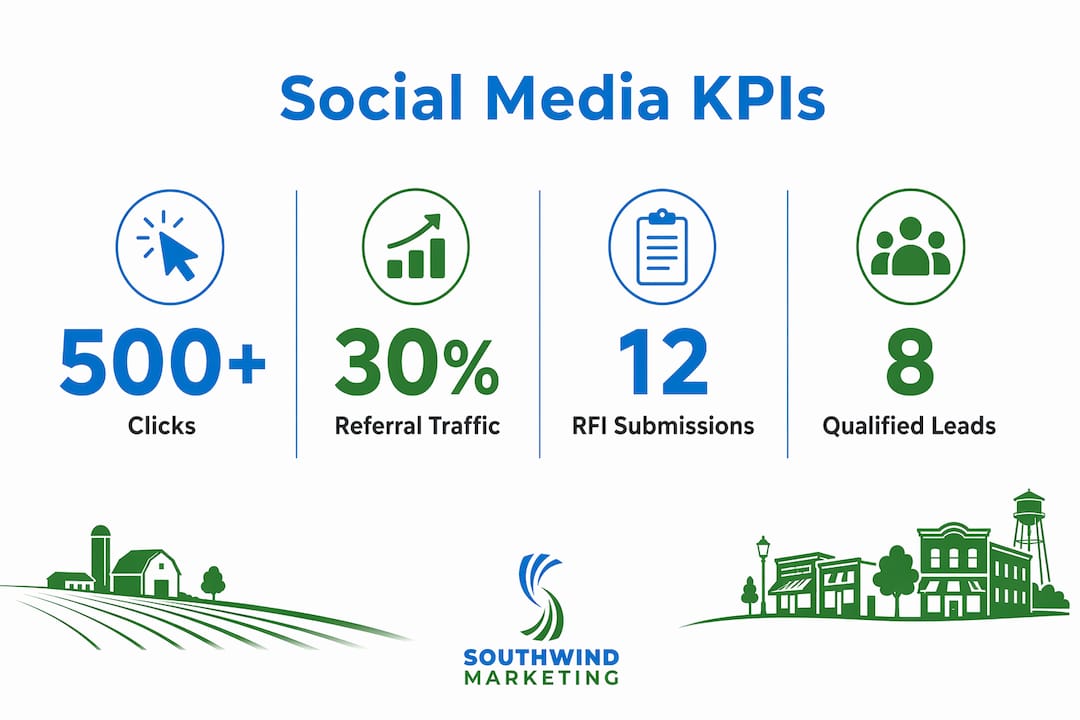
The right KPIs depend on your goals. A community trying to attract site selectors needs different metrics than one focused on resident engagement or retail recruitment. Define your goals first, then work backward to the metrics that prove progress.
Tracking tools that matter:
- UTM parameters on every link shared through social media, so you can trace website visits back to specific posts and platforms
- Conversion pixels on landing pages tied to contact forms, RFI submissions, and newsletter signups
- A CRM or dashboard that connects social traffic to actual lead records
- Monthly reporting that compares social referral traffic to economic outcomes, not just platform analytics
Pro Tip: Build a simple one-page dashboard that shows social referral traffic, RFI submissions, and lead quality side by side. Review it monthly with your team. If a metric does not connect to a real economic outcome, remove it from the report.
| Goal | KPI to Track |
|---|---|
| Investment attraction | RFI submissions from social referral traffic |
| Talent attraction | Job inquiry form completions |
| Resident engagement | Event registrations, survey responses |
| Business retention | Newsletter signups, resource downloads |
Who are your audiences and how do they move through the funnel?
Economic development audiences are not a single group. Site selectors, investors, local business owners, prospective residents, and current community members each have different needs, different questions, and different timelines. Generic broad messaging fails all of them.
Mapping social touchpoints across the buyer journey, from awareness through consideration, decision, and advocacy, aligns your content with where each audience actually is. A site selector in the awareness stage needs data on your workforce and infrastructure. A prospective resident in the consideration stage needs to see authentic community life. Serving both with the same post serves neither.
Audience segments and their primary needs:
- Site selectors and corporate real estate professionals: Workforce data, shovel-ready sites, incentive summaries, and community stability indicators
- Investors and developers: Market demographics, growth trends, and local government responsiveness
- Local businesses and entrepreneurs: Resources, networking opportunities, and success stories from peers
- Prospective residents and talent: Quality of life, housing, schools, and community culture
- Current residents: Local news, events, and ways to participate in community decisions
Gather audience intelligence from your CRM, website analytics, and frontline staff who field calls and emails daily. A discovery phase with stakeholder engagement is the fastest way to uncover authentic community assets and avoid manufactured narratives that audiences see through immediately.
Pro Tip: Interview three to five site selectors or economic development peers annually and ask what digital content influenced their perception of a community. Their answers will reshape your content calendar faster than any analytics report.
Which platforms should you use and what role does each one play?
Platform selection is not about being everywhere. It is about assigning each platform a clear role in your funnel and executing that role well. Social media platforms work best when each one serves a specific audience and funnel stage rather than duplicating the same content across every channel.
For rural communities and small towns, the platform mix typically looks like this:
LinkedIn is your B2B lead generation channel. Post workforce reports, site availability updates, economic data, and project announcements here. Your audience is site selectors, developers, and business decision-makers. Tone is professional and data-forward.
Facebook remains the strongest channel for resident engagement in rural America. Community events, local business spotlights, public meeting announcements, and quality-of-life content all perform well. Your audience is current residents, local business owners, and regional stakeholders.
Instagram carries your lifestyle and community story. Photos of local festivals, outdoor assets, downtown streetscapes, and resident testimonials build emotional connection with prospective residents and talent. Keep captions short and visuals strong.
TikTok and YouTube serve the top of the funnel. Short-form video on TikTok builds awareness with younger audiences considering relocation. YouTube hosts longer educational content, virtual tours, and economic development presentations that nurture prospects over time.
Pro Tip: Assign a single staff member or partner as the owner of each platform. Shared ownership with no clear accountability produces inconsistent posting and missed opportunities. One platform done well beats five platforms done poorly.
How to build a content mix using the 70/20/10 rule
The 70/20/10 content rule is the most practical framework for economic development social media. Seventy percent of your content educates and informs, 20% builds community and social proof, and 10% makes a direct call to action. This ratio keeps your audience engaged without feeling sold to constantly.
The 70% educational layer is where most communities underinvest. This content answers real questions your audiences are asking: What is the cost of doing business here? What workforce training programs exist? What incentives are available? How do I start a business in this community? Educational content builds credibility and keeps your profiles active between major announcements.
The 20% community and social proof layer is your most shareable content. Local business success stories, resident testimonials, project milestones, and event recaps show that your community delivers on its promises. Layering social content with persona-specific landing pages amplifies message recall and drives higher engagement from both investors and talent prospects.
The 10% direct-response layer includes RFI prompts, event registrations, newsletter signups, and contact calls to action. Use this sparingly. When every post asks for something, audiences tune out.
Content pillars that work for EDOs and community leaders:
- Workforce and demographic data snapshots
- Local business spotlights and expansion announcements
- Available sites and buildings with photos and specs
- Community event coverage and behind-the-scenes content
- How-to guides for business incentives and permitting
- Resident and business owner testimonials
Standardizing content with approved branding, templates, and consistent hashtag use keeps your presence professional and makes it easier for staff to post consistently. Limit hashtags to one or two per post. More than that reads as noise.
Pro Tip: Build a content calendar at least four weeks in advance. Map each post to an audience segment, a funnel stage, and a content pillar. This one habit eliminates reactive posting and keeps your 70/20/10 ratio on track.
How do you measure and improve your social media results?
Measurement without a feedback loop is just reporting. The goal is to use data to make better decisions each month. Start by tracking the KPIs you defined in your goal-setting phase, then run structured experiments to improve performance over time.
A/B testing is the fastest way to learn what works. Test one variable at a time: the opening line of a post, the image format, the call to action, or the posting time. Run each test for at least two to four weeks before drawing conclusions. Small improvements in click-through rates compound into significant gains in lead volume over a full year.
- Audit your current content against the 70/20/10 framework. Count how many posts in the last 90 days were educational, community-focused, or direct-response. Most EDOs find they are 80% direct-response and 20% everything else.
- Connect social analytics to your website data. Use Google Analytics or a comparable platform to see which social channels drive the most qualified traffic, not just the most visits.
- Review CRM records monthly to identify leads that originated from social referrals. This closes the loop between a post and an actual economic outcome.
- Establish governance standards. Integrated governance with clear internal policies prevents fragmented posting and keeps your content accessible and consistent. Define who approves posts, who responds to comments, and what topics require leadership sign-off.
- Act on resident feedback. Trust-building social media strategies for public entities prioritize active listening over broadcasting. Monitor comments and messages for recurring questions or concerns and address them in future content.
Pro Tip: Track your website KPIs alongside social metrics. A post that drives 500 clicks but zero form completions tells you the landing page is the problem, not the social content.
Key Takeaways
A strong economic development social media strategy requires audience discipline, channel discipline, and performance discipline working together as a single system.
| Point | Details |
|---|---|
| Treat social media as infrastructure | Position social channels as business development tools, not just promotion, to influence site selectors before formal searches begin. |
| Track outcome-driven KPIs | Measure RFI submissions, lead quality, and website conversions rather than likes and follower counts. |
| Assign platform roles | Give each platform a specific funnel role so content reaches the right audience at the right stage. |
| Use the 70/20/10 content rule | Dedicate 70% of posts to education, 20% to community proof, and 10% to direct calls to action. |
| Build governance standards | Define who posts, who approves, and who responds to keep content consistent and on-brand. |
Why most EDOs are treating social media like a bulletin board
I have worked with economic development organizations across rural America long enough to spot the pattern immediately. The social feed is full of ribbon cuttings, meeting reminders, and grant announcements. Nothing is wrong with any of that content. The problem is that it is 100% of the content, and it is aimed at people who already know the community exists.
Social media for economic growth is not about talking to your current audience. It is about warming a much larger audience that has never heard of your community. Site selectors do not follow your Facebook page. But they do search LinkedIn for workforce data. They do read articles that rank in Google. They do watch short videos that show up in their feed from communities they have never considered. Your job is to be in those places with content that answers their questions before they even know they have them.
The communities I have seen succeed at this share one trait: they treat their economic development marketing program the same way a B2B company treats its sales pipeline. They know their audiences, they map the journey, they create content for each stage, and they measure what actually moves the needle. They also tell true stories. Not polished brochure copy, but real accounts from real business owners about why they chose this community and what they found when they got here. That kind of content builds trust faster than any paid campaign.
The biggest mistake is waiting until you have a prospect to start marketing. By then, you are already behind. The communities that win are the ones that have been building familiarity for years before the site selector ever picks up the phone.
— Southwind Marketing
Southwind Marketing works with EDOs and community leaders
Economic development professionals in rural America need more than general marketing advice. They need a partner who understands site selectors, resident engagement, retail recruitment, and the unique pressures of small-town community growth.
Southwind Marketing builds economic development marketing programs specifically for EDOs, chambers of commerce, Main Street programs, and downtown development authorities across rural America. From social media strategy and content development to website design built for community organizations, every service connects to real economic outcomes. If your community is ready to move from reactive posting to a program that actually attracts investment and engages residents, Southwind Marketing is built for that work. Reach out at southwindmarketing.com to start the conversation.
FAQ
What is an economic development social media strategy?
An economic development social media strategy is a planned program that uses targeted content, assigned platform roles, and measurable KPIs to attract investment, engage stakeholders, and promote community growth. It treats social media as business development infrastructure rather than a promotional channel.
Which social media platforms work best for economic development?
LinkedIn works best for B2B outreach to site selectors and investors, Facebook for resident engagement, Instagram for lifestyle and community storytelling, and TikTok or YouTube for top-of-funnel awareness with broader audiences.
What KPIs should EDOs track on social media?
EDOs should track RFI submissions, qualified leads, website conversions from social referral traffic, and event registrations rather than vanity metrics like likes or follower counts.
How often should economic development organizations post on social media?
Consistency matters more than frequency. A minimum of three to five posts per week per active platform, planned four weeks in advance using a content calendar, keeps your presence credible and your audience engaged.
What is the 70/20/10 rule for economic development content?
The 70/20/10 rule means 70% of posts educate and inform, 20% build community trust through stories and testimonials, and 10% make a direct call to action such as an RFI prompt or event registration.