TL;DR:
- A chamber newsletter engagement strategy personalizes and times communications to boost member response and connection. Focusing on relevance, tone, and timing, chambers can transform newsletters into conversations that encourage member renewal. Measuring replies and direct feedback enhances true community engagement over simple open rates.
A chamber newsletter engagement strategy is the targeted plan to personalize, structure, and time your communications so members actually read, respond, and stay connected. Most chambers send newsletters. Few send newsletters that members look forward to. The difference comes down to three factors: relevance, timing, and tone. Personalized subject lines alone increase open rates by 26%. That single tactic shows how much the right detail changes member behavior. A well-built engagement strategy turns your newsletter from a broadcast into a conversation, and conversations are what keep members renewing year after year.
What are the core components of a chamber newsletter engagement strategy?
Audience segmentation is the foundation of any effective member engagement strategy for chambers. Sending the same message to a new retail member and a 15-year sponsor is a missed opportunity. Segmentation by member activity prevents high unsubscribe rates and improves email deliverability. It also signals to members that you actually know who they are.
The tools you need fall into three categories:
- CRM with email integration: Tracks member history, event attendance, and communication preferences in one place.
- Automation platform: Sends triggered sequences at key lifecycle moments, like onboarding, renewal reminders, and event follow-ups. Email automation reduces staff workload while keeping communication consistent.
- Analytics tracking: Measures open rates, click rates, replies, and forwards so you can refine over time.
The table below compares feature categories to look for when evaluating newsletter tools:
| Feature category | What to look for |
|---|---|
| Segmentation | Filter by member type, join date, or engagement level |
| Automation | Triggered sequences for onboarding and renewals |
| Analytics | Open rate, click rate, reply tracking |
| Mobile optimization | Responsive templates for phone-first readers |
| Integration | Connects with your CRM or membership database |
Pro Tip: Send a short welcome email within 24 hours of a new member joining. Ask one question: "What topics matter most to your business?" The answers give you the segmentation data you need before you send a single newsletter.
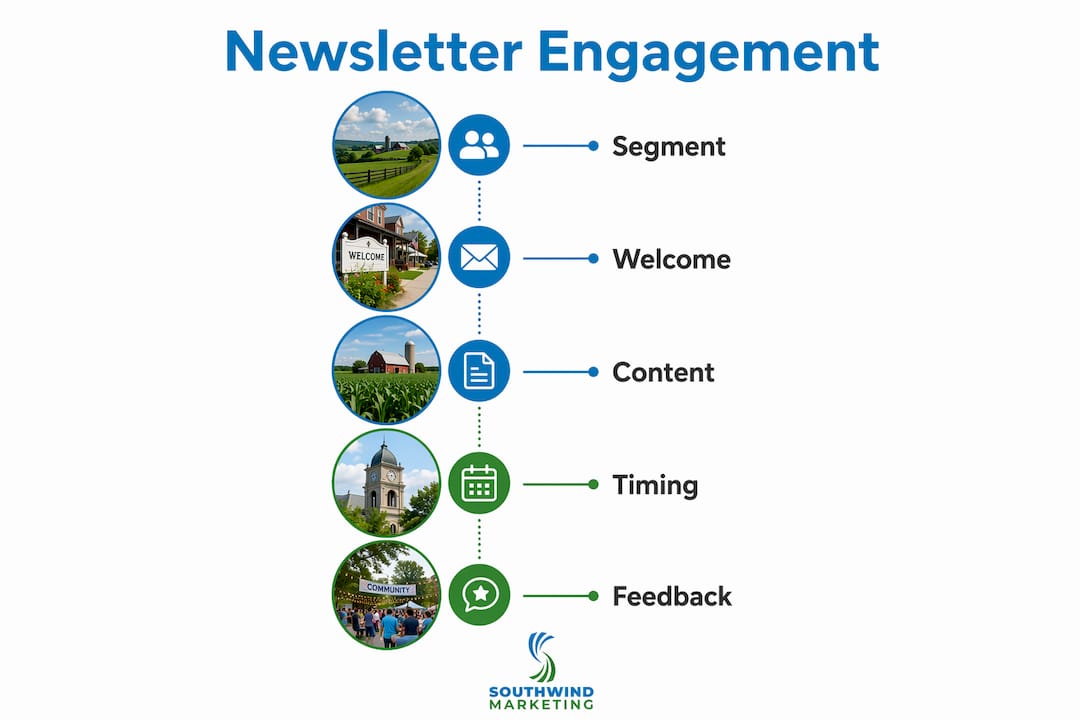
Welcome emails reach open rates as high as 91%. That makes the welcome sequence the highest-performing touchpoint in your entire email program. Use it to collect member interests, not just to say hello.
How to craft newsletter content that members actually read
Content is where most chamber newsletters fail. They run long, cover too many topics, and read like meeting minutes. Optimal newsletter length is 475–610 words for mobile readers. Newsletters over 800 words see a measurable drop in engagement. Keep it tight.
The best chamber newsletter best practices follow a clear content structure:
- One lead story. Pick the most relevant news or event for that send. Single-focus newsletters outperform multi-topic bulletins that readers scan and abandon.
- A member spotlight. Name a real business, share a short story, and let the community see itself in your newsletter. This builds connection faster than any announcement.
- One clear call to action. Register for an event, renew your membership, or submit a business update. One ask per issue.
- A local resource or tip. Something useful that members can apply immediately, not just chamber news.
- A brief community note. A sentence or two about something happening in town. This is where rural chambers have a real advantage. You know your community personally.
The seven-to-one rule applies directly here: deliver seven pieces of value for every one ask. Members who feel served stay subscribed. Members who feel sold to unsubscribe.
Subject lines deserve their own attention. Questions outperform statements. Subject lines phrased as questions boost open rates by 50% compared to declarative subject lines. "Did you catch this week's member deal?" outperforms "Member Newsletter — May 2026" every time. Numbers and first names also lift open rates consistently.
Pro Tip: Read your draft out loud before sending. If it sounds like a press release, rewrite it. Your members want to hear from a neighbor, not a communications department. Local anecdotes and conversational phrasing outperform formal, boardroom-style email every time.
When and how often should chambers send newsletters?
Timing is a lever most chambers never pull. Tuesday through Thursday between 9 AM and 11 AM local time produces the best open rates for email newsletters. Sending on a Friday afternoon or Monday morning puts your newsletter in direct competition with the week's busiest inbox moments.
Frequency matters as much as timing. The right schedule for most chambers is monthly for the main newsletter, with event-specific sends added as needed. Quarterly is too infrequent to build a reading habit. Weekly is too frequent for most small chamber teams to sustain with quality content.
A few chamber communication strategies that hold up in practice:
- Send on the same day and time each month. Consistency builds expectation. Members start to anticipate your newsletter when it arrives reliably.
- Use automation for lifecycle touchpoints. Welcome sequences, renewal reminders, and event confirmations should run without manual effort.
- Reference local time and local events in your send. "This Thursday at the Civic Center" lands better than "at our upcoming event."
- Test one variable at a time. Change your send day for one month, then measure open rate change before adjusting anything else.
Pro Tip: Reference a local landmark or upcoming community event in the opening line of your newsletter. "With the county fair two weeks out, here's what your chamber has lined up" immediately signals relevance to your specific community.
How to measure and improve your newsletter engagement
Open rates are a starting point, not a finish line. Replies and forwards are stronger indicators of true engagement than opens and clicks. A single reply from a member tells you more about community connection than 100 anonymous clicks.
Track these metrics by segment, not just overall:
- Open rate by member type: New members, long-term members, and lapsed members often behave very differently.
- Click rate by content section: Which story or link gets the most clicks? That tells you what members actually want more of.
- Unsubscribe rate by send: A spike after a specific issue signals a content or frequency problem.
- Reply rate: Even one or two replies per send indicates your newsletter is sparking real conversation.
"True community engagement shows up in qualitative responses. A one-line reply from a member often indicates better connection than 100 anonymous clicks. The goal is not impressions. The goal is relationship." — Your Email Newsletter Is Talking
Analytics tell you what happened. Direct member conversations tell you why. Call three members a quarter and ask what they read, what they skipped, and what they wish you covered. In rural chambers especially, that conversation yields more useful insight than any dashboard. Adjust your content mix based on what you hear, not just what you measure.
Avoid the common trap of overvaluing impressions. A newsletter with a 60% open rate and zero replies is underperforming a newsletter with a 35% open rate and five replies. The second newsletter is building a community. The first is just filling inboxes.
Key Takeaways
A chamber newsletter that earns replies and forwards outperforms one that earns opens alone. Relationship-first communication, tight content, and consistent timing are the three pillars every chamber should build on.
| Point | Details |
|---|---|
| Segment your list from day one | Use welcome emails to collect member interests before your first newsletter send. |
| Keep content to 475–610 words | Mobile readers disengage from long newsletters; single-focus issues outperform multi-topic bulletins. |
| Send Tuesday–Thursday, 9–11 AM | Consistent timing builds reading habits and improves open rates across your member base. |
| Measure replies, not just opens | A member reply signals real community connection and is a stronger engagement metric than click rate. |
| Apply the seven-to-one rule | Deliver seven value-add content pieces for every one ask to sustain long-term member trust. |
What rural chambers get wrong about newsletters
I have worked with chambers across rural Oklahoma, Kansas, and the surrounding region long enough to see a pattern. The newsletters that struggle are not struggling because of bad design or wrong send times. They are struggling because they treat members like a list instead of like neighbors.
The most effective newsletter I have seen from a small-town chamber was two paragraphs long. It named three local businesses by name, mentioned a road closure affecting downtown, and asked one question: "What do you need from us this month?" The reply rate was unlike anything that chamber had seen before. No fancy template. No graphic design. Just a person talking to people they knew.
Relationship-first email marketing shifts the goal from broadcasting to connecting. That shift is especially natural for rural chambers, because you already have the relationships. The newsletter just needs to reflect them. Stop writing like a communications department and start writing like the person in town who knows everyone's name.
The other mistake I see constantly is saving the good stuff for the end. Members in small towns are busy. They are running a shop, managing a crew, or sitting on three other boards. If your newsletter does not earn their attention in the first two sentences, it does not earn it at all. Lead with the most relevant thing, every single time.
— Southwind Marketing
How Southwind Marketing helps chambers communicate better
Chambers that invest in their digital presence see stronger newsletter engagement because members trust what they see. A well-designed website and clear community branding make every email you send feel more credible.
Southwind Marketing builds websites for chambers and EDOs across rural America, with a focus on clear communication, mobile performance, and member-first design. We also offer community branding services that give your chamber a consistent identity across every channel, from your newsletter header to your event signage. If your digital presence does not match the quality of your community, your newsletter is working harder than it should. Southwind Marketing serves chambers of commerce across Oklahoma, Kansas, Texas, Iowa, Missouri, and Arkansas.
FAQ
What is a chamber newsletter?
A chamber newsletter is a regular email communication sent to chamber members that shares local business news, events, resources, and updates. Its primary purpose is to keep members informed and connected to the chamber community.
How long should a chamber newsletter be?
The optimal length is 475–610 words. Newsletters over 800 words see reduced engagement, especially among mobile readers who make up the majority of email opens.
How often should a chamber send a newsletter?
Monthly is the right frequency for most chambers. It is frequent enough to build a reading habit without overwhelming your team's capacity to produce quality content.
What subject line gets the best open rates?
Question-based subject lines boost open rates by 50% compared to statement-based subject lines. Personalized subject lines that include the recipient's first name increase open rates by 26%.
How do I know if my newsletter is actually engaging members?
Track reply rate and forward rate alongside open and click rates. A single member reply is a stronger signal of real engagement than dozens of anonymous clicks. Direct conversations with members also reveal what analytics cannot.